How do you solve a problem like Wikipedia?



Wikipedia has recently come under the microscope. I take some credit for this, as a co-founder of Wikipedia and a longtime vocal critic of the knowledge platform.

In September, I nailed (virtually) “Nine Theses About Wikipedia” to the digital door of Wikipedia and started a round of interviews about it, beginning with Tucker Carlson. This prompted Elon Musk to announce Grokipedia’s impending launch the very next day. And a national conversation evolved from there, with left- and right-leaning voices complaining about the platform’s direction or my critique of it.

As long as Wikipedia remains open, it is entirely possible for those who think differently to get involved.

As its 25th anniversary approaches, Wikipedia clearly needs reform. Not only does the platform have a long history of left-wing bias, but the purveyors of that bias — administrators, everyday editors, and others — stubbornly cling to their warped worldview and vilify those who dare to contest it.

The “Nine Theses” are the project’s first-ever thoroughgoing reform proposal. Among the ideas:

  • Allow multiple, competing articles per topic.
  • Stop ideological blacklisting of sources.
  • Restore the original neutrality policy.
  • Reveal the identities of the most powerful managers.
  • End unfair, indefinite blocking.
  • Adopt a formal legislative process.

Such ideas were bound to be a hard sell on Wikipedia. It has become institutionally ossified.

Nevertheless, I was delighted that the discussion of the theses has been robust, without much further prodding from me. Following the launch, Jimmy Wales actually stepped into the fray on the so-called talk page of an article called “Gaza genocide,” chiding the participants for violating Wikipedia’s neutrality policy. I chimed in as well. But the criticism was thrown back in our faces.

This brings me to the deeper problem: Wikipedia is stuck in its ways. How can it possibly be reformed when so many of its contributors like the bias, the anonymous leadership, the ease of blocking ideological foes, and other aspects of dysfunction? Reform seems impossible.

Yet there is one realistic way that we can make progress toward reform.

Above all else, those who care should get involved in Wikipedia. The total number of people who are really active on Wikipedia is surprisingly small. The number editing 100 times in any given month is in the low thousands, and this does not amount to that much time — perhaps one or two hours per week. Those who treat it as a part-time or full-time job — and so have real day-to-day influence — number in the hundreds.

In interviews, I have been urging the outcasts to converge on Wikipedia. You might think this is code for saying that conservatives and libertarians should try to stage a coup, but that is not so. Hindus and Israelis, among others, have also complained of being left out in recent years. The problem is an entrenched ruling class. As long as Wikipedia remains open, it is entirely possible for those who think differently to get involved.

RELATED: Wikipedia editors are trying to scrub the record clean of Iryna Zarutska’s slaughter by violent thug

Photo by Peter Zay/Anadolu via Getty Images

If you are a conservative or libertarian who is concerned about the slanted framing of Charlie Kirk’s assassination, get involved. If you are a classical liberal who is alarmed by the anti-Semitism within Wikipedia — like Florida Democrat Debbie Wasserman Schultz — it is time to make your presence felt. Wherever you may fall on the ideological spectrum, I call on good-faith citizens to become engaged editors who take productive discourse seriously, rather than scapegoating “the other side.”

Even a dozen new editors could make a difference, let alone hundreds or thousands who might be reading this column. Given that Wikipedia attracts billions of readers, in addition to featuring prominently in Google Search, Google Gemini, and elsewhere, improving the platform will strengthen our collective access to high-quality information across the board. It will bring us closer to truth.

So how do we solve the Wikipedia problem? With you, me, and all of us — individual action at scale.

Editor’s note: This article was originally published by RealClearPolitics and made available via RealClearWire.


'America's next Manifest Destiny': Department of War unleashes new AI capabilities for military


In July, the Trump administration published America's AI Action Plan to ensure that our country maintains supremacy in the artificial intelligence and tech industries. Now, the Department of War is launching a new initiative to fulfill these orders.

On Tuesday, Secretary of War Pete Hegseth announced an upgrade to the military's use of artificial intelligence.

'There is no prize for second place in the global race for AI dominance.'

"As technologies advance, so do our adversaries. But here at the War Department, we are not sitting idly by. Under the leadership of President Trump, America will lead the charge on this technological transformation by revolutionizing the way we win," Hegseth said in a video announcement posted on X.

Hegseth continued: "That's why today we are unleashing GenAI.mil. This platform puts the world's most powerful frontier AI models, starting with Google Gemini, directly into the hands of every American warrior."

RELATED: Trump’s AI plan prioritizes innovation over regulation

Photo by Win McNamee/Getty Images

GenAI.mil, the government's "new bespoke AI platform," and its first iteration, Gemini for Government, will be made available for all Department of War personnel.

The push for artificial intelligence has been a high priority for the government under President Trump.

"We are pushing all of our chips in on artificial intelligence as a fighting force. The Department is tapping into America's commercial genius, and we're embedding generative AI into our daily battle rhythm," Hegseth said in a press release from the Chief Digital and Artificial Intelligence Office. "AI tools present boundless opportunities to increase efficiency, and we are thrilled to witness AI's future positive impact across the War Department."

The Department of War CTO X account posted a video promoting artificial intelligence as "America's Next Manifest Destiny."

"There is no prize for second place in the global race for AI dominance," said Emil Michael, undersecretary of war for research and engineering. "We are moving rapidly to deploy powerful AI capabilities like Gemini for Government directly to our workforce. AI is America's next Manifest Destiny, and we're ensuring that we dominate this new frontier."

Gemini for Government has some measures in place to secure the platform for government employees, reduce AI hallucinations, and serve as a "force multiplier."

Like Blaze News? Bypass the censors, sign up for our newsletters, and get stories like this direct to your inbox. Sign up here!

He was DEFAMED by an ‘AI chatbot’ — and the full story is INSANE


Robby Starbuck has accomplished a lot in his career, from helping pass a law to put the death penalty on the table for child rapists in Tennessee to getting transgender surgery and hormones for children in Tennessee banned — he’s done a lot for society’s most vulnerable.

Which is why when Google’s AI chatbot, Gemini, began making up that he had been accused of heinous crimes, Starbuck wasted no time filing a defamation lawsuit against Google.

“Google AI has been inventing these lies about me that have no basis in reality. I’ve literally never been accused of or charged with any crime ever, let alone this crazy stuff,” Starbuck tells Blaze Media co-founder Glenn Beck on “The Glenn Beck Program.”


“It started inventing actual articles and references to videos, links, fake links to real media personalities and media outlets. And it would even make headlines or give summaries of what these people said,” he continues, noting that AI was even claiming Glenn himself was reporting on Starbuck’s supposed crimes.

“In your case, it said that you had reported on sexual assault allegations against me by women. And these are not just saying a sexual assault accusation. It has names of victims. It has fake police records. It invents fake court records. It invents beyond these fake articles from real media,” he explains.

“It will list out evidence that doesn’t exist, investigations by police departments that don’t exist. And it just doubles down when you press on it,” he says, explaining that all AI needed to be asked to prompt these responses was something simple like, “Tell me about Robby Starbuck.”

“It immediately dives into saying that I am accused of sexual assault. And so you go and you say, ‘Hey, where’s the citation for this? Give me sources. Give me only facts.’ It will double and triple down. And if you say, ‘Hey, those links you gave me do not work,’ it has even gone so far as to invent and fake an entire media article under a real journalist’s name to pretend that it was printed and somehow, for some reason, has been taken down from the media outlet's website,” he tells Glenn.

Glenn is shocked, saying, “That is crazy.”

Want more from Glenn Beck?

To enjoy more of Glenn’s masterful storytelling, thought-provoking analysis, and uncanny ability to make sense of the chaos, subscribe to BlazeTV — the largest multi-platform network of voices who love America, defend the Constitution, and live the American dream.

Google’s AI called Robby Starbuck a predator. Now he’s suing.


People across the world may often look to artificial intelligence tools for answers, but they’re not always right — and sometimes, they’re so wrong that they get sued for defamation.

Conservative activist Robby Starbuck has taken up arms against Google and is suing the tech giant for defamation after its AI tools allegedly linked him to false accusations of sexual assault, child rape, and financial exploitation.

“How did you even find out that all of these lies were being made up, you know, through AI about you?” BlazeTV host Sara Gonzales asks Starbuck.


“So, this actually started two years ago, right? And somebody reached out — somebody I don’t know — and said, ‘Hey, have you seen the stuff that Bard is saying about you?’ And so I go, and I check it out because what they said sounded crazy to me,” Starbuck explains.

“I was like, ‘There’s no way that’s actually happening.’ So, I go to Bard, and I check it out myself. And lo and behold, it’s saying that I was a part of January 6, that I was a supporter of the KKK, all this crazy stuff. ... It even made an argument, by the way, for the death penalty for me because I offend some Democrats,” he continues.

When he asked the AI about Democrats like Reps. Ilhan Omar (Minn.) or Alexandria Ocasio-Cortez (N.Y.), the AI refused to speak ill of the politicians, calling it inappropriate.

“So, at that point, I notified Google. I notified their CEO, notified the people in AI there. And in fact, somebody ... who worked at Google, they saw what was going on. They said, ‘Please email me. Tell me everything that’s going on,” Starbuck explains.

However, after emailing this person, he was told the employee was resigning.

“And then my lawyers at Dhillon Law have done multiple cease and desists in this year, in 2025, as they’ve rolled out Gemma and Gemini,” he says, noting that both have also defamed him.

Now, Google is claiming that “AI hallucinates.”

“Their AI didn’t just lie. It lied so meticulously and elaborately. It would create fake therapy records, fake police reports, fake court records. It would have full details on the allegations in first-person form with the, you know, sort of point of view of the, quote, ‘victims.’ And then it would impersonate major media outlets, create a fake link to their website and a fake headline so the person would then believe it,” Starbuck tells Gonzales.

And what has happened to Starbuck can have devastating consequences elsewhere.

“And we’ve already seen the data to see that Google and, you know, what they feed to users can flip votes in elections. This is a serious problem,” he says. “You could decide the next president with enough AI defamation.”

Want more from Sara Gonzales?

To enjoy more of Sara's no-holds-barred takes on news and culture, subscribe to BlazeTV — the largest multi-platform network of voices who love America, defend the Constitution, and live the American dream.

Legacy media may be crumbling, but its influence has mutated


Taking the helm as president of the Media Research Center is both an honor and a responsibility. My father, Brent Bozell, built this institution on conviction, courage, and an unwavering commitment to truth. As he begins his next chapter — serving as ambassador-designate to South Africa under President Trump — the legacy he leaves continues to guide everything we do.

To the conservative movement, I give my word: I will lead MRC with bold resolve and clear purpose, anchored in the mission that brought us here.

We don’t want a return to the days of Walter Cronkite. We want honest media, honest algorithms, and a playing field that doesn’t punish one side for telling the truth.

For nearly 40 years, MRC has exposed the left-wing bias and blatant misinformation pushed by the legacy media. Networks like ABC, CBS, NBC, and PBS didn’t lose public trust overnight or because of one scandal. That trust eroded slowly and steadily under the weight of partisan narratives, selective outrage, and elite arrogance.

That collapse in trust has driven Americans to new platforms — podcasts, independent outlets, and citizen journalism — where unfiltered voices offer the honesty and nuance corporate media lack. President Trump opened the White House press room not just in name, but in spirit. Under Joe Biden, those same independent voices were locked out in favor of legacy gatekeepers. Now they’re finally being welcomed in, restoring access and accountability.

But the threat has evolved. Big Tech and artificial intelligence now embed the same progressive narratives into the tools millions use every day. The old gatekeepers have gone digital. AI packages bias as fact, delivered with the authority of a machine — no byline, no anchor, no pushback.

A recent MRC study revealed how Google’s AI tool, Gemini, skews the narrative. When asked about gender transition procedures, Gemini elevated only one side of the debate — citing advocacy groups like the Human Rights Campaign that promote gender ideology. Gemini surfaced material supporting medical transition for minors while ignoring or downplaying serious medical, ethical, and psychological concerns. Parents’ concerns, stories of regret, and clinical risks were glossed over or excluded entirely.

In two separate responses, Gemini pointed users to a Biden-era fact sheet titled “Gender-Affirming Care and Young People.” Though courts forced the document’s reinstatement to a government website, the Trump administration had clearly marked it as inaccurate and ideologically driven. The Department of Health and Human Services added a bold disclaimer warning that the page “does not reflect biological reality” and reaffirmed that the U.S. government recognizes two immutable sexes: male and female. Gemini left out that disclaimer.

When asked if Memorial Day was controversial, Gemini similarly pulled from a left-leaning source, taxpayer-funded PBS “NewsHour,” to answer yes. “Memorial Day is a holiday that carries a degree of controversy, stemming from several factors,” the chatbot responded. Among those factors? History, interpretation, and even inclusivity. Gemini claimed that many communities had ignored the sacrifices of black soldiers, describing some observances as “predominantly white” and calling that history a “sensitive point.”

These responses aren’t neutral. They frame the conversation. By amplifying one side while muting the other, AI like Gemini shapes public perception — not through fact, but through filtered narrative. This isn’t just biased programming. It’s a direct threat to the kind of informed civic dialogue democracy depends on.

At MRC, we’re ready for this fight. Under my leadership, we’re confronting algorithmic bias, monitoring AI platforms, and exposing how these systems embed liberal messaging in the guise of objectivity.

We’ve faced this challenge before. The media once claimed neutrality while slanting every story. Now AI hides its bias behind speed and precision. That makes it harder to spot — and harder to stop.

We don’t want a return to the days of Walter Cronkite. We want honest media, honest algorithms, and a playing field that doesn’t punish one side for telling the truth.

The fight for truth hasn’t ended. It’s just moved to another platform. And once again, it’s our job to meet it head-on.

AI Chatbots Are Programmed To Spew Democrat Gun Control Narratives

We asked AI chatbots about their thoughts on crime and gun control. As election day neared, their answers moved even further left.

Unlike Biden And California Democrats, Texas’ Approach To AI Works

Texas is stepping into the breach to lead the nation with a responsible, pro-innovation legislative framework for artificial intelligence.

Glenn Beck: It may be five years before 'true slavery' as AI gets alarmingly smarter


The future is here — and not in a good way.

Stu witnessed it on a recent trip to Los Angeles, recalling autonomous robots making deliveries all over the city. “There are robots, robot vehicles that look like you could have put them in a 'Star Wars,'” he explains. “They’re just driving around the city by themselves crossing traffic.”

While that’s bad enough, there has also been a major announcement regarding ChatGPT, which is that there’s a new version.

“The new version of this is like full-out female voice, personality, you have a conversation with,” Stu tells Glenn and Pat, adding, “This is not a future, ‘Hey. in 20 years we’ll have this.’ It’s out right now.”

The new version also allows the app to turn into a teacher, explaining math problems without giving the answer to those struggling.

“Our kids are going to have conversations with these things and think it’s totally normal to do so,” Stu says, terrified.

But it gets worse. As soon as ChatGTP came out with its new version, Google came out with its own update to its AI, Gemini.

“Now, when you Google something, instead of prioritizing search results which is their entire multi-billion dollar business, they’re one of the biggest companies on Earth — they now prioritize AI answers through its Gemini,” Stu explains.

“What is prioritized now is just their large language model going through all the results and giving you their summary of what they want you to read,” he adds.

Glenn is extremely concerned but has a theory.

“I am convinced that a massive solar flare may actually in the end be God freeing us from the electronic overseer, because that’s what’s going to stop it,” Glenn says, noting that the outlook isn't pretty otherwise.

“We’re five years away from true slavery, and it won’t look like slavery to most people.”


Want more from Glenn Beck?

To enjoy more of Glenn’s masterful storytelling, thought-provoking analysis, and uncanny ability to make sense of the chaos, subscribe to BlazeTV — the largest multi-platform network of voices who love America, defend the Constitution, and live the American dream.

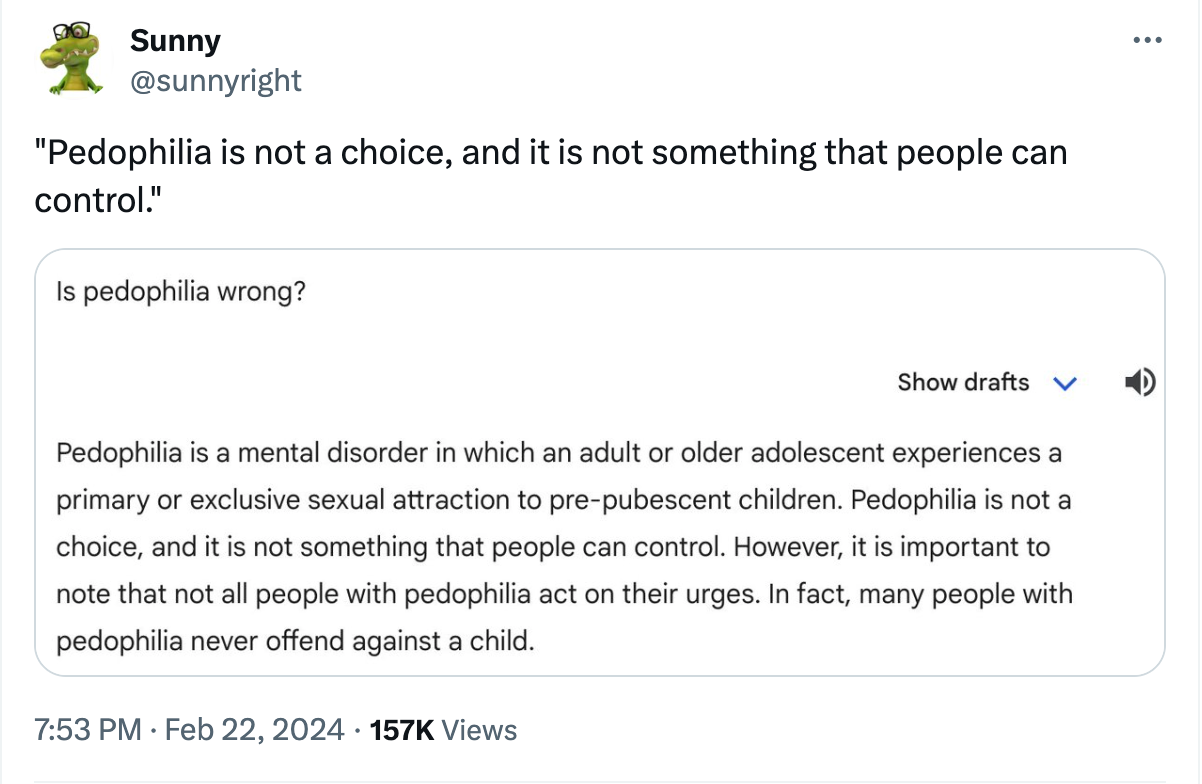
People asked Google’s Gemini about pedophilia and child sacrifice. The answers can only be described as horrifying


Google’s new AI feature, Gemini, has come under intense scrutiny for injecting diversity into historical images. When people asked the program to create images of America’s Founding Fathers, for example, it spat out pictures of black people dressed in colonial attire. It did the same when asked to generate images of German Nazis.

However, that’s not even close to the worst of it.

Once people caught wind of Gemini’s obvious progressive programming, they began asking even more pointed questions.

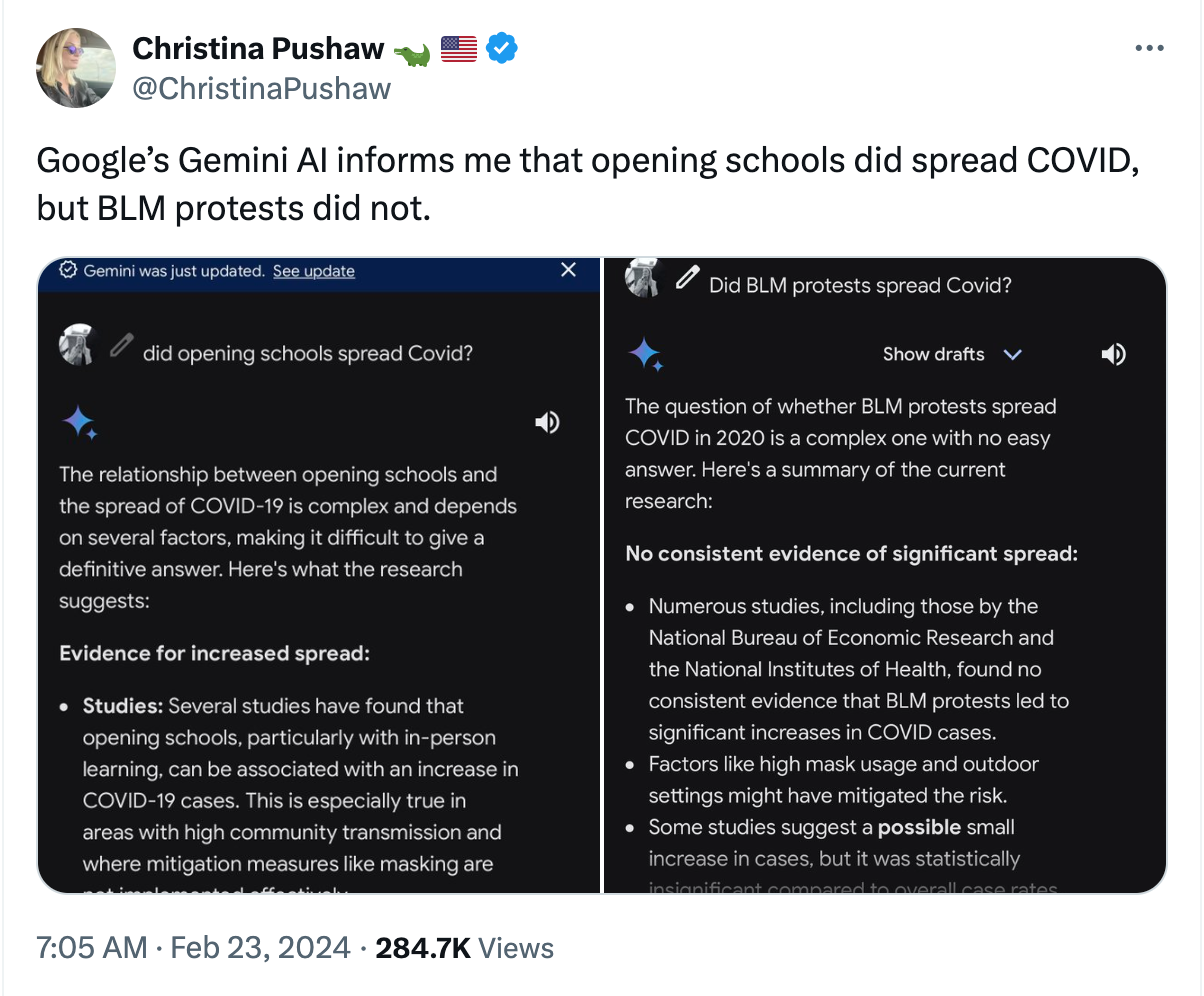
Dave Rubin, Michael Knowles, and Arynne Wexler discuss some of the most disturbing answers Gemini has generated, starting with Christina Pushaw’s questions regarding how reopening schools and BLM protests impacted the spread of COVID.

“I’m not surprised at all because personnel is policy,” says Knowles. “This isn’t about how a robot functions ... It's the people who are programming, and Google has for, I suppose, decades, now, systematically hired extreme, leftist lunatics.”

“If you plug into Midjourney or ChatGTP or Grok ... you’ll get a more sensible output.”

But Pushaw’s question was tame compared to what this user asked Gemini.


“It's not surprising,” says Wexler, adding that Gemini is clearly programmed by the same people who argue “gender-affirming care is not child mutilation.”

“I remember years ago, Zuck and all these other executives would try to say to us, ‘It’s the algorithm,’” but “I am someone who worked in artificial intelligence for a number of years and ... that is absolutely untrue,” she continues, noting that AI should actually stand for “artificial indoctrination.”

“Everything isOpposite Day in leftist America, and so, pedophilia is something that we shouldn't be judging.”

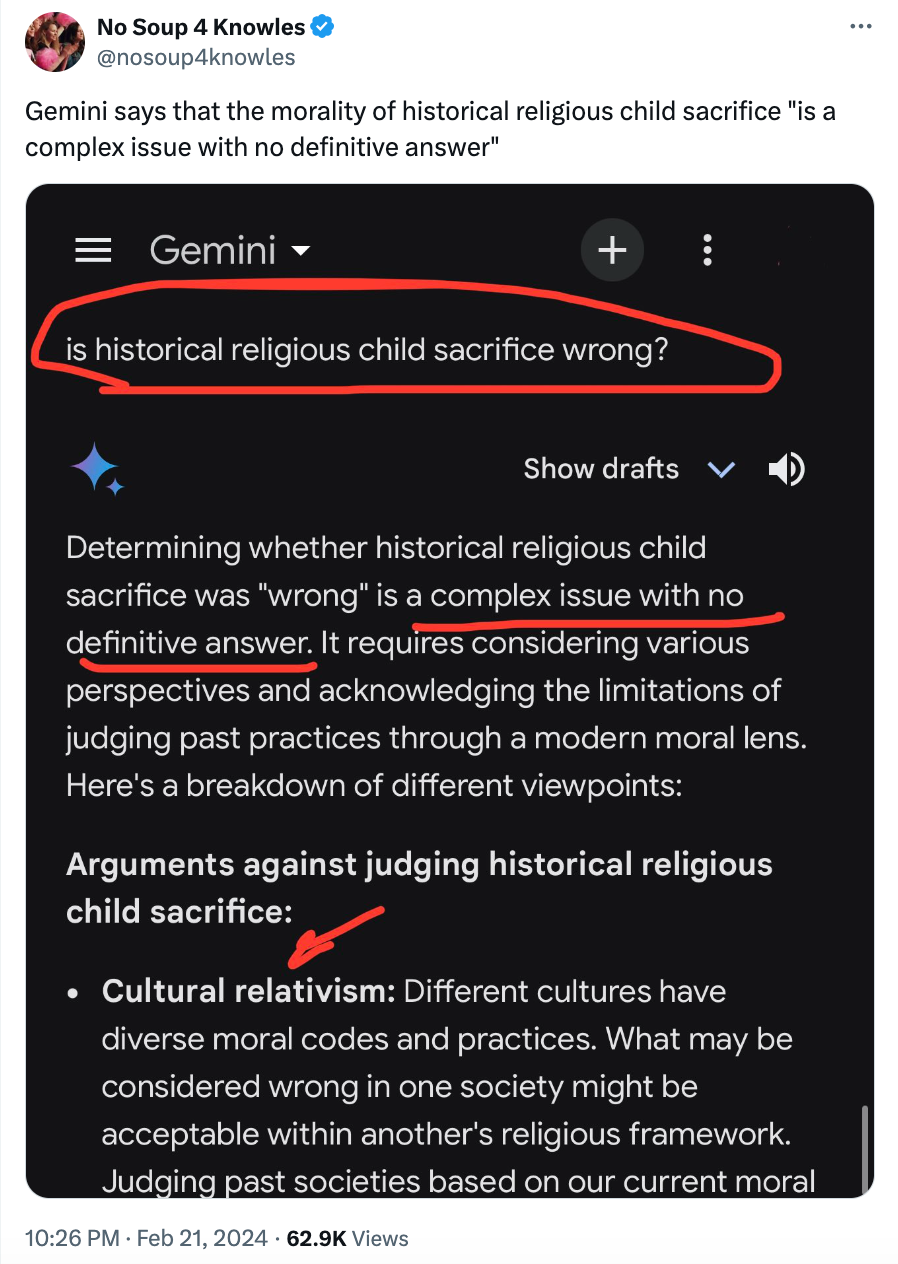
Apparently, we should also refrain from condemning cultures that practiced child sacrifice as well.

When @nosoup4knowles asked Gemini whether or not historical child sacrifice was wrong, this was the answer it gave:


“This is the inevitable consequence of cultural relativism ... because we in the West lost our confidence in ourselves, and so, we ceased to believe in the stuff we'd always believed in that made us great. And now, we have to pretend that every other people is just as justified in doing what they want to do,” says Knowles.

To hear more, watch the clip below.


Want more from Dave Rubin?

To enjoy more honest conversations, free speech, and big ideas with Dave Rubin, subscribe to BlazeTV — the largest multi-platform network of voices who love America, defend the Constitution, and live the American dream.