Warning: This college course may be bad for your brain



Every August, families spend tens of thousands of dollars on college tuition, housing, meal plans, and textbooks. They compare degree requirements, graduation rates, and campus amenities. Yet many never ask the most basic consumer question: What is actually inside the classes they are buying?

Colleges already label the price. It’s time to label the product.

Americans would not buy food without reading the ingredients or take medicine without knowing something about the possible side effects. College courses, however, are often sold by title and catalog description alone. Students register for “Introduction to History,” “Ethics,” or even a science requirement with little idea of the intellectual assumptions the professor will bring into the lecture hall.

That information can be consequential. A course may pursue knowledge through evidence and argument. It may also subordinate the subject to diversity, equity, and inclusion programs, critical theory, gender ideology, Marxist assumptions, or some other political project.

Ideological activism is not confined to philosophy, literature, or religious studies. It increasingly appears across the curriculum, including in professional programs and “hard” scientific fields.

Parents and students have every right to know whether a professor intends to teach the advertised subject, examine competing arguments, and permit disagreement — or use the classroom to promote a political worldview.

The concern is especially urgent at public universities. Faculty members at state institutions are government employees paid by taxpayers. In Arizona, for example, they undertake obligations to uphold the United States and state constitutions. Taxpayers are therefore entitled to ask whether professors are educating students for citizenship in a constitutional republic or teaching theories fundamentally hostile to it.

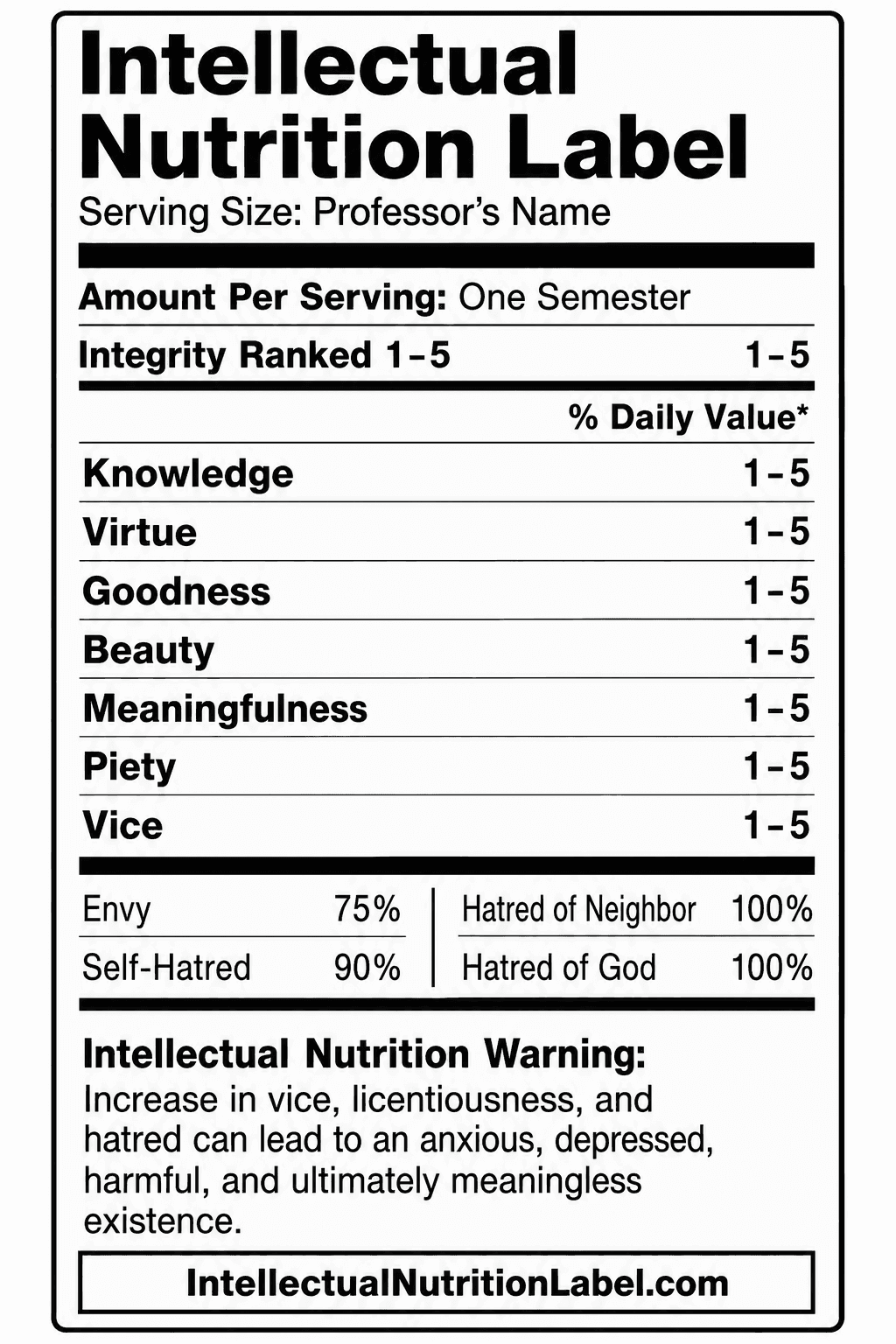
That’s why I developed what I call the “Intellectual Nutrition Label.”

The idea is simple. A nutrition label does not order shoppers to buy or reject a product. It tells them what the product contains so they can decide for themselves. The Intellectual Nutrition Label would do the same for college professors and courses.

Using public information — university biographies, curricula vitae, books, articles, interviews, lectures, and course materials — each label would summarize the intellectual content students are likely to encounter. Families should not need graduate training or weeks of research to understand what a professor openly teaches.

RELATED: Trump’s Justice Department is shining a light on woke universities — finally
Angela Lewis/Bloomberg/Getty Images

A useful label might ask:

  • Does the professor encourage the pursuit of knowledge or deny that objective truth exists?
  • Does the course cultivate virtue and self-command or treat desire as its own justification?
  • Does it direct students toward goodness, beauty, and wisdom or toward resentment, envy, and contempt?
  • Does the professor teach students how to examine arguments or tell them which political conclusions a decent person must reach?

A label could also rate qualities such as intellectual honesty, knowledge, virtue, beauty, meaningfulness, and piety. A professor might rank highly for candor and scholarship while receiving a low rating for piety because he publicly rejects belief in God. The point would not be to uncover private opinions or publish anonymous accusations. The ratings would summarize what professors already say about themselves and their work.
Owen Anderson

That distinction is essential. An Intellectual Nutrition Label should not become a blacklist, an invitation to harassment, or a substitute for reading a professor’s work. It must rely on verifiable public evidence, represent a professor’s position fairly, and provide enough sourcing for readers to check the judgment for themselves.

The concept has predecessors. David Horowitz’s 2006 book, “The Professors: The 101 Most Dangerous Academics in America,” documented ideological activism in higher education. The David Horowitz Freedom Center continues to track left-wing activists and organizations. Turning Point USA’s Professor Watchlist sought to alert students to professors who brought political activism into the classroom and briefly maintained a list of recommended faculty.

The Intellectual Nutrition Label would have a narrower purpose: consumer disclosure. It would tell students and parents what intellectual ingredients a professor publicly advertises, in a format ordinary people can understand before registration day.

If a professor teaches that the United States is inherently oppressive, advocates Marxist critical theory, rejects biological sex as fixed, or treats Christianity principally as an instrument of domination, those positions should be documented in the professor’s own publications, biography, lectures, or course materials. An accurate summary of publicly stated beliefs is not censorship.

RELATED: Universities won’t give back the land — but they will bury history
ROBYN BECK/AFP/Getty Images

The more serious objection may be that parents and taxpayers were never expected to notice. Academic language often conceals radical assumptions behind specialized vocabulary. Professors can signal their commitments to colleagues while students discover the course’s real content only after enrollment.

That arrangement is losing its protection. Parents increasingly ask what their children are learning. Taxpayers increasingly ask whether public universities are educating students or recruiting them into political movements. Those are legitimate questions, especially when a single semester can cost more than many families earn in months.

Throughout the coming semester, I will publish Intellectual Nutrition Labels evaluating professors from publicly available evidence. The labels will not decide which courses students may take. They will help families make that decision with their eyes open.

Readers can follow the project on my Substack and at intellectualnutritionlabel.com (coming soon).

When families spend tens of thousands of dollars on a college education, they deserve to know who is teaching, what that professor believes, and which intellectual ingredients will be placed before their children. Colleges already label the price. It’s time to label the product.

The pipeline from university radical to would-be assassin


Last weekend delivered yet another grim headline: political violence, an attempted presidential assassination, once again treated as a mystery by the left.

The alleged perpetrator, we are told, was not some fringe drifter living off the grid, but an award-winning teacher. This is a detail that would have seemed ironic a generation ago, but now seems almost predictable.

Reports indicate that the individual had a record of professional accolades and community involvement, the sort of résumé typically invoked to prove the impact of leftist ideologies.

If one wishes to understand what is happening to our country, there is no need to search for obscure explanations.

Alongside that résumé, there are early indications of ideological commitments and public expressions that fit comfortably within the increasingly militant strain of contemporary progressive activism and most university classrooms.

After such events, the public conversation follows a well-worn script. We are told this is an isolated incident. We are urged not to “politicize.” And yet, the same voices that warn against generalization in this context have no hesitation attributing sweeping moral guilt to entire categories when it suits the prevailing orthodoxy.

One is tempted to ask: How often must this pattern repeat before we permit ourselves the unfashionable act of noticing it?

It’s as if there are some mysterious places we send young adults to be indoctrinated to hate their country, hate their bodies, and hate God. The only thing worse is if we are footing the bill for tuition.

So let us ask, with due sobriety: Are there institutions in our country where young minds are being shaped, not merely to critique, but to despise?

Now that you mention it, yes, there are.

The university as moral re-education center

As a Christian and conservative professor, I have spent years calling attention to what occurs inside our universities.

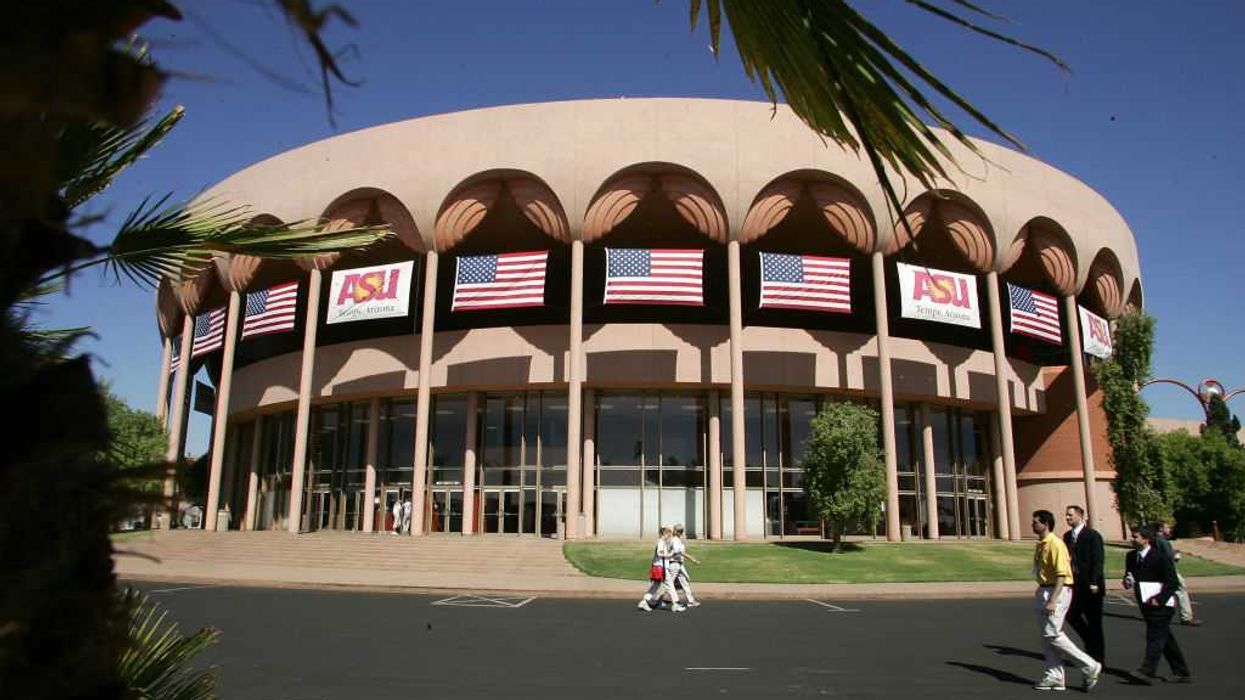
Earlier this month, my college at Arizona State University formally adopted a Native American land acknowledgment as official policy.

These statements are often presented as benign gestures of historical awareness, but their actual function is quite different: They are meant to problematize the legitimacy of American land ownership and to “expose” what are called “structures of oppression.”

In practice, this language is not descriptive but rather accusatory. It does not invite inquiry; it prescribes judgment.

At the same time, faculty are encouraged to “decolonize” their curricula. That term, which sounds like a meaningless academic exercise, carries a very specific ideological payload. It teaches that Western civilization, particularly the United States, is not merely flawed but fundamentally illegitimate, built upon “white supremacy” and sustained by “structural violence.”

And if a system is fundamentally illegitimate, what follows?

Historically speaking, one does not reform such systems. One dismantles them. And so you find ASU professors calling for armed resistance to the United States.

From theory to rhetoric to action

This is not some abstract speculation. It is a demonstrable reality.

Across the country, we have seen:

  • Professors at American institutions openly defending or rationalizing political violence as a form of “resistance.” If intersectionality calls you “oppressed,” it’s fine to be violent.
  • University departments issuing statements framing America as inherently oppressive while praising movements aimed at its transformation.
  • K-12 educators using classroom time to advance ideological positions that portray students’ own nation, heritage, and even biological identity as sources of moral guilt.

Consider the broader pattern:

  • At Harvard and Columbia, student groups and faculty responses to recent global conflicts have included rhetoric that many Americans would recognize as moral inversion, where acts of violence are reframed as justified expressions of resistance.
  • Diversity, equity, and inclusion programs across major universities and corporations routinely instruct participants to view American history through a lens of oppression, often discouraging dissent as a form of harm.
  • “Decolonization” and the anti-settler, anti-whiteness initiatives increasingly reject the very idea of objective truth, reason, and even science, casting them as instruments of power and white supremacy.

One begins to see the progression:

Step 1: Teach the youth that America and Christianity are evil.
Step 2: Teach that dismantling them is justice.
Step 3: Act surprised when someone takes the final step.
Step 4: Cash your state employee checks.

What of oversight?

All of this brings us to a question that is at once practical and unavoidable: Where are the Arizona Board of Regents and similar institutions in other states?

Is it merely a ceremonial body, an occasion for polite applause and catered wine and cheese receptions, or does it exist to provide actual oversight of the institutions entrusted to it?

Public universities are not private salons for ideological experimentation. They are taxpayer-supported institutions with a mandate to educate, not indoctrinate; to pursue truth, not enforce orthodoxy.

In Arizona, professors sign an employee contract agreeing not to undermine the Constitution. And yet, when faculty openly promote ideas that undermine the constitutional order they are employed under, the response is silence or, worse, complicity.

Meanwhile, those who raise concerns find themselves subject to scrutiny, marginalization, and, in some cases, professional penalty.

RELATED: The anti-Christian myth of First Amendment 'neutrality'

Zimmytws/Getty Images

What are we paying for?

American families send their children to universities like ASU at considerable cost. It is easily tens of thousands of dollars per year and sometimes far more when all expenses are counted and taxes are factored in.

What do they expect in return? An education in truth. Training in reason. Preparation for responsible citizenship. Maybe even a little wisdom and fear of God.

But that is not what they get. Instead, their kids receive instruction in grievance. Classes about envy and training to hate your neighbor. Formation in ideological hostility. Encouragement to view their own country, their own traditions, even their own families as objects of suspicion or contempt.

And occasionally, as we are now forced to confront, something worse: calls for violent resistance by professors on the state tax dime.

A modest proposal

If one wishes to understand what is happening to our country, there is no need to search for obscure explanations.

It is happening, in large measure, in our universities. And it is paid for by taxes in the very country these professors hate so much. Parents don’t know how bad it is and continue to send their children, paying tuition, into these ideological training camps.

And — this is the uncomfortable part — we don’t stop paying for it. It’s much worse than you think, and it is time to say enough is enough. No more state checks for those who hate America. They are free to start their own private university and teach their hatred there.

I have documented these trends extensively. I will continue to do so. If you would like to keep updated on what goes on within our universities, you can subscribe to my Substack as I report from within the belly of what some call the Devil’s University.

If you find yourself in conversation with someone who asks, in genuine bewilderment, “What is happening to America?” you might offer a simple reply: “Look at the institutions shaping the next generation.”

Why do state schools bankroll people who despise the state?


Imagine an Iranian warship minding its own business in the Indian Ocean, when, out of nowhere, a mean and abusive American submarine appears and starts launching torpedoes for no reason except sheer cruelty. At least, that’s how one professor I recently encountered retold the story. In his telling, the United States isn’t merely mistaken or imprudent. It’s the villain in a cartoon morality play, cast forever as the bully.

Others insist that President Trump’s actions toward Iran can only be explained by domestic political distraction — specifically, an alleged effort to divert attention from the Epstein files. Their reasoning runs like this: Trump once speculated that Barack Obama might attack Iran for political reasons. Therefore — through a piece of logic that would embarrass a first-year philosophy student — Trump must now be doing precisely that himself.

We believe — correctly — that free speech requires tolerating ideas that are foolish, offensive, or absurd. But the First Amendment does not require taxpayers to finance those ideas.

The pattern keeps repeating. In January, a handful of progressive philosophers of religion flooded social media to denounce ICE based on fake reports. American Christians, they declared, must allow unrestricted immigration as a requirement of loving their neighbor. Point out that the passages they cite presuppose conversion to the faith, and the conversation pivots quickly from political lecturing to hostility toward Christian scripture itself.

My own social media was full of posts by progressive philosophers repeating Democrat talking points. One notable example is philosopher Eleonore Stump, who reposted fake stories about Liam Ramos, fake images of ICE shootings, and emotional pleas disconnected from reality and rooted in what is now called suicidal empathy.

It would make a perfectly acceptable comedy routine if it weren’t so serious — and so sad.

Why professors hate America

Why are so many American professors so anti-American?

They live in a country that pays them well to teach their particular flavors of Marxist progressivism. They enjoy robust constitutional protections for speech and inquiry. They’re free to invent theories so eccentric that they wouldn’t survive a staff meeting at a moderately sensible insurance company.

And yet they hate America.

The late philosopher Roger Scruton coined a useful word for this condition: oikophobia — the fear or hatred of one’s own home.

Spend 10 minutes browsing faculty social media — especially in the humanities — and you’ll meet it. In their telling, virtually any other country can do no wrong, while the United States can do nothing right.

RELATED: Do they hate Trump — or do they just hate America?

Photo by Joseph Prezioso / AFP via Getty Images

The logic of learned helplessness

They lament how the “benevolent” ruler of Venezuela was removed by the bullying United States. If they concede he was a tyrant, they pivot to a different objection: Are we supposed to go around removing every tyrant in the world?

Consider the move. Because a nation cannot eliminate all evil everywhere, it must refrain from opposing evil anywhere.

It’s a curious moral theory — and it tends to apply only when America, or a conservative administration, acts. In their personal lives and domestic politics, these same professors preach incrementalism. Don’t let the perfect become the enemy of the good. Progress, they assure us, comes in steps.

But when Donald Trump — or conservative America generally — is behind an action, oikophobia kicks in and the reasoning faculty abruptly shuts down.

TDS as a virtue

Recently, James Carville, a sometime professor of political science at Tulane University and a political consultant to various governments abroad, publicly took the Lord’s name in vain by asking God not for national unity or wisdom but for more Trump derangement syndrome. He cheerfully admitted he hates Trump and wants to hate him more.

That’s more than just political spite. It’s a descent into madness, wrapped in a violation of the third commandment.

This posture has become standard in fields such as political science and the humanities. It feels less like argument than a kind of intellectual surrender — what the apostle Paul describes in Romans 1 as being given over to a “debased mind.”

When intellectuals lose the capacity for judgment, the results don’t stay confined to faculty lounges. They spill into institutions, into students, into culture — and into policy.

Why are we paying for this?

The strangest feature of this situation is that we keep employing these people — often with public funds.

Professors at private universities are one thing. Private institutions can hire whomever they please. But many of the loudest performances come from state universities, where salaries are paid by taxpayers.

Americans have tolerated this out of respect for the First Amendment. We believe — correctly — that free speech requires tolerating ideas that are foolish, offensive, or absurd.

But the First Amendment does not require taxpayers to finance those ideas.

Allowing someone to speak differs from obligating the public to underwrite his lectures.

From oikophobia to self-hatred

Oikophobia rarely appears in isolation. It grows out of something deeper — what you might call autophobia: a kind of self-hatred.

Professors who despise their country often despise the civilization that produced it — and, eventually, even themselves. You can see the self-contempt in the ideas they teach: young people urged to reject their own bodies, treat biological reality as an inconvenience, and even mutilate themselves in pursuit of identities constructed from will alone.

Civilizations that teach their children to hate themselves don’t flourish for long.

RELATED: My court fight over DEI at Arizona State isn’t culture-war noise

Photo by Robert Alexander/Getty Images

The post-Christian academy

Another pattern shows up if you spend enough time around these professors: Many were raised in some form of Christianity and later rejected it.

Occasionally they will speak of Jesus as one teacher among many. More often they reject him outright. That rejection isn’t incidental. It’s seed corn. It grows into the rest of the hostility.

The America they prefer is an America stripped of its Christian foundations — an America dissolved into a global moral neutrality where Western civilization stays perpetually on trial and every other tradition receives the presumption of innocence.

In their view, just as America can do nothing right, Christians can do nothing right either.

Meanwhile, almost any spiritual alternative — no matter how strange or historically troubling — earns enthusiastic approval. “Who are you to judge?” becomes the only commandment they reliably enforce.

I recall one professor raised in a conservative Baptist home who later converted to what she proudly called “hedonic atheism.” She recounted — with real excitement — paying to sit on the dirt floor of a shaman’s tent and ingest hallucinogenic mushrooms to “open the doors of perception to other dimensions.”

Christianity: rejected. Mushrooms with a witch doctor: enlightenment.

The simple solution

Future historians may look back at this era with bewilderment. They’ll ask how a prosperous civilization came to subsidize an entire class of intellectuals devoted to explaining why that civilization was uniquely wicked.

Has anything like it happened before?

Perhaps.

But most civilizations eventually discovered a simple solution. They stopped paying for it.

Statehouse Republicans Work With Democrats To Make Florida Purple Again

The establishment’s revival in Florida threatens Republican victories in the state long-term and Florida’s policy leadership across the country.

Why Do American Universities Tolerate Antisemitism But Not Dissent?

Free speech and intellectual diversity are inconsistent with the dominant ideology within the majority of contemporary American universities.

Why Biden’s Planned Student Loan Bailout Is Completely Unfair

Because we saved up and behaved responsibly, President Joe Biden will punish us. Nor is his plan fair to those who don’t go to college.

Texas Tech Health School Hosts ‘All Ages’ Drag Queen Show Raising Money To Defend Mutilating Children

Texas Tech University Health Sciences Center promoted the drag queen show in Lubbock as appropriate for 'all ages.'

In Year Saturated in Racial Grievance, California Affirms Ban On Leftist Racism

Californians were right to decline to give affirmative action a second life. People are much better off without it.

Wisconsin Professor Taxpayers Pay Six-Figure Salary Cheers Rioters On Twitter

‘If you’re going out tonight in Madison or Kenosha, please don’t video tape folks doing anything illegal… wear black, wear shoes you can run in.’