A Nation That Won’t Enforce Immigration Laws Isn’t A Nation At All
 It may be that the next few years will decide whether America remains a sovereign nation or succumbs to subversion from within.
The elections of 2026 and 2028 will be “Flight 93 elections,” but not in the way Michael Anton envisioned in 2016. Anton famously compared supporting Donald Trump to charging the cockpit of a hijacked plane: reckless, dangerous, but preferable to certain death.
Nine years later, the metaphor has inverted. The forces that once stormed the cockpit now control it. They have locked the door, fortified the controls, and flown the Republican Party in widening circles toward disaster. No one inside can change course. The GOP plane is rapidly losing altitude, and everyone aboard can see it coming.
Continuing down this path does not preserve conservatism. It buries it inside an irredeemable party.
At this stage, the only rational move involves grabbing a parachute and jumping. Staying seated guarantees political death.
Anton wrote his essay when the Republican Party had already revealed itself as corrupt, inert, and incapable of reform. That decay produced Trump. He appeared as something new: a transactional, deeply flawed outsider promising to smash the uniparty and deliver for workers and small businesses long ignored by corporate Republicanism.
Many voters tolerated Trump’s personal failings and erratic behavior because he represented a rupture. At least it was different.
Nine years on, Republicans carry all the liabilities of Trump’s image and record without securing the benefits that justified the gamble. His better policies stall in court. His worst instincts endure. Meanwhile, Republicans lose elections in territory that once leaned safely red.
Trump obsesses over his ballroom project, courts tech and crypto bros, cuts deals with China and Qatar, and waves away economic pain that millions feel daily. Consumers face rising prices. College graduates struggle to find work. Small businesses buckle under costs. The White House insists the economy is strong.
It is not.
This failure did not begin with Trump. The Tea Party quickly collapsed because it tried to reform a party that could not be reformed. The GOP long ago ceased functioning as a conservative party. It exists to serve corporate donors while marketing fear of the left to a skeptical electorate.
History offers a warning. The Whig Party collapsed once it became obvious that it stood for nothing relevant to its era. The Republican Party replaced it. Today’s GOP has perfected the art of symbolic resistance paired with practical surrender. It’s fake opposition.
Trump’s rise looked like a break from that pattern. Sadly, it was not. He has spent five election cycles endorsing establishment Republicans, preserving the very faction that produced the crisis. His rhetoric attacks “RINOs,” but his endorsements entrench them.
His current agenda reflects the same contradiction: Big Tech, techno-feudal economics, Qatari pandering, Chinese student visas, and government-backed industrial schemes sold as innovation, paired with denial of inflation and hardship.
The result proves electorally poisonous. Republicans repel suburban voters and working-class voters simultaneously. They project the aloof corporatism of the pre-Trump era mixed with cultural coarseness and denial of obvious hardship.
Since 2017, Republicans have compiled a grim down-ballot record, interrupted only by Trump’s 2024 victory against a weak opponent in a terrible economy. Rather than consolidate that win, Trump chose to own the economy outright and burn political capital.
Conservatives now die on hills that are not their own. They inherit Trump’s liabilities without achieving the promised purge of the party’s corporate class. The GOP and Trump’s coalition increasingly merge into a single structure that offers spectacle instead of reform.
RELATED: Democrats are running as Bush-era Republicans — and winning

As Republican candidates face double-digit swings toward Democrats even in light-red districts, the choice sharpens. Conservatives can continue propping up a failed party and risk discrediting their ideas permanently. We could embrace the “aristopopulism” of JD Vance and his circle. Or we could force a realignment.
A new party could channel distrust of techno-feudalism, mass surveillance, foreign labor exploitation, and a K-shaped economy engineered through government favoritism. It could ground itself in tangible productivity, property rights, sound money, privacy, small business, and national sovereignty.
Every decade or so, Republican dysfunction becomes obvious enough to provoke rebellion: Ronald Reagan, Newt Gingrich, the Tea Party, MAGA. Each time, the insurgency gets absorbed and neutralized by the same structure.
We have reached that moment again.
Continuing down this path does not preserve conservatism. It buries it inside an irredeemable party. The Republican Party has reached the end of its rope. The only question is whether conservatives recognize it before the fall becomes irreversible.
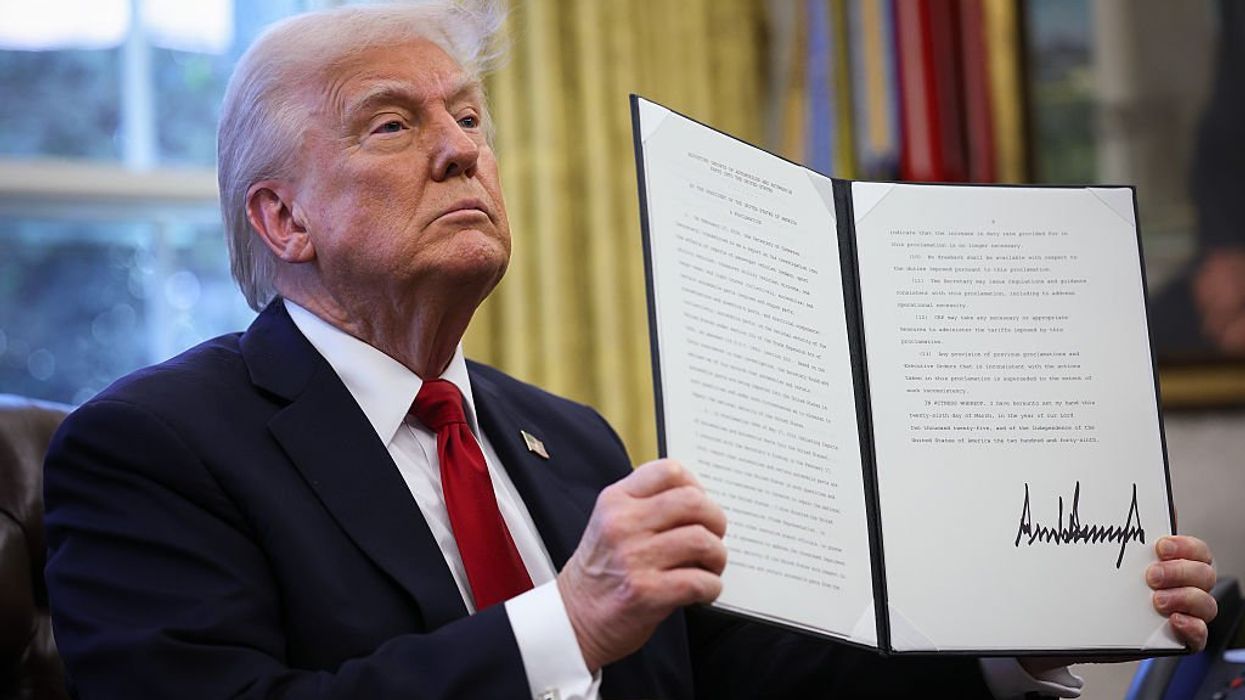
As President Donald Trump grapples with more than a dozen injunctions, Republican lawmakers have targeted "rogue" activist judges with two new bills.
Rep. Darrell Issa (R-Calif.) introduced the No Rogue Rulings Act to restrict U.S. district judges' ability to issue broad injunctions. The bill passed the House Rules Committee on Tuesday in a 9-4 vote along party lines.
'700 District Court judges shouldn't each have nationwide veto power over a President's national security decisions.'
"The bill would allow a district court to issue a nationwide injunction in a case in which two separate states from two separate judicial circuits are parties — making clear the nationwide nature of the dispute. In such a case, the bill provides for the establishment of a panel of three randomly chosen judges to determine whether to issue a nationwide injunction. Such injunctions may be appealed directly to the Supreme Court," the proposed bill reads.
Since Trump's January inauguration, his administration has already been hit with 15 injunctions, stalling a wide range of initiatives such as the end of birthright citizenship, deportation flights, and the elimination of diversity, equity, and inclusion programs.
Issa told the New York Post that his proposed bill is "a constitutional solution to a national problem."
"Time and again, solitary judges have usurped congressional intent and confronted President Trump, rather than dispassionately interpreted the law," he stated.
New York Republican Reps. Claudia Tenney, Nick Langworthy, and Nick LaLota have co-sponsored the bill.
Tenney pointed out that 67% of all injunctions ever issued have been placed against Trump.
"I am supporting the No Rogue Rulings Act to stop radical judges from imposing nationwide injunctions on President Trump's agenda, which 77 million Americans voted for," she wrote in a post on X.
LaLota stated, "700 District Court judges shouldn't each have nationwide veto power over a President's national security decisions."
Rep. Bob Onder (R-Mo.) called the activist judges' actions "unconstitutional lawfare."
Meanwhile, Sen. Chuck Grassley (R-Iowa) on Monday introduced a similar measure, the Judicial Relief Clarification Act, which aims to "limit federal court orders to parties directly before the court — ending the practice of universal injunctions and clarifying the constitutional role of the judicial branch."
It would require parties to file a class-action lawsuit to receive nationwide injunctive relief.
Grassley stated, "For a number of years, but particularly in the last few months, we've increasingly seen sweeping orders from individual district judges that dictate national policy. Our Founders saw an important role for the judiciary, but the Constitution limits judges to exercising power over 'cases' or 'controversies.' Judges are not policymakers, and allowing them to assume this role is very dangerous."
On Tuesday, two House Judiciary Committee subcommittees held a joint hearing examining judicial overreach. Former Rep. Newt Gingrich (R-Ga.) and Paul Larkin, a senior legal research fellow with the Heritage Foundation, joined the hearing as witnesses.
Larkin told lawmakers, "The practice of issuing nationwide injunctions outside the confines of a certified nationwide class action is mistaken as a matter of law and unwise as a matter of policy."
"It is not the courts that are responsible for creating the laws; the courts are responsible for interpreting it as it applies, but they can only do so in the context of a case or controversy," he added. "Only the Congress can create a law. Any time a court enters a judgment that is tantamount to being a law, the judge has gone too far."
Gingrich called the judges' injunctions against the Trump administration "potentially a judicial coup d'état."
“The notion that unelected lawyers can micromanage the executive branch and override a commander in chief who received 77.3 million votes should trouble every American,” he stated.
Like Blaze News? Bypass the censors, sign up for our newsletters, and get stories like this direct to your inbox. Sign up here!

 Repealing Biden-era California waivers is an appropriate exercise of congressional powers against executive misinterpretation of the law.
 Republican candidates owe it to voters — and the unborn — to be artful, clear, and convincing in defense of the pro-life cause.
 freebeacon.com
 www.theblaze.com
 www.theblaze.com
 www.theblaze.com