‘Frankly, He Has Been Killed’: Angry Scholars From UK’s Top Academics’ Union Blame Jason Arday’s Death on Racist Mob, as ‘Race Realist’ Who Ignited the Firestorm Is Suspended

As anger grows among the left over the apparent suicide last week of former Cambridge professor Jason Arday, an influential band of activists within Great Britain’s largest academics’ union is moving to fuel that raw sentiment into action. These academics—from the University and College Union—want to shield other black academics from scrutiny from what they view as a racist, right-wing conspiracy.

The post ‘Frankly, He Has Been Killed’: Angry Scholars From UK’s Top Academics’ Union Blame Jason Arday’s Death on Racist Mob, as ‘Race Realist’ Who Ignited the Firestorm Is Suspended appeared first on .

Star Cambridge Professor Jason Arday Lied for Years About Raising Millions for Charity: Simon & Schuster Scrubbed Financial Details From His New Memoir and Falsehoods From His Bio

The celebrity Cambridge education professor Jason Arday—whose rags-to-riches memoir from Simon & Schuster lands August 11—has repeatedly lied about his charitable fundraising prowess, according to 16 years of records reviewed by the Washington Free Beacon. The revelation comes as Arday's scholarly work and inspiring life story are under heavy scrutiny in Britain from journalists and […]

The post Star Cambridge Professor Jason Arday Lied for Years About Raising Millions for Charity: Simon & Schuster Scrubbed Financial Details From His New Memoir and Falsehoods From His Bio appeared first on .

Warning: This college course may be bad for your brain


Every August, families spend tens of thousands of dollars on college tuition, housing, meal plans, and textbooks. They compare degree requirements, graduation rates, and campus amenities. Yet many never ask the most basic consumer question: What is actually inside the classes they are buying?

Colleges already label the price. It’s time to label the product.

Americans would not buy food without reading the ingredients or take medicine without knowing something about the possible side effects. College courses, however, are often sold by title and catalog description alone. Students register for “Introduction to History,” “Ethics,” or even a science requirement with little idea of the intellectual assumptions the professor will bring into the lecture hall.

That information can be consequential. A course may pursue knowledge through evidence and argument. It may also subordinate the subject to diversity, equity, and inclusion programs, critical theory, gender ideology, Marxist assumptions, or some other political project.

Ideological activism is not confined to philosophy, literature, or religious studies. It increasingly appears across the curriculum, including in professional programs and “hard” scientific fields.

Parents and students have every right to know whether a professor intends to teach the advertised subject, examine competing arguments, and permit disagreement — or use the classroom to promote a political worldview.

The concern is especially urgent at public universities. Faculty members at state institutions are government employees paid by taxpayers. In Arizona, for example, they undertake obligations to uphold the United States and state constitutions. Taxpayers are therefore entitled to ask whether professors are educating students for citizenship in a constitutional republic or teaching theories fundamentally hostile to it.

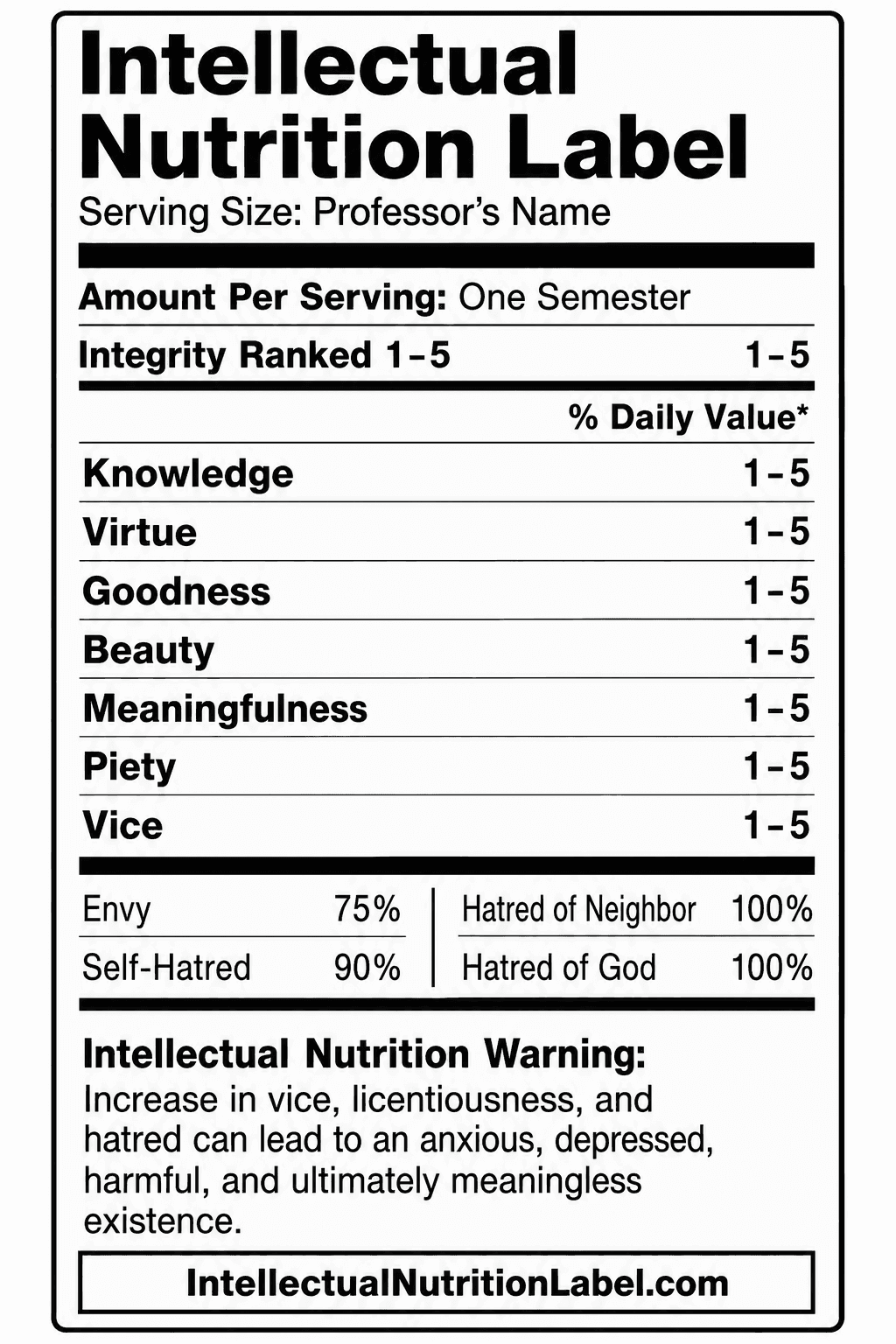
That’s why I developed what I call the “Intellectual Nutrition Label.”

The idea is simple. A nutrition label does not order shoppers to buy or reject a product. It tells them what the product contains so they can decide for themselves. The Intellectual Nutrition Label would do the same for college professors and courses.

Using public information — university biographies, curricula vitae, books, articles, interviews, lectures, and course materials — each label would summarize the intellectual content students are likely to encounter. Families should not need graduate training or weeks of research to understand what a professor openly teaches.

RELATED: Trump’s Justice Department is shining a light on woke universities — finally

Angela Lewis/Bloomberg/Getty Images

A useful label might ask:

  • Does the professor encourage the pursuit of knowledge or deny that objective truth exists?
  • Does the course cultivate virtue and self-command or treat desire as its own justification?
  • Does it direct students toward goodness, beauty, and wisdom or toward resentment, envy, and contempt?
  • Does the professor teach students how to examine arguments or tell them which political conclusions a decent person must reach?

A label could also rate qualities such as intellectual honesty, knowledge, virtue, beauty, meaningfulness, and piety. A professor might rank highly for candor and scholarship while receiving a low rating for piety because he publicly rejects belief in God. The point would not be to uncover private opinions or publish anonymous accusations. The ratings would summarize what professors already say about themselves and their work.

Owen Anderson

That distinction is essential. An Intellectual Nutrition Label should not become a blacklist, an invitation to harassment, or a substitute for reading a professor’s work. It must rely on verifiable public evidence, represent a professor’s position fairly, and provide enough sourcing for readers to check the judgment for themselves.

The concept has predecessors. David Horowitz’s 2006 book, “The Professors: The 101 Most Dangerous Academics in America,” documented ideological activism in higher education. The David Horowitz Freedom Center continues to track left-wing activists and organizations. Turning Point USA’s Professor Watchlist sought to alert students to professors who brought political activism into the classroom and briefly maintained a list of recommended faculty.

The Intellectual Nutrition Label would have a narrower purpose: consumer disclosure. It would tell students and parents what intellectual ingredients a professor publicly advertises, in a format ordinary people can understand before registration day.

If a professor teaches that the United States is inherently oppressive, advocates Marxist critical theory, rejects biological sex as fixed, or treats Christianity principally as an instrument of domination, those positions should be documented in the professor’s own publications, biography, lectures, or course materials. An accurate summary of publicly stated beliefs is not censorship.

RELATED: Universities won’t give back the land — but they will bury history

ROBYN BECK/AFP/Getty Images

The more serious objection may be that parents and taxpayers were never expected to notice. Academic language often conceals radical assumptions behind specialized vocabulary. Professors can signal their commitments to colleagues while students discover the course’s real content only after enrollment.

That arrangement is losing its protection. Parents increasingly ask what their children are learning. Taxpayers increasingly ask whether public universities are educating students or recruiting them into political movements. Those are legitimate questions, especially when a single semester can cost more than many families earn in months.

Throughout the coming semester, I will publish Intellectual Nutrition Labels evaluating professors from publicly available evidence. The labels will not decide which courses students may take. They will help families make that decision with their eyes open.

Readers can follow the project on my Substack and at intellectualnutritionlabel.com (coming soon).

When families spend tens of thousands of dollars on a college education, they deserve to know who is teaching, what that professor believes, and which intellectual ingredients will be placed before their children. Colleges already label the price. It’s time to label the product.

The Nutty Professor: Socialist in Close House Race Taught Ultra-Woke College Classes on 'Whiteness,' 'Prison Industrial Complex,' and 'Genocidal Practices of the Nationstate'

The socialist who has Zohran Mamdani's endorsement to oust Rep. Adriano Espaillat in a New York City Democratic congressional primary co-created a bizarre, DEI-crazed college course that advocated for abolishing schools, which it accused of fueling "genocide," "white supremacy," and "settler colonialism," among other ills.

The post The Nutty Professor: Socialist in Close House Race Taught Ultra-Woke College Classes on 'Whiteness,' 'Prison Industrial Complex,' and 'Genocidal Practices of the Nationstate' appeared first on .

George Washington University Hires Federal Judge Overseeing Antisemitism Lawsuit Against It To Teach 'Ethics and Discretionary Judgment'

George Washington University hired the federal judge who is presiding over a lawsuit accusing the school of "pervasive and severe antisemitic harassment" to teach a GW Law course on "ethics and discretionary judgment," social media posts and course materials reviewed by the Washington Free Beacon show. That judge, Biden appointee Loren AliKhan, has yet to recuse herself from the case, prompting criticism from legal experts.

The post George Washington University Hires Federal Judge Overseeing Antisemitism Lawsuit Against It To Teach 'Ethics and Discretionary Judgment' appeared first on .

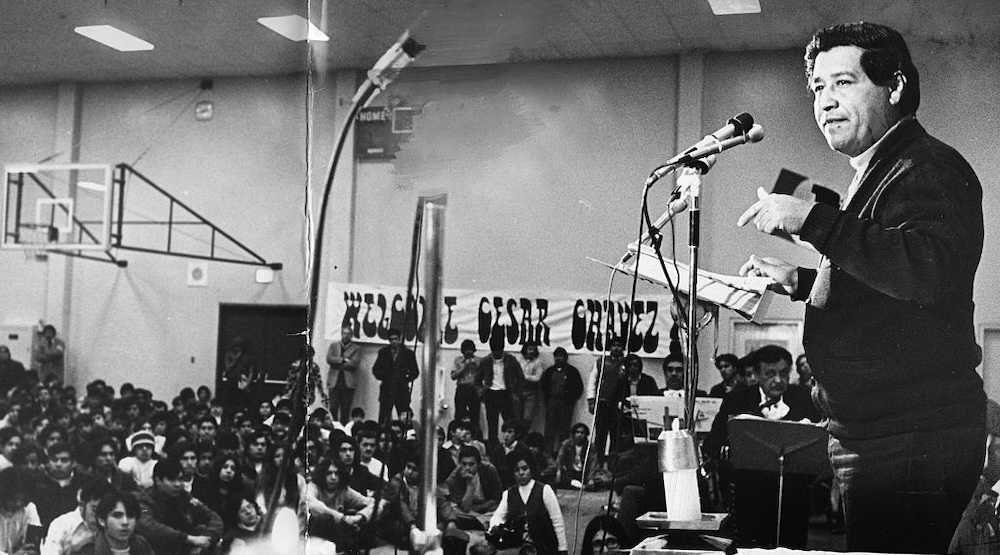
The left’s Cesar Chavez problem is much bigger than Cesar Chavez


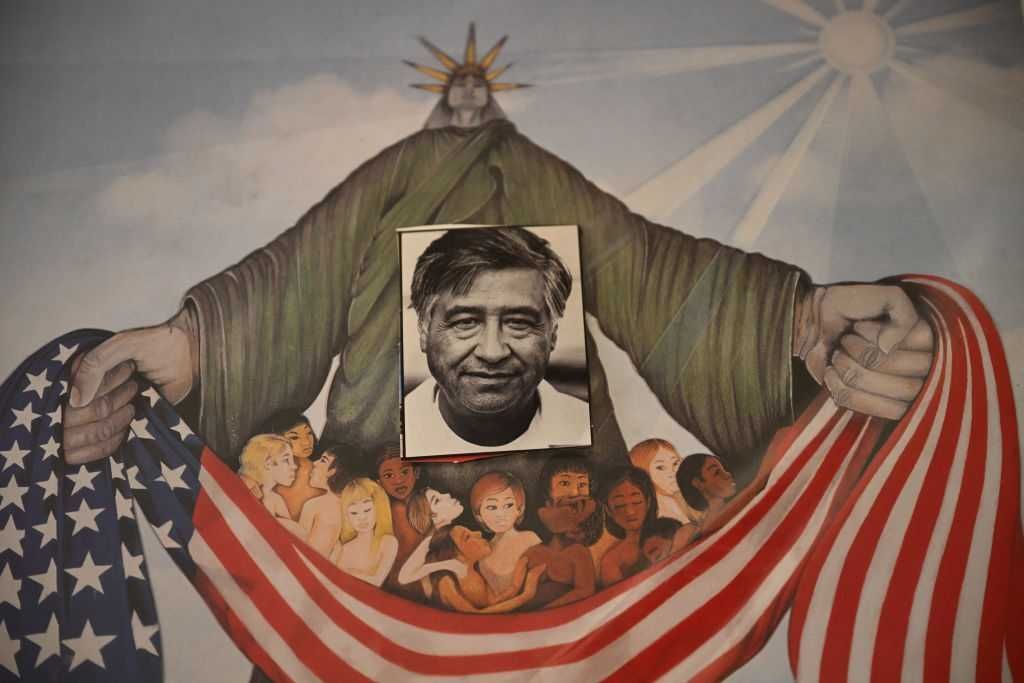
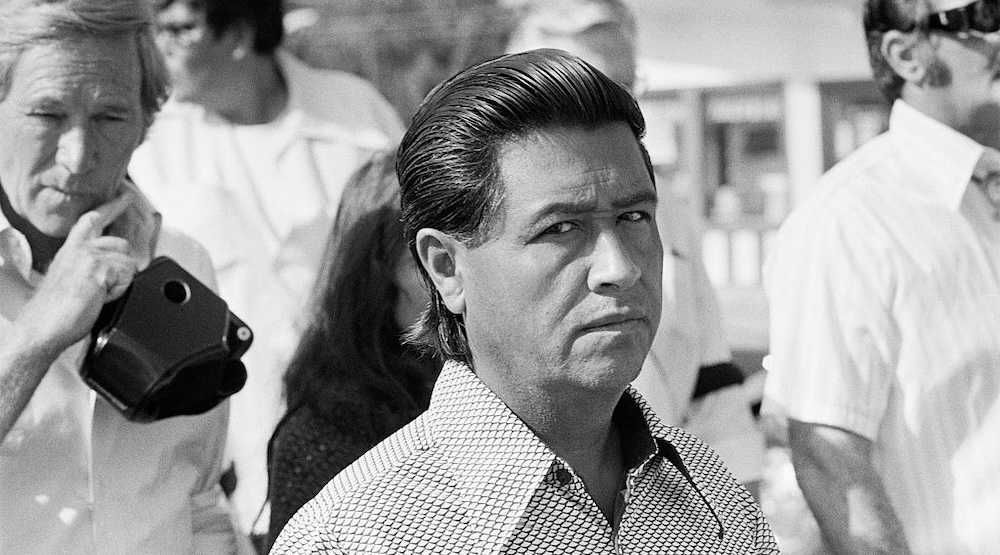
For decades, Cesar Chavez occupied near-canonical status in American universities. The United Farm Workers leader’s name adorned schools, his image filled lecture slides, and his story was told as secular hagiography: the humble labor leader who organized the oppressed, challenged exploitation, and embodied moral courage in the struggle for justice.

Now that image is cracking.

The reassessment of Chavez is not the end of something. It is the beginning of a broader reckoning.

A blockbuster New York Times story this month detailed serious allegations of sexual misconduct, including deeply disturbing claims that, if true, must force a fundamental reassessment of Chavez. The question is not only whether the allegations are true, but why this reckoning arrived only now.

What we are witnessing is not merely the fall of a man but the exposure of a pattern — one that reveals more about the moral framework of academic elites than about Chavez himself.

The manufactured hero

For years, Chavez has been presented, especially in university settings, as a hero of the proletariat. Not always in explicitly Marxist terms, of course. The language is smoother than that. But the structure is unmistakable: Chavez as the labor leader who stood against capital, exposed exploitation, and mobilized collective struggle in the name of justice.

Students are taught to see history as the story of structural oppression and economic conflict. Chavez became a usable symbol in that story. Because he served that function, his image was carefully curated.

What is now becoming clear is that the darker aspects of Chavez’s life were not entirely unknown. Reports of infidelity, domineering leadership, and abuses of power were not buried in some inaccessible archive. They were part of the broader historical record.

Silence around sin

Yet they were largely ignored.

That is how leftist professors handle their heroes. The facts that do not serve the narrative get minimized, reframed, or omitted. This is the first lesson of the current moment: The moral concern of the DEI professoriat is not truth but rather usefulness to the cause.

A figure is praised or condemned not by a consistent moral standard, but by whether he advances a political project. As long as Chavez could serve as a symbol of labor activism and anti-capitalist struggle, his sins remained background noise. Now that those sins threaten his usefulness, they have moved to the foreground.

No new moral conscience has emerged on the left. What we’re seeing is pure calculation.

RELATED: Labor group cancels Cesar Chavez events over 'profoundly shocking' new allegations

Tony Korody/Sygma/Getty Images

A narrow moral vision

The deeper problem goes beyond hypocrisy. The moral vision offered by Chavez’s academic admirers is radically narrow. It focuses almost entirely on one category of wrongdoing: economic injustice. Greed, real and serious as it is, gets elevated into the supreme moral concern. Entire departments and movements organize themselves around exposing and correcting it.

But what about lust? What about pride? What about the abuse of power in personal life, not just economic systems?

Those sins get treated as secondary or, worse, as distractions from the real work of social transformation. The result is a moral framework that is selective and shallow. It addresses external structures while neglecting the corruption of the human heart. Marxism 101 still teaches that if we revolt our way into a better system, we can somehow produce a better man.

But a philosophy with no coherent account of sin cannot solve sin.

From moralism to tyranny

That failure has predictable consequences. If the problem lies mainly in external systems, then the solution must also be external: regulation, enforcement, and conformity. Behavior must be monitored. Speech must be controlled. Dissent must be suppressed.

That is why academic environments that preach tolerance so often practice censorship. That is why calls for equity come paired with ideological compliance. Those who depart from the approved narrative do not get argued with. They get disciplined.

Until we recover a full account of human nature, one that takes sin seriously and looks beyond man for its cure, we will repeat this cycle again and again.

And that is why such movements, once they gain power, tilt toward tyranny. They do not govern by the standards of fairness they once demanded, because their moral framework never grounded those standards in the first place. It only deployed them when useful.

The fall of Chavez is not an anomaly. It is a case study. A movement that cannot account for sin will eventually be undone by it. Robespierre gets guillotined every time.

The deeper problem

At the heart of all this sits a basic misdiagnosis. Man’s greatest problem is not economic inequality. It is not structural oppression. It is not even political injustice, though all of those are real. Man’s greatest problem is sin.

It is the corruption of the heart that gives rise to every form of injustice, whether in the marketplace or the home, the factory or the family. No amount of social reorganization can fix that. You can redistribute wealth, rewrite laws, and restructure institutions and still end up with the same fallen human nature operating under new conditions.

That is why movements that promise moral transformation through politics end in disappointment. They try to fix what is internal by manipulating what is external. A Latin American studies professor once told a friend of mine, “Che su Christo.” Che is Christ.

RELATED: The lie that launched a thousand riots

Fitzgerald Whitney/Los Angeles Times/Getty Images
The only real solution

But there is only one Christ and only one remedy for sin, and it is the one most conspicuously absent from the classrooms that long celebrated Chavez.

The answer is not a program or a policy. It is a person.

Christ does not merely demand outward reform. He gives a new heart. He restores sinners to communion with God. He addresses not only the consequences of sin, but its source. He transforms the inner man, and from that transformation flow justice, righteousness, and love.

That is precisely why He is excluded. A system built on human effort, collective struggle, and ideological conformity cannot tolerate a solution rooted in repentance, grace, and divine authority. It is the works-righteousness religion of our age.

The inevitable reckoning

The reassessment of Chavez is not the end of something. It is the beginning of a broader reckoning. If our heroes are chosen for usefulness rather than virtue, they will disappoint us. If our moral standards are selective, they will collapse under their own inconsistency.

And if we refuse to acknowledge the true nature of sin, we will keep acting surprised by its consequences. The real lesson of this moment is not that another historical figure has fallen. It is that a moral system built on partial truths and ideological commitments cannot bear the weight of reality.

Until we recover a full account of human nature, one that takes sin seriously and looks beyond man for its cure, we will repeat this cycle again and again.

Chair of Harvard's 'Institutional Voice' Committee Insists: 'You Need To Participate in … Resistance'

The Harvard professor who co-chaired the university's institutional neutrality working group, which concluded that the university should not "issue official statements about public matters that do not directly affect the university's core function," has started a new Substack in which he exhorts readers to "participate in … resistance" against the Trump administration.

The post Chair of Harvard's 'Institutional Voice' Committee Insists: 'You Need To Participate in … Resistance' appeared first on .

EXCLUSIVE: She Was Dismissed From a Leadership Post at Harvard. Now She's a Candidate for Columbia's Edward Said Chair in Arab Studies.

A professor removed from her leadership post at Harvard University after bringing in a raft of anti-Israel guest speakers and panelists and few, if any, dissenting voices is among four finalists to become the Edward Said chair in Arab Studies at Columbia University, internal communications reviewed by the Washington Free Beacon show.

The post EXCLUSIVE: She Was Dismissed From a Leadership Post at Harvard. Now She's a Candidate for Columbia's Edward Said Chair in Arab Studies. appeared first on .

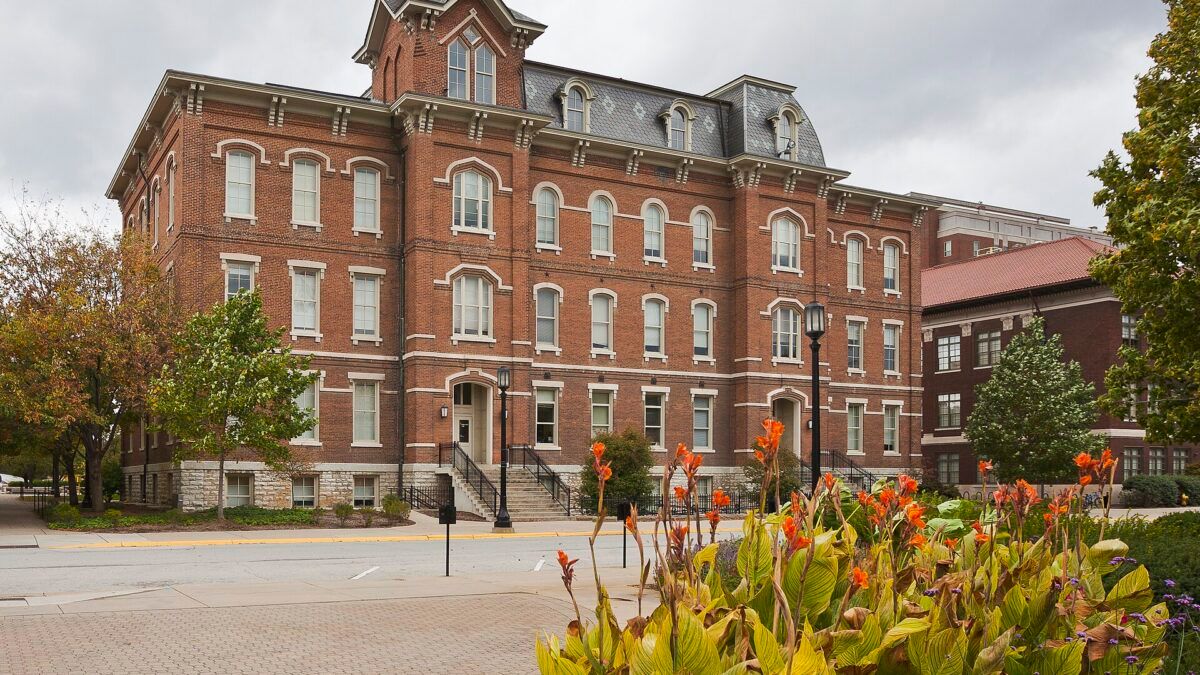
Purdue Hiring 1,000 Foreigners In 5 Years Illustrates Higher Ed’s H-1B Problem

The H-1B program has turned into a privileged hiring initiative for universities, with 16,000 such visas issued for the last two semesters.

Columbia Tries To Distance Itself From New Pulitzer Board Member After Free Beacon Report

Columbia University attempted to distance itself from the Pulitzer Prize Board's newest member, Harvard professor Vijay Iyer, after a Washington Free Beacon report revealed his strident anti-Israel activism and membership in a faculty group that published an anti-Semitic cartoon.

The post Columbia Tries To Distance Itself From New Pulitzer Board Member After Free Beacon Report appeared first on .