Learn to ask meaningful questions



Few remember what economic plan Jimmy Carter tried to sell in 1980. They remember the misery index, inflation and unemployment climbing together, and the hostages in Iran. What they don’t remember are the policy details, because one question cut through all of it.

Ronald Reagan asked, “Are you better off than you were four years ago?”

That was it. Everything Carter wanted to argue for a second term had to pass through that question. Once it didn’t, the rest of the argument no longer mattered.

People escape accountability because we lack the will — or the courage — to let the question stand in the spotlight.

People remember questions like that, not because they were clever, but because they left nowhere to hide.

“What did the president know, and when did he know it?” —Howard Baker

“Can you provide a definition for the word 'woman'?” —Senator Marsha Blackburn

“What's your favorite type of abortion?” —Rep. Brandon Gill

And then there is the question God put to Job, not for information, but for perspective: “Where were you when I laid the foundation of the earth?”

Some questions demand accountability from men, while one reminds man who he is. We used to understand this. Now we try to avoid it.

I have spent four decades in exam rooms, where polite conversation is useless when something goes wrong. You don’t ask questions to sound informed; you ask because something is at stake.

What happened? What changed? What are we doing now?

You don’t let the answer drift into language that sounds right but explains nothing. You bring it back, again and again, until something real emerges. No amount of expertise, credentials, or authority allows someone to evade accountability with a filibuster. You don’t have to know how to perform surgery to do that. You just have to care enough not to be brushed aside.

That discipline is rare in our public life.

A congresswoman recently echoed a talking point her party and much of the media have been pushing. She pressed Pete Hegseth about the 25th Amendment and Donald Trump. It sounded serious, but it wasn’t.

The world watched Joe Biden struggle in plain view. Where was this concern then?

The same thing shows up with Elizabeth Warren. She raised concerns about airline prices while opposing the JetBlue-Spirit Airlines merger that might have reshaped that market.

She is welcome to make the argument, but the question remains: "You opposed the merger, so how is this outcome not on you?"

That question doesn’t ask for a speech; it requires an answer.

The same pattern shows up on a much larger stage. For decades, leaders in both parties have said the same thing about Iran: It cannot be allowed to obtain a nuclear weapon, and it remains a leading state sponsor of terrorism.

That has been the consistent position, even as the policies have differed. Two Clintons, two Bushes, Obama, Schumer, Pelosi, Biden, and scores of others all said the same thing: Iran can't have a nuclear weapon.

Now, when Donald Trump takes steps he argues are aimed at achieving that outcome, many of the same voices object.

RELATED: The media can't hide behind 'we' forever
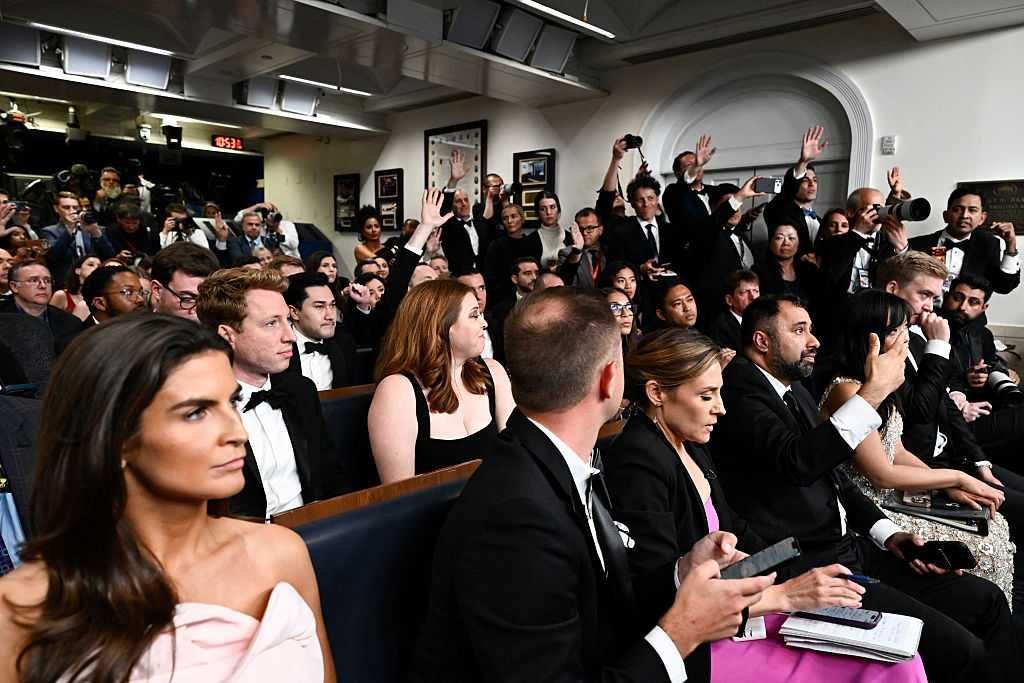
Kent NISHIMURA/AFP/Getty Images

We have also lost the discipline to define the words we use. People throw around “fascist” as if saying it settles the argument, when all it does is raise another question: "What do you mean?"

Not the label, but the definition. If the word means something, it should withstand that question. If it can’t, then it is being used as a weapon or a prop, not a description. Ultimately, the question becomes the teaching moment.

God set that standard in the third chapter of Genesis: “Where are you?” “Who told you that you were naked?”

He didn’t ask because they needed information, but because they needed to see. That’s what a real question does. It brings clarity. It forces things into the open that people would rather leave covered.

Clarity doesn’t come from longer answers. It comes from better questions. And when the question is right, it leaves no room to hide behind time or language.

People escape accountability because we lack the will — or the courage — to let the question stand in the spotlight. The clock runs out. The filibuster works. And the question either goes unanswered or never gets asked at all.

And everyone retreats to their corner, waiting for the next performance.

6 Ways To Detox From Marxist Feminism For A Happier Life

Utility, productivity, and power have supplanted the virtues of what we used to equate with a good woman. How do we detox from this poison?

Evolutionary science and genetics breakthroughs show Adam and Eve are not incompatible with evolution: Report


Christian scientists say that evolutionary science may very well be "making space" for Adam and Eve, Fox News' Tyler O'Neil reported on Monday.

What are the details?

O'Neil reported that scientists, pointing to "genetics breakthroughs," insist that Adam and Eve may not necessarily contradict the theory of evolution.

Christians — many of whom have rejected the theory of evolution as it previously indicated that there was no room for God's first people, Adam and Eve — have long argued about what some see as an impasse between faith and science.

S. Joshua Swamidass, associate professor at St. Louis' Washington University School of Medicine, told Fox that the "societal conflict" of Christianity versus evolution has been "deep and stubborn."

"Now, in a surprise twist, evolutionary science is making space for Adam and Eve," Swamidass explained. "It turns out that the theological questions are about genealogical ancestry, not genetics. In this paradigm shift, we are finding a better way forward, a better story to tell."

In Swamidass' 2019 book, "The Genealogical Adam and Eve: The Surprising Science of Universal Ancestry," the professor argues that genetics and evolutionary theory can work hand in hand with the existence of Adam and Eve.

"Most readers of Genesis understood Adam and Eve to be (1) ancestors of us all, and (2) miraculously created without parents of their own," Swamidass told the outlet. "In contrast, evolution teaches that (3) we share common ancestors with apes, and (4) we arise from a large population, not a single couple. This conflict of fact only seemed solvable by revising foundational Christian theological beliefs, or by rejecting evolution."

"But now, clearing up some big scientific understandings, we know that all four of these things can be true at the same time," he continued. "Even if Adam and Eve lived as recently as just 6,000 years ago, they would be the genealogical ancestors of everyone across the globe by AD 1. They could even have been created de novo, from the dust and a rib. Of course, at the same time, we would also descend from people outside the Garden, others whom God created by a providentially governed process of evolution."

A person inherits 50 percent of DNA from a mother and 50 percent from a father.

"As you go farther back, you have more genealogical ancestors who each contribute less and less to your DNA," O'Neil explained. "While universal genetic ancestors are rare, universal genealogical ancestors are surprisingly common. ... Each individual has four grandparents, eight great-grandparents, and so on, but population size in past generations tends to get smaller, so overlap is inevitable. [Swamidass] argues that by 1 A.D., every person on Earth was descended from Adam and Eve."

In his GAE model — Genealogical Adam and Eve — Swamidass claimed that biological humans, despite the span of time of between the time at which Adam and Eve existed and modern day, may still share a common ancestor with apes as per the theory of evolution, but that God could have "created Adam and Eve from the dust and a rib, without parents, and these two became the ancestors of all humans by 1 A.D."

"Swamidass claims that Genesis appears to require biological humans outside of Adam and Eve's family line because after Cain murders Abel and leaves his parents, he fears that he will be killed, he acquires a wife, and he builds a city," O'Neil added.

What else is there to know about this?

Christian philosophy professor Michael Murray, who previously taught at Franklin & Marshall College, recently commented on Swamidass' researches and said that he believes "we have arrived at the point where we can confidently affirm that the basic evolutionary story is not the threat to Christian orthodoxy that we once feared, and not because we had to compromise on orthodoxy."

"My view is that recent findings in genetics and paleontology have shown that our best scientific theories and data do not rule out a historical Adam and Eve," Murray told Fox in a statement, adding that new developments show that "for all we know, there might have been a pair that is the ancestor of all extant humans or extant Homo sapiens."

He added that there previously appeared to be an "emerging consensus among both secular scientists and scientists of faith that the relevant empirical data was flatly inconsistent with an ancestral pair."

However, recent developments show that an "ancestral pair is not flatly ruled out as was previously thought."

Biology professor Nathan Lents, who teaches at John Jay College, told the outlet that such developments have made Adam and Eve "more plausible."

"I would not say that there is any evidence, historical or scientific, in favor of the existence of Adam and Eve, as they are presented in the Bible," Lents told Fox. "However, there have been developments in our understanding of ancestry and genetics that allow for the possibility of universal ancestors of the entire human population in the surprisingly recent past."

Swamidass told the outlet that "in making space for Adam and Eve, secular scientists have an opportunity to offer an olive branch to religious communities."

"I'm encouraged to see that many religious leaders ... have been eager to take the olive branch," he wrote. "For those seeking to advance science in a fractured society, this is very good news indeed."