‘It poisons the soul’: Jason Whitlock blames 6-year-old shooting teacher on rap culture


A 6-year-old boy shot his teacher, and newly released bodycam footage captures him cursing at authorities — as if he were proud of what he’d done.

BlazeTV host Jason Whitlock doesn’t just blame the parents but also the pedestal that rappers are placed on in American culture.

“The bodycam footage is disturbing, of the police coming to the scene where a 6-year-old boy has shot his teacher. Just saying that is incredible and chilling,” Whitlock says.

“But when you hear the bodycam footage and the way the young boy, while sitting in his teacher or this teacher’s aide lap, the way that he’s talking, and it’s like holy cow. What is going on here,” he adds.


“I don’t care if you call back up, I don’t care if I go to jail, b***h,” the boy is captured saying.

“I stole that from my mom,” he said of the gun. “If you want a piece of me, come get it,” he added.

The boy continued yelling slurs at everyone around him.

“This is a 6-year-old child that just shot his teacher. He sounds like a rapper. He sounds like a criminal, a thug. He sounds like what we have allowed to be created. He sounds like Snoop Dogg,” Whitlock says.

He explains that figures like Snoop Dogg have become the “mascot for America.”

“That’s what Snoop Dogg is,” he says. “You turn on your television and nine times out of 10 you’re going to see Snoop Dogg in some type of commercial, some type of TV show. We’ve turned Snoop Dogg into Santa Claus. We’ve turned Snoop Dogg into one of the most recognizable and allegedly lovable characters in American culture.”

“And you wonder why a 6-year-old boy in Virginia, or anywhere in America, would take a gun to school, shoot a teacher, and then curse and talk to authority in such a disrespectful manner,” he continues.

“The music that we’ve bathed ourselves in, it warps the soul. It poisons the soul. It reframes the mind. It makes a reprobate mind,” he adds.

But it’s not just rap music’s fault.

Whitlock explains that we’re all responsible as “the parents of American culture.”

“We have allowed this culture to become demonic and nihilistic,” he says. “And our heroes, the people that we are comfortable celebrating, they’re nihilistic and demonic, and they don’t hide it. They put out rap albums promoting their demonic and nihilistic worldview, their disrespect, their distrust, their rebellion against any and all authority.”

“And you wonder why a 6-year-old child would bring a gun to an elementary school?” he adds.

Want more from Jason Whitlock?

To enjoy more fearless conversations at the crossroads of culture, faith, sports, and comedy with Jason Whitlock, subscribe to BlazeTV — the largest multi-platform network of voices who love America, defend the Constitution, and live the American dream.

Dear America: Please give cricket a chance


If I told you the guy at the crease picked the leggy’s googly and it sailed past silly mid-on for four, you’d probably — rightly — think I’d had a seizure.

For those of you wondering, I am talking about cricket, arguably Western civilization’s greatest achievement since free speech, Michelangelo’s David, and whatever they have done to Madonna's face.

The US national team also draws heavily on South Asian immigrants and famously beat Pakistan in the 2024 T20 World Cup.

I was inspired to write this after reading Andrew Chapados’ piece in Fearless lamenting Canadians’ loss of ice hockey as the CBC starts experimenting with broadcasting cricket.

Don’t get me wrong. I love ice hockey. When I stayed in Nova Scotia, it didn’t take long to understand why these super-friendly people love the game. The speed, intensity, and aggression. I was hooked. The way the refs mostly let ’em fight it out, the mullets ... more fights. Some of my most memorable nights were spent watching a game on a big TV with a bunch of fishermen and giant cans of Colt 45.

Sticky wicket

But I am going to try to use this article to defend cricket, though I don’t hold much hope.

For starters, explaining the rules is like asking a crab to describe the chemical composition of water. The traditional version of the game, Test cricket, doesn’t help my case. While baseball lasts a few hours, Test cricket can occupy six hours a day for up to five days — and still end in a draw. It’s also possibly the only sport on Earth where the batsman is applauded for leaving the ball alone.

That said, this is a game that requires skill and nerves. The fastest bowlers send the ball down at close to 100 mph, and a short delivery can come screaming toward your ribs, head, or worse.

But my word, it can be boring.

If golf is a good walk spoiled, Test cricket can best be described as a decent sleep disrupted by a light round of applause — followed by a collective groan when the ball hits someone’s nuts.

Good luck selling that to Americans.

America's pastime

I love the game for its history and heritage. The English were knocking the cherry around a field decades before the Pilgrims set foot in the New World. Test cricket is a glorious aristocratic vestige of the British Empire. Naturally, its imperial pedigree has also made it a target for the usual colonialism critiques. All the more reason to embrace the game.

At its most traditional, this sport is steeped in British pomp and pageantry. Cricket players dress in pristine whites, stop for tea, and politely applaud opponents who reach a century. At Lord’s, members watch from a pavilion that looks like the setting for a royal garden party.

A Test match can feel like a temporary reversion to Victorian Britain.

Before anyone accuses cricket of being un-American, best check the history books.

Long before Fenway Park was even a pile of bricks or Cooperstown immortalized its sluggers, America had a thriving cricket culture. New Yorkers were playing matches on Central Park’s North Meadow in the 19th century. Benjamin Franklin reportedly brought home a copy of the 1744 laws of cricket from England — it takes 250 years just to learn the LBW rule — and there is anecdotal evidence that George Washington’s troops played a related game called “wicket” at Valley Forge.

Abraham Lincoln is said to have watched cricket, and early baseball great Jim Creighton played both sports. Decades later, even Babe Ruth himself met Australian cricket legend Don Bradman to see what all the fuss was about.

Twenty20 vision

Which brings me to my modest proposal.

For 50 years America has led the way in exporting its culture around the world. It’s time for recolonization. You’ve given us Steven Seagal; it’s only right we give you cricket.

Sure, the British Empire is not what it was — it currently consists of an elderly mailman on Tristan da Cunha and a heavily discounted Prince Andrew T-shirt kiosk in the Falklands — but a fair trade is a fair trade.

Okay, “Under Siege” was good, but hundreds of straight-to-video slap-fests where Seagal’s biggest enemy is the stairway is enough. Seriously, he uses a body double to go upstairs. I have watched this man “fight” sitting in a swivel chair.

Anyway, back to cricket.

The version you are likely to watch — who am I kidding, you won’t watch it — is T20. Otherwise known as Twenty20, it is a much shorter, flashier variant. “Twenty” refers to the number of overs each side gets; an over is six legal deliveries, or pitches.

Purists on this side of the Atlantic call it baseball in pajamas.

The goal is to score as fast as possible. Hitting a “six” is the rough equivalent of a home run. When a new batsman comes to the crease — home plate, basically — he is sometimes introduced as if he were walking into the Octagon. There are fireworks, cheerleaders, and short bursts of Pitbull or some other awful hype music between the action. The fans are rowdy, and the beer flows like a waterfall.

Like American football, it also stops every eight seconds to ask an attractive woman — sorry, a sideline reporter — standing six inches from a player’s face what’s happening.

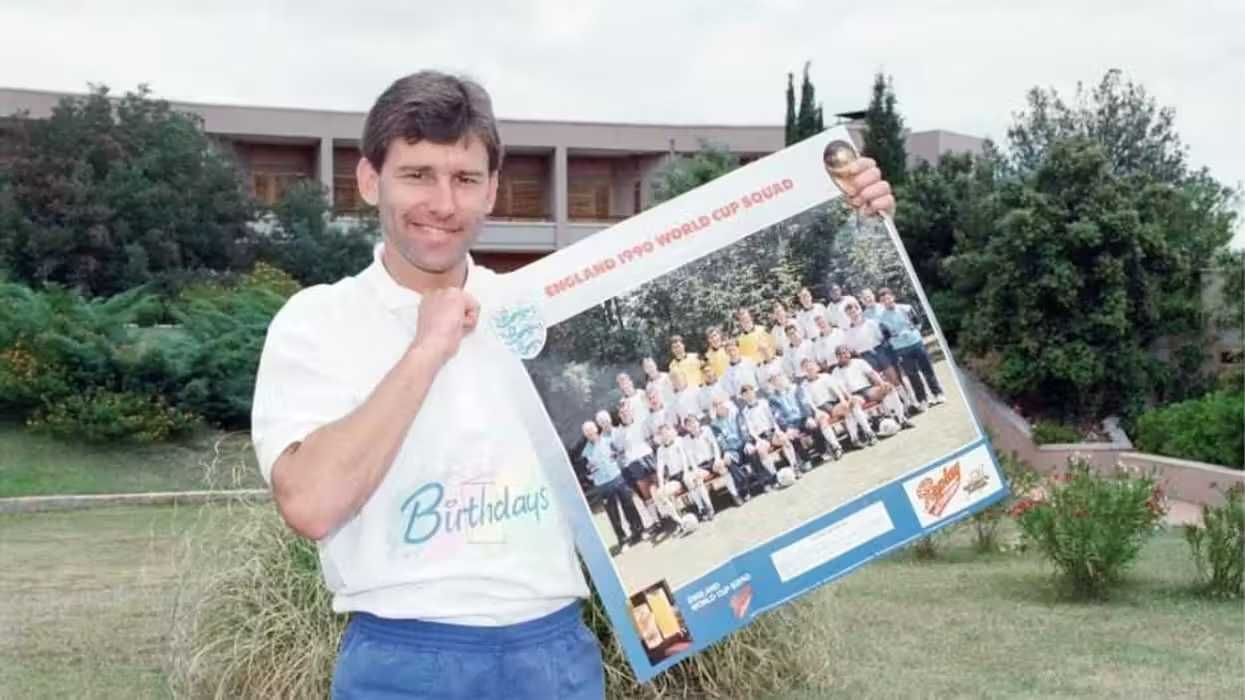
RELATED: My 1990 World Cup sticker book — and a glimpse of football's simpler past

Staff/Mirrorpix/Getty Images

The empire strikes back

Believe it or not, this gaudy spectacle is taking root in the U.S.

Driven in large part by a huge South Asian diaspora, America now has its own professional T20 competition, Major League Cricket, featuring six franchises and plenty of international stars. Several of the teams have direct ties to Indian Premier League clubs, including MI New York, the Los Angeles Knight Riders, and the Texas Super Kings.

MLC features lots of international stars alongside a talented contingent of Indian- and Pakistani-born players. The U.S. national team also draws heavily on South Asian immigrants and famously beat Pakistan in the 2024 T20 World Cup. Several of its players came to America to work in tech. These guys are really good, cricket is in their blood, and honestly, even their H-1B team would give Australia a run for its money.

To give you a taste of the madness, during the 2024 T20 World Cup, a temporary 34,000-seat stadium was erected in Nassau County to host, among other matches, India versus Pakistan.

This rivalry makes Packers-Bears look like a Disney movie. Geopolitics is played out with a bat and ball before one of the biggest audiences in world sport.

America’s acquiescence truly arrives in 2028, when cricket returns to the Olympics for the first time since 1900 — in Los Angeles, of all places.

So America, open your arms. You’ve conquered baseball, basketball, and football — but not soccer; your women’s team is hilarious. Now let a bunch of foreign blokes in neon pyjamas take over for a few weeks.

Forget the British Empire striking back. This is the subcontinent striking back.

To borrow a well-known phrase: Howzat!

European Soccer Fans Are Falling In Love With American Culture And It’s The Best Thing On The Internet

With America's 250th anniversary on the horizon, these Europeans remind us how lucky we are to be here.


When Archie Comics found Jesus: Strange artifacts from a once-Christian culture


Winn the barber ran a tidy, one-chair shop in an office park off Route 222. That meant a wait — especially since my mother usually brought my two younger brothers as well — but I didn't mind.

Like Winn, who always wore a starched white coat and slicked his hair back with Brylcreem, I was a creature of habit, and I had a ritual for these bimonthly visits. I'd plop down into one of the vinyl-covered seats and catch up on the adventures of Archie Andrews and the rest of the Riverdale High gang.

In the 1970s, evangelical Christianity may not have been culturally dominant, but it was culturally permissible.

Normally, I stuck to more serious fare — "Batman," "Daredevil," maybe the odd "Sgt. Rock" if the spinner rack was looking particularly picked over. But Winn exclusively stocked his waiting room with Archie Comics.

Revival in Riverdale

Sophisticated cineastes will cry at "The Notebook" if they watch it on an airplane — something about the altitude. And something about Winn's place — the fake wood paneling on the walls, the smell of Barbicide mingling with the eerie "easy listening" music wafting from a hidden speaker somewhere — lowered my critical defenses. I couldn't get enough of these soothingly repetitive teenage misadventures.

Then, one afternoon I picked up an issue that seemed off. Entitled "Archie's One Way," the cover featured Archie and friends in his "jalopy" — comically overheating and leaking fluid everywhere — getting yelled at by a cop for ignoring the obvious street sign. "Do you know this is ONE WAY?"

So far, so good. Typical Archie setup. But instead of a wisecrack from Reggie or Jughead, we get Betty piping up from the back seat, arms raised in joyful celebration: "This is cool! The officer is WITNESSING to Archie!"

Huh.

A new creation

I opened the cover and read with a kind of dawning horror, like the lone survivor in a body snatchers movie. The art, the lettering, the bright colors were exactly the same, but somehow, when I wasn't looking, the wholesome yet wholly secular teens I'd come to know and love had been swapped with evangelical Christian duplicates.

I had encountered one of the licensed line of Archie issues put out by Spire Christian Comics from 1973 to 1982.

The idea came from longtime Archie artist Al Hartley, who'd had a born-again experience in 1967 and thought Archie would make a great way to spread the gospel. Although he was Jewish, John Goldwater — who had created Archie along with partner Louis Silberkleit some 30 years earlier — agreed.

The regular Archie books continued unchanged. These proselytizing stories lived in their own lane, distributed through Christian bookstores and churches — although often making it out into the wider world, as I and other unsuspecting readers can confirm.

RELATED: The night of the gun was never-ending — until the day I surrendered to Christ

Old Man in Prayer by Workshop of Rembrandt van Rijn, circa 1629. Barney Burstein/Corbis/VCG/Getty Images
'Divorce Any Style'

The message wasn't subtle: In that same issue, the gang ends up in what appears to be Riverdale's never-before-seen version of Times Square, recoiling at marquees advertising movies like "Divorce Any Style" (rated X), "Crime Pays," and "Sex Sex."

In another, Betty helps an injured hippie classmate (a great kid, notes Archie, before she "got into the drug scene") accept Christ into her heart after a bad car accident.

The idea of Archie Comics as Jack Chick tract seems strange now. But is it any stranger than the recent TV series "Riverdale," the requisite "bold" and "subversive" take that turned its Anytown, U.S.A., into a hotbed of conspiracies, crime, and gothic melodrama?

What's really strange to contemplate from today's vantage point is that Archie's conversion didn't inspire any kind of national uproar. Granted, before the internet, it was much harder for outrage to spread; most people not in Spire's audience probably didn't know these comics existed.

But I think it was also something else.

Negative world

Writer Aaron Renn has described American culture as moving from a “Positive World,” in which Christianity carried social legitimacy, to a “Neutral World,” and now to a “Negative World,” where public Christian identity can carry reputational cost. However one draws the lines, the Archie–Spire experiment clearly belongs to an earlier era.

In the 1970s, evangelical Christianity may not have been culturally dominant, but it was culturally permissible. Just as even liberal Democrat Jimmy Carter could speak of committing adultery "in his heart" (in Playboy magazine, of all places) and still get elected, a mainstream publisher could allow its most recognizable teenager to kneel in prayer and trust that the sky would not fall.

The moment was not confined to Riverdale — or Protestantism. In the '80s, Marvel produced comic book biographies of Pope John Paul II and Mother Teresa.

As late as the early '90s, Marvel launched a joint venture with Christian publisher Thomas Nelson to publish the adventures of the Illuminator — a superhero with explicitly God-given powers — as well as adaptations of "The Pilgrim's Progress" and C.S. Lewis' classic "The Screwtape Letters." The imprint was shut down after only two years.

'Nuff said?

In 2000, Marvel founder Stan Lee approached Episcopal priest Peter Wallace about creating comics based on a "biblical worldview" for his new online venture Stan Lee Media. In a 2023 article, Wallace recalled his pitch:

This approach would promote belief in God, the example of Christ’s life, the reality of supernatural conflict, strong moral values, and an altruistic lifestyle. Our stories would be fully compatible with the Bible and religious tradition, but without painting ourselves into a corner theologically. The goal of this approach — a goal that’s urgently needed today — is to open young minds to the reality of God, to build a strong case for faith and morality by example, without being preachy or dogmatic. It can help launch youth of all ages on a quest for truth and a personal relationship with God.

When SLM went bust along with many other first-wave internet start-ups, the idea was forgotten.

Also in 2023, Archie Comics introduced its first transgender character, more than a decade after Riverdale's first gay student made the scene. The "queering" of Archie was probably inevitable; comic books, like movies and TV, have embraced 21st-century America's religious zeal for "LGBTQ representation," among other modish concerns loosely falling under the category "woke."

But in his 85-year history, Archie Andrews has seen a lot of trends come and go — from the jitterbug and acid rock, to MTV and even crypto. As the "peak woke" of the Trump/Biden/Trump era recedes, we're apparently seeing a bit of a religious revival among the young. Who's to say our favorite red-headed, perpetual 16-year-old won't get caught up in the spirit too?

White culture exists — and America is losing it


Jeremy Carl, Trump-appointee and author of “The Unprotected Class,” faced a grilling at the United States Senate when Sen. Chris Murphy (D-Conn.) tore into his beliefs on “white identity.”

“You’re now retreating to ethnic identity. You don’t speak about ethnic identity. You speak about white identity. So tell me the values that stitch together white identity and that make it different than black identity,” Murphy asked.

“I would say that the white church is very different than the black church in terms of its tone and style on average. Foodways could often be different. Music could be different, if you look at the Super Bowl halftime show, which was not in English this year,” Carl explained.

Murphy responded, “So our ability to access white churches or white food or white music is being erased?”


“I am concerned with the majority common American culture that we had for some time, that through particularly mass immigration, I think has become much more balkanized, and I think that weakens us,” Carl said.

BlazeTV host Jonathan “Lomez” Keeperman is of the mind that Carl is right.

“On second viewing, I mean, I watched this live, and by the way, in the context of this hour-long Senate hearing, he was just getting grilled from all directions ... he was being accused of anti-feminism, he was being accused by [Sen.] John Curtis of Utah [R] for not being, like, sufficiently loyal to Israel. And then there was this white thing,” Lomez tells BlazeTV co-host Christopher Rufo on “Rufo & Lomez.”

“And I think what we saw there was him a little bit stumbling through the answer, but it’s actually the right answer. I mean, he gives the right answer, the specific details,” Lomez continues.

Lomez points out that there are different parts of American culture, and different races have their own piece.

“I’m not saying this, by the way, just to please a liberal listener. It’s all true, OK? This is all deeply embedded in our culture and the common culture as well, but it is predominantly what we might call 'white,'” he explains.

“When you turn on Netflix or something, or like Hulu, or just turn on the TV, there’s BET. There’s Black Entertainment Channel, and there’s black stories to enjoy with your family on Hulu, and then there’s Asian stories, and you know, you get the whole diaspora of all these different groups,” he continues.

“There’s no white channel, there’s no white story section ... because ... that is the baseline culture that these other things are kind of orbiting around and existing within. And what Jeremy is suggesting here is that we are losing that common culture. We are losing that common white culture,” he adds.

Want more from Rufo & Lomez?

To enjoy more of the news through the anthropological lens of Christopher Rufo and Lomez, subscribe to BlazeTV — the largest multi-platform network of voices who love America, defend the Constitution, and live the American dream.

Vivek Ramaswamy Is Wrong About American Identity And Wrong About America

A disembodied notion of American identity means that America is really nothing at all, and no one is really an American.
Spanish-Speaking Abrego Garcia Doesn’t Actually Want To Be An American

We've built a system over the past few decades in which it is entirely possible to live and work without ever having to fully assimilate.

America’s cultural comeback: American Eagle swaps woke ads for Sydney Sweeney and Shelby GT350


Under President Donald Trump, America is undergoing an incredible transformation through his MAGA agenda that puts the country and the American people first.

But policy isn’t the only thing that’s changing. The culture is following suit. Take American Eagle Outfitters’ recent blue jeans commercial as an example. The 2025 denim advertisement features American actress Sydney Sweeney — who’s gained significant attention for her curvaceous, Marilyn Monroe-esque figure — driving a 1965 Shelby Mustang GT350.

It’s a commercial that draws on celebrity appeal and classic, nostalgic American imagery. And more importantly, it’s a return to commonsense, agenda-free marketing.

Glenn Beck and co-host Stu Burguiere compare American Eagle’s new ad to the one they pushed in 2019, which crammed a woke agenda down consumers’ throats.

The 2019 advertisement features an overweight African-American woman with purple hair whom Glenn describes as a “Lizzo-style woman.”

The Sweeney ad, in contrast, “is directly aimed at American men,” Glenn says, specifically “the kind of men that everyone has said for the last 10 years should be ashamed of themselves.”

While Stu agrees that Sweeney is certainly appealing to the typical male, the commercial, he believes, is excellent marketing because it is aimed not at men but at “the typical American woman” — the person “who’s buying the jeans.”

The ad, he says, asks women, “Don’t you want to look good for men?”

“What [American Eagle is] acknowledging there is, ‘Hey, men and women are attracted to each other,’ he says. “When you present an image of a woman who’s attractive to men, women might want to buy the products that make them also look attractive to men, and that’s okay.”

But for years, the primary goal of marketing — to sell goods and services — was supplanted by DEI, body positivity, and other progressive agendas, often at the expense of profit.

The fact that American Eagle is returning to agenda-free marketing is evidence that the cultural tides are turning.

“This ad would not have happened a few years ago,” even “just two years ago,” Glenn says.

The problem, he explains, was never that companies included diverse body types in their marketing campaigns. In fact, that’s necessary to appeal to a broad audience. The problem was that for several years, nearly all advertising was “glorifying [being] fat” — a move straight out of the progressive playbook.

What it did, Stu explains, is normalize and encourage people toward mediocrity, but that’s not what America is about. America is about excellence and “aspiring towards something.”

To hear more of Glenn and Stu’s commentary, watch the episode above.

Want more from Glenn Beck?

To enjoy more of Glenn’s masterful storytelling, thought-provoking analysis, and uncanny ability to make sense of the chaos, subscribe to BlazeTV — the largest multi-platform network of voices who love America, defend the Constitution, and live the American dream.

This Independence Day, Ditch The DNA Test And Learn More About Your American Ancestors

In a frustratingly divided nation, we need stories that unite us to a shared American vision of the good life based on our nation’s founding principles.