How loony leftists like Joy Reid and Neil deGrasse Tyson wokewash their past sins


Is Joy Reid okay?

From the look of things, obviously not. The MSNBC host has built a career on outrage and hyperbole, but her recent antics suggest something far more unhinged. In a bold attempt to deflect criticism over her apparent adoption of President Trump’s signature look, Reid chose to shave her head.

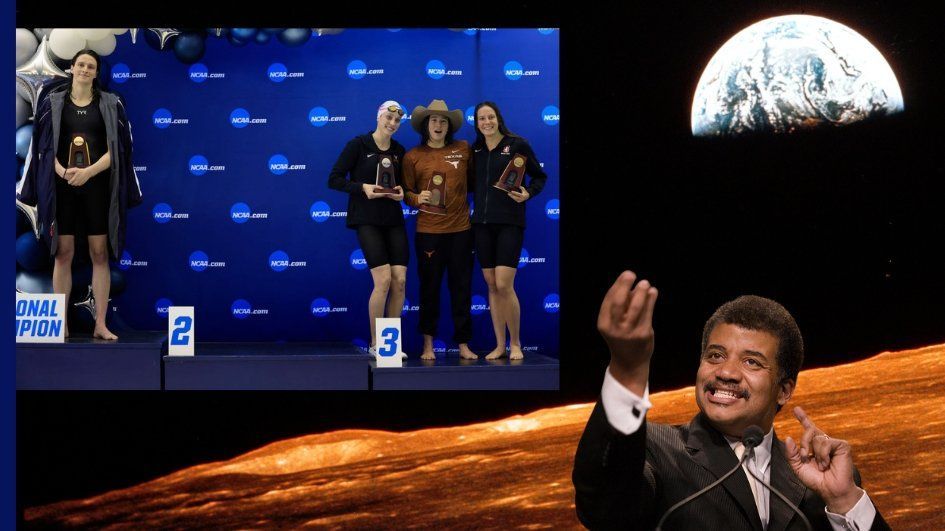
Neil deGrasse Tyson wrestled in college; he is intimately familiar with the profound physical differences between the two sexes.

She thought this move would silence her critics. Spoiler alert: It didn’t.

Instead, it sparked laughter, not at her critics but squarely at her. A middle-aged woman shaving her head in a fit of defiance doesn’t scream empowerment. It screams instability.

Turkey terror

More recently, Reid released a pre-Thanksgiving video warning that some Americans might not feel "safe" around their MAGA relatives. To bolster her point, she hosted an equally unhinged Yale psychiatrist who suggested that LGBTQ+ individuals should avoid conservative family members entirely. This is not reasonable advice. But reason and Reid are estranged bedfellows. They parted ways many moons ago.

The 55-year-old is a case study in what happens when someone builds her platform not on ideas but on the fragile foundation of identity politics and moral posturing. Reid's critics don’t need to discredit her; she does that all on her own. In trying to be everything to everyone on the left, she’s become a caricature of modern media: loud, hollow, and entirely insufferable.

Skeletons in her closet

Reid frequently lectures viewers on inclusion, tolerance, and justice, casting herself as a champion of the left’s ideals. But, I ask, are her views genuine or merely a theatrical performance?

Reid’s relentless grandstanding feels more like an elaborate deflection from her own controversial past — a past that is completely at odds with the persona she now projects.

In 2018, when homophobic blog posts from her early career resurfaced, she initially apologized, admitting to some of the commentary. But when more posts emerged, Reid’s story shifted dramatically.

Suddenly, she claimed her blog had been hacked years earlier, a defense that crumbled under scrutiny. The notion that a hacker planted posts in real time, matching her public commentary, defied logic. Even her cybersecurity consultant admitted that the evidence failed to support her claims. In other words, Reid was clearly lying.

Despite this troubling history, the pundit turned activist has positioned herself as a self-appointed arbiter of morality, eager to denounce others while her own record remains anything but spotless. Of course, it’s possible that she’s undergone a complete transformation and truly become the progressive warrior she now claims to be. But the sheer insanity of her rhetoric suggests something else: specifically, overcompensation.

Reid’s crusade against conservatives feels less like conviction and more like a desperate bid to rewrite her narrative, to drown out the sins of her past with louder, more righteous indignation.

Beam him up

Reid is not alone in her reinvention. Consider Neil deGrasse Tyson.

Once a respected figure in science and pop culture, Tyson has devolved into a farcical self-parody. He’s not just woke. He’s hyperwoke.

The astrophysicist’s shift from measured reason to full-throated wokeness didn’t happen by accident.

In 2019, four women accused him of sexual misconduct, a controversy that could have ended his career (four seems like a lot). Instead of addressing the allegations head-on, Tyson pivoted. Overnight, a man who once prided himself on logic became one of the loudest proponents of the woke agenda, particularly when it came to the most contentious of topics.

Yes, that’s right: trans athletes in women’s sports.

Tyson, supposedly a man of science, has publicly argued that it’s perfectly acceptable for biological men to compete against actual women.

One assumes he doesn’t actually believe this. Tyson wrestled in college; he is intimately familiar with the profound physical differences between the two sexes. The peddler of bad ideas and even worse ties may be many things, but stupid isn’t one of them — though you could be forgiven for thinking otherwise.

His recent appearance on "Real Time with Bill Maher" was a master class in self-sabotage. When Maher, who oscillates wildly between bouts of wokeness and moments of clarity, confronted him on the undeniable physical advantages men have over women in sports, Tyson played dumb. Rather than being honest, he leaned on smug quips and feeble attempts at humor.

The performance flopped, laying bare not just the weakness of his argument but the pathetic pandering driving it.

Spineless signaling

Reid and Tyson are two sides of the same coin, figures who have sacrificed authenticity to appease an audience hungry for performative contrition.

They are not champions of progress; they are cowards and phonies. Too afraid to stand by their own convictions, they embody the spinelessness that comes with prioritizing approval over integrity. They exemplify self-preservation, willing to say or do whatever it takes to sustain their increasingly meaningless careers.

When they look in the mirror, one wonders whether they smile or whether tears of shame silently stream down their cheeks. Only they can answer this.

What is indisputable, however, is the fact that both Reid and Tyson have traded integrity for applause, hoping that louder declarations of virtue will obscure their past controversies. It won’t. It can’t. We all see them for what they truly are.
Scientists make groundbreaking discovery of low-frequency gravitational waves that create ripples in the fabric of space-time, proving Einstein correct 100 years later


Scientists made a groundbreaking discovery of low-frequency gravitational waves that are likely from supermassive black holes that create ripples in the fabric of space-time.

In 1915, Albert Einstein published his General Theory of Relativity, in which he determined that the intense gravity of extremely massive objects warps the fabric of space-time. If these gargantuan objects collide with each other, then gravitational waves would be sent into the universe.

Gravitational waves were first discovered in 2015 by the Laser Interferometer Gravitational-Wave Observatory.

The LIGO defines gravitational waves as "ripples in space-time caused by some of the most violent and energetic processes in the universe.

"The strongest gravitational waves are produced by cataclysmic events such as colliding black holes, supernovae (massive stars exploding at the end of their lifetimes), and colliding neutron stars," the LIGO explains. "Other gravitational waves are predicted to be caused by the rotation of neutron stars that are not perfect spheres, and possibly even the remnants of gravitational radiation created by the Big Bang."

On Wednesday, scientists announced that they had finally discovered these elusive low-frequency gravitational waves – which likely confirms Einstein's theory made over 100 years ago. The discovery was made after 15 years of data collection.

Scientists from the North American Nanohertz Observatory for Gravitational Waves announced in a news release:

The groundbreaking discovery was made by scientists with the North American Nanohertz Observatory for Gravitational Waves (NANOGrav) who closely observed stars called pulsars that act as celestial metronomes. The newly detected gravitational waves — ripples in the fabric of space-time — are by far the most powerful ever measured: They carry roughly a million times as much energy as the one-off bursts of gravitational waves from black hole and neutron star mergers detected by experiments such as LIGO and Virgo.

"These are by far the most powerful gravitational waves known to exist," said Maura McLaughlin – the codirector of the NANOgrav Physics Frontiers Center. "Detecting such gargantuan gravitational waves requires a similarly massive detector, and patience."

NEW Discovery of Gravitational Waves | NSF's Discovery Files www.youtube.com

"It's like a choir, with all these supermassive black hole pairs chiming in at different frequencies,” said NANOGrav scientist Chiara Mingarelli. "This is the first-ever evidence for the gravitational wave background. We’ve opened a new window of observation on the universe."

Scientists describe the low-gravitational waves as making a low-pitched "hum."

"Now that we have evidence for gravitational waves, the next step is to use our observations to study the sources producing this hum," said Sarah Vigeland of the University of Wisconsin-Milwaukee, chair of the NANOGrav detection working group.

Scientists believe the source of the low-gravitational waves is supermassive black holes crashing into each other in a death spiral.

"Those black holes are truly colossal, containing billions of suns’ worth of mass," NANOGrav explained. "Nearly all galaxies, including our own Milky Way, have at least one of the behemoths at their core. When two galaxies merge, their supermassive black holes can meet up and begin orbiting one another. Over time, their orbits tighten as gas and stars pass between the black holes and steal energy."

Luke Zoltan Kelley, a theoretical astrophysicist at Northwestern University and NANOGrav, said it is possible that the low-gravitational waves could also be created by cosmic strings, dark matter, and primordial black holes that formed soon after the Big Bang.

Gravitational waves create a 'cosmic symphony' that scientists are tuning into www.youtube.com

The scientists were able to find the low-gravitational waves by data collected from 67 pulsars, basically turning these pulsars into a galaxy-wide telescope.

"They closely observed pulsars, the ultra-dense remnants of massive stars that went supernova," NANOGrav said. "Pulsars act like stellar lighthouses, shooting beams of radio waves from their magnetic poles. As the pulsars rapidly spin (sometimes hundreds of times a second), those beams sweep across the sky, appearing from our vantage point on Earth as rhythmic pulses of radio waves."

"The pulses arrive on Earth like a perfectly timed metronome," the statement read. "The timing is so precise that when Jocelyn Bell measured the first pulsar radio waves in 1967, astronomers thought they might be signals from an alien civilization."

Over the 15 years of analysis, the collision of massive cosmic bodies may have disrupted the arrival of the signals from the pulsars.

"And if that pulse is a little bit late or a little bit early, then we may be able to attribute that to a gravitational wave passing through," said Jeff Hazboun, an astrophysicist at Oregon State University and a member of the NANOGrav team.

"As a gravitational wave passes between us and a pulsar, it throws off the radio wave timing," according to Phys.org. "That’s because, as Albert Einstein predicted, gravitational waves stretch and compress space as they ripple through the cosmos, changing how far the radio waves have to travel."

NPR said, "What they found is a pattern of deviations from the expected pulsar beam arrival timings that suggests gravitational waves are jiggling space-time as though it's a vast serving of Jell-O."

Popular Mechanics noted, "And here’s the key: light travels through space at a finite speed. The flashes from a pulsar at a certain distance from Earth will always hit Earth at the same intervals, because it will always take the light the same amount of time to travel from there to here. But if there’s suddenly, say, more space between the pulsar and Earth, it will take the light longer to travel from there to here, and the clock-like timing will be thrown off."

Mingarelli declared, "What’s next is everything. This is just the beginning."

Like Blaze News? Bypass the censors, sign up for our newsletters, and get stories like this direct to your inbox. Sign up here!

Major Discovery of Loud Gravitational Vibrations Across The Entire Universe www.youtube.com