ICE gets watched. Who’s watching the immigration lawyers?



As a deportation officer, I managed cases from beginning to end. I took the file when it opened and stayed with it through custody determinations, immigration court, appeals, travel-document requests, and, when it came to that, the flight home.

We worked those cases on the merits and nothing else. Not race. Not nationality. Not religion. Not politics. What did the file say, and what did the law allow?

A rule that exists only on paper is not much of a safeguard.

Anyone who worked differently answered for it, because immigration enforcement is watched constantly: by the Department of Homeland Security Office of Inspector General, Immigration and Customs Enforcement's Office of Professional Responsibility, the Office for Civil Rights and Civil Liberties, detention inspections, congressional oversight, federal litigation, and a press corps often eager to publish before a case is even closed.

I never objected to that scrutiny. Enforcement power is serious power, and it should be examined hard. I have said so under oath.

What I do not understand is why the examination so often seems to stop at the government's side of the table.

On the other side sits a disciplinary regime that is hardly weak on paper. Federal regulation subjects immigration practitioners to discipline for grossly excessive fees, solicitation through runners for financial gain, frivolous filings, false statements, and other misconduct. A lawyer's signature on a filing certifies that he has read it, made a reasonable inquiry, and has a basis in fact and law for putting it before the court.

In other words, the rules already recognize the problem.

And the misconduct is not hypothetical.

In Illinois, immigration attorney Robert DeKelaita was convicted by a federal jury of conspiracy to commit asylum fraud, making false statements in asylum applications, and procuring perjury during asylum interviews. Federal prosecutors said applications filed through his firm contained fabricated accounts of rape, murder, torture, kidnapping, and bombing. Some clients obtained asylum, lawful permanent residence, and eventually citizenship on the strength of those lies.

In New York, a Queens immigration attorney received five years in federal prison after submitting more than 100 asylum applications containing false persecution narratives, criminal histories, and travel histories. Prosecutors said she invented stories, forged clients’ signatures, and falsely notarized affidavits.

RELATED: The conservative base will remember this betrayal
PATRICK T. FALLON/AFP/Getty Images

In Georgia, an attorney went to federal prison after filing false documents in employment-based immigration matters, surrendering her law license, and forfeiting $100,000 in fees.

Those are the spectacular cases. The quieter misconduct may be more common and, for individual families, just as destructive.

Illinois disciplinary records describe an attorney who allowed nonlawyer office managers to practice law out of his firm, failed to diligently represent immigration clients, withdrew from others without adequately protecting them, and failed to return tens of thousands of dollars in unearned fees.

That does not make national news. But to the client who handed over his savings, it can be devastating.

An enforcement officer has two reasons to care.

First, every fabricated claim consumes real resources: an adjudicator, a docket slot, government-attorney preparation time, and often years of delay. Fraud also poisons the well for the applicant behind it who is telling the truth. When adjudicators repeatedly encounter manufactured versions of the same persecution story, the genuine claimant has a harder road.

Second, I have watched families pay lawyers for cases that were dead on arrival, then get billed again at every continuance while the years ran out. Immigration law is complicated enough without desperate clients being sold false hope.

The point is not that immigration lawyers are uniquely corrupt. Most are not. Nor is it that government officers deserve less oversight. They do not.

The point is symmetry.

RELATED: DHS is naming names, and the media is melting down
Stephen Maturen/Getty Images

If ICE officers are properly subjected to inspectors general, professional-responsibility offices, civil-rights review, congressional oversight, litigation, and press scrutiny, then the lawyers whose conduct can determine whether a family loses its savings, whether a false asylum claim enters the system, or whether a genuine claimant waits even longer should face meaningful accountability too.

There is a straightforward way to begin measuring whether that accountability exists.

How many practitioner complaints does the Executive Office for Immigration Review receive each year? How many are substantiated? How many end in discipline, suspension, or disbarment from practice before the immigration courts? How long does the process take?

Those are not classified questions. They are basic oversight questions.

If the numbers show a functioning disciplinary system, publish them and let the public see it. If they show a large gap between complaints and consequences, Congress should ask why.

A rule that exists only on paper is not much of a safeguard.

Immigration enforcement deserves scrutiny because government power can ruin lives when abused. Immigration representation deserves scrutiny for the same reason.

Dear UK: If You Have To Ask Foreigners Not To Rape The Local Women, Don’t Import Them

'If you have sex with someone without their consent, this is called rape. Rape is a serious crime in the UK.'

The Fed’s Massive Paperwork Backlog Creates A Gigantic Mass Migration Loophole

For a certain kind of applicant, the backlog isn't a failure of the system. It's the entire strategy.

Trump Is Running Out Of Time To End Refugee Asylum Abuse For Good

The Trump administration can and must permanently improve asylum integrity, or risk our border looking like Spain again.


Glenn Beck: Feds should give ZERO DOLLARS to NYC after Mamdani's latest stunt


Last week, the Supreme Court voted for the federal government’s ability to remove protections for citizens of Haiti and Syria — and New York City Mayor Zohran Mamdani (D) isn’t having it.

“We saw today the Supreme Court make a decision that is putting so many people’s lives in jeopardy. And I just came back from a rally with 1199 as I stood alongside a number of Haitian New Yorkers who are concerned about what this means for their status in our city,” Mamdani began in a video statement.

“And frankly, this city, the one that we love, is one that has been built by so many from so many different parts of the world. And that includes our Haitian brothers and sisters, our Syrian brothers and sisters. And we stand here ready to be in solidarity with all of those who are concerned by today’s decision,” he said.

“Now, what that means when it comes to our city is if you are worried about what this means for your status, if you’re worried about what this means for your family, I would encourage you to call our Mayor’s Office of Immigrant Affairs hotline,” he added.


“Notice when the Supreme Court goes on their side, you absolutely must positively follow it. But if it doesn’t go their way, well, then they have all kinds of NGOs that come out of the woodwork to subvert,” Glenn comments.

“Is New York part of the United States or not? Because I’m fine with it. Cut it off ... not one federal dollar goes to New York City. I am fine with that,” he continues.

Glenn points out that behind Mamdani is a flag, but it’s not the American flag.

“I just saw a rainbow flag behind him ... so he’s got that flag,” Glenn says, explaining that the mayor is threatening “rebellion.”

And President Donald Trump appears to be taking notice.

“The Communists are finally making their move. I’ve been waiting and preparing for this for a long time,” Trump wrote in a post on Truth Social.

“I mean, that makes me happy,” Glenn adds.

Want more from Glenn Beck?

To enjoy more of Glenn’s masterful storytelling, thought-provoking analysis, and uncanny ability to make sense of the chaos, subscribe to BlazeTV — the largest multi-platform network of voices who love America, defend the Constitution, and live the American dream.

The Supreme Court puts border judges back in their lane


For years, America’s immigration policy has been determined less by the elected branches of government than by a handful of federal district judges. Presidents proposed policies, Congress enacted statutes, and almost inevitably, a single judge somewhere in the country would issue an order purporting to suspend those policies nationwide.

That era may finally be drawing to a close.

Federal judges possess neither the democratic legitimacy of Congress nor the political accountability of the president.

The Supreme Court’s two immigration decisions issued last week mark an important turning point — not simply because they uphold significant Trump administration immigration policies, but because they reaffirm a more fundamental constitutional principle: Immigration policy belongs primarily to the political branches, not the judiciary.

The court’s decisions addressed different questions: Mullin v. Doe concerned the executive’s authority over Temporary Protected Status, while Mullin v. Al Otro Lado involved the government’s ability to regulate when and how aliens arriving at the border may invoke asylum procedures.

Both opinions reject the increasingly common assumption that federal judges may freely substitute their policy preferences for those of Congress and the president in matters of immigration.

That conclusion should surprise no one familiar with the Constitution or with the current court’s commitment to adhere to its original meaning.

Article I gives Congress authority over naturalization and immigration. Article II charges the president with faithfully executing the immigration laws and conducting the nation’s foreign affairs. The judiciary’s role is different. Courts are supposed to resolve concrete legal disputes — not make immigration policy. For too long, however, that distinction has been blurred.

Beginning during the first Trump administration and accelerating in recent years, nationwide injunctions or nationwide class actions have become the preferred weapon of litigants seeking to defeat executive policies with which they disagree. A single district judge can effectively veto the actions of the elected branches for the entire nation, often within days of a complaint being filed and long before appellate review. Nothing in the Constitution contemplates such extraordinary judicial power.

Federal judges possess neither the democratic legitimacy of Congress nor the political accountability of the president. Their authority extends only to deciding the cases before them and granting relief necessary to protect the specific parties before the court. They were never intended to function as a continuing supervisory council over every major policy dispute in the country. Last week’s decisions reflect a welcome recognition of that important constitutional principle.

Immigration, perhaps more than any other area of law, requires political judgment. Decisions concerning border security, humanitarian protection, foreign relations, labor markets, and national sovereignty inevitably involve competing policy considerations that courts are poorly equipped — and constitutionally unauthorized — to balance.

RELATED: Trump should force Congress to pass the SAVE America Act — now

Aaron Schwartz/Bloomberg/Getty Images

Reasonable people may disagree about how policy judgments in the area of immigration should be resolved. Americans have long debated the proper scope of asylum protections, the wisdom of Temporary Protected Status, and the best means of securing the southern border.

But under our constitutional system, such decisions are supposed to occur in Congress, at the White House, and ultimately at the ballot box — not through nationwide decrees issued by unelected trial judges.

Critics will undoubtedly portray the Supreme Court’s two rulings as victories for one political party or another. That misses the larger point. The real winner is the constitutional separation of powers.

When courts respect the limits of judicial authority, they strengthen rather than weaken the rule of law. Judicial modesty is not judicial abdication. Courts remain fully empowered to decide actual cases, interpret statutes, and enforce constitutional guarantees. What they are not empowered to do is assume responsibility for making national immigration policy, a distinction that protects everyone.

The precedents the Supreme Court established will not apply only to Republican presidents or conservative policies. They will constrain future courts considering the actions of Democrat administrations as well. Constitutional principles endure precisely because they are not dependent upon agreement with the policy of the moment.

The framers deliberately divided governmental power among three separate branches because concentrated power is dangerous regardless of who exercises it. Judicial overreach is no less inconsistent with constitutional government than executive overreach or legislative overreach.

The Supreme Court’s decisions on immigration represent an encouraging course correction. They remind lower courts that judges are not policymakers. They reaffirm that immigration decisions belong principally to the elected branches. And they take another step toward restoring the proper constitutional balance among the three branches of government.

That is good news not only for immigration policy, but also for the Constitution itself.

Editor’s note: This article appeared originally at the American Mind.

From Parental Rights To Elections, Here Are 3 Major Cases SCOTUS Just Agreed To Hear

The U.S. Supreme Court is busily dishing out its final opinions before heading into America’s 250th birthday. But it’s also announcing which cases it’ll be hearing in its upcoming fall term. As part of its Monday order list, the high court revealed that it will be taking up and holding arguments in a series of […]

SCOTUS: No, Asylum Seekers Don’t ‘Arrive’ In America When They’re In Mexico

The U.S. Supreme Court sided with the Trump administration on Thursday in a dispute over an immigration policy critical to combating migrant surges at America’s southern border. The decision was 6-3, with Justices Sonia Sotomayor, Elena Kagan, and Ketanji Brown Jackson in the dissent. Known as Mullin v. Alt Otro Lado, the case centers around […]
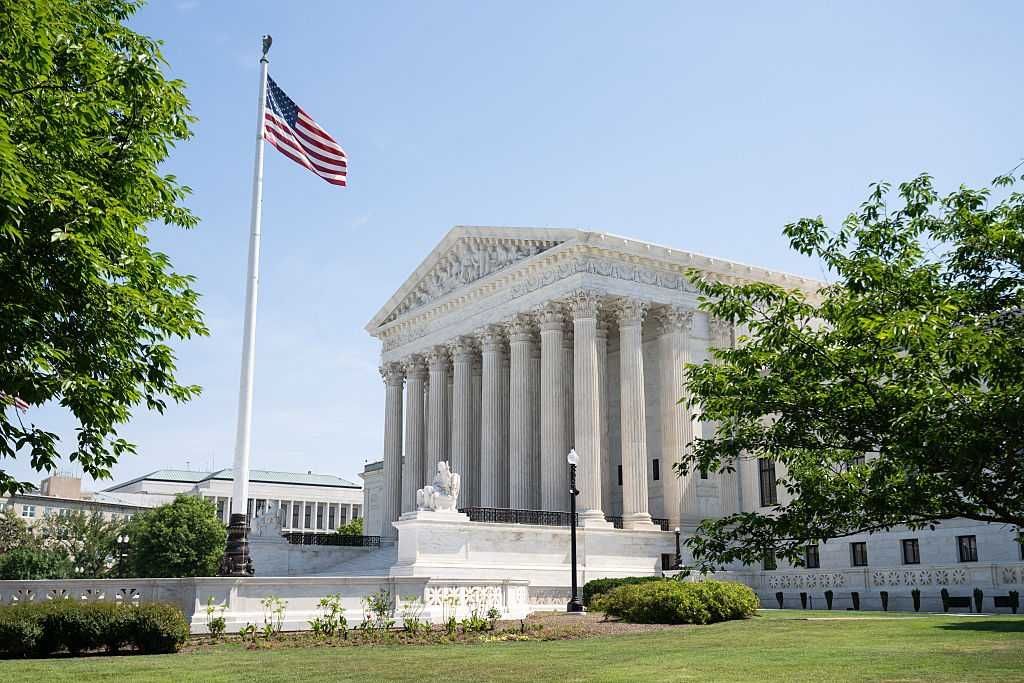
Supreme Court sides with Trump administration regarding asylum-seekers


The Supreme Court has ruled in favor of Homeland Security Secretary Markwayne Mullin and the Trump administration regarding when asylum-seekers officially "arrive" in the U.S.

In a 6-3 decision split along ideological lines, the Court held that aliens seeking asylum do not “arrive in the United States” until they physically cross the border into the country and therefore are not entitled to inspection by border officials until they have entered onto U.S. soil.

'An alien "arrives in the United States" only when he crosses the border.'

The case stems from the federal government’s “metering” policy — first adopted in 2016 amid a surge of migrants at the southern border — that limited the number of aliens whom Customs and Border Patrol agents would inspect each day for asylum. When a port of entry reached capacity, officials physically prevented additional aliens from entering until capacity became available again.

In 2017, asylum-seekers and Al Otro Lado, an immigration advocacy organization, brought forward a class-action lawsuit arguing that the federal government was unlawfully denying aliens access to asylum procedures.

The federal district court in Southern California granted summary judgment in favor of the noncitizens and declared the government’s policy unlawful.

The metering policy was then discontinued in November 2021, though the second Trump administration has attempted to revive it.

A divided Ninth Circuit panel affirmed the summary judgment, ruling that an alien “arrives in the United States” when said alien — even while standing on the Mexico side of the border — encounters a U.S. official and thus must be inspected for asylum claims.

Writing for the majority, Justice Samuel Alito reversed the lower court’s ruling. The court held that the meaning of “arrives in the United States” requires physically entering the country. Therefore, under the Immigration and Nationality Act of 1952, an alien standing on the Mexico side of the border is not entitled to inspection by a U.S. official.

“We hold that an alien who is standing in Mexico does not ‘arriv[e] in the United States’ by attempting, and failing, to set foot in this country. An alien ‘arrives in the United States’ only when he crosses the border,” Alito wrote.

RELATED: Ketanji Brown Jackson melts down over SCOTUS ruling against Hawaii gun law: 'The court's objective is protecting guns'

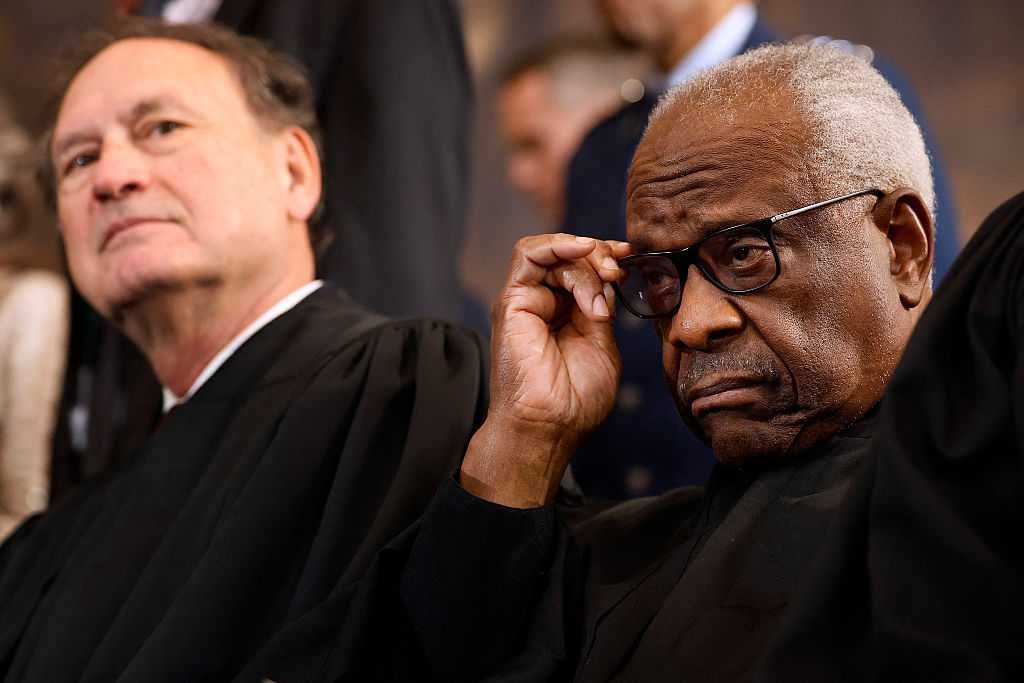
U.S. Supreme Court Associate Justices Samuel Alito (L) and Clarence Thomas (R).Chip Somodevilla/POOL/AFP/Getty Images

The court highlighted the text of other INA provisions and subsequent amendments to the statute to indicate that Congress intended asylum and inspection rights to apply only after an alien enters the country.

“That Congress amended §1158(a) in IIRIRA to replace ‘at a land border or port of entry’ with ‘arrives in the United States’ suggests that we should not read those phrases — which carry different ordinary meanings — to have the same meaning.”

Justice Sonia Sotomayor, joined by Justices Elena Kagan and Ketanji Brown Jackson, dissented, arguing that Congress intended border officials to inspect and process all aliens who present themselves at ports of entry, regardless of whether they have physically stepped into the U.S. The dissent contended that the majority’s decision “ignores the statutory context and history” of the INA and weakens the asylum protections Congress created for people fleeing persecution.

"The Court today holds that the Executive Branch may circumvent all these mandatory procedures by having U.S. immigration officers stand at the border and physically block noncitizens from setting a foot onto U.S. soil.”

Sotomayor added, "The Court's illogical interpretation is driven almost entirely by a fixation on a single word: 'in.'"

Like Blaze News? Bypass the censors, sign up for our newsletters, and get stories like this direct to your inbox. Sign up here!