Austin’s ‘Property of Allah’ shooter is immigration failure made flesh


Being president of the United States is a job unlike any other. Wise leadership often goes unnoticed because the public never sees the disasters it prevented. Feckless leadership leaves a paper trail of avoidable tragedy — and nowhere does that trail run clearer than immigration.

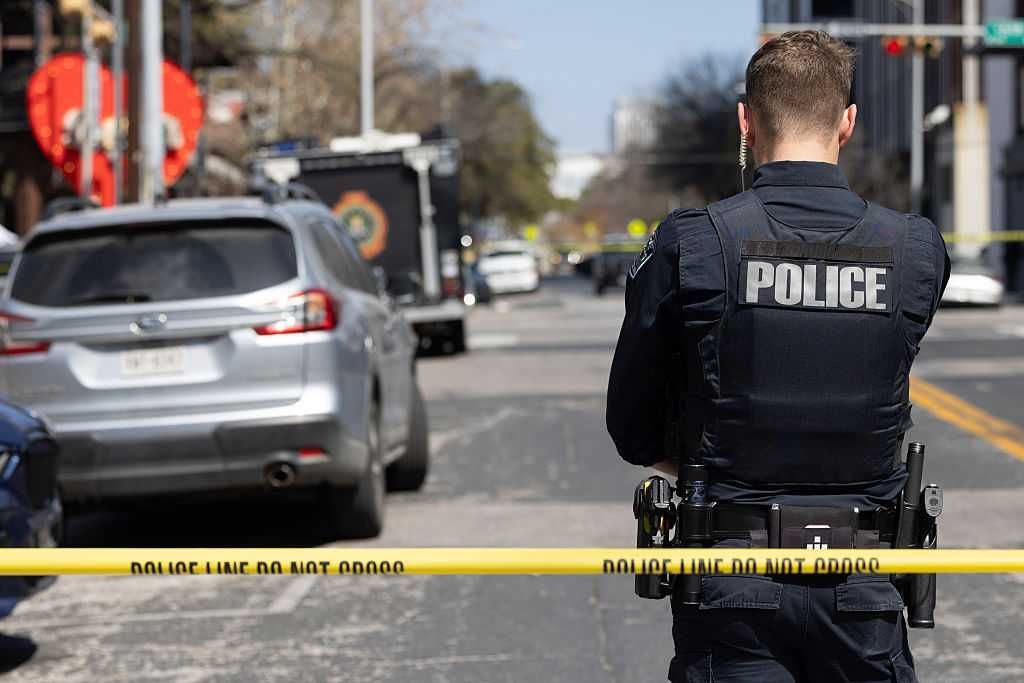
The mass shooting over the weekend in Austin, Texas, offers a grim case study. Ndiaga Diagne opened fire at a popular bar near the University of Texas, killing two people and injuring 14 others before police killed him. The story of how he entered the country, stayed, and ultimately gained citizenship reads like a checklist of missed opportunities for enforcement and vetting.

A government that takes national security seriously screens more aggressively, removes violators faster, and treats immigration law as law — not as a set of suggestions.

Diagne, a 53-year-old naturalized U.S. citizen originally from Senegal, moved through an immigration system that repeatedly rewarded leniency and procedural box-checking over basic security judgment. As the U.S. hardens its defenses amid escalating conflict with Iran, the country should confront these shortcomings and adopt reforms that put Americans’ safety first.

A path to citizenship full of red flags

Diagne’s record raises questions that any serious system should have addressed long before he was granted citizenship.

He entered the United States on a B-2 tourist visa on March 13, 2000, during the Clinton administration. A year later, New York City police arrested him for illegal vending. That offense alone might not have warranted major action, but it marked the beginning of a pattern. Reports also suggest he overstayed his visa, since tourist visas for Senegalese citizens typically allow a stay of six months.

By 2006, during the George W. Bush administration, he adjusted his status to lawful permanent resident through marriage to a U.S. citizen. In April 2013 — during the Obama administration — he became a naturalized citizen, despite earlier signs of disregard for immigration rules and later arrests in New York between 2008 and 2016. Some of those matters remain sealed, and public reporting about the underlying conduct varies, but the volume alone should have triggered deeper scrutiny at every stage.

Reports also describe Diagne as emotionally disturbed. He reportedly applied for asylum years after becoming a citizen — a move that makes little sense on its face and raises further questions about stability, intent, and how carefully officials reviewed his file over time.

The attacker’s presentation added another disturbing layer. He wore a hoodie emblazoned with “Property of Allah” alongside an Iranian flag. Reports about images from his home also claim he kept pictures of Iranian leaders. Even if investigators ultimately draw a different conclusion about motive, the optics underscore the obvious point: When the system admits, legalizes, and naturalizes people with glaring warning signs, the country absorbs the risk.

None of this looks like a one-off error. It looks like a culture of permissiveness — a system that too often treats enforcement as optional and vetting as a formality.

RELATED: The great replacement, American style

piranka via iStock/Getty Images

We’ve seen this pattern before

Austin did not occur in a vacuum. The 2015 San Bernardino terrorist attack left 14 people dead and 22 injured at a holiday party. One perpetrator, Tashfeen Malik, entered the U.S. on a K-1 fiancé visa during the Obama administration. Investigators later said she pledged allegiance to ISIS online before the attack.

San Bernardino revealed the same basic weakness: immigration pathways that assume good faith, overlook warning signals, and fail to connect the dots until bodies lie on the ground.

Now place those lessons in the current context. Iran’s regime has built its influence by exporting terror through proxies such as Hezbollah and Hamas. As U.S. and Israeli strikes pressure Tehran, the regime’s remaining options include asymmetric retaliation. Domestic security officials should treat that risk seriously, especially after reports that the Biden-Harris administration released more than 700 Iranian nationals into the interior. Even if only a tiny fraction pose a threat, the consequences could be catastrophic.

America cannot afford “sleeper” operatives posing as refugees or asylum-seekers from terrorist-sponsoring regimes. A government that takes national security seriously screens more aggressively, removes violators faster, and treats immigration law as law — not as a set of suggestions.

Democrats have opposed border security, tougher deportations, and reforms such as the SAVE Act. They dress up their opposition as compassion. In practice, permissive policies expand the pool of illegal residents, increase pressure for amnesty, and reshape political incentives through reapportionment and election machinery. Americans pay the price. The dead in Austin and San Bernardino paid the price.

Americans should say, with one voice: No more.

Texas officials tried to mow an unkempt lawn; Austin man shot at them, engaged in hours-long standoff with police, watched his house burn, fatally shot by SWAT officer


What started as Austin city workers attempting to trim a Texas man's unkempt lawn resulted in the homeowner shooting at landscapers, a house fire, and a standoff with police that ended with a deadly encounter.

The owner of the property was reportedly notified during the summer that "weeds were more than a foot tall," which violated the city code. The owner was allegedly ordered to mow the lawn by Aug. 19. Apparently, the homeowner never complied.

Around 9:16 a.m. on Wednesday, Austin Police offers attempted to serve a nuisance search warrant, but they were unable to locate the resident, according to Austin Police Chief Joseph Chacon.

At 10:21 a.m., an officer reported gunshots were being fired at them, and the shooter was inside the home where the search warrant was issued.

"They attempted to cut the lawn for him, and this is the reaction they got," Austin Police spokesperson Jose Mendez said in a statement.

"They immediately backed off. They got all of the staff that was working on the house to safety and a SWAT call was initiated for a barricaded subject," said Chacon.

A SWAT team arrived at 10:43 a.m., along with a mental health counselor, and a crisis negotiator. Officials attempted to deescalate the situation for several hours by communicating with the gunman through a public address system.

However, the man fired several shots at officers in the rear of the residence at roughly 3:19 p.m.

Law enforcement deployed a robot into the home to assess the situation. The camera on the robot informed authorities that a fire had been started in the home and was spreading quickly. Despite the dangerous fire, the man refused to come out of the home until the dwelling became fully engulfed in flames.

The armed man exited through the garage with "weapons in his hands."

"At that time, a SWAT officer shot and struck the resident who went down with a gunshot wound," Chief Chacon said.

Officers pulled the downed man away from the inferno and treated his life-threatening wounds. The man was taken to a local hospital – where he was pronounced dead.

A code inspector suffered a minor shoulder injury during the standoff while seeking cover, according to the Statesman.

The house fire was extinguished by Austin Fire Department before it could spread to the nearby homes.

The SWAT officer who shot the man has been with the department for eight years and will be placed on administrative leave during administrative and criminal investigations into the fatal shooting.

Police kill man after standoff in southwest Austin | KVUE www.youtube.com

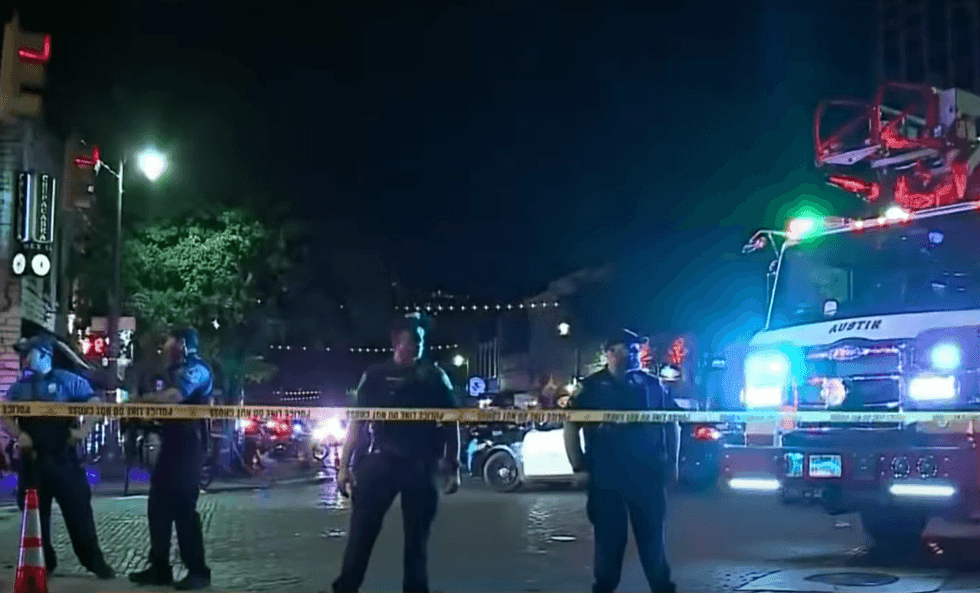
Videos show chaotic scene after 13 people shot in Austin's entertainment district; suspect still at large


Photos and videos show a chaotic scene after at least 13 people were injured from a mass shooting in Austin's bustling entertainment district. Police in the Texas city say the perpetrator is still at large.

The first call of shots fired came in to 911 around 1:24 a.m. local time Saturday. The incident occurred in a popular area featuring bars and restaurants, which attracted large "pre-pandemic" sized crowds on the night of the incident. Austin-Travis County EMS medics responded to the emergency, which they described as an "active attack."

Taylor Blount was at a bar on Sixth Street when he heard the gunshots.

"I only heard them from a single weapon and then everyone started running in different directions," Blount told the Austin American-Statesman. "People were freaking out a lot, and there were some people crying, but most people were just freaking out."

(CAUTION: Graphic video):

Another part of the raw video from the scene of the mass shooting in #Austin. Stay with @KVUE for latest. https://t.co/P1HrPVvhtF

— Christina Ginn (@ChristinaKVUE) 1623505520.0

"It was very difficult to contain the scene, it was very difficult for EMS to make their way into this crowd," interim Austin Police Chief Joe Chacon said. "And because of the nature of the injuries, officers had to go ahead and use their police vehicles to put some of these shooting victims into their vehicles and transport them themselves."

EMS took four people to the hospital by ambulance, Austin police took six other victims to the hospital, and three were taken by private vehicle.

"I'm happy to report no one has died," Chacon said.

"We do have two patients in critical condition," he added. "We have a total of 11 people transported to one hospital, one was transported to a different hospital and one person reported to an Urgent Care Clinic. So there is a total of 13 shooting victims."

"Our officers responded very quickly," Chacon continued. "They were able to immediately begin life-saving measures for many of these patients, including applications of tourniquets; applications of chest seals."

"Security (on Sixth Street) is always pretty good down here because of the way that we cordon off the streets, block off the streets, using barricades and try to keep people safe that way," he said.

Photos show a chaotic scene in downtown Austin after 13 people were shot early Saturday morning… https://t.co/wHzEfxyRnO

— Austin Statesman (@statesman) 1623501225.0


More photos from scene of #Austin mass shooting. Stay with @KVUE. https://t.co/hTTDDMwEBt

— Christina Ginn (@ChristinaKVUE) 1623505522.0

The "large crime scene" was blocked off following the incident to begin the investigation. Investigators are reviewing video footage of the area of the shooting, including from the Public Safety Camera System. Detectives from the Aggravated Assault, Homicide, Organized Crime, and Gang units are involved in the investigation, police said. The FBI Joint Terrorism Task Force Team is also on scene, Chacon noted.

Authorities say the perpetrator appears to have fired randomly into the crowd. The interim police chief said the motive for the shooting was "unclear" at this time. Investigators have not ruled out gang involvement. "At this time, this appears to be an isolated incident," Chacon stated.

Police noted that they do not have a "very detailed" description of the suspect, who Chacon said is a "black male wearing a black shirt with a skinny build and with dreadlocks."

Chacon said Saturday's incident was part of an alarming trend of shootings in Austin.

"What we have seen in recent months and over the last year or so is an increase in gun violence," Chacon said. "And so this is just emblematic of that, it continues, and it's something we're trying to work to decrease."

Anyone with more information or video of the shooting are encouraged to call police detectives at 512-974-8477, or contact Crime Stoppers by calling the tip line at 512-472-8477 or the mobile app.

13 hurt in downtown Austin shooting; suspect not in custody www.youtube.com


Police: At least 13 people hospitalized after mass shooting in downtown Austin www.youtube.com