Robust Homeland Security Must Be Funded, Not Shut Down
 Americans deserve a DHS strengthened by recent resource increases, and as agile and effective as possible in carrying out its core mission.
Republicans’ prospects in the coming midterms and in 2028 depend on whether the party delivers on the core promises of President Trump’s 2024 mandate. Analysts can debate which element of that mandate carries the most weight — taming inflation, avoiding foreign entanglements, or restoring American manufacturing — but one commitment stands out for its clarity and its political power. It sits at No. 2 on agenda 47: “Carry out the largest deportation operation in American history.”
Promise No. 1 — sealing the border — is already well underway. That makes mass deportation the decisive test of the coalition that put Trump back in office.
Voters did not support a symbolic crackdown on illegal immigration. They supported a measurable, large-scale operation.
Voters who formed this coalition expect results, not excuses. If they sense drift or retreat, enthusiasm collapses. And once that energy collapses, the old Republican apparatus regains its opening to steer the party back toward a pre-Trump agenda — even if that shift results in losing Congress or the White House in 2028.
A party cannot hold a coalition together if it fails to deliver on the promises that built it.
Trump set a high bar for himself when he compared his plan to the 1954 Eisenhower operation. He did that because the illegal immigration crisis has reached historic levels, and because voters, in poll after poll, signaled support for mass deportation on a scale few would have imagined a decade ago. They reached a simple conclusion: The country has been pushed past its limit.
As 2025 closes, however, the numbers fall short of expectations. Even the administration’s most generous internal projections place this year’s removals around 600,000. That figure includes categories beyond the Immigration and Customs Enforcement removals most Americans associate with deportation. The true ICE number will be lower.
But even accepting the 600,000 estimate, the figure amounts to only 4.2% of the conservative estimate of 14 million illegal immigrants in the country — or 2.9% of Trump’s own 21 million estimate. No one knows the exact number, but everyone can see this: The removals remain far below the mandate.
The 1954 comparison underscores the gap. Eisenhower’s operation removed or induced the departure of roughly one million illegal immigrants out of an estimated two to five million — roughly 30% using a middle-range estimate. Today’s effort hasn’t come close to those numbers. We’re not even in the same hemisphere.
The Trump administration faces obstacles Eisenhower never did: a legal system engineered to delay deportations indefinitely; an activist judiciary hostile to enforcement; state and local officials who obstruct federal immigration law; and a political climate in which ICE agents face sustained hostility and, in some cases, violence. The environment is different.
But meaningful action remains possible.
The administration should begin by pushing the $45 billion allocated to ICE through the One Big Beautiful Bill Act into immediate, strategic deployment. That requires industrial-size detention infrastructure, not scattered partnerships with small facilities dressed up with branded names. A mass deportation program demands a foundation capable of sustaining it.
The second step carries political risk: rejecting the narrowing of “mass deportation” to criminal illegal immigrants alone. That redefinition cannot stand. With only about 500,000 criminal illegal immigrants in the country, focusing exclusively on that group guarantees a token enforcement effort, not a mass removal program.
Voters did not support a symbolic crackdown. They supported a measurable, large-scale operation.
RELATED: Judges break the law to stop Trump from enforcing it

Quantity requires worksite enforcement — the same strategy that drove the 1954 operation. Concentrating enforcement where illegal immigrants gather in large numbers is the only credible way to meet the promise. Anything less becomes a public-relations exercise.
Political and corporate interests will fight tooth and nail to stymie the effort. They prefer an enforcement regime that preserves cheap labor, avoids political controversy, and allows them to claim credit for supporting “border security” without bearing any of the cost.
But the country needs a policy that matches the scale of the problem, not a performance of seriousness designed to placate donors and editorial boards.
Republicans must treat this mandate as a matter of political survival. If they fail to meet it, they risk losing the very coalition that returned Trump to office. The result is predictable: an establishment revival inside the GOP and a collapse of populist momentum heading into 2028.
Voters asked for decisive action. They asked for measurable progress. They asked for a departure from the decades of drift that allowed the crisis to grow. Now they expect the administration to deliver.
Let’s face it: Republicans are staring at a wipeout in the midterm elections. The economy is battered, GOP leadership looks unfocused, and swing voters show signs of fatigue with the endless drama surrounding Trump. The trend lines point in one direction.
But another truth sits alongside it: Republican voters still want a reason to show up. The base will not match the left’s turnout intensity unless the party gives them a fight worth having. And no issue energizes the conservative electorate more than immigration. If Republicans intend to use their remaining political capital, this is where to use it.
At a minimum, Trump should return to his original 2015 promise: Pause immigration and restore sanity to a system voters believe is broken beyond recognition.
Last week, Rep. Chip Roy (R-Texas) introduced exactly that fight.
Roy’s PAUSE Act freezes all legal immigration — except temporary tourist admissions — until the federal government establishes permanent enforcement against illegal entry and against categories of immigration voters have opposed for years. The bill sets clear conditions for lifting the moratorium.
The bill accomplishes all of this in fewer than 10 pages. Original co-sponsors include Reps. Keith Self (R-Texas), Brandon Gill (R-Texas), Andy Biggs (R-Ariz.), Lauren Boebert (R-Colo.), Eli Crane (R-Ariz.), and Andy Ogles (R-Tenn.).
Conservatives have pushed these reforms for nearly two decades. Some ideas surfaced in the Trump years through executive actions, but courts blocked several and entrenched others — especially anchor-baby citizenship and taxpayer-funded K-12 education for illegal aliens.
Other essential reforms, such as ending optional practical training, halting visas from China, or barring Sharia-law adherents, were never attempted.
RELATED: Trump can’t call it ‘mission accomplished’ yet

The genius of Roy’s bill is simple: It creates a standing incentive for courts, presidents, and future Congresses. If judges want legal immigration to continue, they must revisit the policies that created the crisis in the first place.
If Trump focused his attention on this bill — and forced congressional Republicans to choose — he could unite conservatives heading into primary season. A transformational immigration fight would energize GOP voters at a moment when the party shows weakness across the map.
Democrats have over-performed by an average of 15 points in recent special elections. That surge alarmed Republicans enough that they pulled Rep. Elise Stefanik (R-N.Y.) from consideration for U.N. ambassador for fear of losing her district, which Trump carried by 15 points. Democrats are now pouring money into Tennessee’s 7th Congressional District, which Trump carried by 20. A party that cannot defend safe seats is a party in trouble.
If Republicans can’t win in red America during a bad economy, it’s not because voters demand new talking points. It’s because the party has failed to deliver on the core issues that animate its base.
RELATED: The right must choose: Fight the real war, or cosplay revolution online

Trump could offer a fresh economic vision or finally follow through on repealing Obamacare. But at a minimum, he should return to his original 2015 promise: Pause immigration and restore sanity to a system voters believe is broken beyond recognition.
The window is closing. If Republicans refuse to use the power they still possess, they will lose it — not gradually, but suddenly.
The PAUSE Act gives them a chance to reverse that trajectory. The question is whether they will take it.
I was out to dinner with my wife when my phone rang. The caller ID said “POTUS.” My wife muttered, “Oh, s**t.” President Donald Trump told me he wanted me to take care of three things: secure the border, run a mass deportation operation, and find hundreds of thousands of missing children. Those were his instructions when he offered me the job as his border czar.
As of today, we have the most secure border in the nation's history. I don’t take credit for that. The credit goes to President Trump for signing the executive orders that ended catch-and-release, reinstated Remain in Mexico, and put into place the agreements and policies that worked. And the greatest credit belongs to the men and women of the United States Border Patrol, the finest I’ve ever met.
Every day I look at the numbers: criminals arrested, terrorists stopped, children rescued. It makes me proud — proud of ICE, proud of Border Patrol, and proud of the president who made it possible.
Under Trump, Border Patrol brought down illegal immigration more than 90% in just seven weeks — even faster than I thought possible. I expected it would take 120 days. That’s what happens when the men and women of Border Patrol are allowed to do their jobs.
For the last four years, I’ve been raising hell about the open border intentionally inflicted on this country by the Biden administration. This wasn’t mismanagement or incompetence. It was by design.
I know because I was there under President Barack Obama. Former President Joe Biden was vice president, and former Secretary of Homeland Security Mayorkas was deputy secretary. We faced a family surge back then. We stopped it by building family residential centers, detaining migrants until they saw a judge, and then deporting the 90% who lost their asylum claims. It worked.
But when Biden and Mayorkas returned to power, they did the opposite of what they knew worked. They refused to detain. They refused to let Immigration and Customs Enforcement do its job. They created chaos by design. Every day the border was open, women were raped, children died, families were trafficked, and terrorists slipped through. A harrowing 31% of women who cross the border through cartels are sexually assaulted. That’s horrendous.
Trump’s policies cut illegal immigration by 96%. That meant fewer rapes, fewer deaths, fewer trafficked children, and less fentanyl poisoning Americans. Trump’s policies saved thousands of lives every week. But you won’t hear that from the media.
The Biden administration called itself humane. That’s a lie. Under Biden, a record number of migrants died — over 4,000. A quarter-million Americans died from fentanyl crossing an open border. Sex trafficking hit all-time highs. Cartels made record profits smuggling people and drugs.
Compare that to today: Trump’s secure border has reduced crossings from 10,000 to 15,000 a day under Biden to as few as 162 — all arrested, all returned, zero releases. That is a secure border.
Biden’s so-called humane approach killed more Americans and more migrants, and it enriched cartels. There is nothing humane about that.
ICE removals since January are approaching 400,000. About 70% of arrests are of criminals — and yes, DUI counts. Ten thousand Americans die every year from drunk drivers. The other arrests include gang members and even suspected terrorists. ICE is enforcing the laws Congress passed.
But sanctuary cities stand in the way. They release criminal aliens back into neighborhoods instead of handing them over to ICE. They call themselves “welcoming.” In reality, they are sanctuaries for criminals. Victims in immigrant communities don’t want predators back in their neighborhoods. Sanctuary politicians know this, but they put politics above safety.
So we’re flooding the zone. Chicago’s mayor said I wasn’t welcome. I went anyway. In one day, ICE arrested child predators, gang members, drug traffickers, and murderers. Chicago will be made safe again.
ICE agents are under attack like never before. Assaults against agents are up 1,000%. Their families are being doxxed. Members of Congress call them Nazis and racists, even though all they do is enforce the laws Congress wrote. It’s disgusting.
Trump also tasked me with finding hundreds of thousands of missing migrant children. It’s the hardest job, because kids don’t have digital footprints. We rely on the so-called sponsors who took them in — many with fake addresses. Too often, these children end up in sex trafficking or forced labor.
We’re trying to reunite kids with their parents. We even had agreements to return children safely to Guatemala. But liberal judges blocked us. These same people accuse Trump of family separation. Yet Biden’s failures have led to half a million separations and more than 300,000 missing children. Who are the real masters of family separation?
Biden released millions into this country because he wanted to delay their hearings for years. Why? To buy time for amnesty and to gain political power through census reapportionment. That’s not just cynical — it’s selling out America.
Trump’s policies, by contrast, work because they follow the law. If you enter illegally, the law says you shall be detained. That law is saving lives today.
I took a pay cut to come back under Trump because I respect him as much as I respected my father. He’s not perfect — no man is — but when it comes to border security, there’s no one better.
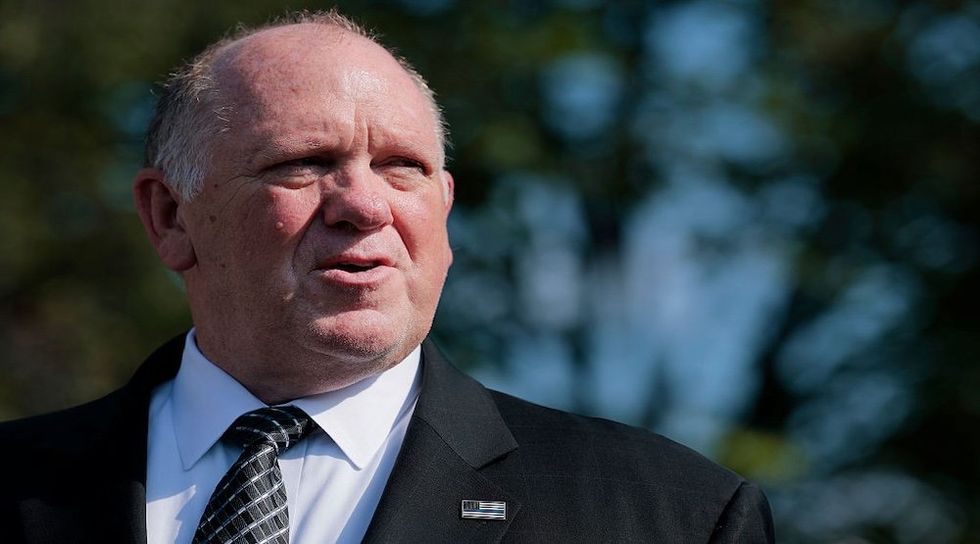
Every day I look at the numbers: criminals arrested, terrorists stopped, children rescued. It makes me proud — proud of ICE, proud of Border Patrol, and proud of the president who made it possible.
To those agents on the front lines: Thank you. You are making this country safer every day.
And to the politicians, judges, and media who attack us: Shame on you. We’re not going anywhere.
Editor’s note: This article has been adapted from remarks delivered on Wednesday, September 3, at the fifth National Conservatism conference (NatCon 5) in Washington, D.C.
The Department of Homeland Security is taking a victory lap after a steady winning streak on immigration enforcement, according to a memo obtained exclusively by Blaze News.
The memo, which was circulated to Republican lawmakers on Thursday, details all of the major accomplishments that have taken place under President Donald Trump and Secretary Kristi Noem's leadership. Within Noem's first 200 days in office, the United States experienced an "unprecedented" decline in the foreign born population, a surge in enforcement, and accelerated deportations.
'A historic start to the largest deportation operation in American history.'
"This incredible achievement is the direct result of President Donald J. Trump's decisive, unapologetic immigration policies and Secretary Noem's aggressive, disciplined implementation - both of which have put Americans first," the memo reads. "Together, they have delivered the strongest immigration enforcement outcome in American history."
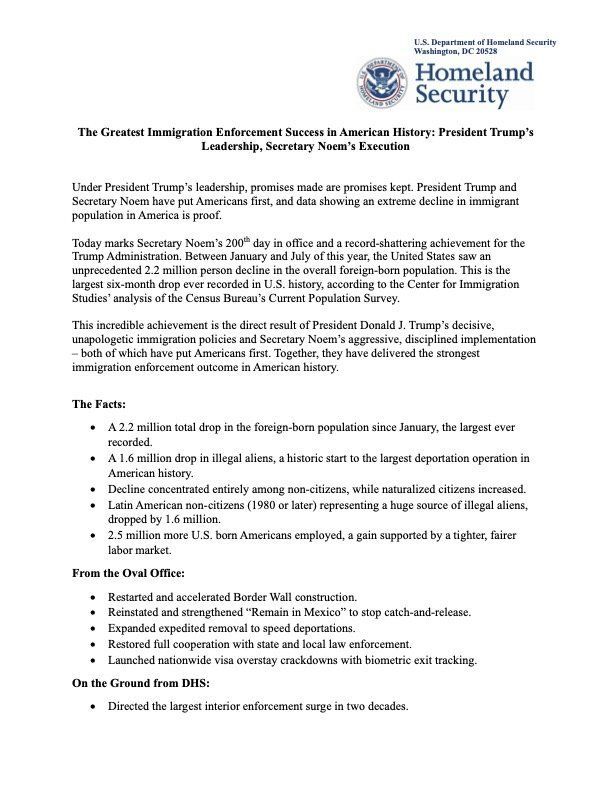
The United States experienced a 2.2 million drop in foreign born population since January, which is the largest ever recorded drop according to the memo. There has also been a 1.6 million drop in illegal aliens within the same time frame, which the memo said is "a historic start to the largest deportation operation in American history."
While there was a decline concentrated among non-citizens, there was simultaneously an increase in naturalized citizens. The memo also said that 2.5 million more U.S. born Americans were employed since January, which is a gain "supported by a tighter, fairer labor market."
RELATED: Exclusive: Congress pushes bipartisan bill preventing Mexico's 'illegal seizure' of American assets
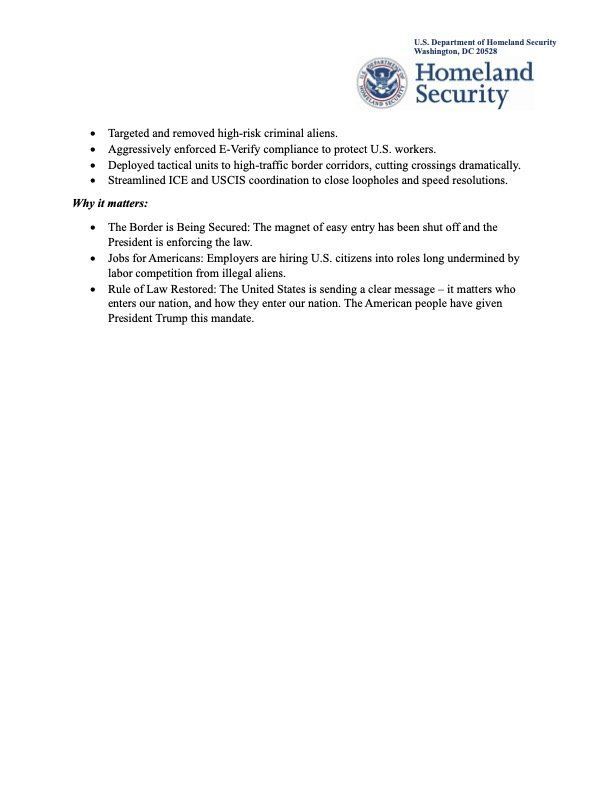
These "record-shattering" figures are supported by the policies pushed by the White House and implemented by DHS. The Trump administration has restarted and accelerated the construction of the border wall, reinstated the "Remain in Mexico" policy, expedited deportations, reinforced cooperation with state and local law enforcement, and even cracked down on visa overstays with biometric exit tracking.
"The United States is sending a clear message - it matters who enters our nation, and how they enter our nation," the memo reads. "The American people have given President Trump this mandate."
Like Blaze News? Bypass the censors, sign up for our newsletters, and get stories like this direct to your inbox. Sign up here!
President Donald Trump's administration may have secured another border victory, this time concerning wall materials purchased by American taxpayers during his first term.
The materials, which were put up for auction by former President Joe Biden, will reportedly soon be returned to Trump following a fierce legal battle.
In December, a federal judge blocked Biden from selling off any more of the materials after Texas Attorney General Ken Paxton (R) accused the former administration of undermining Trump by selling the material "for pennies on the dollar."
'GovPlanet has reached an agreement, working with the Office of the Border Czar, to return border wall materials that were previously deemed surplus and sourced by the federal government to GovPlanet via existing contracts.'
The material, valued between $260 million and $350 million, was auctioned on GovPlanet, an online government surplus marketplace, in 2023 after Biden halted Trump's border construction in January 2021.
Trump previously accused Biden of "deliberately selling off border-wall materials at a major financial loss" to undermine "pro-wall policy." He claimed that the former administration's conduct "likely constitutes a criminal act, such as a conspiracy to defraud the United States."
GovPlanet has previously stated that most of the border wall materials were provided to "authorized recipients, including U.S. Customs and Border Protection and the states of Texas and California." It noted that the remaining roughly 40% of materials were listed for auction on the online marketplace.
Texas officials attempted to purchase some of the material with plans to return it to Trump once he reclaimed office in January, so he could finish constructing the border wall.
RELATED: Judge blocks Biden admin from selling Trump's border wall materials in final days

Texas Lt. Gov. Dan Patrick (R) stated in December, "I will bid on all of that wall, and we will buy it in Texas, and we will give it to Donald Trump."
GovPlanet told Fox News Digital on Friday that it has plans to return some of the material to the Trump administration.
"GovPlanet has reached an agreement, working with the Office of the Border Czar, to return border wall materials that were previously deemed surplus and sourced by the federal government to GovPlanet via existing contracts," the company stated.
"A third-party firm that has been contracted for construction of the border wall will take receipt of the materials over the next 90 days."
RELATED: Trump moves to halt Biden's 'potentially criminal' sale of border wall materials

According to GovPlanet, it will return the materials to the federal government "at cost" to "protect the millions of dollars that U.S. taxpayers had already invested in this initiative."
"We are expediting the transfer of these materials to support the administration's border protection plans. We value our long-standing partnership with the U.S. government and look forward to continuing to support America's federal agencies," the company added.
A White House official told Fox News Digital that the administration is "grateful for all third parties who are interested in helping keep America's borders safe and secure."
Like Blaze News? Bypass the censors, sign up for our newsletters, and get stories like this direct to your inbox. Sign up here!
President Donald Trump made clear from the start: A nuclear-armed Iran is unacceptable. But until just recently, few paid attention. In March, Director of National Intelligence Tulsi Gabbard testified that while Iran had enriched a suspicious amount of uranium, it lacked a viable weapons program — let alone a bomb.
At the same time, left-wing agitators tried to spread immigration riots from Los Angeles to the rest of the country. Trump stayed focused on the domestic agenda his voters demanded. Israel’s sudden strike on Iran threatened to drag the United States into another foreign war — and derail Trump’s progress at home.
Trump knows his voters support a strong defense — but they’re tired of wasting American blood and treasure to fight foreign wars while their country falls apart at home.
Now that the U.S. has carried out a precision strike and set back Iran’s nuclear program, it’s time for Trump to return his full attention to rescuing America from Joe Biden’s open-border catastrophe.
Every presidency races against time, political capital, and public attention. Trump understood from the outset how easily foreign entanglements — especially in the Middle East — can swallow an administration.
That’s one reason the MAGA base remains loyal: Trump prioritizes domestic issues most presidents ignore while playing global policeman. Even while negotiating with Iran, Trump kept his focus on immigration. He battled leftist protesters and rogue judges at home, while keeping one eye on foreign threats.
But nearly two years after the terrorist attacks on October 7, Israeli Prime Minister Benjamin Netanyahu saw the window for war with Iran closing. Israel launched initial strikes on June 13 without American approval. Supporters insisted Israel could finish the job alone.
That was welcome news to Trump’s base, which feared any new conflict in the Middle East would derail his domestic policy blitz. But then the neoconservatives started moving the goalposts. Suddenly, it wasn’t just about airstrikes — it was about regime change.
Trump approved the use of U.S. bunker-buster bombs, believing them essential to destroy uranium enrichment sites buried deep in Iran’s mountains. U.S. forces entered and exited Iranian airspace without incident, delivering their payloads. Both sides issued conflicting reports about the strike’s effectiveness. But Trump clearly saw the operation as a means to reduce foreign policy pressure and pivot back to domestic priorities.
That pivot didn’t go as quickly as planned.
Israel and its allies quickly shifted from nuclear disarmament to full-blown regime change. Iran fired retaliatory missiles at a U.S. base in Qatar. While those strikes appeared calibrated to avoid casualties, tensions escalated.
Trump announced a ceasefire he had brokered between Iran and Israel. Both nations violated it within hours.
Netanyahu even defied Trump directly, ordering another strike while the president live-tweeted his demand for Israeli jets to turn back. They dropped their payloads anyway.
Frustrated, Trump told reporters Tuesday morning he was fed up with both countries. Israel, a close ally, had no interest in honoring its commitments. “Truth is, they have been fighting so long and so hard they don’t know what the f**k they’re doing. Do you understand that?” he said.
RELATED: It’s not a riot, it’s an invasion

American and Israeli interests were never fully aligned. Israel wants regime change. It lacks the capability to do it alone. Americans don’t want a nuclear Iran, either, but they have no appetite for another long war.
Trump’s airstrike may have succeeded, but that won’t satisfy Netanyahu. He clearly hopes to drag Trump into a broader conflict.
Israel’s refusal to respect a ceasefire negotiated by its primary benefactor makes the next step obvious: walk away.
On Tuesday, Trump issued a flurry of social media posts calling for mass deportations. He got what he wanted in Iran. Now, he’s ready to exit.
Would Israel continue its push for regime change without U.S. support? Maybe. It’s time to find out. The U.S. shouldn’t fight another unpopular Middle East war for an ally that won’t keep its word.
In his farewell address after his first term, Trump listed avoiding war as one of his proudest achievements. He knows his voters support a strong defense — but they’re tired of wasting American blood and treasure to fight foreign wars while their country falls apart at home.
Republicans always promise domestic wins. They spend their political capital overseas. Trump’s first hundred days this term have been different. He’s delivered rapid-fire domestic victories. That’s where the focus belongs.
Americans don’t want more war in the Middle East — especially one waged on behalf of an ally that does not respect their president. Biden’s open-border nightmare still haunts the nation. Crime, poverty, trafficking, and collapsing infrastructure all stem from the ongoing invasion of illegal immigrants.
Whatever nuclear threat existed in Iran has been neutralized.
Now Trump must do the job he was elected to do — the job he wants to do.
Deport illegal aliens, finish the wall, and put America first.
The GOP doesn’t resemble a big tent any more — it looks more like a boundless landfill. No shared vision or coherent guiding principles bind the party’s disparate factions beyond not having a “D” next to their names. That’s why it’s impossible to pass a reasonable budget bill that cuts spending without including massive subsidies for high-tax blue states.
The rift between the Freedom Caucus, the K Street crowd, RINOs, and the Trump White House remains unbridgeable. So what’s the realistic path forward on budget reconciliation?
With real leadership, Trump could sign the most consequential part of his 2024 mandate into law — before the smoke clears in LA.
Focus on the one issue that unites the base: immigration enforcement.
Riots in Los Angeles this week have made the case for an immigration-only reconciliation bill even stronger. The public sees the connection. The urgency is obvious. And President Trump, understandably frustrated by the calendar — it’s June and he hasn’t signed a single major legislative win — wants action now.
But cramming unrelated tax and health care provisions into one big, bloated bill guarantees disaster. Good members will face a bad vote. So why not act decisively?
Split the immigration provisions from the rest. Make them tougher. Pass the bill right away, while the chaos in L.A. is still at the front of everyone’s mind. Save the fiscal brawls for later.
The current draft of H.R. 1, the One Big Beautiful Bill, includes about $185 billion in new funding for Immigration and Customs Enforcement, Customs and Border Protection, and new and improved border infrastructure. It also tacks on another $150 billion in defense spending — a top White House priority.
Even strong provisions need offsets. But in a party this fractured, cutting spending isn’t just difficult — it’s practically taboo.
Still, by limiting the bill to the Department of Homeland Security and Pentagon spending and scrapping the tax components, Republicans would only need to offset $335 billion over 10 years.
RELATED: How much Green New Scam spending will survive the One Big Beautiful Bill?
That’s well within the realm of possibility. They could hit that number using the consensus cuts and immigration reforms already in the bill. No gimmicks. No sleight of hand. Just political will and a sense of timing.
The current bill would generate about $77 billion in new revenue from immigration-related fees and taxes on remittances. It saves hundreds of billions more over the next decade by cutting off illegal aliens from Medicaid, Obamacare, and food stamps.
Republicans should go farther and ban illegal aliens from claiming the child tax credit — a move that could save another $50 billion.
Instead of loading the first reconciliation bill with a jumble of unrelated and divisive provisions, Republicans should focus on consensus items: national security, enforcement of sovereignty, and policies that put Americans first.
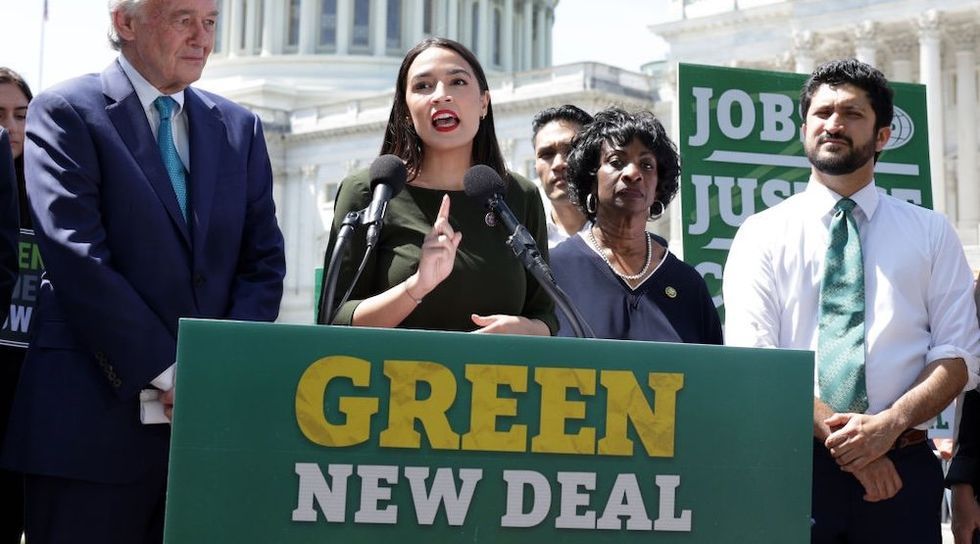
If the Republicans were more ambitious, they would use this bill to repeal the Green New Deal. Funding illegal immigration and the Green New Deal were the Biden administration’s two most transformative and unpopular policies. Target both. Pass the bill right away. Deliver a win that matches the mandate voters gave Trump — and give the president a badly needed legislative victory.
Throwing $180 billion more at enforcement won’t solve the immigration crisis. Spend a trillion on deportations, and it still won’t matter if courts continue to block action.
Even in Trump’s rare Supreme Court wins on immigration, the justices insisted every illegal alien must receive due process — despite deportation being a civil process, not a punishment.
No president can litigate his way out of an invasion. Even with favorable rulings, Trump won’t deport enough illegal immigrants before the next Democrat takes office. That’s the hard truth.
Now is the moment to fix it.
Americans are watching a violent, coordinated invasion unfold in real time. The bill should formally declare an invasion — and include an amendment by Rep. Chip Roy (R-Texas) to strip judicial review from deportation cases involving noncitizens and, ideally, legal permanent residents.
Under that reform, the administration’s removal decisions would stand. No federal judge could second-guess them. No more delays, appeals, or lawfare.
Roy’s amendment would transform the first reconciliation bill into a singular focus on Trump’s most unifying, necessary, and popular campaign promise. It would hand him a quick, clean victory while the nation remains fixated on the border invasion.
RELATED: Americans didn’t elect Trump to bust SALT caps or overhaul Medicaid
So why not just split the agenda into two bills and get on with it?
Here come the usual GOP excuses. Let’s knock them down one by one.
Excuse 1: “We only get one bite at the apple.”
White House deputy chief of staff Stephen Miller claims Republicans must use reconciliation just once to avoid the Senate filibuster.
But Democrats already broke that precedent in 2021, pushing through two separate reconciliation bills with a green light from the Senate parliamentarian, who noted that reconciliation should be reserved for “extraordinary circumstances.”
But ultimately, this isn’t the parliamentarian’s call. The decision rests with President Trump and Senate Majority Leader John Thune (R-S.D.). If Biden’s team could do it, so can we.
Excuse 2: “Without this bill, Americans face massive tax hikes.”
This line is pure fearmongering. The 2024 election wasn’t about taxes. MAGA never revolved around tax cuts for their own sake — that was the old GOP. Yet somehow, this bill morphed into another tax-centered mess.
The truth? Most tax provisions in the current draft — from an expanded child tax credit and higher standard deduction to new breaks for seniors, overtime, and tips — enjoy broad bipartisan support.
No Democrat wants to get blamed for letting these expire. Even in a lame-duck session, they wouldn’t allow a public tax hike. The only serious dispute involves the top marginal rate. Trump has already signaled he’s open to a modest increase if it means getting the rest of the agenda passed.
And let’s be honest: The current bill isn’t exactly Reaganesque. It’s loaded with progressive goodies, including an obscene expansion of the SALT deduction.
Even the pro-tax-cut Tax Foundation calls the bill’s economic impact weak and overly complicated. This isn’t a bold, pro-growth package — it’s a muddled compromise.
The irony is that ending taxes on tips — perhaps Trump’s most prized tax provision — already passed the Senate 100-0. Why not pass that and similar provisions in the House and place it on Trump’s desk without wasting budget reconciliation?
Excuse 3: “We can’t include policy provisions in a budget bill.”
Critics claim the Byrd Rule blocks the inclusion of policy reforms — like immigration or judicial changes — in a reconciliation bill. That excuse doesn’t hold up.
The original House-passed bill included a provision that barred states from regulating artificial intelligence. That isn’t budget-related. That is pure policy.
By comparison, a provision removing judicial review from deportation cases would directly cut costs by eliminating thousands of court hearings. That’s a legitimate budgetary angle — and far more defensible than regulating AI through backdoor channels.
The Byrd Rule exists, yes. But the party in power determines what gets through. The president and Senate leadership can overrule the parliamentarian. Democrats did it. So can we.
Fast-forward to this week: The streets of Los Angeles are on fire again. And instead of seizing the moment to deliver on the most urgent national priority, Miller is using anti-ICE violence to ram through a bloated mega-bill — all because it includes ICE funding.
But if solving immigration were the real goal, Republicans would just split the bill already. They’d put the judicial reform language in the first package. And they’d pass it immediately.
With real leadership, Trump could sign the most consequential part of his 2024 mandate into law — before the smoke clears in L.A.
After the House narrowly passed President Trump’s “big, beautiful bill” — in true Washington fashion, it’s already been reduced to an acronym: BBB — the usual suspects sounded the alarm. Libertarians and deficit hawks recoiled. Elon Musk, the former DOGE chief, called it a “disgusting abomination.” He warned it would pile another $2.4 trillion onto the national debt over the next decade. Sen. Rand Paul (R-Ky.) slammed it as hypocritical, saying Republicans can’t keep pushing tax cuts without real spending cuts to match.
I sympathized. I flinched at the trillion-dollar price tag too. My immediate thought: “This is what Democrats and GOP sellouts do — not fiscal conservatives.”
The BBB is the first major Republican bill in decades that doesn’t bend to Democratic narratives. It doesn’t apologize for putting American citizens first.
Then Stephen Miller showed up.
While critics accused the bill of being just another bloated omnibus, Miller pushed back. He took to X to argue that the BBB isn’t some lobbyist-driven monstrosity. It’s a focused, unapologetic conservative package: secure the border, overhaul welfare, and revive the economic growth unleashed by the 2017 tax cuts. For the first time in a long time, I decided to hear the argument out.
I didn’t need much convincing on border security. But Miller pointed out something the corporate left-wing media barely mentioned: The BBB fully funds the border wall — both physical infrastructure and new tech. Republicans have promised that since 2016. Nearly a decade later, they finally have a bill that delivers.
— (@)
This isn’t more messaging fluff. The bill puts $45 billion toward border security — the largest commitment in U.S. history. It increases Immigration and Customs Enforcement detention capacity by 800% over the previous fiscal year, funding facilities to detain more than 100,000 people per day. It also includes $8 billion to hire 10,000 new ICE officers and staff.
If the bill ended there, it would be a no-brainer. But I still had concerns — starting with the deficit.
We can’t call ourselves fiscal conservatives while borrowing like Democrats. Miller knows that, and he didn’t dodge the question.
The bill, he argued, enacts the most sweeping welfare reform in U.S. history. It includes over $2 trillion in net spending cuts. Programs like Medicaid and food stamps would be tied to citizenship and work requirements — policies conservatives have supported for years but rarely fought for seriously in Congress.
And then there’s the tax side.
The BBB extends the 2017 Tax Cuts and Jobs Act — one of the clearest drivers of economic growth during Trump’s first term. That’s what triggered the $2.4 trillion deficit estimate, according to the Congressional Budget Office.
But here’s the twist: The CBO’s figure isn’t based on new spending. It’s based on continuing tax relief. Miller’s argument is straightforward — there’s a world of difference between scoring a bill that way and actually running up the national credit card.
RELATED: Trump’s $9.3B rescission push faces a GOP gut check
Attributing the deficit to tax cuts is like blaming hydrogen peroxide for the wound it’s meant to treat. The real cause of the deficit isn’t lower taxes. It’s decades of spending on bloated welfare, bureaucratic waste, and corporate handouts that the DOGE identified — exactly the kind of garbage the BBB cuts.
Even ABC News, buried in the middle of a critical write-up, admitted that the bill would cut taxes by $3.7 trillion and reduce spending by $1.2 trillion. If that’s not a conservative win, what is?
Letting the 2017 tax cuts expire over CBO scoring fears would amount to a massive tax hike on the working and middle classes. Extending them strengthens the economy, boosts small businesses, and keeps the government from choking growth just to massage a deficit number.
Border security — check. Welfare reform — check. Pro-growth tax cuts — check. So why cram it all into one bill? Why not pass each measure individually, on its own merits?
Miller addressed that too. In a perfect world, each item would pass as a clean bill. But in the real world, every one of these provisions would require 60 votes in the Senate — including Chuck Schumer’s. That’s not happening.
— (@)
The reconciliation process, however, only requires a simple majority. It’s the only legislative path available. For once, Republicans are using the rules the way Democrats do: to win.
I didn’t like it at first. It felt like a compromise. But now I see it as the only way to do what we’ve been saying we want to do for years.
The BBB is the first major Republican bill in decades that doesn’t bend to Democratic narratives. It doesn’t water down core principles. It doesn’t apologize for putting American citizens first.
And unlike Louisiana Republican House Speaker Mike Johnson’s endless parade of “small ball” continuing resolutions, the BBB actually moves the ball down the field. It lays out a coherent conservative agenda — and the administration is determined to get it passed.
— (@)
I’m still a fiscal hawk. I still want smaller bills, much less spending, and a federal budget that doesn’t look like a summertime pig roast. But I also want results. And this might be the only chance we have to deliver the policy victories we’ve been promised for a generation.
Stephen Miller changed my mind. I hope other conservatives will give him a fair hearing too.
You can’t litigate your way out of an invasion.
Removal is not considered a criminal punishment but an administrative consequence of sovereignty. If it were treated as a form of punishment, it would require due process and could take months to remove even the worst offenders. We see that happening now, and we can no longer afford these delays.
President Donald Trump should challenge overreaching court rulings and use resources more effectively to maximize the number of removals.
Imagine you are a liberal judge on the federal bench. You know the political system — including all three branches of government and both major parties — grants you sweeping authority to dictate policy through an injunction. Regardless of legal precedents, constitutional constraints, rules of standing, or national security concerns, you can issue an opinion that instantly becomes “the law of the land.” Why wouldn’t you exploit that power like a judicial version of Kim Jong Un?
By cutting through the legal obstacles, ICE could apprehend and remove individuals in a single step.
At some point, we must stop blaming judges for legislating with impunity and start holding the other branches accountable for not just relinquishing their own power but for enabling judges to usurp the law. As St. George Tucker wrote in his commentaries on the Constitution, “If we consider the nature of the judicial authority, and the manner in which it operates, we shall discover that it cannot, of itself, oppress any individual; for the executive authority must lend its aid in every instance where oppression can ensue from its decisions.”
If President Trump is unwilling to simply ignore these lawless rulings, he should at least insist that Congress include a provision in a must-pass bill to eliminate all judicial review for deportations. At a minimum, lower courts should be removed from the process entirely. Unless a plaintiff files a habeas petition claiming the individual is actually a citizen or has been misidentified, all removals should be final.
We already have several million immigrants with criminal convictions living in this country, at least eight million who entered during Joe Biden’s term, and many others who arrived earlier. If we continue to extend this level of due process — whether through administrative courts or Article III courts — we risk undermining our sovereignty. This explains why Trump is averaging only a few hundred thousand removals annually at the current pace.
How did President Dwight D. Eisenhower manage to remove more than one million illegal aliens in just a few months in 1954 — after the passage of the modern Immigration and Nationality Act — without facing endless lawsuits? Today, every deportation becomes a legal battle.
Eisenhower’s administration had fewer resources, just 800 Border Patrol agents, and primitive technology. Still, they got the job done because they believed in themselves and in the nation. They also understood that you don’t repel an invasion through litigation. Our immigration system was never designed to grant full due process to individuals here illegally, and that principle should be clarified in the Immigration and Nationality Act.
When court proceedings — even in administrative courts — are required, Immigration and Customs Enforcement currently must provide detention space for each person it apprehends rather than taking them directly to the point of removal. By cutting through the legal obstacles, ICE could apprehend and remove individuals in a single step.
But how?
Trump is currently using military and commercial flights to remove illegal aliens. Most flights carry only 100 to 200 passengers and are difficult to secure against potential unrest. They also cost more, rely on airports in potentially hostile countries, and require additional personnel.
A better option might be to use Navy and Coast Guard vessels from ports in Florida and Texas, which sit along the Gulf Coast toward Latin America. The president could also call on the Department of Transportation’s National Defense Reserve Fleet. This force of about 100 ships receives nearly $1 billion in annual appropriations and can be activated within 20 to 120 days for emergency sealift operations during wartime or in response to disasters.
The NDRF includes mostly cargo ships and tankers. Its Ready Reserve Force — comprised of 41 vessels — provides extra shipping capacity or rapid deployment for U.S. military forces. These ships are stationed at 18 ports, including three in Texas and one in Florida.
This fleet features National Security Multi-Mission Vessels, each able to carry 1,000 people — far more than the roughly 100-person capacity of a C-17 plane or the 150 to 200 seats on most commercial aircraft. These ships can stay at sea for 14 days without resupply and include medical facilities, enough space for 60 cargo containers, a helicopter landing pad, and roll-on/roll-off vehicle capacity. They could be activated immediately and based at a designated port along the Gulf of America.
By using these vessels, President Donald Trump could transport far more unauthorized immigrants for removal at a lower cost than air travel.
One major obstacle to large-scale deportations is a lack of detention space. Shifting to maritime operations would shorten the time illegal aliens spend in custody by reducing reliance on deportation flights. Newly apprehended people would enter detention as those previously held depart.
Yet, Trump doesn’t need hundreds of billions of dollars to build new detention facilities. During Operation Desert Storm, U.S. forces suddenly found themselves guarding 65,000 Iraqi prisoners of war who surrendered en masse. The military constructed temporary detention sites practically overnight. Trump could replicate this approach by ordering the National Guard to set up outdoor facilities near Gulf Coast “deportation ports.” It’s an inexpensive, efficient way to get the job done.
Trump will have only one shot to get mass deportations done right. If he deports just a few hundred thousand people each year despite a mandate to address the crisis, critics will say mass deportations are unworkable and push for amnesty. Now is the time for Trump to use every tool and resource at hand to meet that mandate.






 thefederalist.com
 www.theblaze.com
 www.theblaze.com
 www.theblaze.com