In France And Britain, Multiculturalism Is Leading To Authoritarianism
 The leaders of France and Britain are calling for censorship regimes because enforcing multiculturalism requires suppressing freedom.
The protagonist of Chuck Palahniuk’s novel "Lullaby" investigates an ancient African poem so powerful it has the ability to kill anyone who hears it spoken aloud. I’ve never had quite that reaction to a work of literature. There is, however, one word that sends my blood pressure high enough that it may yet finish the job: reparations.
Yes, the West Indies are rattling the change jar again, pursuing reparations from Britain that one prominent estimate puts at £18.8 trillion — roughly six times the U.K.'s annual GDP.
If we are going to do this consistently, North African states might be presented with a bill for the Barbary slave raids on Europeans. Scandinavians can cough up for the Vikings.
Caribbean governments are escalating their campaign to make Britain pay reparations for slavery. At the Third CARICOM Regional Conference on Reparations in Barbados last month, Barbadian Prime Minister Mia Mottley told attendees it was time to move beyond advocacy and build a specific, “evidence-based case” for reparatory justice.
The campaign is no longer merely rhetorical. CARICOM has adopted a revised Ten-Point Plan calling for measures, including debt cancellation, public health and education programs, cultural development, and monetary compensation. Regional leaders are also exploring legal routes to pressure Britain into negotiations.
Jamaica has gone furthest. In September, its government petitioned King Charles — in his capacity as Jamaica’s head of state — to refer three questions concerning slavery to the Judicial Committee of the Privy Council, Jamaica’s highest court. The petition asks, among other things, whether Britain has an obligation to provide restitution for slavery and its continuing consequences.
The Jamaican government has stressed that the petition itself contains no monetary claim. Charles nevertheless agreed to refer the questions to the Privy Council, giving the reparations campaign precisely the legal hearing its architects wanted.
Here we go again.
You cannot financially compensate someone who died 200 years ago. Attempting to correct centuries-old injustice by redistributing wealth from people who never enslaved anyone to people who have never been slaves is economically illiterate and morally absurd. Reparations are the equivalent of throwing gold into a grave — an act of submission, a meaningless gesture meant to extract wealth and absolve white guilt.
There is also the obvious problem of deciding who owes whom.
Should Britain eventually pay some form of collective compensation to Caribbean states, black tax-paying citizens of the U.K. would be among those footing the bill. Meanwhile, plenty of people in both Britain and the Caribbean have ancestries that refuse to cooperate with the tidy racial categories reparations politics requires.
Some descendants of slaves also have slave-owning ancestors. Some Africans were enslaved by other Africans. Kingdoms including Dahomey and the Ashanti Empire captured and sold people from rival societies into the Atlantic trade.
But why waste time with nuance when you can slap an invoice on the nearest white guy whose long-dead relatives navigated the Atlantic?
And therein lies the problem. Identity politics has trained us to view slavery almost exclusively through the racial dynamic of the transatlantic trade. That trade was monstrous, but slavery was hardly its invention. Africans enslaved Europeans. Asians enslaved fellow Asians. For centuries, slave traders operated across North Africa, the Middle East and the Indian Ocean world.
The Omani Sultanate made Zanzibar (now Tanzania) one of East Africa’s great slave-trading centers. Millions of Africans across Central and East Africa endured capture and forced migration through the wider slave-and-ivory trade, with victims marched to the coast and many sent through Zanzibar to plantations or onward to Arabia, Persia, India, and elsewhere.
When did you last hear a serious campaign demanding reparations from Oman?
Any form of “reparative justice” must eventually encounter a statute of limitations. Otherwise, we end up in an infinite regress: litigating ghosts, assigning inherited guilt and putting the morality of long-dead civilizations on trial.
If we are going to do this consistently, North African states might be presented with a bill for the Barbary slave raids on Europeans. Scandinavians can cough up for the Vikings.
Or we can go further back and charge the Italians, whose Roman ancestors under Emperor Claudius put my ancestors to work building roads and forts.
RELATED: The long defeat: What William Wilberforce can teach American Christians
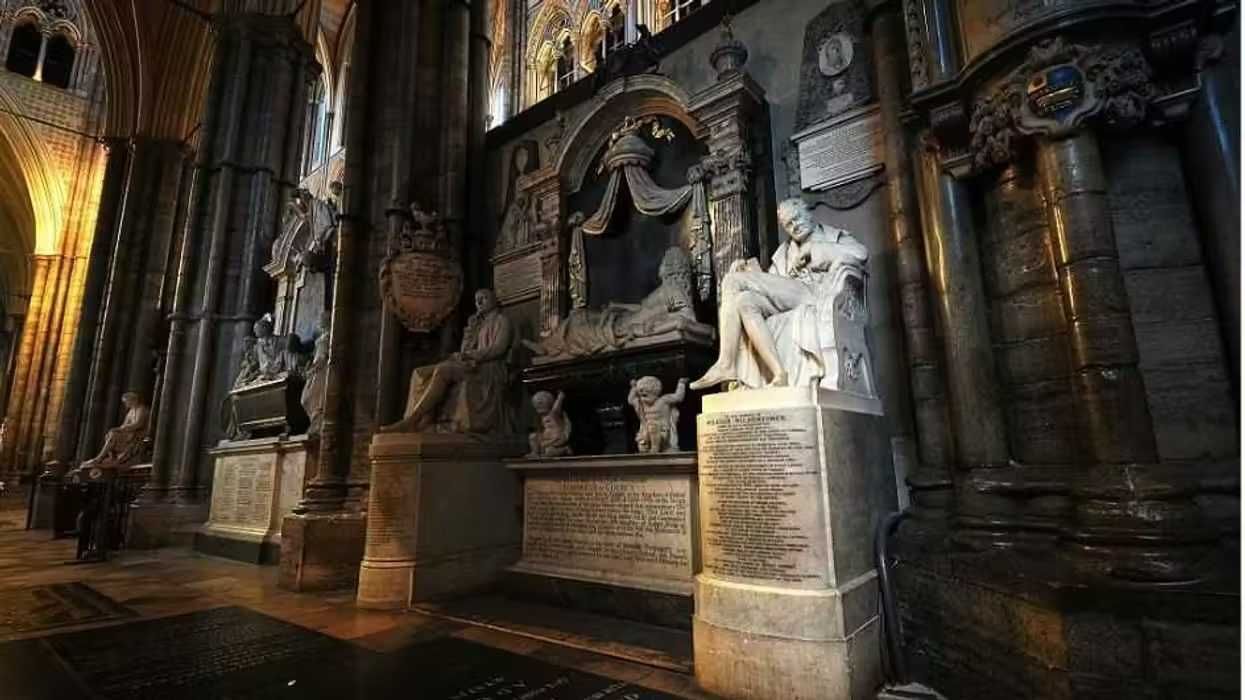
The British expended significant blood and treasure suppressing the slave trade after abolition. Parliament had already committed £20 million (roughly £2 billion in today's money — about $2.6 billion — and equivalent to around 40% of annual government expenditure at the time) to compensate slave owners for the loss of their “property.”
The government had to borrow heavily to finance the compensation, and much of that borrowing was later folded into other liabilities. A government bond containing some of the original slavery-compensation obligation was not finally paid off until 2015.
The Royal Navy’s West Africa Squadron, meanwhile, spent more than half a century hunting slave ships along the African coast. It captured roughly 1,600 vessels and liberated around 150,000 Africans.
The posting was notoriously brutal. West Africa was known among Europeans as the “White Man’s Grave,” where malaria, yellow fever, and dysentery killed sailors far more readily than combat. Thousands of British sailors died while serving on the station, most from tropical disease, as the squadron continued intercepting slave ships in some of the harshest conditions in the Royal Navy.
Against that history, the latest reparations estimate is breathtaking. Former International Court of Justice judge Patrick Robinson helped produce a calculation putting Britain’s liability at roughly £18 trillion — a sum that would lock the country into debt for generations.
Speaking of debt bondage, the International Labour Organization estimates that nearly 50 million people are living in modern slavery today — 28 million in forced labor and another 22 million in forced marriages.
Meanwhile, UNICEF has estimated that roughly 40,000 children — some as young as 7 — work in mines across southern Congo, many of them in the cobalt trade. Some labor underground in poorly reinforced tunnels where collapses can kill or maim them — digging minerals that feed the global battery supply chain so climate zealots in L.A. can drive around in virtue-signaling eco cars.
Where are the reparations for them?
When it comes to historical grievance and perpetual victimhood, two can play that game.
Jamaica spent centuries flooding Britain with rum. By the late 18th century, Jamaican distillers were shipping millions of gallons a year across the Atlantic, supplying nearly 90% of Britain’s imported rum. Think of the alcoholism. The cirrhosis. The drunken fistfights. The regrettable tattoos. Perhaps Britain should send Kingston the bill.
Absurd? Of course. That is the point. History is an endless chain of conquest, exploitation, migration, cultural exchange, brutality, and inheritance. Follow the logic of collective ancestral liability far enough and everybody eventually becomes both plaintiff and defendant.
Mottley herself is a formidable example of the ambiguity the reparations movement prefers to flatten. She attended Queen’s College in Barbados, one of the island’s oldest elite schools — a distinctly British colonial inheritance, founded in 1883 to provide an education modeled on Britain’s leading institutions. From there, she went to the London School of Economics.
Now she leads a movement that puts education and public instruction at the center of its reparations program, alongside demands for money, debt relief, and other forms of redress.
King Charles, meanwhile, is preparing for another Caribbean trip and Commonwealth summit this autumn, where Buckingham Palace says he will again acknowledge Britain’s role in slavery but will not issue an apology. The British government continues to reject paying reparations.
Good.
There is nothing wrong with studying slavery, mourning its victims, or acknowledging the wealth and institutions it helped create. But if Caribbean governments want to put a price tag on that history, Britain should answer with some history of its own.
Weeks after her office published a guide reminding migrants not to rape children, U.K. Home Secretary Shabana Mahmood suggested that some foreigners cannot even wait until reaching British shores to begin raping vulnerable people.
The home secretary made this damning admission in an interview that aired the day after English police basically locked down an entire coastal town in order to neutralize protests over the arrival of yet another ship carrying nearly 150 illegal aliens.
'Our country is falling apart.'
Mahmood, the Muslim daughter of Pakistani migrants, admitted in an interview with "The Rest Is Politics" that aired on Monday that foreign gangs effectively control the flow of illegal aliens from Northern France, not the U.K.
"You can almost guarantee that every woman that's in the north of France has probably been raped along the journey. Some of the men, too. They've certainly been abused and threatened," continued Mahmood. "Like that is not the model that should decide whether somebody gets to come to the U.K., make this their place of sanctuary, and ultimately become one of us, right? We should be deciding that."
According to a 2021 United Nations Women report, migrant girls and women experience violence "at all stages of migration" — not only at the hands of human traffickers and family members but at the hands of other migrants as well.
Last month, for instance, Spanish police arrested a trio of illegal migrants who allegedly gang-raped a fellow migrant on their way from Morocco to one of the Canary Islands controlled by Spain, reported the Express (U.K.).
RELATED: What is anarcho-tyranny? Modern Britain gives a disturbing glimpse of our future.
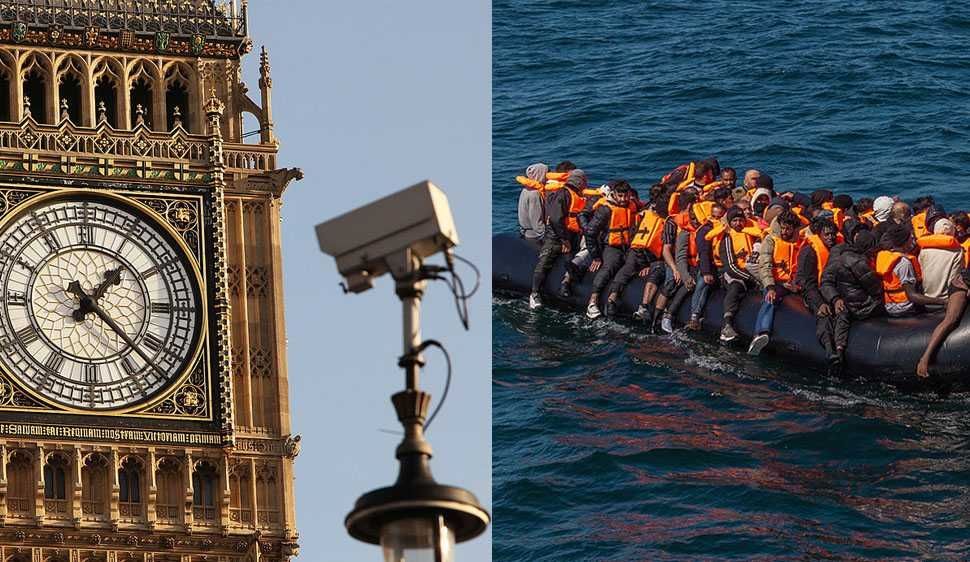
Despite claiming that Britons should decide who comes into their country and highlighting the problem of rape among the inbound migrants, Mahmood — a committed "part of the pro-Palestinian cause" — suggested that the U.K. has an obligation to bring in more refugees in order to "do right by, you know, the people of the world."
Data from the Home Office shows that eight boats carrying 609 illegal aliens landed on British shores on Monday; five boats carrying 418 illegal aliens arrived on Sunday; two ships carrying 164 illegal aliens arrived on Saturday, and one ship carrying 91 illegal aliens arrived on Friday.
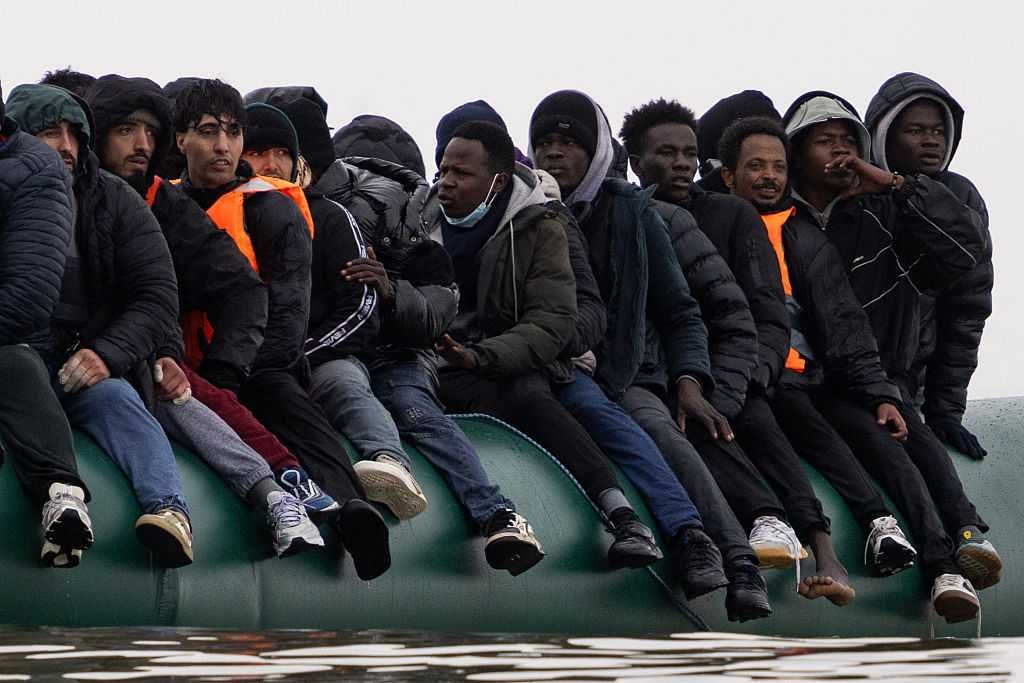
One boat was apparently having trouble crossing the English Channel, so the Royal National Lifeboat Institution and a French vessel lent the 149 would-be trespassers a hand and brought them ashore at Gosport on Sunday evening, reported the BBC.
This did not sit well with the people of the maritime town, including Donna Jones, the Conservative candidate for mayor of Hampshire and the Isle of Wight. Jones called on Mahmood "to intervene urgently, to ensure that UK Border Force has the capacity and vessels to transfer people on the water to Dover."
"No sites across the southern coastline of Britain should be used as 'landing sites,'" continued Jones. "We are not equipped and we do not have the resources to keep policing this."
George Madgwick, a Reform U.K. member of the Hampshire County Council, shared footage showing locals shouting, "Send them back," as the boats carrying the illegal aliens pulled into port.
"It’s heartbreaking because Portsmouth Harbour is the home of the Royal Navy. It’s our nation[']s pride and joy," wrote Madgwick. "And we are allowing an invasion of foreign nationals in through the same waters[.] With the Hasler detention centre due to open next year to house up to 600 [migrants] at one time this area is likely to be a hot bed for future arrivals and I’m just lost for words."
Madgwick added, "Our country is falling apart. Most normal people with common sense can see it clear as day. These people aren’t far right thugs. They are normal people who can see how bad things are getting and want to be heard."
Observing that locals and Britons from further afield were mounting a protest, the Hampshire and Isle of Wight Constabulary — the same police force whose officers disregarded the dying pleas of Henry Nowak, the English teen whom a Sikh thug murdered, then accused of racism in December — decided to effectively lock down the town.
RELATED: Diversity is our strength? Britain has to remind migrants: Don't rape kids
Hampshire police announced on Sunday, "We have deployed officers to the area to support our partners in the event of an emergency at sea, and to facilitate peaceful protest. To ensure the safety of our local communities as well as those who may wish to protest, we are making use of a variety of police powers."
In addition to prohibiting face coverings, empowering officers to "remove any items being used to conceal [a protester's] identity," and isolating protesters in a parking lot, Hampshire police said that a dispersal order was in effect in Gosport until 7 a.m. Tuesday.
Under the order, police had the authority to "order a person to leave the area with no return within a specified time period."
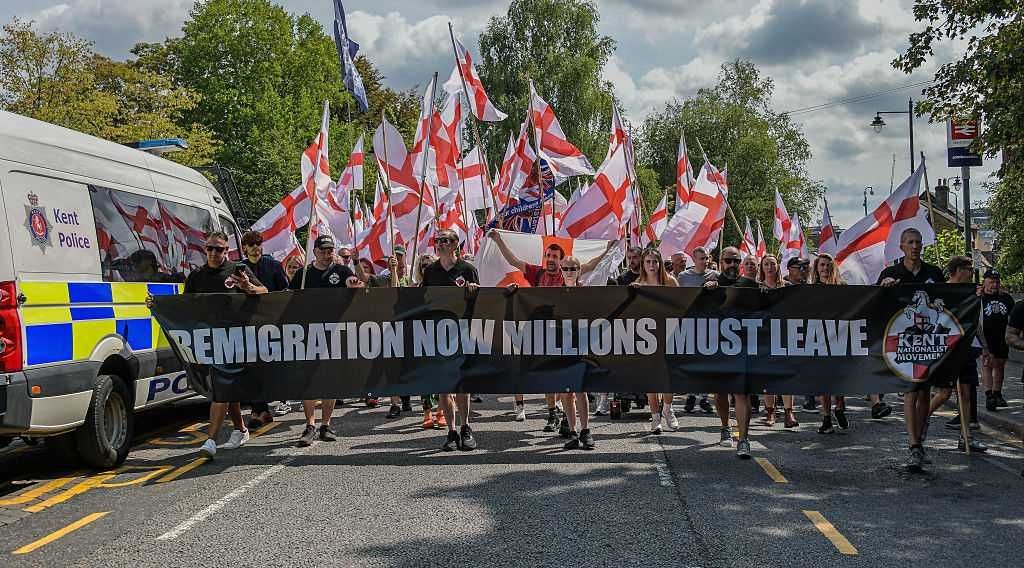
Despite the threat of arrest and being treated like cattle, hundreds of Britons turned out to protest while the illegal aliens were bussed out of town. At least 12 people were arrested, and one man has been charged with "failing to comply with a prohibited assembly direction."
Conservative MP Dame Caroline Dinenage condemned the de facto lockdown, noting in a letter on Monday to Mahmood, "Last night many residents were left feeling vulnerable, some felt trapped in their houses, with emergency services at risk of being over-stretched, and some local roads barricaded by the police. This also impacted local businesses, which were forced to close for the evening."
"Moreover, the decision to disembark the boat in the Gosport area sends a clear message to people-smuggling gangs, indicating that this is a viable new route, and this simply cannot be allowed to happen."
Zia Yusuf, the spokesman for Reform U.K., called Gosport "the latest ground zero for the invasion of Britain" and stated, "Please stop calling them 'small boats.' The vessel that landed in Gosport carried almost enough invaders to fill an Airbus A321. Nobody would describe that as a 'small plane.' Terrorists and murderers are being welcomed by Labour."
Like Blaze News? Bypass the censors, sign up for our newsletters, and get stories like this direct to your inbox. Sign up here!
After World War II, Britain and America arrived at much different conclusions about national identity, immigration, and patriotism — and according to Winston Marshall, the reason may explain why the two nations are now facing very different cultural futures.
“Today when someone on the left says, ‘You’ve offended me, I look back at them and go, ‘Good,’” Freitas says to the former Mumford & Sons musician, noting that meanwhile, the British are known for politeness.
“Do you think that otherwise very positive attribute has been used to silence the British people when it comes to pushing back against some of these claims?” Freitas asks.
“Absolutely,” Marshall answers. “Politeness is more than that. It’s doing tremendous damage to the country. It’s killing the country. We’re being polite to people and to ideas that don’t deserve politeness, and it’s because of fear of offense.”
“This has largely come from the progressive side. But those are the people with power,” he explains.
“It’s at the expense of the vulnerable people in Britain and that’s where it’s actually no longer acceptable. Very little consideration is given, let’s say, to the victims of the grooming gangs or the victims of mass migration,” he adds.
Marshall points out that just in the last month, there were “two synagogues in London firebombed,” “Jewish children chased down the street by a car,” and “two Jews stabbed in the neck.”
“In the last year, we had two Jews killed by a bloke whose literal first name is Jihad,” he tells Freitas.
“The prime minister is very reluctant to use the word Islamism. And it’s because there’s this fear of offending the Muslim community,” he adds.
Marshall believes this is directly connected to the aftermath of World War II.
“There’s many elements to it. I at the moment am inclined to think that something happened at the end of the Second World War, which is that we all rightly had to deal with the problem of what had just happened and the horrors of the Holocaust and rightly, we said, ‘Never again,’” Marshall says.
While Nazism and facism were now seen as evil, nationalism and religion were put into that category as well.
“Now the Americans learned a different lesson. They learned that American nationalism defeated facism. We should have learned the same thing, and I don’t quite understand how we didn’t,” he explains.
“We took this different lesson, and within that I think there was another set of ideas, which was the slightly later, the progressive, post-structuralist, that postmodernist school of thought, which is ... a rehashing of Marxism where instead of it being economic classes, it’s classes based on identity,” he adds.
Start watching Nick Freitas NOW at blazetv.com and use the promo code NICK for $20 off your BlazeTV+ subscription.
Can Britain still change course, or has the country already passed the point of no return?
After attending the Unite the Kingdom rally, BlazeTV host Nick Freitas is asking that question — and Konstantin Kisin, who is an immigrant himself, has some answers.
“Do you believe that there is any chance within the next five to 10 years that there is a party that controls parliament with enough of either a majority or a ruling coalition that they will significantly curtail immigration and actively deport illegal immigrants?” Freitas asks Kisin.
“I think there is no reason why Reform can’t do that, other than the legislative system is set up in such a way that they’re going to have to sweep away a lot of Blair-era legislation,” Kisin answers.
“Actually, the reason that the Conservative Party wasn’t able to deal with the issue is partly they didn't realize that when Blair was in power, they basically legislated their values into law,” he continues.
“So now, things like net zero, not deporting illegal immigrants, etc., it’s the law,” he explains, noting that despite all of this, "Reform, if they are elected, can address that problem.”
Kisin likens the influx of immigrants to inflation and people’s general understanding of it.
“The difficulty is, Nick, that it’s like inflation. Inflation goes down from 3% to 2.5%, and people say, ‘Things are getting cheaper.’ You don’t understand how inflation works. Inflation is the rate of change,” he tells Freitas.
“So getting mass immigration down from its peak of almost a million a couple of years ago to a couple of hundred thousand is great. You still have a couple of hundred thousand people coming in,” he continues.
“The challenge that people are really frustrated by is the fact that the country has changed very dramatically and in ways that they don’t like,” he says, adding, “And undoing that is a much bigger project than reducing the number of people coming in.”
“Making the Argument with Nick Freitas” is available on BlazeTV+, YouTube, and major podcast platforms.
Start watching Nick Freitas NOW at blazetv.com and use the promo code NICK40 for $40 off your BlazeTV+ subscription.
Activist, journalist, and Unite the Kingdom rally organizer Tommy Robinson chatted with Nick Freitas to warn about the dangers of the Islamic invasion of the West. As the Muslim population pushes out Christian communities, there’s plenty to worry about in the United States and abroad, Robinson believes, but hope lingers on the horizon.
Robinson was born in 1982 in Luton, a small but dense borough in Bedfordshire, England. At the time, Robinson recalled on an episode of "Making the Argument with Nick Freitas" that aired on Friday, only one mosque stood tall in town — a stark contrast to the 45 mosques now in the 17-square-mile region today.
’Muhammad was a war leader. He was a barbarian. He was a rapist. He murdered, beheaded 600 people in one day.’
It’s not just the religious layout of the town that’s changed, though, Robinson claims. It’s the culture.
“White English are now a minority in Luton,” Robinson declared, and he might be right.
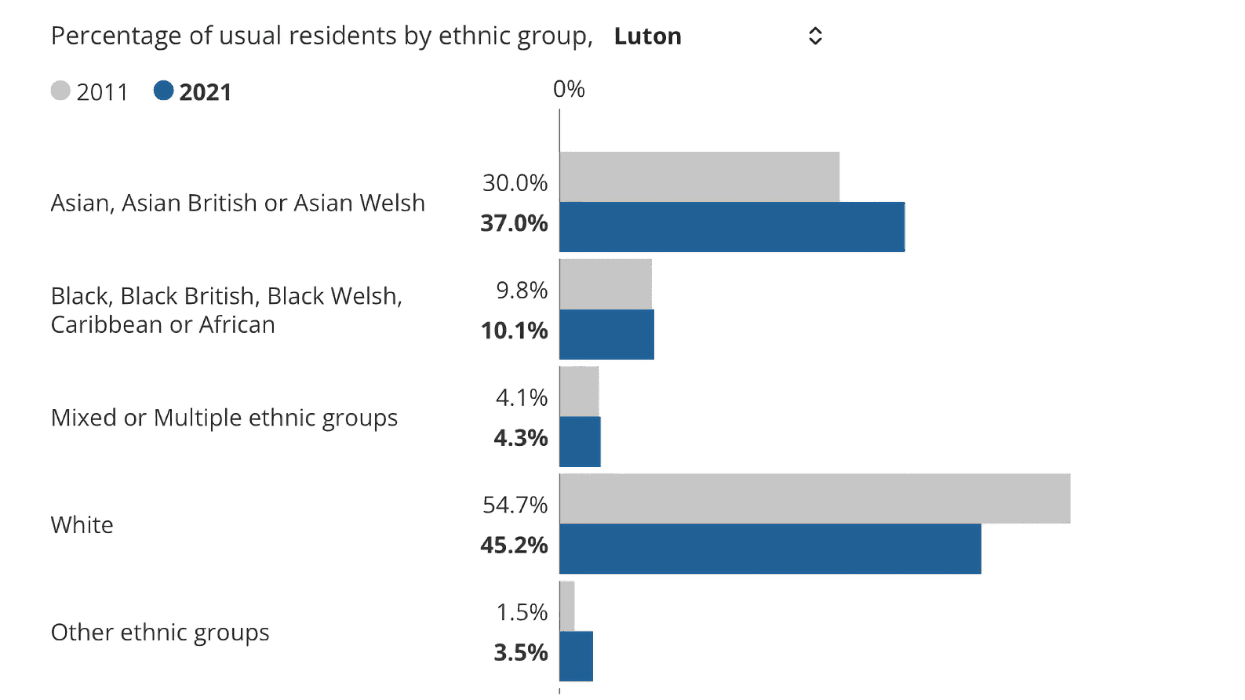
Luton census data from 2021 shows that at the time, the white population still held the majority position at 45.2%, with “Asian, Asian British or Asian Welsh” coming in second at 37%. However, the data makes no distinction between white English citizens and white non-English citizens.
Even more alarming, census numbers from 2021 and 2011 show a clear trend of the white population decreasing in Luton while all other ethnic categories have made mild to significant gains. Even if the white population isn’t the minority on paper yet, it is clearly on the decline.
Diversity isn’t necessarily the main problem, Robinson explained to Freitas. After all, he is the son of an Irish newcomer and had school friends from as far away as Italy and Bulgaria.
Instead, he is more concerned about the proliferation of Islam and the Muslim culture over Christianity in his hometown and the Western world at large.
“There's never been racial tensions in Luton,” Robinson professed. “There's been religious tensions” with no assimilation.
He went on to highlight an important distinction between the Muslim population and everyone else: “Go into the [Luton] town center and find me any Muslim that's with a non-Muslim as a friend. You won't find one.”
According to Robinson, Muslims don’t mingle with non-Muslims in town. Instead, they push other groups out of their communities as they grow from within.
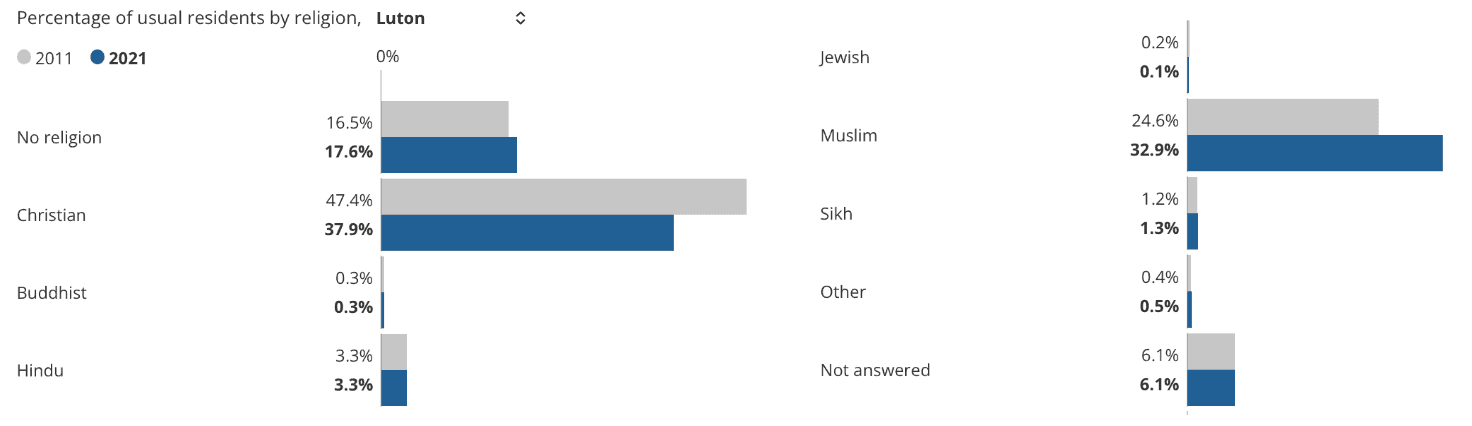
The census data highlights this, as well. In 2021, Christianity fell by 9.5% while the Muslim population grew by 8.3%.
Robinson views Islam as a primary threat, not just to Luton but to the United States, as well.
“[Islam is] not just another religion. Muhammad wasn't just another leader. Muhammad was a war leader. He was a barbarian. He was a rapist. He murdered, beheaded 600 people in one day. He's a very different man. He should not be compared in any sort of way to Jesus Christ.”
In both the U.K. and the United States, the “racist” label, in particular, has become a popular weapon for the left in cases involving Muslims.
“Fear is paralyzing,” Robinson admitted. “And the fear of being branded a racist — these words become so powerful that they paralyze an entire nation of men. The toughest men in the world were scared.”
Britain Is Gone, and America Is Next w/ Tommy Robinson
Today, the West is under attack, Robinson insists. The Islamist threat is already inside the walls of the U.K. in hubs like Luton, and once those are conquered, the United States is next. And if anyone pushes back?
“They'll go mad,” Robinson issued an ominous warning. “They'll burn the place. Violence is coming ... whether we like it or not.” Luckily, he believes that hope is on the horizon, at least for America.
“If I was Americans, I'd be optimistic, because you've got Trump. When you voted for Trump, it wasn't a vote to save America. It was a vote to save Western civilization. You give us hope.”
Like Blaze News? Bypass the censors, sign up for our newsletters, and get stories like this direct to your inbox. Sign up here!
A reasonable viewer could spend the opening minutes of “The Pendragon Cycle: Rise of the Merlin” wondering whether he clicked on the wrong show.
Daily Wire promised an Arthurian epic, yet here are the doomed inhabitants of Atlantis, bull dancers, pagan priests, and a princess named Charis fleeing a civilization about to sink beneath the sea. Camelot is nowhere in sight; neither is Arthur.
Christianity belongs to the world of 'Pendragon' as naturally as its mud, blood, and steel.
That bewilderment contains the key to the series and its considerable ambition. “The Pendragon Cycle” is not another retelling of the sword in the stone. Instead, it attempts to dramatize what had to happen before Arthur could arrive: the transformation of a pagan world into one capable of producing the Christian king of legend.
“The Pendragon Cycle: Rise of the Merlin,” a seven-episode series that premiered earlier this year exclusively on DailyWire+ and arrives on Prime Video in the U.S. today, was created by Daily Wire co-founder Jeremy Boreing and draws principally from “Taliesin” and “Merlin,” the first two novels in Stephen R. Lawhead’s sprawling “Pendragon Cycle.” Boreing has dreamed of bringing Lawhead’s books to the screen for nearly three decades, and it shows. Nobody could accuse “Pendragon” of cutting corners.
Consider Atlantis. Rather than have its inhabitants speak English with exotic accents, the production hired classical scholar and Daily Wire contributor Spencer Klavan to invent an Atlantean language, complete with grammar, vocabulary, and a fanciful linguistic genealogy reaching back before the Fall.
Shot in Hungary and Italy, “Pendragon” also makes splendid use of forests, mountains, rivers, and untamed country. The CGI impresses when called upon, but some of the show’s best special effects were provided by God. Nature is beautiful, immense, and frightening, as it ought to be in a story about men trying to build a civilization from the ruins of another.
The largely unfamiliar cast helps. Tom Sharp carries Merlin through a formidable range — warrior, husband, broken exile, prophet, and bard — without turning him into a wizardly caricature. James Arden gives Taliesin a searching, otherworldly quality that makes his eventual conversion feel earned. Rose Reid anchors the strange Atlantean opening as Charis and, thanks to her people's extraordinary longevity, provides a living connection to that vanished world.
Finney Cassidy makes an appealingly restrained Aurelius, a would-be king of the Britons, while Myles Clohessy supplies the martial force as his warrior brother Uther. Brett Cooper, probably the one face Daily Wire viewers will recognize immediately, disappears effortlessly into Ganieda, Merlin’s wife.
The history underneath all this is real enough. Roman rule in Britain effectively collapsed in the early fifth century, leaving a fractured country vulnerable to invasion and internal warfare. It is somewhere in this murky post-Roman world that the distant roots of the Arthur legend are generally thought to lie.
The legend itself came later and accumulated over centuries. Brittonic tales of a heroic Arthur were expanded and transformed by Geoffrey of Monmouth, French romance writers, and eventually Thomas Malory, gathering along the way Camelot, Lancelot, the Round Table, the Grail, and the explicitly Christian moral universe we now associate with King Arthur.
Lawhead, who served as a producer on the television adaptation, works backward from that inheritance. He takes the myth and plants it in the soil of post-Roman Britain, imagining the people, conflicts, and spiritual transformations that might have prepared the ground for Arthur.
Christianity is crucial to that transformation, but Lawhead doesn’t have it simply sweep away the enchanted pagan world that preceded it. The bard remains a bard; prophecy, mystery, and supernatural power remain. What takes place is closer to a baptism of myth, in which the old stories and powers are not discarded so much as given a new orientation.
That begins with Taliesin and Charis, Merlin’s parents. Both inherit pagan worlds and find them spiritually inadequate. Taliesin encounters the Christian priest Dafyd; Charis has already watched the splendor and religion of Atlantis fail catastrophically.
The decisive contrast arrives when Morgian, Charis’ sister and a powerful pagan priestess, sacrifices a foal she and Taliesin had once saved, then offers herself to him and proposes that together they build a world more powerful than Atlantis. He refuses. “There is a new power at work in the world,” he tells her. “I’ve seen it. A God who does not ask us to sacrifice what we love, but who sacrifices what He loves for us.”
Charis eventually embraces Taliesin’s faith and is baptized. Their son therefore inherits the bardic and prophetic world of his father and the lost Atlantean world of his mother. Merlin’s struggle is not to acquire power — he already possesses plenty — but to discover what that power should serve.
His answer eventually becomes explicit: “Not by my power, Jesu, but thine.”
RELATED: Cry 'God for England'
This is unapologetically Christian television, yet it rarely feels like a stereotypical “Christian movie.” Christianity belongs to the world of “Pendragon” as naturally as its mud, blood, and steel.
That allows the series to be dark without becoming decadent. There is war, lust, treachery, mutilation, and genuine evil. But unlike HBO's “Game of Thrones,” “Pendragon” has little interest in treating sexual degradation or cruelty as proof of adult sophistication. Its Christian worldview actually permits it to be darker rather than lighter: The world is fallen and men do terrible things, which means courage, mercy, and sacrifice can also mean something.
That same idea shapes the series’ understanding of leadership. Uther is the more formidable warrior, but his brother Aurelius begins to reveal a different kind of strength. When warned against risking himself for people under Saxon attack, Aurelius replies, “I have only one thing to offer my people: everything.”
There, in miniature, is Lawhead’s conception of Christian kingship. The pagan conception of power sacrifices others. The Christian king sacrifices himself.
Boreing and company don’t always make things easy for the viewer. Seven episodes carry a formidable load of characters, kingdoms, generations, and mythology, and the chronology occasionally doubles back on itself. This is a show that rewards close attention — you’re going to want to put your phone down. In an era of television designed for “second screening,” there’s something refreshingly demanding about that. “Pendragon” assumes its audience is willing to keep up.
A more cautious, commercially minded adaptation would get to the familiar beats immediately: the boy, the sword, Camelot, Guinevere, the Round Table. Boreing has enough faith in the material to let it breathe. He spends an entire season on Atlantis and Taliesin, the retreat of Rome, the making of Merlin, and the spiritual formation of the Britain Arthur will inherit. Only in the final moments do we reach the threshold of the Arthurian story most of us know.
There is plenty of story waiting on the other side. Lawhead’s central cycle has been complete for decades, with “Arthur,” “Pendragon,” and “Grail” still ahead of the television series. A second season has not yet been announced, though Boreing says a first draft has already been written and the cast is ready to return.
Most Arthurian stories begin with a Christian moral universe already in place. “The Pendragon Cycle” goes backward to imagine how that world came into being — how pagan myth might be gathered rather than discarded, how power might be subordinated to something higher than itself, and how a shattered country might become capable of producing a king.
Britain is among the Western nations whose liberal elites embraced the cult of multiculturalism and repeated the mantra "diversity is our strength" while welcoming unassimilable hordes from the third world. The fallout of this toxic empathy has been severe and far-reaching.
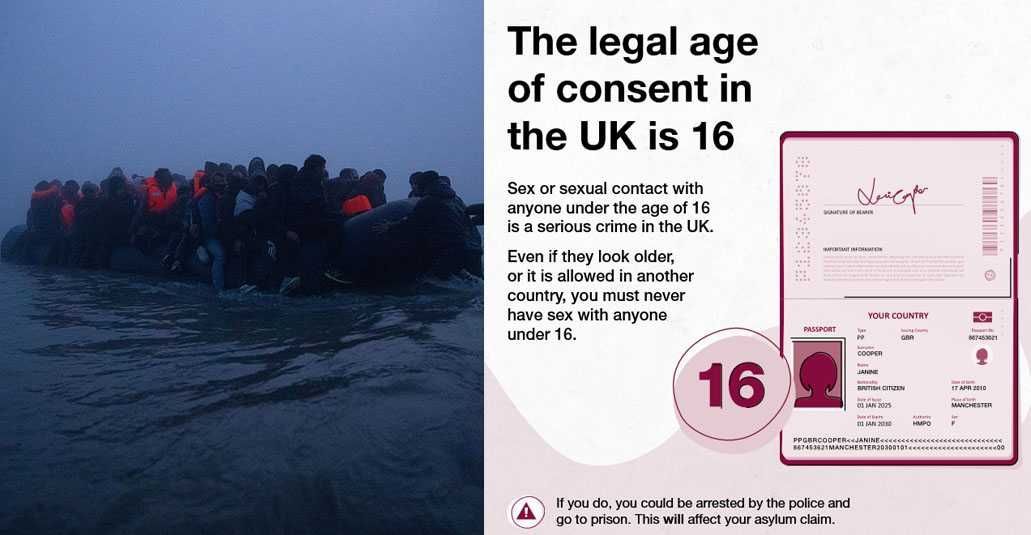
It has gotten so bad, in fact, that the British Home Office evidently saw cause to remind migrants on Wednesday not to rape or mutilate children.
'The Home Office should instead deport them.'
The government's new booklet, titled "Understanding behaviours and expectations in the U.K.: A guide for asylum seekers," states at the outset, "We understand that coming to a new country can be difficult, and that laws and customs here may be different from your home country. In the U.K., there are laws that protect everyone's safety, dignity, and rights. It is important that you understand them."
The booklet points out, for instance, that women in the United Kingdom are actually allowed to "work and earn their own money; study and go to school or university; travel freely; choose who they marry, or choose not to marry; [and] make their own decisions about their lives."
The Home Office underscored that even husbands, fathers, and brothers cannot make decisions for an adult female without her consent.
In the section on sex and consent, the Home Office informed newcomers that unlike whatever backwaters they may hail from, "In the U.K., the law is clear and strict: Both people must agree to sex or sexual contact of any kind."
"If someone is asleep, drunk, or unable to respond, they cannot consent," added the booklet, published just days after an Eritrean migrant, 33-year-old Bruke Desalagne, was found guilty of raping an intoxicated elderly man for 20 minutes outside a church in North London.
After telling asylum seekers that they are expected not to threaten people into having sex with them, the Home Office's booklet emphasized that statutory rape is indeed a crime.
"The legal age of consent in the U.K. is 16. This means that anyone under the age of 16 is considered a child and cannot legally agree to have sex," said the document. "There are no exceptions to this rule. Even if they say yes, it is still illegal. You could go to prison, lose your support and accommodation, and it will affect your asylum claim."
Of course, the United Kingdom won't deport all foreign child rapists.
For example, the victims of 73-year-old child rapist Shabir Ahmed were informed in June that the criminally convicted leader of a Pakistani grooming gang — which police said victimized as many as 50 girls — was being released from prison and could not be deported due to provisions under the Immigration Act of 1971.
RELATED: What is anarcho-tyranny? Modern Britain gives a disturbing glimpse of our future.
Besides reminding migrants that women have rights and that it's wrong to have sex with children, the Home Office guide noted that asylum seekers are expected to refrain from making sexual comments to strangers, making kissing noises at passersby, stalking individuals in public or blocking their paths, and verbally abusing people because of their religion, sex, or appearance.
The booklet concludes by informing asylum seekers that it is a crime to "take sexual images of someone without their consent" and to "share sexual images of someone without their consent."
On Wednesday, the Home Office also released a leaflet titled "Keeping children safe in the U.K.," again reminding asylum seekers that "what is allowed in some countries may be illegal here."
In addition to reminding foreigners that sex with children is a crime and that children shouldn't be beaten with "objects like belts or sticks," the leaflet notes that "female genital mutilation (FGM) and forcing a child to marry are serious crimes in the U.K."
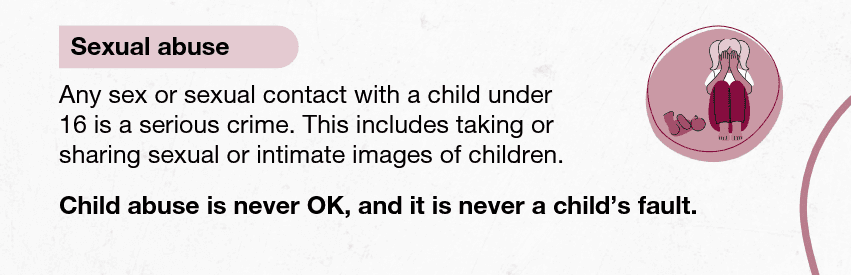
Just in case asylum seekers manage to miss these materials, the Home Office apparently has produced posters stating that sex with children "will affect your asylum claim."
"The Home Office has spent your money to produce these posters for illegal migrants," tweeted Reform UK leader Nigel Farage. "Why are we letting these people into our country?"
Chris Philp, the Conservative member of parliament serving as shadow home secretary, wrote, "The Home Office has just issued a booklet to illegal immigrants advising them not to commit rape and sexual assault, including of children[.] This tells us all we need to know about the kind of people illegally entering our country."
"Illegal and legal immigrants are coming from places and societies where attitudes towards women are completely incompatible with Western society," continued Philp. "It seems like every day there is another report of an illegal immigrant raping or assaulting women and young girls here. Instead of trying to train these mainly young, male illegal immigrants to behave in a civilised way towards women, the Home Office should instead deport them."
According to data obtained from the U.K. Ministry of Justice by the Telegraph, foreign nationals were responsible for over 25% of sexual assaults on women that were successfully prosecuted in 2024. The Telegraph noted that another 8% of sexual assaults on women were committed by offenders of "unknown" national origins, meaning the overall proportion of convicted foreign-born rapists is likely much higher.
It appears Britons are tiring of all this diversity.
A poll released in November by the National Center for Social Research found that whereas 64% of American respondents said that diversity strengthens society, only 49% of British respondents agreed. Forty percent of Britons said that white people declining as a share of the population was bad for society.
Like Blaze News? Bypass the censors, sign up for our newsletters, and get stories like this direct to your inbox. Sign up here!
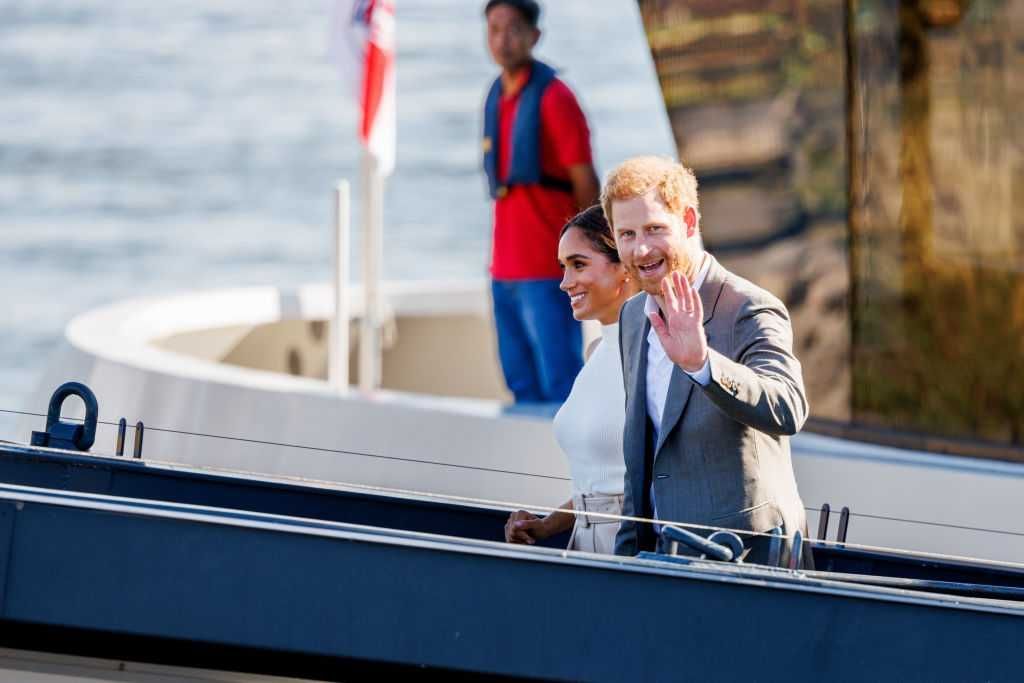
Prince Harry and Meghan Markle evidently weren't cut out for the land of the free. After braving a few years of luxury in Los Angeles, they're now planning to pull up stakes and retreat to Britain.
After British taxpayers were squeezed for roughly $3 million to refurbish the couple's 18th-century home on the grounds of Windsor Castle estate, the Duke and Duchess of Sussex announced in January 2020 their decision to "carve out a progressive new role within this institution" and "step back as 'senior' members of the Royal Family."
'I can't see a world in which I would be bringing my wife and children back.'
They dawdled around Canada for a time, then moved to the United States in 2020 to purportedly pursue a "more peaceful," private life free of royal duties.
In February 2021, Buckingham Palace announced that Queen Elizabeth had informed the duke and duchess that:
in stepping away from the work of the Royal Family it is not possible to continue with the responsibilities and duties that come with a life of public service. The honorary military appointments and Royal patronages held by the Duke and Duchess will therefore be returned to Her Majesty, before being redistributed among working members of the Royal Family.
Liberated from the responsibilities and honors bequeathed to the prince by his forefathers, the duo has spent recent years chasing the limelight.
The DEI duchess — who upon settling in California suggested on multiple occasions that Britain is racist and that she and Prince Harry left because of supposed bigotry in the House of Windsor — has not, however, enjoyed the kind of media success for which she apparently pined.
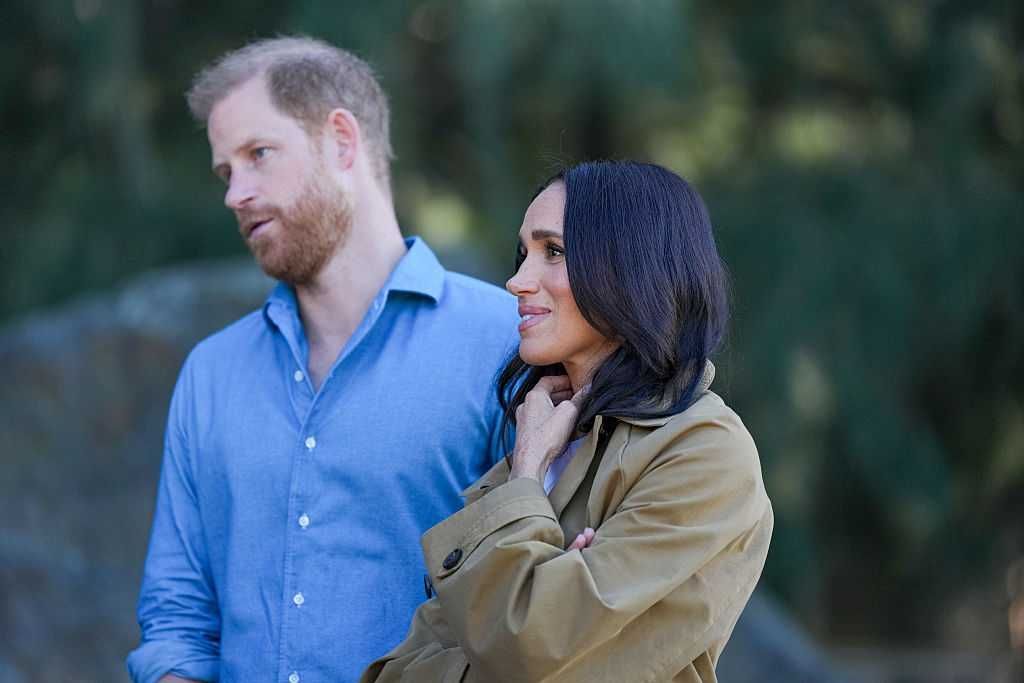
Netflix announced in July 2021 that Markle's animated feminist series "Pearl" was going into production. The project was flushed the following summer.
'F**king grifters.'
While the couple's 2024 Netflix docuseries "Polo" — dubbed an "unintentional comedy" by the Guardian — actually made it to air, it was a total flop.
Earlier this year, Netflix divested from Markle's lifestyle brand As Ever and decided not to renew her cooking show "With Love, Meghan."
The couple had a lucrative deal with Spotify valued at roughly $20 million, but that collapsed in 2023 after the duke and duchess failed to produce more than one series and a holiday special. At the time, a Spotify executive branded them "f**king grifters."
The couple's latest flop, a documentary called "Cookie Queens" that they executive-produced, had made less than $600,000 as of Aug. 18, according to reported box-office figures.
The couple has decided to move back to Britain sometime this month, according to an exclusive report from the Telegraph.
King Charles was reportedly informed of the couple's decision on Sunday.
Their children, 7-year-old Prince Archie and 5-year-old Princess Lilibet, have been enrolled to start school in the U.K., a part of the world that Prince Harry once complained "has been created by white people for white people."
The Telegraph noted that the couple plans to keep their homes in Montecito, California, and Portugal, and that Markle will run her lifestyle brand from the United Kingdom.
When asked about what motivated the return, a source close to the couple told CNN only that they enjoyed their family visit to Britain in July.
On the question of security for the duke and duchess, a Home Office spokesman told the Guardian, "The U.K. government’s protective security system is rigorous and proportionate," adding that "it is our longstanding policy not to provide detailed information on those arrangements, as doing so could compromise their integrity and affect individuals’ security."
British Prime Minister Andy Burnham said, "We wish them well in the move that they're making."
The royals' decision to return comes one year after Prince Harry stated that despite missing his homeland, "I can't see a world in which I would be bringing my wife and children back to the U.K. at this point."
Blaze News did not immediately receive comment from Buckingham Palace or the Duke and Duchess of Sussex.
Like Blaze News? Bypass the censors, sign up for our newsletters, and get stories like this direct to your inbox. Sign up here!
 The government is setting up illegal migrant camps for fighting-age men from some of the West’s greatest recent enemies and yet is surprised when its military bases come under internal attack from within.


 www.theblaze.com
 www.theblaze.com
 www.theblaze.com
 thefederalist.com