
Curious about prediction markets? Stu Burguiere shows you the ropes.
Prediction markets have been harshly criticized over claims of insider trading and illegal gambling practices, leading to politicians and media demonizing them wholesale. Are their warnings symptoms of a growing problem in dire need of recourse, or is it all part of a smear campaign meant to wrest political power away from the people? Today, we dispel the myths of these “dangerous” prediction markets, highlight the differences between the top trading apps, and gain some powerful insights from our very own Stu Burguiere.
What is a prediction market?
A prediction market is a system that allows users to trade shares on the outcomes of specific events. In the words of the Commodity Futures Trading Commission, “Prediction markets offer a variety of products designed to help the public forecast, plan for, hedge, and even harness perceptions of future events.”
'When I take a position, I assume I'm going to hold it until resolution.'
Although today’s prediction markets revolve heavily around politics and sports, the first markets centered on something a little less glamorous — agriculture. The Grain Futures Administration of 1922 was a regulatory commission tasked with combating fraud among grain traders. Their efforts were so effective that, by the 1930s, the commission expanded into other products and industries. Under a new name, the Commodity Exchange Administration oversaw markets that regulated cotton, eggs, rice, butter, metals, energy, and more. Finally, in 1974, Congress passed the Commodity Futures Trading Commission Act, which created the Commodity Futures Trading Commission that oversees prediction markets to this day.
The important thing to keep in mind is that prediction markets are nothing new — they’ve been around for a century! However, an increase in online accessibility and notoriety has landed these legal trading platforms in hot water.
Why prediction markets are “dangerous”
If you spend any time online, you’ll see how prediction markets are vilified by everyone from politicians to the media. Most of them claim the same thing — prediction markets are a form of online gambling, a practice that isn’t legal on a federal level. In fact, some states, like Arizona, are suing popular prediction market apps, accusing them of illegal betting practices.
The New York Times even called prediction markets “dangerous,” noting that “prediction machines have become infrastructure for the legitimacy of event outcomes, no matter how outlandish.” In other words, prediction markets have the power to reveal truths and trends outside the media’s control, making them a direct threat to the left-wing media machine.
According to the chairman of the CFTC, Michael S. Selig, prediction markets exist as a way to combat the fake news, stories, and narratives of the media. Instead of relying on talking heads to tell their audience how they should feel about a particular event, users log on to their favorite prediction market app and vote on an event’s outcome based on their own knowledge and deductive reasoning. Since users are discouraged from voting in favor of outcomes they believe to be a lie, prediction markets reveal societal truths backed by real money, giving facts more weight than misinformation with an honesty incentive at the end.
Both left-wing media and politicians, like Arizona’s Democrat Attorney General Kris Mayes, hate prediction markets because they take narrative power away from the elite and put it back into the hands of the people. As for the warnings of illegal gambling? That’s a lie. The CFTC classifies prediction markets as financial products similar to stocks traded on the stock exchange, which are completely legal and regulated by the federal government.
RELATED: Prediction markets let you 'bet' in states where gambling is banned: Here's how

Top prediction market apps
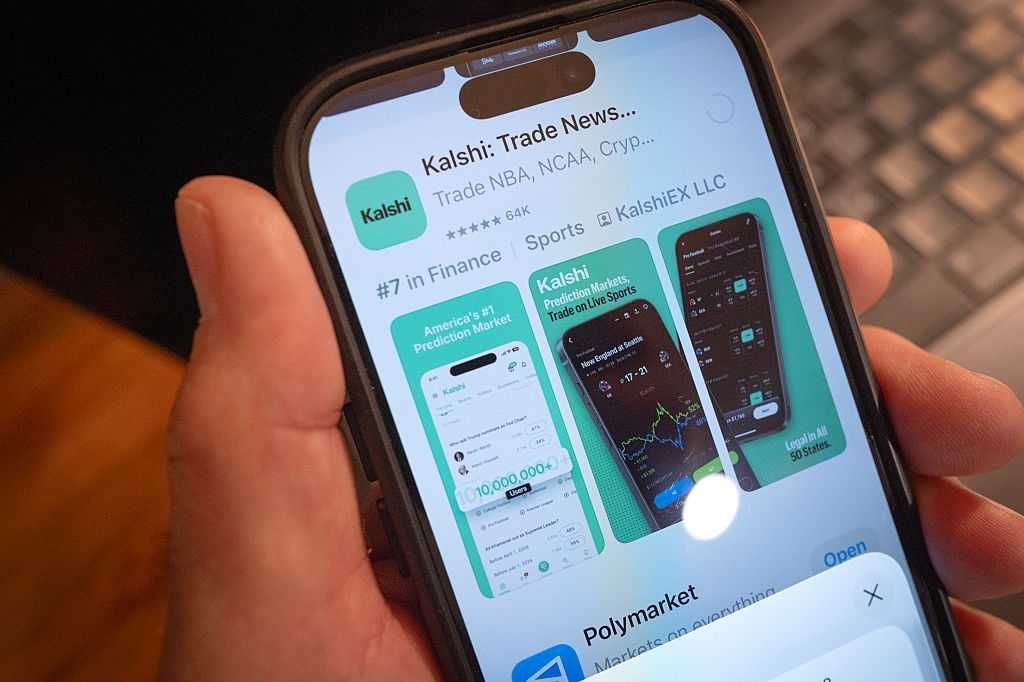
Thanks to prediction market apps, the markets themselves are easier to access than ever. Two apps in particular dominate the App Store and Google Play: Polymarket and Kalshi.
Polymarket is a sports-first trading app with robust stats on the MLB, NBA, NHL, golf, and more. It also offers a section for politics and weather, with more categories on the way, but if you’re a sports fanatic, Polymarket is a great place to start.
Kalshi offers a much broader range of trading options. From sports to politics to crypto, culture, and more, Kalshi’s rounded trading portfolio makes trading much more accessible for new and seasoned users who prefer more variety.
Since both apps are financial products, you will need to provide some personal information to create your account — this can include your first and last name, date of birth, phone number, home address, your Social Security number, a form of government ID (either a driver’s license or a passport), and a current selfie for verification.
Remember that prediction markets are subject to the same ethics and government regulations as the stock market. That means all trades are subject to government scrutiny, and insider trading laws do apply.
Make markets ‘Predictable with Stu Burguiere’
To get a better understanding of prediction markets and how they work, we chatted with BlazeTV resident expert Stu Burguiere. Here’s what he had to say:
Q: What are the big differences between the prediction market platforms? Are there any benefits to choosing one platform over another (taking into account the UI, trade options, trading fees, etc.)?
A: I think it’s beneficial for the ecosystem to have many different approaches. Kalshi is the best known in the U.S., they started here as a fully regulated platform in 2021. I was using the platform within their first few weeks of existence, but they didn’t get election markets until 2024 after suing the government and winning.
Polymarket took a more crypto-forward approach and mostly remained overseas in a bit of a gray area for U.S. users. They have since launched Polymarket U.S. but have only recently expanded beyond sports.
PredictIt has been around much longer but was limited in the amount you could invest in any contract until recently. Their fees have been a famous sticking point among the nerd community, of which I am a member.
There are also several other smaller players and rumors of up to a couple of dozen new prediction markets on the way. Some of these will likely partner with deep-pocketed companies and attempt to challenge the big boys.
Q: What are the pros or cons of using multiple prediction market apps?
A: If you’re a serious trader or someone investing a lot of money in this area, it is probably worth being on multiple apps and sites. Even markets with high liquidity will sometimes have differences in price by a few percentage points, and there’s little downside in chasing the best price. You also will find instances where a nearly identical-looking contract has preferable rules on one site over another.
It can get confusing to keep track of everything, but if you’re looking at this as part of a real money portfolio, it’s worth it to look for these advantages.
But for someone just getting started, I wouldn’t sweat it.
Q: Which app provides the best trading data to make a sound decision, set expectations, etc.?
A: I think you can find the information you need to trade pretty easily on most, if not all, of the various markets once you get comfortable. I wouldn’t say any of them are the places where you’re doing research, though. The most important part is to always read the rules because the headline question is occasionally more complicated than you think.
Q: Are there any delays in depositing money to trade or receiving money after a trade is complete?
A: I find it to be about as easy as funding any investment account. Kalshi, for example, offers no-fee bank transfers in one to three days, almost instant crypto transfers, and even Venmo, CashApp, Google Pay, PayPal (fees vary), and traditional bank wire transfer. Maybe even carrier pigeon.
You won’t be surprised to hear they make it very easy for you to deposit your money! But I have also never had an issue at all withdrawing funds from any of them.
If you’ve never dabbled in crypto, the overseas Polymarket exchange can be a little intimidating. The U.S. version seems to be more manageable for the average person.
Q: Are there any missing features between the mobile and desktop web versions of Kalshi and Polymarket?
A: I prefer desktop for anything complicated. It’s pretty easy to make basic trades on the apps or to see how your investments are performing. When you are looking back at your history, you’re going to want the desktop, unless you have a fetish for scrolling and clicking “more” over and over again.
Q: Is there any risk of “wash trading” or manipulation where users can sway the stock in favor of a certain outcome?
A: I don’t think manipulation presents much risk overall, especially with the current market liquidity. There are people much smarter than me trading thousands of times a week, and that’s part of the deal. But that’s not how I go about it. When I take a position, I assume I’m going to hold it until resolution. If you take that approach, it doesn’t really matter where the markets move on a day-to-day basis. In the end, you’re either going to be right or wrong, and no market actor can change that.
Q: How serious are the “illegal gambling” lawsuits, and what are platform holders like Kalshi and Polymarket doing to push back against this narrative?
A: As with any innovation, there are plenty of annoying government officials trying to screw it up. Throw in a hefty dose of established actors looking to protect their turf against competition, and the threat is serious in scope if not in argument.
Luckily, for the time being, we have Michael Selig as CFTC chair, and an administration friendly to financial innovation. Selig has correctly been aggressive in defending the authority of the CFTC to maintain oversight over these markets. Just like your state can’t ban you from buying Walmart stock, they shouldn’t be able to stop you from participating in prediction markets.
This could all change under a different Congress or a President AOC, but we can deal with that level of hell when we arrive in it.
Q: How do prediction markets handle ties? Do these come up often or rarely?
A: I would say a tie is very rare. Most of the rules are written to make them impossible. In the old days, there were sometimes markets with poorly written rules or descriptions that led to controversy. This isn’t particularly common anymore, but it does occasionally happen.
There was a recent example revolving around the removal of the leader of Iran. Kalshi is legally prohibited from listing or paying a contract that is the result of death or assassination. This was clear in the rules, but a lot of people don’t read them. So there was controversy over the required unwinding of that contract, and some overseas markets without those restrictions resolved the contract in a totally different way.
Those rare examples get lots of press but occur in a tiny percentage of the markets available. Most people will never even experience one of them.
Q: Do you have any tips, tricks, or advice for new users who are just starting to get into prediction markets?
A: Start small and assume you’re wrong more often than you think you are. Challenge yourself on your priors, and especially in politics, make sure you’re not investing with your heart. I always feel better investing in a race when I’m on the side of the candidate I want to lose. At the very least, if I’m wrong, I’m happy with the outcome in real life. And if the candidate I dislike winds up winning, at least I’m being paid for my pain. It’s hedging your life.
Oh yeah, and hang out with us at PredictableShow.com.
Tune in
Still curious about prediction markets? Maybe you want to throw some of your own cash on a current event, but you’re not sure how to get started? Check out Stu’s new show — “Predictable with Stu Burguiere” on YouTube and Substack — for the latest prediction market news, updates, insights, and more.Predatory gambling apps are using loopholes to avoid state laws

For this year’s March Madness, the action goes far beyond the court: Millions of teenagers too young to step into a Las Vegas casino are placing college basketball bets on prediction market platforms.
It’s the latest form of legally dubious gambling, a growing “campus frenzy” in which unsafe and unregulated sports betting sites are masquerading as investment.
People as young as 18 can wager nationwide, even in the 11 states where online sports gambling remains illegal.
As moms, we take nothing more seriously than the obligation to protect our kids and communities. Prediction markets do the opposite: They exploit college students by luring them into sports “event contracts” through shady marketing, financed fraternity parties, and social media influencers.
Passed off as merely predictions of who will win a game or tournament, these contracts are sports gambling in disguise. They should be regulated as such, treated the same as the online sports betting that has proliferated nationwide since the Supreme Court effectively legalized it in 2018.
By skirting state and tribal laws, prediction markets are offering unregulated sports betting without consumer protections or age minimums, avoiding state gambling taxes that fund important education and infrastructure programs. An estimated $657 million state gaming tax dollars have been lost since prediction markets waded into the sports arena.
At Moms for America, we proudly joined the new Gambling Is Not Investing coalition to make sure this pernicious trend is reversed — and that prediction markets’ sports event contracts are stopped until they comply with state gambling laws.
Our cause is made more urgent by the unrelenting growth of prediction markets. They seem to be everywhere, with people betting — sometimes with alleged inside information — on everything from elections to developments in the U.S. war against Iran.
But athletics drive the action. Sports regularly account for over 85% of volume on Kalshi, one of the two major prediction market platforms along with Polymarket, according to a 2025 report from Keyrock and Dune Analytics.
Since early 2024, the report found overall monthly volume on prediction markets has surged from under $100 million to more than $13 billion.
Prediction markets are exchange platforms in which people trade event contracts based on predicting the outcomes of future events. They offer many of the same bets as sportsbooks, including moneyline, spread, player props, and over/under outcomes.
Yet even though they clearly constitute sports betting, prediction markets claim they are regulated by the federal Commodity Futures Trading Commission rather than state gambling agencies. This claim allows their gambling activities to be rebranded as “trading,” or “investing” — and means that people as young as 18 can wager nationwide, even in the 11 states where online sports gambling remains illegal.
RELATED: Arizona files 20 criminal charges against Kalshi for flouting state gambling laws
Since most states with legal online sports betting restrict it to people 21 and older, this loophole has created a “three-year window” for prediction markets to target the 18- to 20-year-old crowd.
As the Wall Street Journal put it in a recent expose, Kalshi and Polymarket are aiming their marketing “at an eager group of users that isn’t known for financial discretion: college students.”
The targeting has not been subtle: Both platforms have been paying student influencers and creators on TikTok and Instagram to promote them, while Polymarket has offered to help fund parties for fraternities in exchange for signing up users.
The platforms are taking advantage of a troubling trend: extensive gambling among teenagers just short of college. Common Sense Media, which recently surveyed more than 1,000 U.S. adolescent boys ages 11 to 17, found that nearly half of 17-year-olds gambled in the past year.
This exploitation of our youth must stop. Since prediction markets clearly promote gambling, they should be regulated by state gambling agencies that enforce safeguards and compliance standards.
A number of states, correctly seeing prediction market platforms as “sports gambling in disguise,” are asserting their regulatory authority in federal courts.
As March Madness heats up, the NCAA recently urged the CFTC to suspend college sports offerings in prediction markets until the agency implements stronger regulations.
Amid the various calls for action, we urge the public to weigh in. Tell your elected officials and state leaders that prediction markets should not be a back door for unregulated sports gambling.
After years of flying under the government’s radar, the cryptocurrency industry is facing major regulation

Sens. Debbie Stabenow (D-Mich.) and John Boozman (R-Ark.) introduced a bipartisan bill that would give regulatory authority over cryptocurrencies to the Commodities Futures Trading Commission. Under the bill, all cryptocurrency platforms — including traders, dealers, brokers, and sites that hold crypto for customers — would be required to register with the CFTC.
CFTC chair and former Stabenow aide Rostin Behnam recently testified before the Senate Committee on Agriculture, Nutrition, and Forestry, which has authority over the CFTC. In the testimony, Behnam stated that the CFTC needs more authority to properly regulate crypto. Stabenow and Boozman lead the Senate committee.
Calls for more oversight over crypto have peaked this year as prices across the industry continue to collapse since their peak last November. Bitcoin, the most widely used cryptocurrency, is currently trading at a fraction of its all-time high, down from more than $68,000 in November 2021 to about $23,000 this week.
The Securities and Exchange Commission (SEC) has served as the primary regulatory agency of cryptocurrency in recent years. Other members of Congress, as well as consumer advocates, have suggested that regulatory authority should lay with the SEC as opposed to the CFTC. The CFTC had a budget last year of $304 million with roughly 666 employees. In contrast, the SEC had a budget of nearly $2 billion and 4,500 full-time employees, according to the Associated Press.
The AP also reports that passage of the Stabenow-Boozman bill would be considered a win by the cryptocurrency industry, which sees the CFTC as a more “industry-friendly” regulator than the SEC. The cryptocurrency industry is “trying to get anyone other than the SEC to regulate them,” said Cory Klippsten, CEO of Swan Bitcoin.
This bill is the latest in federal efforts to reign in the crypto market. In June, Sens. Kirsten Gillibrand (D-N.Y.) and Cynthia Lummis (R-Wyo.) proposed a sweeping bill called the Responsible Financial Innovation Act. That bill would require the IRS to adopt guidance on digital assets and would make a distinction between digital assets that are commodities and those that are securities. It also names the CFTC as crypto’s primary regulator.
Earlier this year, President Biden issued an executive order calling on agencies to look at ways to regulate digital currencies. This followed the administration’s 22-page report last November calling on Congress to pass crypto regulation.
 www.theblaze.com
 www.theblaze.com