Rebuild the republic one classroom at a time



The shocking assassination of Charlie Kirk at Utah Valley University puts an exclamation point on the degraded state of reasoned debate in America.

Like many in the last month or so, I’ve found myself doing a deep dive into Kirk’s YouTube channel, watching debate after debate. You learn something from watching them in full: Kirk was willing to talk to anybody, and he always brought liberals to the front of the line.

We must teach our students to be virtuous, both individually and politically.

He was pugnacious at times, but always civil. His interlocutors sometimes resorted to ad hominem attacks, and their arguments often collapsed under a steady stream of his questions and retorts. Time after time, these students lost the debate with Kirk because they simply didn’t know enough.

‘Action civics’

What causes a person to stake out a position with such confidence before mastering the evidence to support it? For many of the students who challenged Kirk, the answer is “action civics.” This pedagogical theory holds that the highest form of civic participation is protest rather than discussion. Its result is thoughtless grandstanding or worse. The antidote to this state of affairs is classical education rightly understood.

When it comes to civics, knowledge is necessary but not sufficient. Civic life requires more than a grasp of American history and government, as important as those things are. It requires us to be people formed by practice in the habit of reasoned deliberation — people who know how to disagree and be disagreed with and who are willing to change their opinions when they learn something.

Political speech — reasoned discussion about the good within a regime — allows us to improve our opinions by sharing them with others and refining them through conversation and disagreement. Civic education divorced from these practical virtues produces either performative activism or feckless intellectualizing.

These virtues can be cultivated within the classroom through classical education. Reading and discussing works from Aristotle to the Federalist allows students to wrestle with enduring questions about justice, rights, and the good life. They learn not only to discern what is right but also to pursue it amid the complexities of a changing world.

Yet the real formation comes in seminars and Socratic discussions, which are laboratories of civic practice.

After years outside of the classroom, this semester I began teaching a course on moral and political philosophy to 11th graders. These students are young, but after years in a classical school, they have some real learning under their belts. The task this year is to develop within them the habits necessary for a real seminar conversation, with Socratic discussion three days a week and a full-blown seminar on the other two.

Running a seminar

In a well-run seminar, teachers merely provide a question about a great work of literature, history, or philosophy, intervening to guide the discussion only rarely. As in life, no authority swoops in to give the right answer and make decisions for everyone else. It’s the students who lead and who learn to find their way together.

A properly run seminar allows students to disagree and be disagreed with. They are forced to humble themselves before an author and a text, to scrutinize their own opinions, and to discard error in favor of knowledge.

But it isn’t a lawless environment. Students in a well-run seminar know that they are to speak about the text and only the text. Every comment must respond to the previous speaker. Non sequiturs are not allowed, and the students don’t interrupt each other (we are still working on that last one).

If we want a citizenry capable of sustaining liberty, we cannot settle for activist training without understanding, nor abstract lectures without practice.

When they do speak, they have to ground their statements in an argument drawn from the text. If they don’t have an interpretation of the text to offer, they can ask a thoughtful question, which is often just as beneficial to the conversation as a well-reasoned argument.

Disagreement in the seminar room is an opportunity to learn that disputing someone’s argument doesn’t mean impugning their character. Most teenagers are terrified to disagree with someone their own age and even more terrified to be disagreed with. But after a few weeks, they develop thicker skin. They learn to think more about the substance of their argument and less about their social standing.

RELATED: How Charlie Kirk’s life shows the power of self-education

skynesher via iStock/Getty Images

When the arbiter of the debate is the text itself, everyone knows that success means advancing the clearest and most correct reading. And when the text is rich and deep, it takes time, conversation, and disagreement to interpret it well.

Disagreement is an opportunity for clarification. In a well-developed seminar, it’s welcomed. What matters is not superficial civility, but the willingness to examine and revise our opinions in light of reason and fact, to argue from truth rather than feeling, and to labor toward a common understanding.

Dare to disagree

In a way, these classroom discussions on Plato and Virgil, Swift and Shakespeare, are a crash course in practical civics. Not protest, not theory, but character formation through dialogue, study, and experience — all preparing students not only to understand their country but to participate in it responsibly. In a way, classical education creates more people like Charlie Kirk.

If we want a citizenry capable of sustaining liberty, we cannot settle for activist training without understanding, nor abstract lectures without practice. We must teach our students to be virtuous, both individually and politically. Only then will they be capable of self-government — not as activists or spectators, but as citizens.

Editor’s note: This article was published originally at the American Mind.

Effective School Accountability Comes from Parents, Not Tests

Using tests to rate schools teaches teachers to serve spreadsheets rather than students, raising numbers rather than cultivating minds.
In Latest Term, Supreme Court’s ‘Conservative Majority’ Plays By The Left’s Rules

The Supreme Court continues to grant legitimacy to the leftist revolution that has overtaken and transformed most aspects of our nation.

To Love Math, Kids Should Start Older And Encounter Its Beauty

Math is something to enjoy. It is not a tool that will make you rich or a box to check for college admissions.

Secularists think they won at the Supreme Court — but they’ll lose in the end


The Supreme Court disappointed Christians when it deadlocked in Oklahoma Statewide Charter School Board v. Drummond.

The justices' 4-4 split keeps in place the ruling of the Oklahoma Supreme Court that St. Isidore of Seville Virtual School may not operate as a charter school in the state — for now, anyway.

Denying American families access to the winning combination of a Catholic charter school is not only unconstitutional but also unconscionable.

The court’s “non-decision decision” came about, in part, because Justice Amy Coney Barrett recused herself from the case. Barrett did not explain her reasons, but her close ties to Notre Dame’s Religious Liberty Clinic and her friendship with a chief adviser to the school likely played a role.

How this happened

In the face of progressive accusations of unethical behavior, the justices recently agreed to a code of conduct that represents “a codification of principles” governing their conduct. Importantly, a justice is “presumed impartial” and “has an obligation to sit unless disqualified.” The code adds, presciently, that “the absence of one Justice risks the affirmance of a lower court decision by an evenly divided Court — potentially preventing the Court from providing a uniform national rule of decision on an important issue.”

Back in 2003, Justice Antonin Scalia, for whom Barrett once served as a law clerk, denied a motion for his recusal based on his friendship with then-Vice President Dick Cheney, who was a named party in a case before the Court.

"The people must have confidence in the integrity of the Justices, and that cannot exist in a system that assumes them to be corruptible by the slightest friendship or favor, and in an atmosphere where the press will be eager to find foot-faults," Scalia wrote.

In any event, what is done is done. And more importantly, Barrett’s recusal is not binding for future cases.

The victory that wasn’t

Secularists and opponents of school choice have been celebrating the outcome, even though split decisions do not constitute binding legal precedent.

As Notre Dame Law Professor and Supreme Court scholar Richard Garnett observed, “The do-nothing denouement in this particular round of litigation does not preclude other courts, in other cases, from vindicating the no-discrimination rule and permitting religious schools to participate in charter-school programs.”

Garnett is right. The twin religion clauses of the First Amendment — the Free Exercise Clause and the Establishment Clause — permit certification of religious schools like St. Isidore’s as charter schools.

Take, for example, the court’s recent decisions involving the Free Exercise guarantee and school choice initiatives. When the court struck down the “No-Aid” provision in Montana’s state constitution that excluded religious schools and families from a publicly funded scholarship program for students attending private schools, Chief Justice John Roberts reaffirmed the Free Exercise Clause’s demand for fairness.

“A state need not subsidize private education,” he observed. “But once a State decides to do so, it cannot disqualify some private schools solely because they are religious.”

Similarly, in Carson v. Makin, the court found that Maine violated the Constitution when it excluded religious schools from participating in a voucher program for rural students. Roberts, again writing for the court, explained that “the State pays tuition for certain students at private schools — so long as the schools are not religious. That is discrimination against religion.”

No clause against faith

Allowing religious schools such as St. Isidore’s to participate in a state’s charter school program is merely a natural application of this principle of fairness. But what about the Establishment Clause?

Oklahoma Attorney General Gentner Drummond argued that certifying St. Isidore’s as a charter school would violate the Establishment Clause.

His argument has some appeal, particularly for secularists who want public schools to have a virtual monopoly over America’s educational system. Granted, the Supreme Court has repeatedly held that the Establishment Clause prohibits public schools from providing religious instruction. Private schools, by contrast, are free to do so. Charter schools receive public funding, but they are privately established and controlled schools with minimal regulatory oversight by the government.

Consequently, charter schools are not state actors. And because they are not state actors, a charter school’s endorsement of any particular religion does not constitute a violation of the Establishment Clause.

Success secularism can't match

Charter schools currently exist in 45 states and the District of Columbia. A recent study reveals that charter-school students “show greater academic gains than their peers in traditional public schools.” The study also found that “charter students in poverty had stronger growth, equal to seventeen additional days of learning in math and twenty-three additional days of learning in reading, than their [traditional public school] peers in poverty.”

As for the benefits of a Catholic education, Catholic school students “continue to outpace public schools in math and reading, while public school student achievement has not returned to pre-pandemic levels and reading scores continue to decline following a sobering trend last reported in 2022.”

Denying American families access to the winning combination of a Catholic charter school, then, is not only unconstitutional but also unconscionable.

The split decision affirming the Oklahoma Supreme Court means that families in the Sooner State cannot yet benefit from the stellar Catholic education offered by St. Isidore's as a charter school.

Still, it needs repeating: The order does not set precedent. The question of whether the Constitution allows a state to exclude religious schools from its charter program is not settled.

A call for clarification will likely be before the court soon and, with a full bench, we should expect that principles of fairness and religious freedom will prevail.

WATCH: 9-year-old prodigy schools Democrats about 'unlocking talents' through school choice


A 9-year-old prodigy delivered an important lesson to Democrats regarding school choice while recently testifying before Nevada lawmakers.

Juliette Leong took a stand for educational freedom during her powerful speech in front of Nevada lawmakers.

'Wow, Juliette understands education policy better than most Democrats.'

Leong is a vocal proponent of Assembly Bill 584, a legislative proposal introduced on May 14 that is aimed at overhauling the state's public education system and enhancing school choice for students in Nevada. The transformative school choice bill — also known as the Accountability in Education Act — has been championed by Nevada Gov. Joe Lombardo, a Republican.

AB 584 introduces RISE education accounts, which would empower students and parents to redirect public funds toward private education, charter schools, homeschooling, or tutoring services if their local public school is failing to meet performance standards.

"This bill expands school choice, holds schools accountable for performance, supports educators, and prioritizes literacy and career readiness," Leong wrote on Instagram. "Nevada has given $11.5 billion to its school districts this biennium, but without accountability, no amount of money will ever be enough."

Leong recently told the Assembly Committee on Ways and Means, "I'm here today to express my strong support for AB 584 to expand school choice."

"Thanks to Governor Lombardo, Nevada is on its way to becoming a true school choice state, giving the children the tools to thrive," the 9-year-old proclaimed.

"Our school system is too large and too slow to keep up with the world shaped by rapidly changing job markets," Leong explained. "That's why families need options like smaller private schools, charter schools, and homeschooling."

Leong said, "I spell at a third-grade level and do high school-level math, and no school could accommodate my needs, so I'm homeschooled."

RELATED: Test scores drop at SF elementary school that spent $250K on 'Woke Kindergarten' program to teach anti-police lessons, 'disrupt whiteness'

Video Screenshot juliette.leong Instagram

Juliette noted that her homeschooling has enabled her to thrive in numerous ways, including being an "internationally acclaimed art prodigy, award-winning mathlete, philanthropist, entrepreneur, and influencer who is enrolled in college classes," according to Leong's personal website.

Leong began painting at 8 months old and started selling her paintings for nearly $20,000 when she was just 7 years old.

All of the proceeds from the sales of her paintings have been donated to charities and organizations such asAsian American Donor Program, Race to Erase MS, Ladies Who Rock 4 A Cause, Oakland Public Education Fund, Art in Action, Mensa Foundation, APA Heritage Foundation, and Asian Inc.

Leong has reportedly donated more than $250,000 to numerous nonprofit organizations.

Juliette — who is a TEDx speakerhas exhibited her artwork at the Reno Tahoe International Art Show, the Children's Discovery Museum of San Jose, and the Reno Generator.

Leong is also a talented violinist who, at age 5, was the youngest violin soloist to perform at Carnegie Hall. She is the youngest member of the Reno Philharmonic Youth Symphony Orchestra.

Juliette is also an impressive singer who has performed the national anthem for the Texas Rangers, Oakland Athletics, Reno Aces, and Sacramento River Cats.

RELATED: DeSantis ratifies 'game changer' school choice bill allowing all Florida students to get school vouchers

Furnished by the Leong family

Leong told the lawmakers, "It's not just about academics. It's about unlocking talents, building confidence, and creating opportunities. It's about teaching kids to solve problems and make a difference."

"Since every kid is different and every family has different circumstances, school choice is how we prepare Nevada students for real-world success, and that everyone who wants a job gets a job," Juliette stressed. "The world is moving forward, and Nevada needs to move forward with the world. Thank you, Governor Lombardo, for fighting for school choice."

Leong's speech on school choice racked up thousands of views on social media and caught the eye of Sen. Ted Cruz (R-Texas).

"Wow, Juliette understands education policy better than most Democrats," Cruz declared on the X social media platform.

Cruz added, "I’m leading the fight to ensure that my Universal School Choice Act is included in President Trump’s One Big Beautiful Bill — let’s get school choice done."

Lombardo said in April, "After delivering the largest investment in K-12 education in Nevada’s history, we owe it to our communities to match that investment with real results — and real accountability. I’m proud of what we’ve done so far. But let’s be clear — we can no longer accept lack of funding as an excuse for chronic underperformance."

Gov. Lombardo declared, "That’s why I’m introducing the Accountability in Education Act, which is legislation built on one guiding principle: No child in Nevada should be trapped in a failing school because of their ZIP code or held back because of how much their parents or guardians earn."

Assembly Bill 584 will face scrutiny from the state’s Democrat-controlled legislature.

“He has leverage, because if there are gonna be certain things that the Democrats want to pass, and the governor has a veto power, so they have to figure out how to work with him so, like, both sides can get what they want,” Valeria Gurr — a senior fellow at the American Federation for Children — told the Washington Examiner. "Maybe not everything will pass, but certain pieces certainly will pass."

RELATED: How a federal case could decide the future of faith-based schools

Like Blaze News? Bypass the censors, sign up for our newsletters, and get stories like this direct to your inbox. Sign up here!

Charter Schools Are Not ‘State Actors,’ And SCOTUS Should Have Said So

Charter schools need more autonomy than district schools if American families are going to have real choice in education.
Amy Coney Barrett’s recusal leaves religious liberty twisting in the wind


The U.S. Supreme Court’s 4-4 deadlock last week left intact the Oklahoma Supreme Court’s ruling against St. Isidore of Seville Catholic Virtual School — a failure of constitutional courage and a setback for educational freedom.

The tie lets stand a decision that discriminates against faith-based institutions by denying them the same public charter school opportunities extended to secular organizations. It rests on a misguided reading of the First Amendment’s Establishment Clause and ignores the protections guaranteed by the Free Exercise clause.

Families deserve more than crumbling bureaucracies and ideological indoctrination. They need real alternatives — the kind private and parochial schools have offered for generations.

Plaintiffs, including the Oklahoma Statewide Charter School Board, made a compelling case: Excluding St. Isidore solely because of its Catholic identity violates the Constitution.

In Carson v. Makin (2022), the Supreme Court ruled that states cannot deny religious organizations access to public benefits otherwise available to all. Charter schools, while publicly funded, operate independently and serve as laboratories of innovation. St. Isidore committed to meeting Oklahoma’s curriculum standards and serving any student who applied. Its disqualification stemmed from one reason alone: its religious mission.

That’s religious discrimination, plain and simple.

The Oklahoma Supreme Court misread the Establishment Clause, and the U.S. Supreme Court failed to correct the error. The clause doesn’t forbid religious organizations to participate in public programs. It forbids the state to establish an official religion — not from offering families the freedom to choose a Catholic education within a public framework.

St. Isidore wouldn’t force anyone to adhere to Catholic doctrine. It would simply give parents another option — one grounded in a Judeo-Christian worldview and committed to academic excellence. Banning that option undermines pluralism and silences voices that have historically delivered high standards and moral clarity in American education.

Meanwhile, public education in the United States teeters toward collapse. Students trail their peers globally. In some districts, basic literacy remains out of reach. Families deserve more than crumbling bureaucracies and ideological indoctrination. They need real alternatives — the kind private and parochial schools have offered for generations.

Faith-based schools routinely outperform their government-run counterparts. Instead of blocking them from public charter programs, states should welcome their success and harness their model. Innovation doesn’t threaten the system. It might save it.

Oklahoma Attorney General Gentner Drummond, despite claiming to be a Republican, sided with liberal secularists in opposing St. Isidore. His legal brief warned of “chaos” and raised alarm over hypothetical funding for “radical Islamic schools” — a tired slippery-slope argument that ignores the core issue of equal treatment under the law.

RELATED: This red-state attorney general has declared war on the First Amendment

Bill Clark/CQ-Roll Call Inc. via Getty Images

Drummond abandoned conservative principles like school choice and religious liberty. Instead, he backed those who place rigid interpretations of church-state separation above fairness. His stance helped fuel the Supreme Court’s deadlock and undercut Oklahoma families seeking diverse educational options.

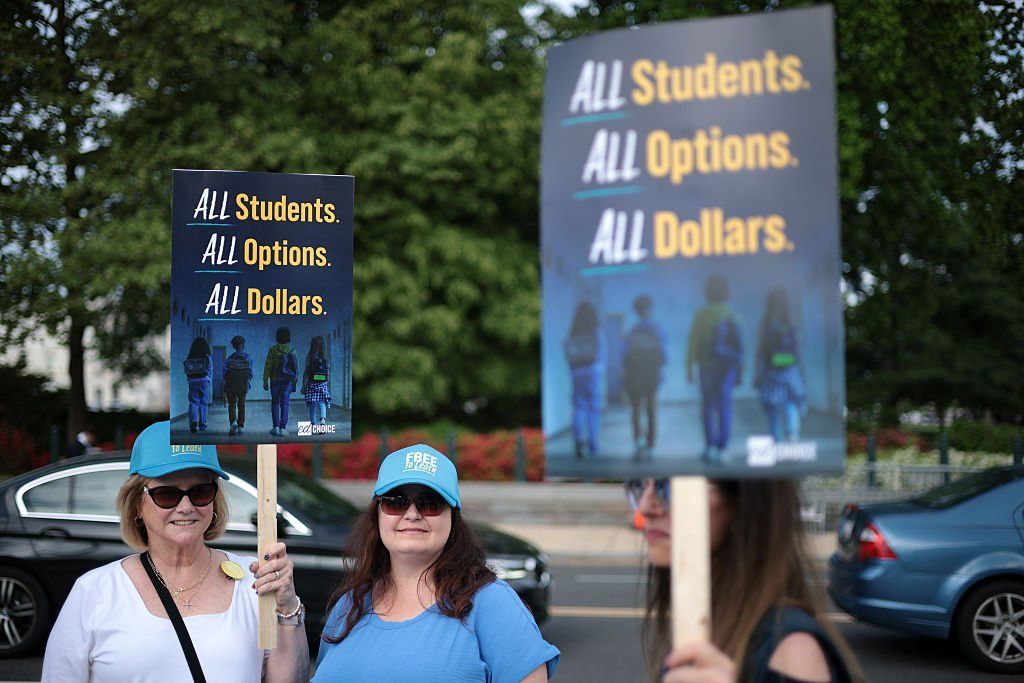
The Supreme Court’s failure to resolve this question, due in part to Justice Amy Coney Barrett’s recusal, leaves a constitutional gray area: Can states bar religious organizations from public programs that remain open to everyone else?

Parents deserve the right to choose schools that reflect their values — whether religious or secular. By excluding St. Isidore, the state has effectively declared that faith-based institutions are second-class citizens. That’s not just bad policy. It’s a dangerous precedent in a nation founded on religious liberty.

The founders never intended to wall off religion from public life. They saw the Christian faith and Judeo-Christian values as cornerstones of strong, free societies. Most early American schools were church-run. Today, the pendulum has swung too far to the left. Progressive bureaucrats attack the very moral foundations that made America successful in the first place.

If we want to make America great again, we need to reclaim those values and push back against the cultural nonsense that sidelines faith.

If we want to reverse the decline of American education, we need more choices — not fewer. This fight isn’t over. Oklahoma will keep defending parental rights and religious freedom. The St. Isidore case remains unfinished business — and we intend to finish it. Faith-based schools must have the freedom to educate our children without unconstitutional restrictions.

SCOTUS Declines To Nullify Lower Court Blockade On Establishing First Public Religious Charter School

In a stunning Thursday ruling, the U.S. Supreme Court declined to nullify an Oklahoma Supreme Court decision blocking the establishment of the nation’s first public religious charter school. The final vote was deadlocked at 4-4, with Associate Justice Amy Coney Barrett recusing herself from the case. The high court did not offer a written opinion […]