![]()
Sometimes, life has this way of turning down the volume on all the chaos, and in that stillness, we get a clear glimpse of what truly matters. One of these moments occurred in my life last month.
It was a quiet January night, just a few days before the presidential inauguration. I was lying in bed in the middle of the night with my 6-year-old, Echo, gently calming her after a night terror had awakened her. As she finally drifted back to sleep, I felt a heaviness settle over me, thick and suffocating, like the air before a storm. It pressed against my chest, not like a weight, but like a presence — something unseen yet undeniable. At that moment, I could only think to bow my head, close my eyes, and offer a silent prayer to God.
The valley of the shadow of death
In September 2024, our family suffered a heart-wrenching loss — one I’m not prepared to speak about in detail yet, but I will when the time is right. Not long after the tragedy, I met an incredible woman named Diane, a bishop, who had prayed with me after my loss and was the first to ask me if I wanted to be saved. (I’m still getting the hang of the lingo. Some say pastor, preacher, or minister, depending on the church — but I know Diane as a deeply faithful soul who helped guide me closer to Jesus. For that, I am forever grateful.)
I first crossed paths with Diane through my masseur, Ade — pronounced “Ah-day” — a Mayan-Mexican immigrant I got to know after my divorce from Echo’s dad. Ade is a kind, quiet Christian who would whisper prayers for me while he worked without ever letting on. It wasn’t until months later that he told me about it. To this day, he remembers the first time we met and how worried he was about me. Coming out of my previous marriage, I was thin, fragile, totally worn down, and in anguish.
Faith is not about having all the answers but about trusting in the one who does.
One day, it finally hit me that his prayers were doing more to heal me than the deep tissue massage ever could. As we were wrapping up a session, I asked, “Hey, Ade, do you know anyone who can help keep ‘bad energy’ away from people? Basically an exorcism.” Ade looked at me, paused, and simply said, “Yes — when you are ready.”
In the weeks following our family’s loss, I saw Ade again, and as he had so many times before, he prayed for me. But this time was different. I bowed my head, let the tears fall, and begged for God’s help. It was then that Ade connected me with Diane.
The water and the blood
That next morning in January, I called Diane, who had texted me earlier, “I want to talk with you about getting baptized.” This felt like the final confirmation of something I already knew: It was time. I called her then, and we decided that on Sunday (the day before President Trump’s inauguration), she and her husband, Peter, would baptize me in my backyard.
As she pulled into my driveway, I was struck by her presence. Like me, she is a woman of mixed race from Oakland. With piercing blue eyes and curly black hair, she is a grandmother in her 70s with a quiet strength about her. I soon learned she was no ordinary chaplain but, in fact, the lead chaplain at Santa Rita Jail, the fifth-largest jail in the country.
![]() Image source: Nicole Shanahan
Image source: Nicole Shanahan
During that meeting, Diane opened her worn and well-loved Bible — filled with highlights, underlines, and Post-it tabs. A book that had been studied and prayed over thousands of times. She moved through it with laser precision, guiding me to verse after verse as I struggled to read through my blurry, tear-filled eyes. The pain of life sometimes can consume your entire reality, and the injustice, the loss, and the extreme nature of it all can feel genuinely unbearable. The weight of the world, perpetuated by greed, lies, and indifference, can often feel hopeless. Diane looked at me and said with absolute certainty that Jesus could save me — that his blood is able to wash away sins and defeat the darkness that haunts the innocent.
I think it took the pain of that moment, the desperate need for hope, and the unwavering intensity in Diane’s eyes to finally break through the last, most stubborn skeptic in me. When Diane asked if I wanted to be baptized, I didn’t hesitate — I said yes.
The whole armor of God
I’ve always believed in God, but I never fully grasped the reality of the devil. Growing up with a father who seemed overcome by his demons, I try to avoid “bad energy.” He was addicted to alcohol and would fall into manic rages, yelling profanities at the wall. He would scream, laugh, cry, and wail all in a single evening, alone downstairs in our home in Oakland. I was taught that my father was a “sick” person, but I never seriously considered whether demons were real — until recently. Honestly, my last year in politics changed that. Learning just how far some will go to inflict atrocities on innocent Americans has shocked me awake. Other unexplainable events have also forced me to reconsider whether we are waging a war not merely with flesh and blood but with spiritual forces.
Many people shy away from acknowledging the reality of spiritual warfare. But anyone who has seen addiction up close or lived through deep trauma and witnessed how evil takes hold in this world knows that the battle of good versus evil isn’t just theoretical — it’s real and all around us.
Demons certainly exist, and Jesus is our covenant with God to fight them. When I said “yes” to accepting Jesus as my savior, I felt something I could hardly put into words. It was like being wrapped in a warm cocoon while becoming a grounded, weighted, immovable obelisk.
I’ve long practiced meditative prayer, influenced by years of practicing yoga, studying Eastern religions, and engaging in “personal development” through programs like the Hoffman Process. But now, my prayers are directed toward Jesus. He is the bridge between us and heaven — our intercessor before the divine creator.
A Jew for Jesus
In the summer of 2014, I converted to Judaism.
As I wrote to my rabbi at the time, “I am choosing to become Jewish for many reasons. One of the largest aspects of Judaism I’ve come to enjoy is that it brings families together, and if I’m going to give my future kids something I didn’t have growing up, Judaism provides a wonderful blueprint.” (I was engaged to marry a Jewish man then, and we had celebrated Jewish holidays for years together.) The process was long and immersive: over a year spent at Congregation Emanu-El in San Francisco, attending study sessions and group conversion classes several times a week. I wrote a 10-page conversion statement — one of the best pieces of writing from that chapter of my life, in hindsight. It was a deep dive into the Torah, guided by the wisdom of several teachers.
For over a decade, I identified as Jewish. But now, with the New Testament in my hands, I see the world’s spiritual pain in a way I never could before. It’s like a veil has been lifted, revealing a deeper understanding of the struggle between light and darkness.
Today, I am a Jew for Jesus.
![]() Image source: Nicole Shanahan
Image source: Nicole Shanahan
When my partner, Jacob, heard I was getting baptized, he didn’t hesitate. “I want in — I want to be baptized, too,” he said. I smiled and said, “Great, we’ll both be Jews for Jesus!”
Jacob comes from a rich and complex spiritual lineage. His father is a Brooklyn-born Ashkenazi Jew, and his mother is a blonde Scandinavian Lutheran from Ohio. Although raised in the American Jewish tradition, Jacob has felt a pull toward Christianity in recent years. He also sensed that something was missing in his spiritual journey.
Jesus longed more than anything to save “God’s lost sheep.” It was the deepest, most unfulfilled desire of the holiest being to walk this earth. And I believe that longing still exists today — an aching truth we’ve ignored, distorted, and misunderstood for far too long. The universe itself is pressing us forward, like cheese through a grater, forcing us to feel the weight of God’s pain, the sorrow of a Father who gave his only Son, only to see him rejected instead of upheld as the one true Messiah.
For those who are searching, who feel the same longing I once did, I can only say this: Keep asking, keep seeking, keep knocking. Faith is not about having all the answers but about trusting in the one who does. And when you find him, you will know you are finally home.
Nisi Dominus aedificaverit domum, in vanum laboraverunt qui aedificant eam. Amen.
— (@)
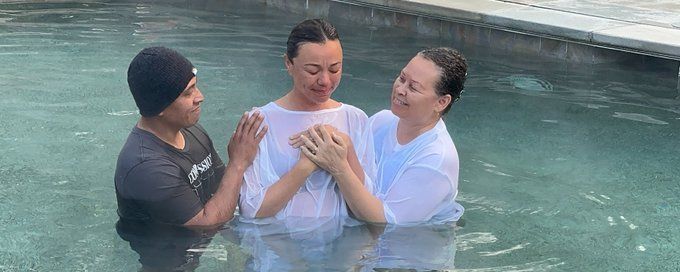
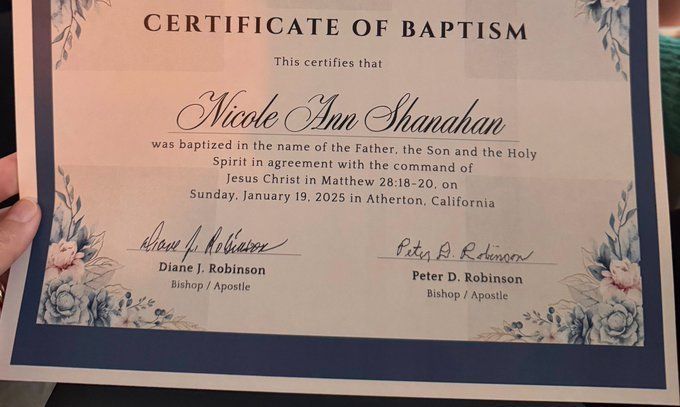 Image source: Nicole Shanahan
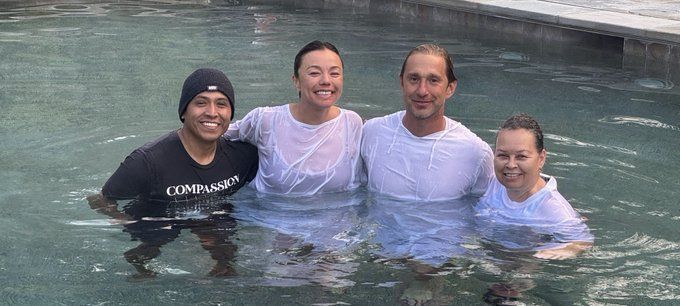 Image source: Nicole Shanahan
 www.theblaze.com
 www.theblaze.com