Glenn Beck: I wish I had realized THIS about Christmas much EARLIER


If you’re a parent, you may have wandered into the stage of life where all of your children are no longer gathered around your Christmas tree on Christmas morning — and Blaze Media co-founder Glenn Beck is no stranger to this stage.

“You pine for the days when we were all together,” Glenn says, before recalling his best and worst Christmases.

“I remember I was broke, dead broke. Stu, he was, like, 18 years old, and he’s living in an apartment. He’s got a nicer apartment than I did. We lived in the same complex. I was, like, 35 or 40. And I just was completely broke,” Glenn recalls.


“I was with my daughter, and we were in a CVS, and she was there by the cash register, and there was this little ornament. ... It was a little teeny tree ornament. And she’s like, ‘Oh, that is so nice.’ And she was little little. And I thought, ‘Oh.’ ... It just broke my heart because all I could think of is, ‘I can’t even afford that. I’m such a loser as a dad,’” he continues.

However, this was not Glenn’s worst Christmas.

“My worst Christmas was the first time I had real success, and I decided, I’m going to buy everything I ever have ever wanted for my kids. And literally the boxes were almost up to my waist. I mean, I had all the kids and all the presents and everything you could possibly want,” Glenn explains.

“And it was so empty. That was my worst Christmas. And my kids never talk about that Christmas. Never,” he says.

“Somewhere along the line, we let that lie creep in, and we bought into it — the lie that says what I give is what you’re worth. That lie is absolute poison, and it’s absolutely not true,” he continues.

“You think that your kids are counting boxes, and quite honestly, teenage years, they might be. They might be. But they grow out of those. You just put up with the teenage years. They’re coming. They suck. They go away. They’re not counting boxes; they’re not looking at labels. ... They’re counting on you,” he adds.

Want more from Glenn Beck?

To enjoy more of Glenn’s masterful storytelling, thought-provoking analysis, and uncanny ability to make sense of the chaos, subscribe to BlazeTV — the largest multi-platform network of voices who love America, defend the Constitution, and live the American dream.
You’ve got the Christmas story wrong: Lee Strobel tells Glenn Beck the ONE Greek word that shatters our classic narrative


Back in 2005, “The Case for Christ” author and Christian apologist Lee Strobel published a book called “The Case for Christmas: A Journalist Investigates the Identity of the Child in the Manger.”

In September this year, 20 years after its original publication, Strobel released an updated version of his Christmas book to include the latest scholarship, research, archaeological findings, and scientific insights that have emerged since.

On this episode of “The Glenn Beck Program,” Glenn interviews Strobel about these fascinating new findings that change the way we read the Christmas story.

According to the most widely accepted narrative, Mary and Joseph came to Bethlehem for the census, arrived at an inn, but were turned away by the innkeeper for lack of space, forcing Mary to give birth to Jesus in a separate stable or barn among animals, where she laid him in a manger.

But Strobel says there’s one Greek word that changes this narrative entirely, and that word is “kataluma.”

In the ancient manuscripts of the gospel of Luke, “kataluma” is the word used to describe the place where Mary and Joseph were turned away, but it doesn’t mean inn, according to most scholars.

It actually translates to “guest room.”

A typical house in first-century Bethlehem, Strobel explains, had “one large room broken down into two parts.”

“The larger part was a living area — that’s where people would live, eat, sleep — and then there was a couple of steps down to a smaller area where the animals were brought at night,” he explains.

However, because animals were often seen as beloved pets, sometimes they were allowed to come up into the main living area. A manger (a feeding trough) was therefore a common item in both the upper and lower spaces of the house.

Wealthier families also had a “kataluma” — a guest room — in their homes, used for hosting traveling family and friends.

The original scriptures say that Mary and Joseph were turned away from the “kataluma” because it was occupied. This means that the couple likely didn’t seek shelter at an inn at all but rather at a relative’s home.

It makes sense that the “kataluma” would have been full at this time because of all the people traveling into Bethlehem for the census. Mary and Joseph, Strobel explains, were likely told by their relatives that they could just stay and birth the baby in the main living area.

“And yes, there is a manger there. And yes, some of the animals may have come up the stairs because of the commotion,” he says, reiterating that animals and mangers were common in a home’s main living space.

“There probably was no inn,” he concludes.

But an imprecise translation for “kataluma” isn’t the only evidence for this new narrative.

Strobel explains that Luke uses the word “kataluma” only one other time in the book, and it clearly refers to a separate room in a family home. But he uses a different word — “pandocheion” — to refer to a traditional inn in the parable of the Good Samaritan.

“If he wanted to use the word ‘inn,’ he would have used ‘pandocheion,’ but he didn’t. He used ‘kataluma,’” he says.

Further, “in first-century Jewish culture, the value of hospitality was so high that it would have been impossible for an innkeeper to turn away a pregnant Jewish woman,” Strobel tells Glenn.

“It would have destroyed his business. ... And we don’t even know there were any inns in Bethlehem. It was a small town — 500 people. It wasn’t on a main crossroads. There may or may not have even been an inn there in the first place,” he adds.

The revelation that Jesus was most likely born in a home rather than in a dirty barn “changes everything,” Glenn says.

But there are even more details that the traditional Christmas story gets wrong about Jesus’ birth, according to Strobel.

According to the standard narrative, Mary is on the verge of giving birth when she and Joseph arrive in Bethlehem, but this urgency, Strobel says, comes from “a book of fiction that was written in 200 A.D.”

The scriptures only tell us “that while they were in Bethlehem, she gave birth. Doesn’t say they’re in Bethlehem five minutes or five days or five months,” he explains.

To hear more incredible revelations from Strobel’s investigations into the authentic Christmas story, watch the video above.

Want more from Glenn Beck?

To enjoy more of Glenn’s masterful storytelling, thought-provoking analysis, and uncanny ability to make sense of the chaos, subscribe to BlazeTV — the largest multi-platform network of voices who love America, defend the Constitution, and live the American dream.
Catholic priest goes on CNN to rewrite history and make the story of Christmas about progressive politics


A Catholic priest raised eyebrows on Christmas for describing Jesus in highly political modern political terms unrecognizable to the ancient world.

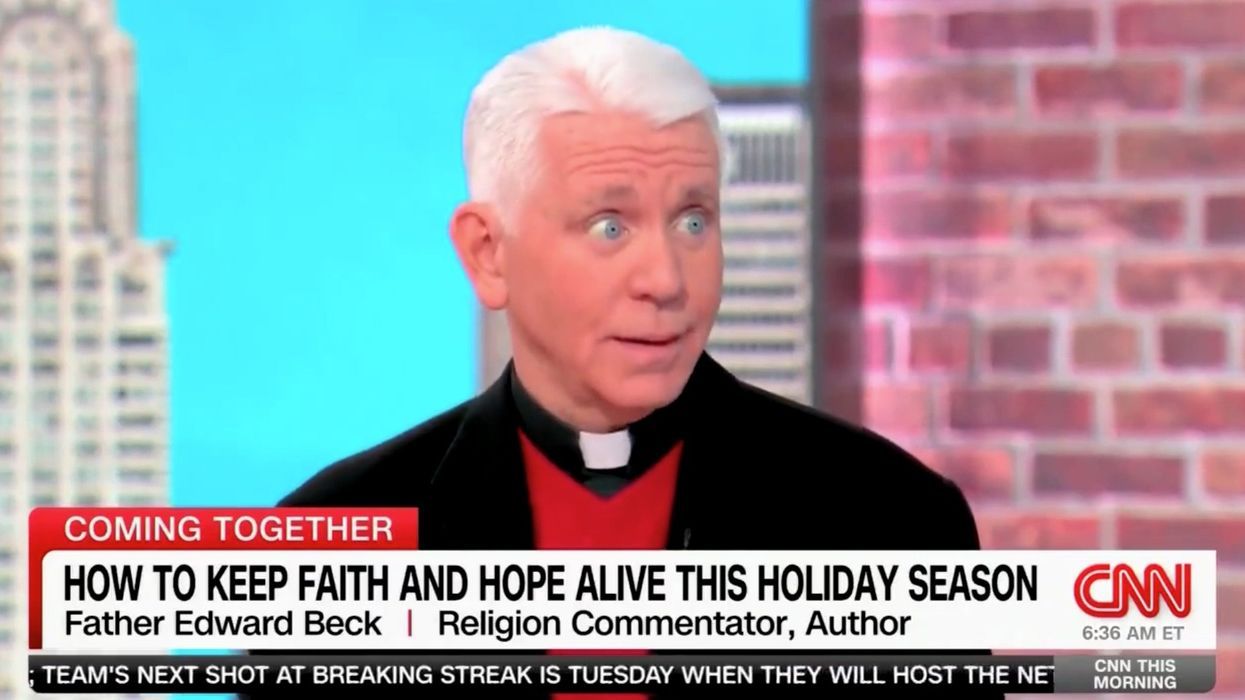
On Christmas morning, CNN anchor Poppy Harlow asked Catholic Fr. Edward Beck, a CNN religion commentator, to speak to anyone feeling "hopeless" during the holiday season.

At first, Beck hit the nail on the head. "I think the message of Christmas is that God enters into it with us, and we're not alone in it," he said. But then he entered into the land of progressive politics.

"What I'm so struck by is that the story of Christmas is about a Palestinian Jew," he said.

"Now, how often do you find those words put together? A Palestinian Jew born into a time when his country was occupied, right? They can't find a place for her to even give birth. They're homeless. They eventually have to flee as refugees, into Egypt no less," Beck continued. "I mean, you can't make up the parallels to our current world situation right now. And so in some way, that is who we believe God becomes, born into that situation."

— (@)

There are several problems with Beck's declaration.

First, Jesus was not a "Palestinian Jew." Beck uses "Palestinian" to describe Jesus' ethnicity when, in fact, "Jew" describes both Jesus' religion and his ethnicity. Jesus was Jewish because he was a descendant of David in the tribe of Judah and because he was born in Judea.

Second, the emergence of the "Palestinian" identity is a modern development, taking root in the 20th century. No one living in the first-century Roman province of Judaea would have described themselves as a "Palestinian." The province, in fact, was renamed to "Syria Palaestina" in the second century, about 100 years after Jesus' death, following the Bar Kokhba revolt.

Third, Jesus was not born in an "occupied" country. The Roman Empire won de facto control of Judea in the first century B.C. and retained control of the region (later through the Byzantine Empire) until the Muslim conquests of Syria in the seventh century. Thus, the land into which Jesus was born was as "occupied" then as the U.S. is "occupied" today.

Fourth, there is no evidence that Mary and Joseph were "homeless." Luke 2, which recounts the birth of Jesus, does not describe Jesus' family as such.

Beck is the same Catholic priest who two years ago said that Christians who did not receive the COVID-19 shot should not attend Christmas church services.

Like Blaze News? Bypass the censors, sign up for our newsletters, and get stories like this direct to your inbox. Sign up here!

‘Die Hard’ Is An Anti-Christmas Movie

[rebelmouse-proxy-image https://thefederalist.com/wp-content/uploads/2023/12/Screenshot-2023-12-19-at-6.50.14 AM-1200x675.png crop_info="%7B%22image%22%3A%20%22https%3A//thefederalist.com/wp-content/uploads/2023/12/Screenshot-2023-12-19-at-6.50.14%5Cu202fAM-1200x675.png%22%7D" expand=1]'Die Hard' embodies the most cynical, and often truthful, view of what Christmas has come to mean in modern America.

Drunk South Carolina man gets caught on video stealing Santa statue, but holiday theft ends in a merry Christmas story


A drunk South Carolina man was caught on video stealing a Santa statue from a Greenville restaurant. However, the Christmas thief had a revelation that restored the yuletide faith.

A man was caught on video stealing a Santa Claus statue from outside the Bonjour Main restaurant in downtown Greenville on Dec. 11.

WSPA-TV reporter Henry Coburn was covering the story, and interviewing the restaurant's owner Mayra Gallo. The owner interrupted the interview, "He's sitting right up there."

The holiday hijacker returned to the scene of the crime – not to steal another Christmas decoration, but to apologize for his naughty behavior. Less than 24 hours after stealing the Santa statue, the thief returned to Bonjour Main to beg for forgiveness.

The man – who identified himself as Melvin – had brought the owner a dozen roses in an effort to apologize for stealing the Santa statue.

To accept his apology, Gallo asked Melvin to come clean with a TV interview with Coburn. The owner promised not to press charges as long as Melvin's apology was sincere.

Melvin said, "I'm sorry. Really sorry. I know saying sorry doesn’t do anything, but I promise I’ll do better."

Coburn noted that Melvin "looked both nervous and extremely embarrassed."

The Kris Kringle crook claimed he was celebrating a friend's birthday on the night of the theft with some alcoholic beverages. He admitted that he may have indulged in a few too many spirits.

He confessed, "Just wasn’t thinking. I was like, 'That’s cool. Wish I had it.'"

Coburn wrote on Twitter, "He said that less than 24 hours later (and doubtlessly more sober), he brought it back. He says he felt horrible, wanted to make things right and, of course, wanted to avoid charges."

"I'll do anything I can to make things right, pay for any damages, fix anything I can, work for free," Melvin pleaded. "I'll literally do anything to resolve this situation in the most positive way possible."

Gallo took Melvin up on his offer to help around the restaurant. She said that not pressing charges was her Christmas gift to Melvin.

In the end, the Santa Claus statue robbery ends in a merry Christmas story.

ONLY ON 7: Upstate Santa thief apologizes www.youtube.com

The 'reason for the season' is to be grateful for all the sacrifices made for us


“Remember the reason for the season!” is the sign we see all over once the holidays start popping up. What is that exactly?

It’s funny, when I was growing up, everyone knew what the reason was. Not everyone recognized or believed in the sacrifice that Jesus Christ made for the sins of the world. But we lived in a culture and a country that at least knew what it was, even if some rejected it.

It’s different now.

Our culture, our nation, has splintered. There are many many reasons for this, but one of those is that we just don’t celebrate Christianity in as unified a way as we used to. People in the Western World simply don’t have as much space for any faith, much less Christianity, as we used to.

But the central reason for Christmas is still one that all people can recognize, despite their faith, or lack thereof. The reason for the season is that no man is an island, and we all have people that came before us that sacrificed in order for us to be where we are, to have what we have and be what we are. And it is good for us to stop and think about those sacrifices made for us, and be thankful, and grateful.

And this is true in every spheres of our lives.

As an American, a central part of my identity is to be grateful for all the people who sacrificed so much for this incredible nation to be created and maintained for decades until I was lucky enough to participate in it. Part of my identity is to continue that work, in whatever way I can, to preserve and maintain the institutions upon which this country is founded, and those that made it great.

Part of my identity is to recognize the sacrifices my father and my mother made to make me who I am, and to be grateful to them and respect those sacrifices by living a life they would be proud of. That extends to my own family now, I have to repay the sacrifices made for me by sacrificing for them.

Even as simply a person who was born at a time where the world has advanced to such an incredible age, I have to force myself to stop sometimes, quit taking things for granted, and look around and marvel at the awesome miracles that technology and our human inventiveness have produced for us to share and flourish. Even those are gifts from a God who planted that inventiveness into the human soul and provided the elements in creation for us to invent with.

Part of the reason I believe in Christianity is that I have so much to be grateful for. The central story, the incredible narrative at the center of the Bible is that a holy and perfect God came down to save humanity and made an unfathomable sacrifice for us, to redeem us from our sins, and draw us to Him in a way we could never do on our own. It is the highest most perfect sacrifice that encompasses all others.

As I look around at every miraculous good that God has provided to me, to all of us, I am reminded at the reason for this holy season.