Arriving ‘Legally’ Doesn’t Magically Make Immigrants Good Americans
 If we continue to prioritize a project of culturally incompatible 'diversity' over a robust form of Americanism, we will continue to see foreign conflicts play out on our streets.
Earlier this month, the Cato Institute — perhaps the most effective think tank advocating open borders — published a study claiming that since 1994, immigration has generated a whopping $14.5 trillion surplus in tax revenues over expenditures.
Critics quickly noted that Cato’s study uses a strange standard for judging immigration policy. For example, the study admits that immigration drives up housing prices by increasing demand, yet it still treats the resulting rise in property-tax payments from homeowners — citizens and noncitizens alike — as a benefit.
Who the ‘American people’ were in 1776 or 1787, or are in 2026, is a much-disputed question, but that does not exempt us from trying to answer it.
But perhaps more fundamental is the study’s idea of what should count as an expenditure on immigrants. It treats the educational and medical expenses of immigrants’ American-born children — all of whom Cato claims are “birthright citizens” — as expenditures on citizens rather than on immigrants. This is the same kind of sleight of hand we saw during COVID, when the rise in illness experienced after the first of two shots was counted as cases among the unvaccinated rather than the half-vaccinated.
Statistical games aside, such studies raise a far deeper question: To whose well-being, security, and liberty is the government of the United States directed? That is answered for us in the preamble to our fundamental law, the Constitution of 1787:
We the People of the United States, in Order to form a more perfect Union, establish Justice, insure domestic Tranquility, provide for the common defence, promote the general Welfare, and secure the Blessings of Liberty to ourselves and our Posterity, do ordain and establish this Constitution for the United States of America.
When I cited the preamble recently, the libertarian economist Glen Whitman replied that it is not binding law. Perhaps, but it is something more fundamental than law — it tells us what our laws should be trying to achieve.
Who the “American people” were in 1776 or 1787, or are in 2026, is a much-disputed question, but that does not exempt us from trying to answer it.
When John Rawls — the late political philosopher and the most influential liberal theorist of my generation — tried to explain how rational people should design society’s basic institutions, he did not treat civilization as nothing more than a collection of isolated individuals. In his famous “original position,” he argued that we should imagine ourselves not only as individuals but also as representatives of “continuing persons” — family heads, or stewards of enduring family lines.
This concept of continuing persons was Rawls’ clunky but effective mid-20th-century version of Gouverneur Morris’ more eloquent “ourselves and our posterity.” It does not seem crazy or racist — Rawls would have said it was reasonable — to think that immigration policy should be assessed from the perspective of current citizens and their descendants. In fact, that was how the historical Rawls claimed we should think about immigration, much to the surprise and dismay of his students and epigones.
On social media, we find the repeated cry that the so-called great replacement — the notion that elites are exchanging native populations for more tractable revenue producers — is a demagogic lie. After all, the open-borders pundits argue, more immigration doesn’t mean anybody is forced to leave.
RELATED: America has immigration laws — just not in these courtrooms
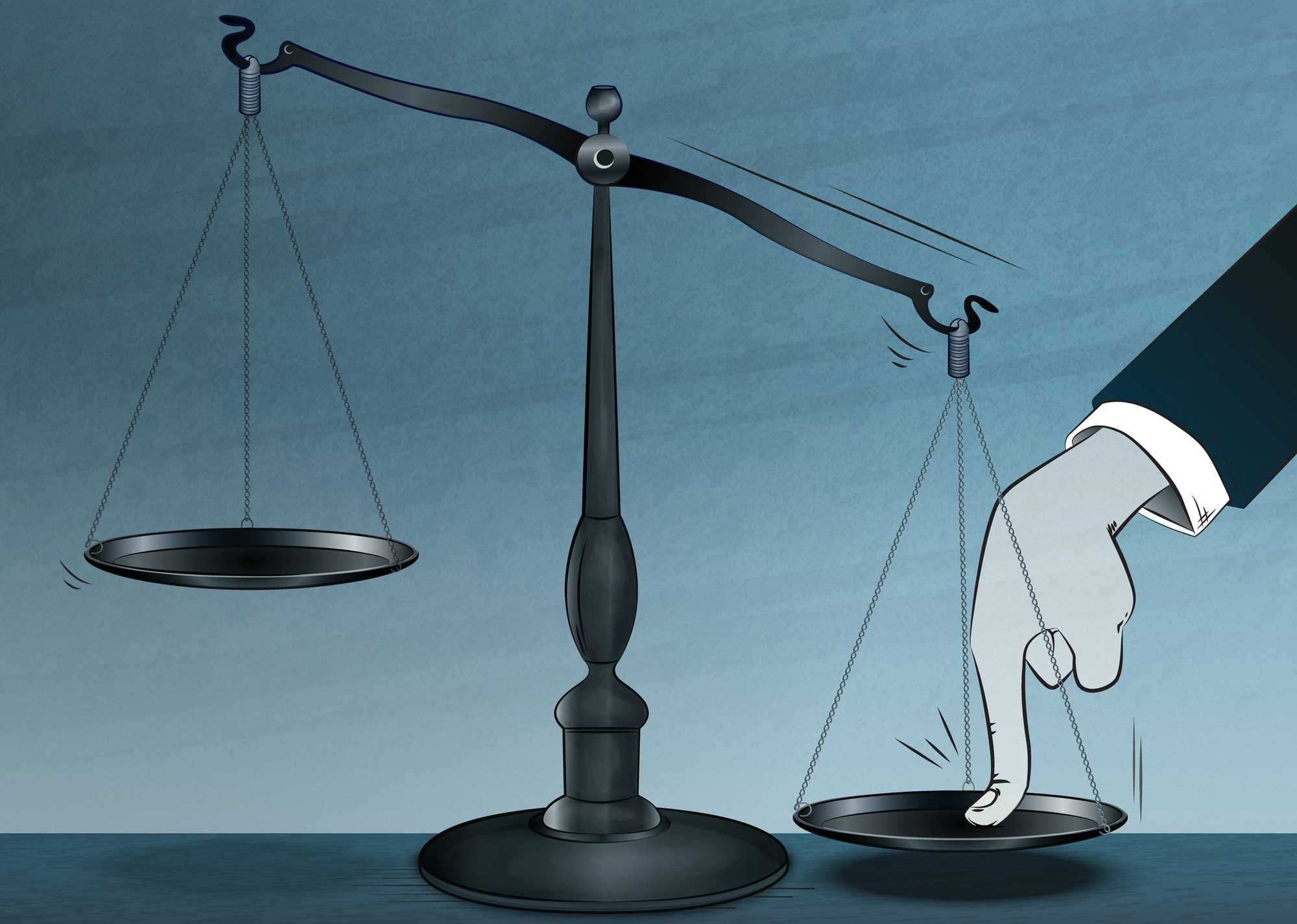
But we are all forced to leave. Someday, each of us will be reunited with his or her fathers and mothers. Our descendants — the children, grandchildren, and great-grandchildren we leave behind in the country we made for them — are our posterity.
Another problem is that mass immigration not only increases the demand for housing, but it also suppresses the wage expectations of the native-born, particularly native-born men who are low-income workers. By increasing housing prices and reducing lifetime wages, mass immigration erodes the economic foundation required for family life, making fewer native-born men marriageable.
This decreases the fertility of the native-born. While an increasing share of children are born to unwed mothers, unwed parenting is sufficiently difficult that few such mothers have more than one child, and very few have more than two. Governments then trumpet studies like Cato’s to justify bringing in immigrants to support the aging natives who do not have enough of their own posterity to meet the fiscal need.
To paraphrase Charles de Gaulle, the graveyards are full of irreplaceable men. But if we want our graves to be tended and our memories to be revered by our posterity, we need to work now to ensure that immigration policy serves the welfare, security, and liberty of that posterity.
Those who continue the work of George Washington and the other founders by maintaining and passing on the union they built — stronger, more united, and free — may not be their blood relatives, but they can justly claim to be their spiritual progeny.
A version of this article appeared originally at the American Mind.
Elon Musk’s appearance on “The Joe Rogan Experience” last week should be required listening for anyone who still believes “one citizen, one vote” is the bedrock of our republic. For more than three hours, Musk — engineer, entrepreneur, and agent provocateur — peeled back the curtain on what he called Washington’s longest-running con: a taxpayer-funded pipeline that turns illegal immigrants into future Democrat voters.
Musk didn’t hedge. The ongoing government shutdown, he said, isn’t about continuing resolutions or fiscal cliffs. It’s about Democrats refusing to cut the hundreds of billions in welfare spending that draw migrants across the border. Turn off the cash, and the migrants leave. Cut the flow of migrants, and the left’s imported electorate vanishes.
When the rule of law returns to our borders, it returns to our ballot boxes. That’s a future worth shutting down the swamp to secure.
Joe Rogan was gobsmacked, for good reason. The former head of the Department of Government Efficiency described, in clear terms, what many Americans have long suspected but have been told was a conspiracy theory: The government’s own spending has become a political machine.
Musk’s argument is simple. Blue-state welfare programs — Medicaid expansions, housing vouchers, EBT cards, in-state tuition — advertise America as “free everything” for those who cross the border. When Rogan asked what would happen if those benefits stopped, Musk replied, “The Democratic Party will lose a lot of voters.”
Not some — a lot. California’s supermajority didn’t appear by chance, he noted; it was built city by city, sanctuary by sanctuary.
That blueprint is now spreading to Georgia, Arizona, Nevada, and other battlegrounds with generous welfare systems. The U.S. Census already rewards high-immigrant states with extra congressional seats and Electoral College votes. Add motor-voter laws, same-day registration, and ballot harvesting, and you don’t need a single illegal ballot to tip the scale. The counting itself does it.
This is arithmetic, not a conspiracy theory. Since 2021, the Department of Homeland Security’s parole programs have admitted more than a million people under “humanitarian” pretexts. Federally funded NGOs meet them at the border, fly or bus them to swing districts, and sign them up for every benefit imaginable.
Musk argued that ending the handouts would prompt a voluntary exodus within weeks — no ICE raids or roundups required. Yet Democrats treat any effort to cut those programs as existential sabotage. Why? Because their own numbers show what happens when the inflow stops: Red states stay red, blue states fade to purple, and the Electoral College map becomes competitive again.
That, Musk said, is why Democrats would rather grind Washington to a halt than surrender their demographic advantage. The “shutdown” isn’t a budget fight — it’s a fight to preserve a political machine.
Enter Donald Trump’s enforcement agenda: the program many voters thought they were getting after the 1986 amnesty deal that never delivered. Mass deportations. Mandatory E-Verify. The end of catch-and-release. A full audit of every federal dollar funneled to “new arrivals.”
Critics reflexively cry “xenophobia,” the same way they called a border wall “immoral.” But this isn’t about left versus right — it’s citizens versus cartels. A union welder in Pennsylvania, a black business owner in Atlanta, and a Latino pastor in Miami all lose when the voting power of citizens is diluted by noncitizens who bypass the legal system their grandparents followed.
Representative government dies when representation is determined by who sneaks across the border first. Real elections require verifiable citizens, not harvestable bodies. Ethical leaders don’t traffic in future ballots; they protect the franchise like nuclear codes.
The appeal of Trump’s immigration plan is that it’s universal. America First means American tax dollars for American citizens, not for an imported electorate. Require proof of citizenship to register to vote. End chain migration and the visa lottery. Finish the wall. Empower ICE and Customs and Border Protection to do their jobs. The crisis collapses the moment the incentives do.
RELATED: ‘Operation MRE’: Meals, reform, enforcement in a SNAP!

No more midnight ballot drops in swing districts. No more census manipulation. Just the restoration of an old promise: play by the rules, and the rules will protect you.
This fight transcends party and personality. It’s about whether your grandchild’s vote will still count in 2050. Support strong immigration enforcement. Demand audits of federal spending. Tune out media race-baiting and sentimental excuses. End the programs that siphon taxpayer money into the hands of those who broke the law to get here.
When the rule of law returns to our borders, it returns to our ballot boxes. That’s a future worth shutting down the swamp to secure.
The shocking assassination of Charlie Kirk at Utah Valley University puts an exclamation point on the degraded state of reasoned debate in America.
Like many in the last month or so, I’ve found myself doing a deep dive into Kirk’s YouTube channel, watching debate after debate. You learn something from watching them in full: Kirk was willing to talk to anybody, and he always brought liberals to the front of the line.
We must teach our students to be virtuous, both individually and politically.
He was pugnacious at times, but always civil. His interlocutors sometimes resorted to ad hominem attacks, and their arguments often collapsed under a steady stream of his questions and retorts. Time after time, these students lost the debate with Kirk because they simply didn’t know enough.
What causes a person to stake out a position with such confidence before mastering the evidence to support it? For many of the students who challenged Kirk, the answer is “action civics.” This pedagogical theory holds that the highest form of civic participation is protest rather than discussion. Its result is thoughtless grandstanding or worse. The antidote to this state of affairs is classical education rightly understood.
When it comes to civics, knowledge is necessary but not sufficient. Civic life requires more than a grasp of American history and government, as important as those things are. It requires us to be people formed by practice in the habit of reasoned deliberation — people who know how to disagree and be disagreed with and who are willing to change their opinions when they learn something.
Political speech — reasoned discussion about the good within a regime — allows us to improve our opinions by sharing them with others and refining them through conversation and disagreement. Civic education divorced from these practical virtues produces either performative activism or feckless intellectualizing.
These virtues can be cultivated within the classroom through classical education. Reading and discussing works from Aristotle to the Federalist allows students to wrestle with enduring questions about justice, rights, and the good life. They learn not only to discern what is right but also to pursue it amid the complexities of a changing world.
Yet the real formation comes in seminars and Socratic discussions, which are laboratories of civic practice.
After years outside of the classroom, this semester I began teaching a course on moral and political philosophy to 11th graders. These students are young, but after years in a classical school, they have some real learning under their belts. The task this year is to develop within them the habits necessary for a real seminar conversation, with Socratic discussion three days a week and a full-blown seminar on the other two.
In a well-run seminar, teachers merely provide a question about a great work of literature, history, or philosophy, intervening to guide the discussion only rarely. As in life, no authority swoops in to give the right answer and make decisions for everyone else. It’s the students who lead and who learn to find their way together.
A properly run seminar allows students to disagree and be disagreed with. They are forced to humble themselves before an author and a text, to scrutinize their own opinions, and to discard error in favor of knowledge.
But it isn’t a lawless environment. Students in a well-run seminar know that they are to speak about the text and only the text. Every comment must respond to the previous speaker. Non sequiturs are not allowed, and the students don’t interrupt each other (we are still working on that last one).
If we want a citizenry capable of sustaining liberty, we cannot settle for activist training without understanding, nor abstract lectures without practice.
When they do speak, they have to ground their statements in an argument drawn from the text. If they don’t have an interpretation of the text to offer, they can ask a thoughtful question, which is often just as beneficial to the conversation as a well-reasoned argument.
Disagreement in the seminar room is an opportunity to learn that disputing someone’s argument doesn’t mean impugning their character. Most teenagers are terrified to disagree with someone their own age and even more terrified to be disagreed with. But after a few weeks, they develop thicker skin. They learn to think more about the substance of their argument and less about their social standing.
RELATED: How Charlie Kirk’s life shows the power of self-education

When the arbiter of the debate is the text itself, everyone knows that success means advancing the clearest and most correct reading. And when the text is rich and deep, it takes time, conversation, and disagreement to interpret it well.
Disagreement is an opportunity for clarification. In a well-developed seminar, it’s welcomed. What matters is not superficial civility, but the willingness to examine and revise our opinions in light of reason and fact, to argue from truth rather than feeling, and to labor toward a common understanding.
In a way, these classroom discussions on Plato and Virgil, Swift and Shakespeare, are a crash course in practical civics. Not protest, not theory, but character formation through dialogue, study, and experience — all preparing students not only to understand their country but to participate in it responsibly. In a way, classical education creates more people like Charlie Kirk.
If we want a citizenry capable of sustaining liberty, we cannot settle for activist training without understanding, nor abstract lectures without practice. We must teach our students to be virtuous, both individually and politically. Only then will they be capable of self-government — not as activists or spectators, but as citizens.
Editor’s note: This article was published originally at the American Mind.
Most Americans assume proof of citizenship is required to vote. It isn’t. But thanks to the Trump administration’s new rule, the honor system that governs voter registration may finally be replaced with real safeguards.
At a time when Americans can’t seem to agree on anything — not even how to avoid a government shutdown — one principle still unites the country: Only U.S. citizens should vote in U.S. elections.
By requiring proof of citizenship at the point of registration, the Trump administration is doing what most Americans already assumed was happening.
A new poll from the Center for Excellence in Polling found that 87% of likely voters, including 80% of Democrats, support requiring individuals to prove their citizenship before registering.
The catch? More than 60% of those same voters believe the law already requires it. Nearly 70% of Democrats think citizenship is verified before registration. They’re wrong.
Yes, it’s illegal for noncitizens to register to vote. But the “verification” process amounts to checking a box. Election officials take applicants at their word. The result: a nationwide honor system for one of our most fundamental rights.
And bad actors are exploiting it. A 2024 study estimates that between 10% and 27% of noncitizens living in the United States are registered to vote. Census data suggests that could mean anywhere from 2 million to 5 million noncitizens on the rolls.
Consider Michigan, where a Chinese citizen faces felony charges for illegally voting in the 2024 election. Or Florida, where Russian and Uzbek nationals were arrested for allegedly conspiring to submit 132 fraudulent registration applications.
The problem goes beyond isolated cases. In Iowa, the Des Moines superintendent — earning roughly $286,000 a year — was arrested by ICE for living in the country illegally. He had been registered to vote in Maryland since 2012.
These examples add to a growing list of noncitizens caught on voter rolls in Arizona, Illinois, Michigan, North Carolina, New Jersey, Pennsylvania, and Virginia.
Election fraud isn’t new. After the September 11 attacks, investigators discovered that eight of the 19 hijackers were registered to vote in Virginia or Florida, most likely through routine driver’s license applications.
For decades, we’ve known this vulnerability exists. But only now do we have a serious effort to close it.
President Trump signed an executive order this year requiring proof of citizenship to register to vote. The Election Assistance Commission has followed up with a proposed rule that would make documentary proof of citizenship mandatory.
RELATED: Trump order leads to investigation of 33 potential incidents of noncitizen voting, AG Paxton says
The Foundation for Government Accountability will be submitting comments in support of this rule before the October 20 deadline, alongside many others calling for stronger election security.
The proposal does more than enforce the law — it meets Americans where they already are. Voters believe citizenship is required to register, and they want it enforced. This rule would finally align government policy with public expectation.
Voting is not a casual privilege. It is a right that belongs exclusively to citizens of the United States. That right is weakened every time the honor system allows a noncitizen to slip through.
By requiring proof of citizenship at the point of registration, the Trump administration is doing what most Americans already assumed was happening: protecting the ballot box for citizens and restoring trust in the democratic process.
Republicans are having more babies than Democrats, and the difference has only increased in the Donald Trump era.
Several reports, along with data from the National Center for Health Statistics and Centers for Disease Control and Prevention, show a clear relationship between red and blue counties and their fertility rates.
Not only do fertility rates get higher the more a county votes for Republicans, but the contrast with Democrat counties is growing stronger over time.
'We need a culture that values our children intrinsically.'
According to a data analysis by the Institute for Family Studies, Trump support equals more families. For every 10% increase in Trump votes in 2024, there is an expected fertility rate increase of 0.09 in a woman's lifetime.
The IFS also noted that in counties that had less than 25% of their votes going to Trump, like D.C., the median fertility rate was 1.31. In counties with a more than 75% vote share for Trump, the median fertility rate was 1.84. Of course, 2.1 or above is the ideal replacement rate, but the contrast is still large.
Moreover, the gap in fertility rates has grown by 85% in the last 12 years.
In the Barack Obama vs. Mitt Romney era of 2012, there was an 8% fertility difference between red and blue counties. According to the IFS, that difference has more than tripled to a 26% difference in 2024.
RELATED: America last: Hillary Clinton lets truth slip about illegal aliens and low US birth rates
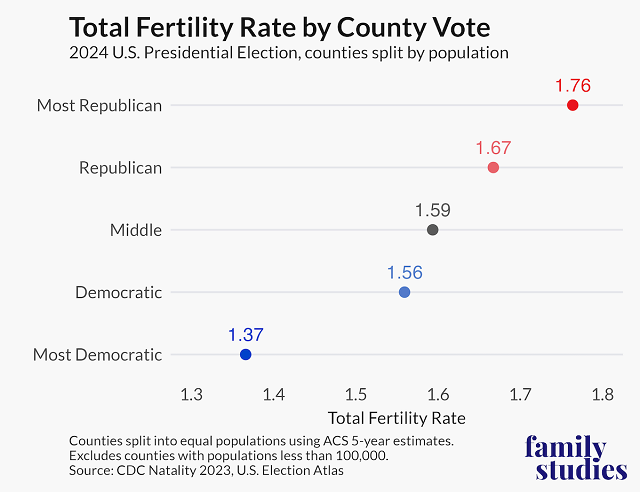
In counties with more than 100,000 people, the "most Democratic" voter turnout correlates with a drastically lower fertility rate than the rest of the country, with a 1.37 birth rate. While moderate Democrat numbers are closer to the American average, the swing is big toward the "most Republican" counties, which average a 1.76 birth rate.
The Republican fertility advantage can be directly attributed to marriage, says Grant Bailey, research associate at IFS.
"Republicans (and conservatives) marry at higher rates, and married adults have much higher fertility rates than do singles," Bailey told Blaze News. "With that said, even within marriage, conservatives have more children than their liberal peers."
Bailey explained that even many married liberals never have children, and that drives an even bigger divide between the fertility rates across party lines.
RELATED: Hormonal birth control: As bad for you as smoking
"It’s no secret that birth rates have been in free fall worldwide for decades and that continuing on our current course will spell economic and social disaster for many," Erika Ahern told Blaze News.
Ahern, an author at CatholicVote and a mother of seven, said that increasing a family’s demand for children requires "a shift in how we as a society value children and family altogether."
Ahern added, "Instead of emphasizing the cost and inconvenience of children, we need a culture that values our children intrinsically."
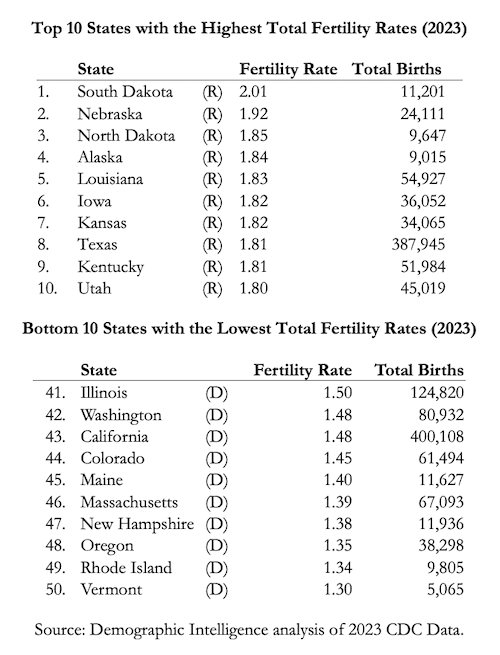
According to CDC data, the top 10 states with the highest birth rates in 2023 were Republican, and the bottom 10 were Democrat.
South Dakota is the only state with a birth rate above 2, at 2.01. Nebraska, North Dakota, Alaska, and Louisiana round out the top five.
On the bottom end, Vermont has just a 1.3 birth rate, the worst in the nation. Other than Oregon, which ranks 48th on the birth rate list, the Northeast dominates the bottom of the rankings. Maine, Massachusetts, New Hampshire, and Rhode Island are all near the bottom, with birth rates of 1.4 or below.
In 2022, Vermont, Wyoming, and Delaware had the fewest births by state in the country, with five states having fewer than 10,000. This can be attributed to population size for all but Vermont, which came in last on the CDC's fertility rate rankings for 2022.
California had by far the most births of any state in 2022, approximately 420,000, but nowhere near the highest fertility rate; it was 11th worst.
Like Blaze News? Bypass the censors, sign up for our newsletters, and get stories like this direct to your inbox. Sign up here!
 What interests take precedence over 84 percent of Americans wanting U.S. elections reserved for U.S. citizens?
 How can there be a legal injury in removing a citizen of Somalia, Venezuela, Afghanistan, Mexico, or any other country, from the U.S.?
 Unlike Democrats, Republicans have no unified vision of what they view as success for the country.

 Democrats stand to be greatly harmed if they abide by Trump's new election integrity order, which is why they're taking him to court.
 thefederalist.com
 www.theblaze.com
 www.theblaze.com