• Home
  • Bookmarklet
  • pbs.org
  • Public CR Newsletter
  • statnews.com
  • americangreatness.com
    X
    HomeNewsletterLiberty ScoreContactTermsPrivacy
    EXPLORE
    Bookmarkletpbs.orgPublic CR Newsletterstatnews.comamericangreatness.com
    ABOUT
    Privacy PolicyTerms of UseRSS Feed
    Copyright © RebelMouse 2017

    America’s founders deserve better than AI slop


    Oratory is out of fashion. The word itself sounds archaic to our ears, denoting something people used to practice in antiquity and at long length in 19th-century America. Even the more down-to-earth sounding “rhetoric” is heard to mean “mere” rhetoric — words false or deceptive by definition. Politicians talk about “messaging,” and the more significant politicians have layers of staff for “communications.”

    This does not bode well for the forthcoming 250th anniversary of the Declaration of Independence. Every politician in America will feel obliged to say something for the occasion. Whoever can — with perhaps some rare exceptions — will deploy a staff member or staff members to draft his remarks.

    The American people declared to the world and under God principles constituting not just the foundation and purpose of their political existence, but the only foundation for legitimate government.

    The staff members themselves, products of American universities where American history is frowned upon or given the 1619 treatment, will have to do original research to prepare for the task. A significant percentage of them will rely on artificial intelligence. Patriots have reason to wonder whether there is a politician (or comms team) in America today who understands and can articulate for his fellow citizens and the world the meaning of July 4, 1776.

    John Quincy Adams took July 4, 1776, with the utmost seriousness. The Declaration of Independence and the American Revolution became the north star of his politics over a 60-year career of devotion to his country and its cause.

    He understood that man is a political animal because he is endowed by nature with logos (speech, reason) and that in American politics, the statesman’s first task is to understand the logos — the word fitly spoken, the apple of gold — of the Declaration of Independence.

    He articulated his understanding of the Declaration and its principles beautifully, often, and at length in formal orations and other speeches and writings from the early to the late years of his remarkable political career. He served for a few years in his late 30s and early 40s, when he was also a United States senator, as the first Boylston Professor of Rhetoric and Oratory at Harvard. Later, in what his biographer Samuel Flagg Bemis called his “second career” of nine outspoken terms in the House of Representatives, he became known as “Old Man Eloquent,” in great part for his faithful championing of the principles of the Declaration. He was an avid, lifelong student of Cicero.

    Adams was born into the American Revolution to a mother and father who were revolutionaries. When he was 7 years old, the Battle of Bunker Hill took place (Saturday, June 17, 1775) within earshot of the farm in Braintree, Massachusetts, where he lived with his mother, Abigail, and three siblings.

    On the morning of the battle, his mother took him with her and climbed to the top of nearby Penn’s Hill. From there, the two could see fire and smell the smoke from houses burning in Charlestown. John Quincy remembered the moment vividly to the end of his life. His father, John, was 400 miles away in Philadelphia as part of the Massachusetts delegation to the Second Continental Congress. Braintree was in a war zone.

    RELATED: America turns 250 with a broken heart
    Carolyn Cole/Los Angeles Times/Getty Images

    Weeks before, as militia streamed into the area in the wake of the battles of Lexington and Concord, Abigail Adams had collected the family’s pewter dishes and melted them down to make bullets in a large kettle held over the kitchen fire. From time to time, she heard alarms, warning that the Royal Navy was about to land forces along the coast. She had good reason to fear that the British would try to seize rebel leaders and their families.

    The best John Adams could do at the time was to write to his wife from Connecticut: “In Case of real Danger ... fly to the Woods with our Children.” July 4, 1776, was still more than a year away, undefined in the uncertain future. But young John Quincy Adams was already learning its lessons.

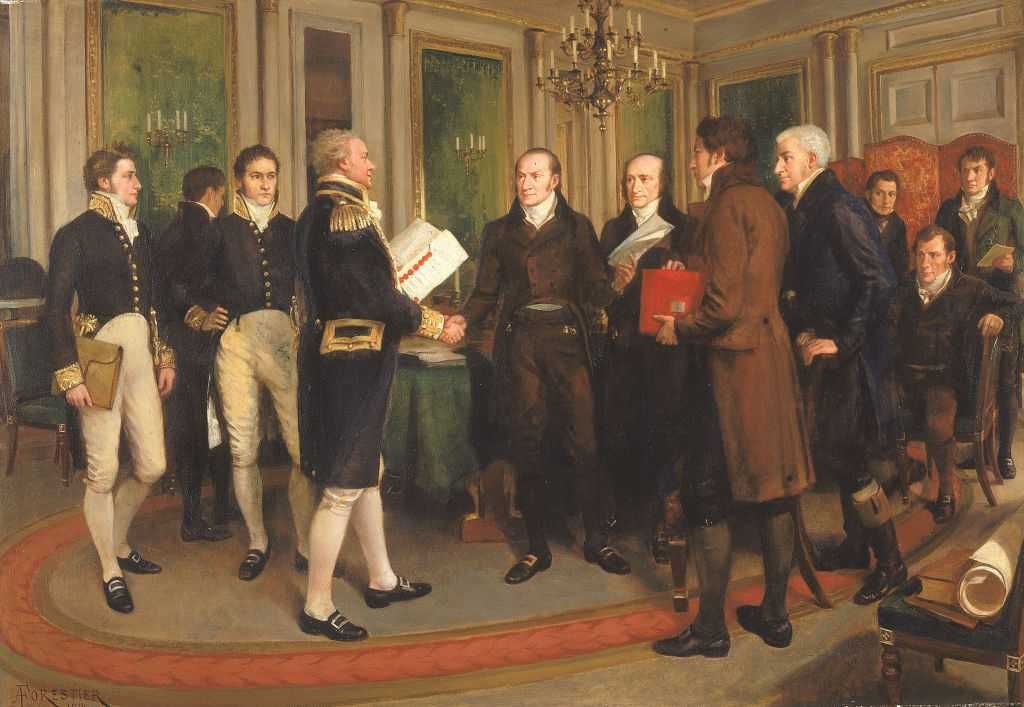
    On July 4, 1785, less than two years after the peace settlement ending the American war for independence, 17-year-old John Quincy, who had served as his father’s private secretary during the peace negotiations, was sailing back to America after six life-forming years in Europe. He wrote in his journal, slightly misquoting James Thompson’s “Rule Britannia,” that July 4 was:

    The greatest day in the year, for every true American. The anniversary of our Independence. May heaven preserve it: and may the world still see:
    A State where liberty shall still survive
    In these late times, this evening of mankind
    When Athens, Rome, and Carthage are no more
    The world almost in slavish sloth dissolv’d.

    The mature John Quincy would come to believe that on that date the American people declared to the world and under God principles constituting not just the foundation and purpose of their political existence, but the only foundation for legitimate government. He held that these principles of reason emerged in the providence of the Christian God through centuries of oppression and superstition and were destined in the providence of God to spread across the earth.

    In God’s good time, the feudal monarchies of Europe would be overthrown and replaced by regimes based on the true principles of the American Revolution. The same providential fate awaited all the world’s barbarous, savage, or tyrannical regimes.

    These facts, in his mind, were perfectly compatible with the maxim he would make famous, that America goes not abroad in search of monsters to destroy — and equally compatible with the reality he faced throughout his political career, that America itself, in its freedom, might abandon its principles and descend into barbarous tyranny.

    In Fourth of July orations over four decades, Adams would explain to his fellow citizens why and how, in fidelity to the laws of nature and nature’s God, America should, in all weathers, steer its course by the north star of the principles of the Declaration.

    These orations and other speeches and writings are conveniently collected in “John Quincy Adams: Speeches and Writings,” recently edited by David Waldstreicher, the distinguished professor of history at the City University of New York Graduate Center, for the Library of America. They are full of history, reasoning, learning, and even oratory that should come in handy for those hoping to say something that rises to the occasion of the coming semiquincentennial.

    Editor’s note: A version of this article appeared originally at the American Mind.
    The crown laughed at our Declaration — but America got the last word


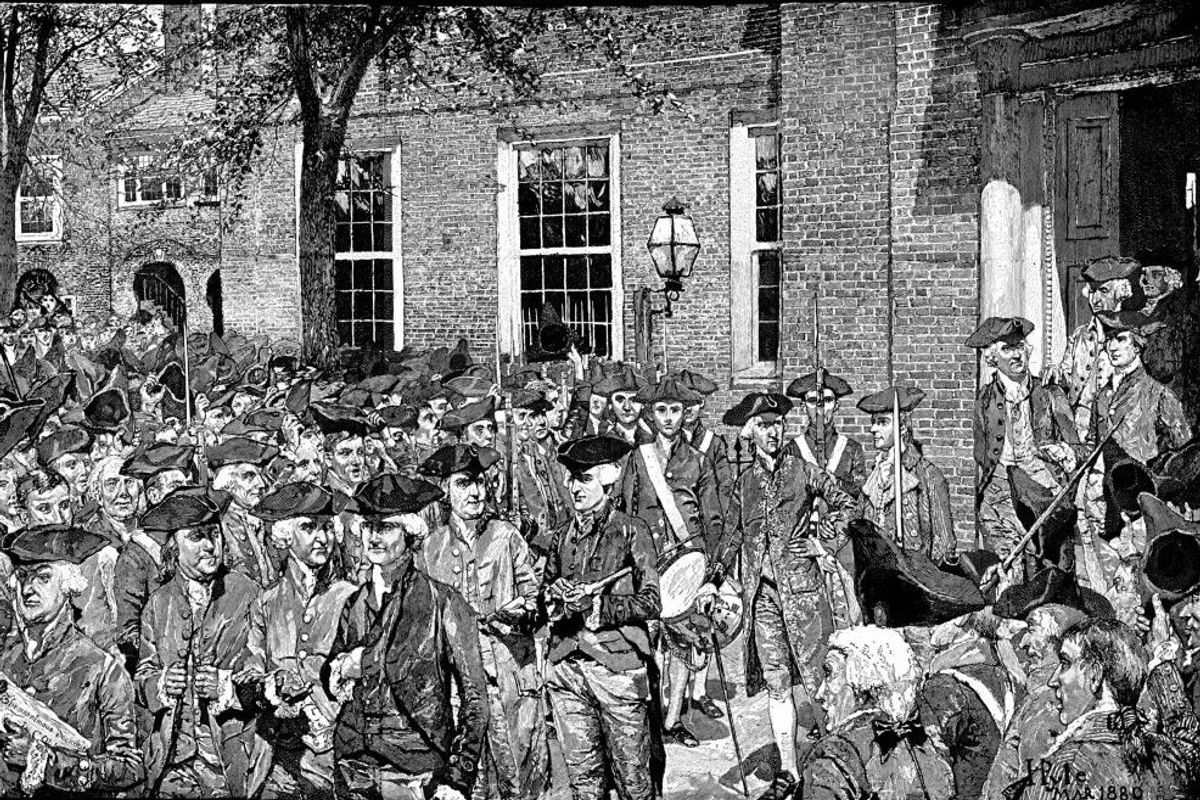
    John Adams believed America’s independence should be marked with “pomp, shews, games, sports, guns, bells, bonfires and illuminations.” He got his wish. Within a year of the Declaration’s signing on July 4, 1776, celebrations had become a colonies-wide tradition.

    The reaction across the Atlantic, however, struck a very different tone.

    This wasn’t just about taxes or trade policy. It was about the belief that free men could govern themselves.

    The British response was not stunned disbelief or deep introspection. It was mockery — and, ultimately, a grave miscalculation.

    The war didn’t begin with the Declaration. A year earlier, in August 1775, King George III had already issued a Proclamation of Rebellion. The crown had stopped viewing the dispute as a matter of political redress. It now saw open revolt.

    But the Declaration shifted the terms. What landed in London by mid-August 1776 wasn’t a petition or compromise. It was a bold, philosophical argument for national divorce. In British eyes, it was treason.

    A declaration dismissed

    British newspapers published the Declaration widely. The London Chronicle printed it, along with other major papers. But few took it seriously. To them, it was just another provocation from unruly colonials.

    The elite mocked Thomas Jefferson’s talk of “unalienable rights.” Gen. William Howe, sent to crush the rebellion, called the Declaration “extravagant and inadmissible.” The British state responded accordingly.

    RELATED: July 4 exclusive: What we love about America

    LeoPatrizi via iStock/Getty Images

    Within weeks, more than 32,000 British troops — including 8,000 German mercenaries — sailed into New York Harbor. It was the largest overseas force Britain had ever fielded. Howe aimed to stamp out the uprising before year’s end.

    The campaign nearly succeeded.

    George Washington’s army suffered defeat after defeat, narrowly escaping destruction on Long Island. By autumn, the American position looked hopeless.

    France’s revenge

    But while Britain saw a dying rebellion, France saw a chance to strike.

    Even before 1776, French agents had begun quietly arming the colonists. The Declaration gave them a pretext to go farther. Though Louis XVI had no love for democracy, he did have a long memory — and Britain’s victory in the Seven Years’ War had come at France’s expense.

    With the Declaration in hand, France could cloak strategic revenge in the language of liberty.

    Formal recognition wouldn’t come until 1778, but the shift had begun. French arms, cash, and eventually troops transformed the conflict. What began as a colonial revolt became an international war.

    Back in London, the American cause began to attract sympathy in Parliament.

    In 1777, future British Prime Minister William Pitt took to the House of Lords to warn his colleagues: “You cannot conquer" America.

    He was right.

    Not just a rebellion — a revolution

    What Britain failed to grasp was that America hadn’t simply declared independence. It had declared a new theory of government: one grounded in consent, not inheritance.

    The crown mistook revolutionary conviction for rhetorical flourish. Britain's government believed the colonists would fold in the face of overwhelming force. But this wasn’t just about taxes or trade policy. It was about the belief that free men could govern themselves.

    Ideas like that can stand up to empires — even the most powerful in the world.

    From darkness to light: The revolution against a rigged system


    We stand on the precipice of what may be the greatest awakening in human history. The veil is being lifted. The hidden hands that have controlled nations, siphoned resources, and dictated reality are being exposed. We are left staring into the raw, unfiltered truth: We have been ruled, not represented. We have been deceived, not educated. We have been poisoned, not nourished. We have been enslaved, not free.

    The elites who lulled us into complacency with a system that fed us lies have stolen from us, and the theft has been total. They stole our money through manipulated markets, illegal taxation, and an economic system designed to keep the masses in debt while a select few print infinite wealth for themselves. They stole our health, pushing pharmaceuticals over natural medicine, feeding us toxic food, and silencing those who dared to reveal the truth about disease, healing, and the miraculous capabilities of the human body. They stole our history, rewriting it to serve their control.

    The old world is dying, and something magnificent is emerging in its place.

    But now, the cracks are irreparable. The truth is spilling out in every direction — fraudulent wars, stolen elections, false flags, engineered societal collapse, and decades of human suffering caused not by fate, but by design — and the people are finally seeing it.

    The people who once scoffed at the idea of a corrupt elite rigging the system are now seeing their bank accounts drained, their freedoms eroded, and their children indoctrinated. They are watching as those in power hoard resources, live without consequences, and mock those who suffer under the weight of their policies.

    And now, something is stirring: the recognition that we are not meant to be cattle in their system. We are the architects of the future.

    A brighter world is within our grasp

    Imagine what would happen if we took back what was stolen, rejected the elites’ lies, and embraced the truth

    Imagine free energy — technology that has existed for decades but was buried to keep us dependent on cartel-controlled oil, power grids, and monopolized resources. Imagine healing without hospitals — medical advancements that can regenerate tissue, eliminate disease, and extend human life span – technology that has already been discovered yet has been suppressed to keep the pharmaceutical industry fat with profit.

    Imagine an education system that actually educates — a system that teaches the truth of history, the art of critical thinking, and the power of self-sufficiency. Imagine a world where children are not programmed for obedience but trained to become free and sovereign beings.

    We could have all of this, and we could have it quickly. But first, we must break the chains.

    The reckoning begins with us

    The first step in recovery is acknowledgment. We are at the collective moment where the drunkard stands in the wreckage of his life and admits, “I have a problem.” We are that nation. We are that world. We acknowledge what has been done to us, and we cannot unsee it.

    And now, we must act.

    This is why the American Made Foundation has launched the DOGA — the Department of Government Accountability. We are done asking for justice. We are done waiting for the elites’ courts, committees, and rigged systems to clean up their corruption. The people will hold them accountable, demand the receipts, and ensure that every one of them is exposed, prosecuted, and removed from the levers of power.

    The theft ends now

    What is happening now is not a political shift. It is not a moment. It is an epochal transformation, a civilizational rebirth. The old world is dying, gasping its last breath in the corridors of Washington, in the boardrooms of billionaires, and in the crumbling towers of media propaganda.

    In its place, something magnificent is emerging: a world of sovereignty. We can build a government where power is returned to the people. We can unleash an economy where innovation is unleashed, not stifled. We can forge a society where justice is restored, families thrive, and the next generation is empowered, not enslaved.

    This is not wishful thinking or a dream. This is the natural order of things and ours for the taking.

    We stand at the breaking point between two worlds. One is governed by the decayed, corrupted system of the elites’ deception. The other is the bright, boundless future governed by truth. The choice is ours, not theirs.

    We have been kept in the dark, but now we have the light. Once a people know the truth, they can never be ruled again.

    This is our time. The reckoning has begun. The rising is now.

    Why America’s Ruling Class Is So Incompetent

    Elites are inevitable; their legitimacy and continuity is not. Ours lack the virtue and wisdom needed for good governance and leadership.

    If States Don’t Roll Back Lockdowns, Americans Will Increase Their Civil Disobedience

    In contrast to the rising hopes of most Americans, Dr. Anthony Fauci is preaching more caution, more isolation, and more of the same even as millions of Americans are now vaccinated.

    It’s Been One Terrible, Horrible, No Good, Very Bad Week For The Democratic Party

    The acquittal of Donald Trump is the culmination of a problematic week for the triggered left.

    Dem reps push legislation to abolish ICE. Polled voters favor keeping it

    Rep. Mark Pocan, D-Wis., is proposing legislation to abolish Immigration and Customs Enforcement, the Washington Post reported Tuesday.

    The legislation, which is co-sponsored by Rep. Pramila Jayapal, D-Wash., and Rep. Adriano Espaillat, D-N.Y., both of whom are immigrants, would “shutter the agency, probe whether its agents had flouted international law, and create a special commission to rethink how the federal government handles asylum seekers and undocumented immigrants,” the Post said.

    A recent poll from Politico showed that only 25 percent of voters agreed that ICE should be abolished; 54 percent were in favor of keeping the federal bureau.

    Socialist Democratic House nominee Alexandria Ocasio-Cortez, actress Cynthia Nixon, and Antifa-booster Keith Ellison have been among the loudest in the call to abolish ICE.

    Keep reading...Show less
    Get the Conservative Review delivered right to your inbox.

    We’ll keep you informed with top stories for conservatives who want to become informed decision makers.

    Today's top stories

    'Anne Frank had white privilege' was a trending topic on Twitter, the outlandish claim was immediately torn apart: 'It's time to shut the internet down. Completely.'

    www.theblaze.com

    'OK, that’s spooky’: Biden-masked stranger creeps up to Texas family’s door and eats a banana

    www.theblaze.com

    Fake ultra-luxury watches from China seized — and they would have been worth millions if real, CBP claims

    www.theblaze.com

    Trump endorsee announces resignation after allegedly stealing from Walmart — but there's more to the story, he says

    www.theblaze.com

    Saban Taught Us Excellence Is A Process, Not Just A Result

    thefederalist.com

    The knuckleball taught a father when to step back

    www.theblaze.com

    Dimwitted Quisling David French Has An Infinite Appetite For Ritual Humiliation

    thefederalist.com

    The DSA Plans To Incite Nationwide Violence Ahead Of 2028 Election

    thefederalist.com