Parents, Staff Claim Expensive Nashville Christian Prep School Has Gone ‘Woke’
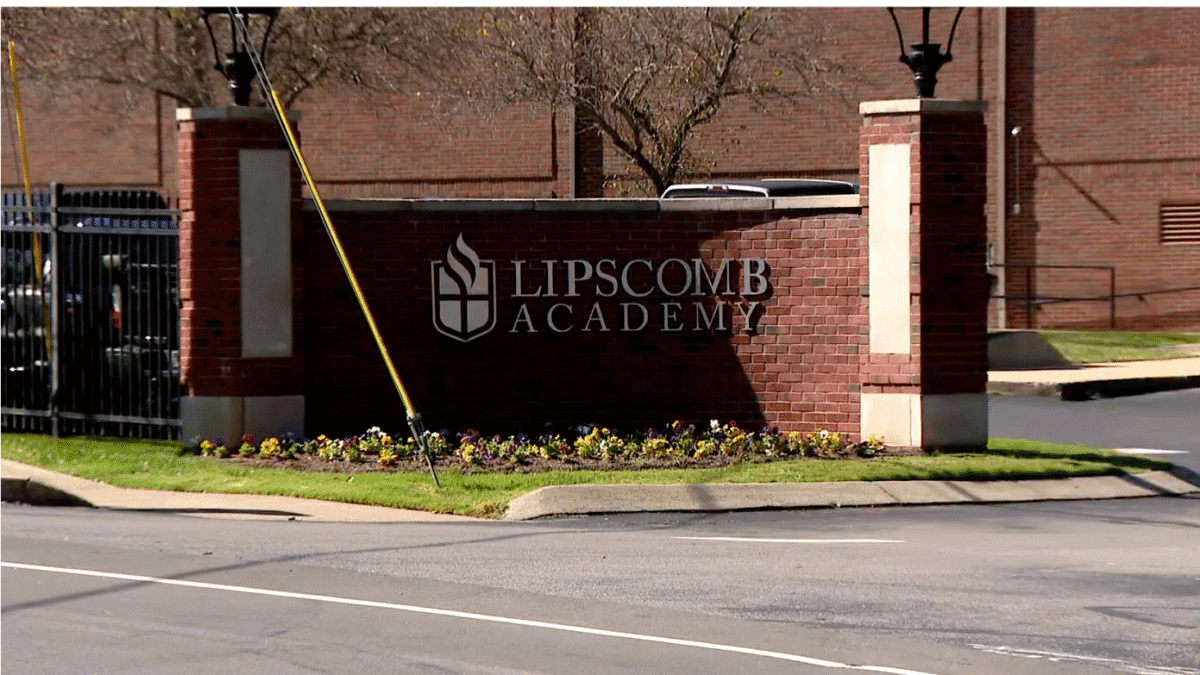 Lipscomb Academy officials vehemently deny claims that the private school's leadership has injected DEI into the Church of Christ school.
Although it received scant media attention, the FBI foiled a plot by members of the pro-Palestinian Turtle Island Liberation Front to bomb Southern California businesses on New Year’s Eve.
Most Americans have probably never heard of the term “Turtle Island,” a name said to be used by some indigenous communities to describe North America. “Turtle Island” proponents view the United States as a nation founded on stolen land and express solidarity with a host of anti-American positions and groups — most notably pro-Palestinian activists who support dismantling “colonizing” and “oppressive” power structures.
These ideas are being promoted by organizations that pressure school administrators to implement anti-American educational material.
TILF’s attempted terror attack shows the natural ends of the group's subversive ideology: hatred, division, and violence. And unfortunately, teachers who view their role as agents of social change are now disseminating these ideas through the country’s K-12 schools in an effort to turn America’s students into child soldiers on the front lines of the country’s culture war.
Curricula such as liberated ethnic studies — a benign-sounding program that encourages students to view the world through an oppressor/oppressed lens and to treat their peers accordingly — is one such vector. Turtle Island is frequently cited in school curricula in the form of land acknowledgements, as well as in school meetings and school board notices on how to “support teachers of color.” The phrase also appears in lesson plans on “the social construction of race” that seek the “inclusion of Black and Latino studies in the public school curriculum.”
In 2021, a whistleblower provided Defending Education with photographs of a classroom at Los Angeles Unified School District’s Alexander Hamilton High School, where posters included “in 2020, make Israel Palestine again and make America Turtle Island again,” "F**k the Police,” and “F**k Amerikka, this is native land.” While those responsible ultimately removed the material under pressure, it is certain that those materials would have remained if not for withering public pressure.
Unsurprisingly, professors promote these ideas in college courses nationwide.
At the University of Minnesota-Twin Cities, students can take a course called “Critical Indigenous Theory,” in which “indigenous” is described as a “comparative, interdisciplinary, and global project that exceeds the material conditions of Turtle Island ...” One of the required readings for that class is “Inter/Nationalism: Decolonizing Native America and Palestine.”
The University of Texas offers at least five courses with explicit land acknowledgements to Turtle Island, while at the University of California, Irvine, a doctoral candidate wrote a 300-page dissertation on the development of liberation schools on Turtle Island.
While examples abound of academics forcing radical ideas on impressionable university students, it is particularly galling for this to take place in the nation’s taxpayer-funded universities.
It is important to recognize that these ideas aren’t occurring organically. They are being promoted by organizations that pressure school administrators to implement anti-American educational material.
Consider the Great Schools Partnership, which provides professional development to K-12 school districts. The GSP’s self-proclaimed goal is “redesigning” public education with anti-American propaganda, including a 2020 blog post that preached about the need to “Decolonize Education” on “Turtle Island” while smearing Christopher Columbus.
There’s also the Zinn Education Project, a so-called history program coordinated by Rethinking Schools and Teaching for Change, which refers to Turtle Island in its abortion advocacy.
One of the most concerning examples of Turtle Island’s negative influence is through its connection to Teach Palestine, an organization corrupting K-12 education with anti-Israel propaganda. Teach Palestine’s sixth-grade lesson plans emphasize the need to “talk about Palestine and Turtle Island in the same breath.”
RELATED: Why are we playing by the rules with people who follow no rules at all?
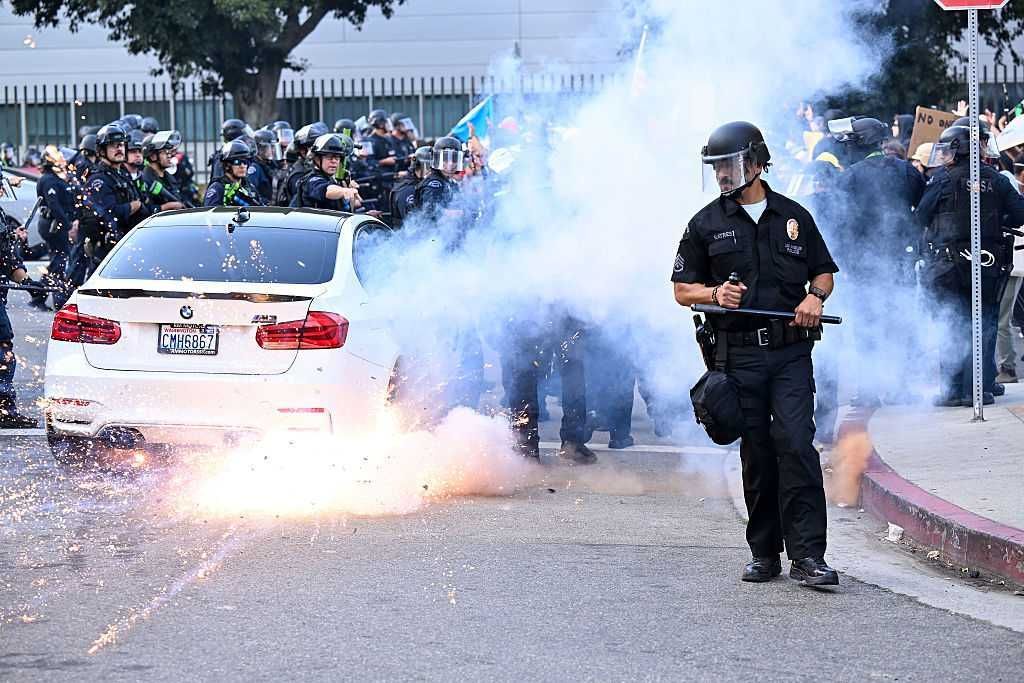
Through incendiary rhetoric about the perceived injustices indigenous people suffer, Teach Palestine actively encourages students to believe that their country and its history are inherently evil. While the organization doesn’t explicitly endorse violence, its partisan framing, one-sided view of history, and portrayal of Israel and the United States as oppressive colonizers could lead some, like the suspected TILF bombers, to justify violent resistance.
We’re already seeing the effects of this brainwashing destabilizing America.
Anti-Israel protests erupted on college campuses in the wake of the October 7, 2023, massacre in Israel, resulting in Jewish students across the country being violently attacked by their peers. Many of the 18- to 21-year-olds complicit in these riots seemed to genuinely believe they had the moral high ground and that they were “liberating” their campuses from “oppressive” power structures.
Their skewed logic and hatred are the inevitable result of forcing anti-American ideological frameworks on young students, rather than encouraging pupils to think critically for themselves or teaching the basics of history, science, and mathematics — areas where American students are increasingly falling behind.
Without critical thinking and basic education, future leaders and voters become frighteningly easy to pressure into despising their country — and into treating violence as a legitimate answer.
The fact that 2026 nearly started with a Turtle Island-inspired bombing should be a wake-up call for our leaders to address this crisis in the months ahead.
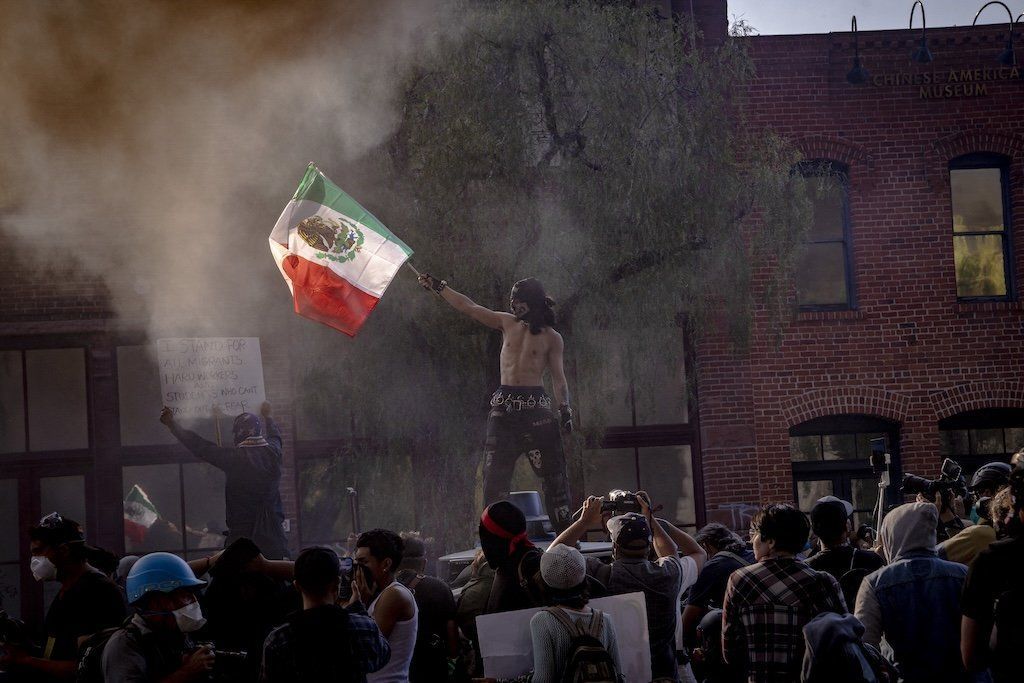
Some images linger like bad philosophy. One such image: a masked individual standing triumphantly on a vandalized car, waving a giant Mexican flag, at a protest against mass deportations. It’s not a political cartoon. It’s the radical left’s icon. And it perfectly captures the confused moral universe behind the Los Angeles riots and the so-called “indigenous land” movement.
— (@)
As a professor at a secular university, I can assure you this isn’t fringe lunacy. It’s the tip of the philosophical iceberg. Beneath that smoldering car is a massive ideological structure that has been meticulously constructed over decades — paid for, ironically, by federal and state tax dollars.
These rioters don’t actually want to return the land. They want the luxury of moral superiority minus the inconvenience of coherent thought.
If it were possible, I’d love to survey the people flipping cars and heaving concrete blocks at police cruisers. I strongly suspect many of the ringleaders hold degrees in the liberal arts — more specifically, degrees in identity activism. You know the type: gender studies, black studies, Latinx studies, queer theory, or some intersectional combination thereof.
If you visit the department websites of these programs at any given university, you’ll often find “activist” listed as the No. 1 career path. No need to wonder what you can do with a $120,000 degree — you can become the ideological arsonist who trains the next generation to believe the United States is irredeemably Christian, unjust, and colonial — and maybe even get in some looting of the capitalist luxury stores.
So when you see a rioter in Los Angeles shouting on CNN about how the land was “stolen from Mexico,” just know: That’s the university curriculum talking. In one now-viral clip, a young woman (yes, I just assumed her gender) yells at a police officer, “As long as you feel OK with capitalism, racist, imperialist state.” Asked if she even knows what she’s saying, her reply is priceless: “Yes, b***h, I'm in college.”
Exactly.
These students have never been taught about the establishment of land ownership in world history or even the basic historical facts of the American Southwest. They don’t know that Mexico owned it for only 27 years, yet they think it is their ancestral homeland. If anything, Spain should be in the mix, asking for it back from Mexico.
And remember: We’re all paying for that education through state funding — drawn from taxes paid by ... wait for it ... capitalists. No gratitude. No irony. Just tuition-funded tantrums.
RELATED: The lie that launched a thousand riots
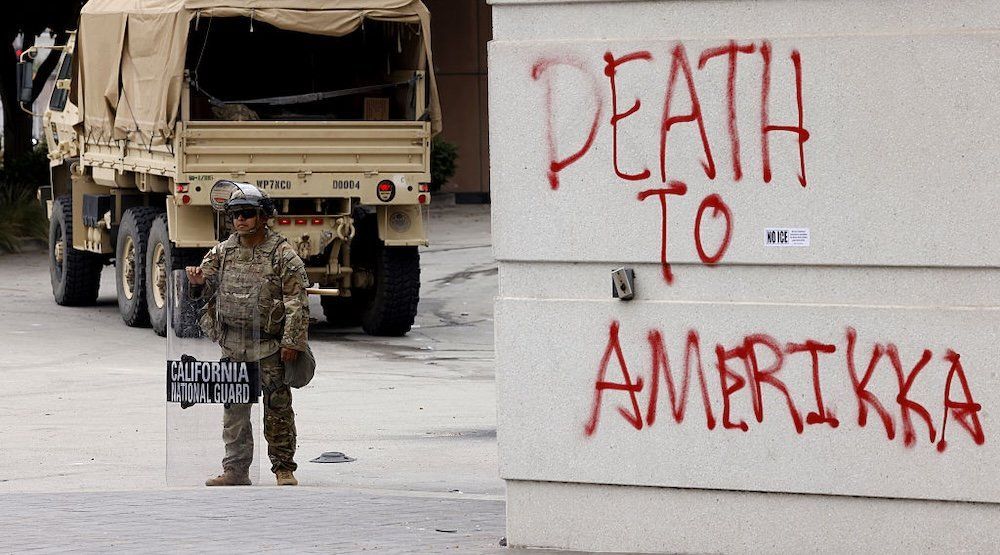
A modest glance at history will remind you that the United States conquered large parts of Mexico in 1848. But here’s the twist: The U.S. didn’t just grab the land and walk away whistling. No, it gave back a substantial portion, paid Mexico $15 million (a princely sum at the time) for the remaining territory — including what is now California — and forgave the Mexican government’s outstanding debts.
But the student activists aren’t interested in political history. And they don’t really want to live in Mexico. Even if they did, Mexico's immigration laws are strict, its economy is difficult, and it most certainly doesn’t tolerate foreigners burning down public property in the name of “revolution against the government.”
These rioters don't actually want to return the land. They want the luxury of moral superiority minus the inconvenience of coherent thought. They want their air conditioning, DoorDash, TikTok, and virtue signaling ... on stolen land. Any one of them could sell the assets they acquired within the capitalist system and donate the proceeds to an indigenous cause. But they want to make other people do this with their money.
At their campus protests and university-sponsored events, they perform ritualized “land acknowledgments,” reciting that their college stands on “unceded indigenous territory,” as if confessing to a metaphysical sin. But the penance never includes selling their house and giving it to a tribe. And why?
Because the first tribes are lost to history — conquered by later tribes, who were themselves conquered, until eventually the Spanish brought law and order to warring tribes. The cycle of conquest is not new; it is one of the oldest stories in human civilization. What’s different now is the selective outrage.
Here lies the real problem: Modern activist ideology seeks to appeal to justice but lacks a standard by which to define it. This is why all of this activist nonsense we are paying gender studies professors to teach is so empty. It appeals to justice without any standard by which to adjudicate the question.
If the land was stolen, then: Who stole it? From whom? And what court now has jurisdiction?
Even if you could answer the first two — and in most cases, you can’t — the third is impossible under their belief system. If you begin playing “we were here firsties,” you have to go all the way back.
Theirs is a godless appeal to justice, and godless justice is just another word for mob rule. It is ultimately just mob rule stirred up by malcontents to motivate masses of discontents — which is why they are simply called Marxists. Not because they’ve read “Das Kapital” but because they’re looking for a framework that legitimizes their rage and offers power without accountability. And in Marx, they find a convenient excuse to tear down everything that came before — especially anything remotely Christian.
All of their disappointment in life is aimed at the outward object called “the United States.” No reflection on their own condition — just rage against the machine.
But for those who believe that God is the final judge, the phrase "Let God judge between us” is not a cliché. It’s a fearful thing. It means a moral order lies beyond human manipulation. It means that even if we don’t see civil justice now, true justice is ontological, everlasting, and inescapable.
Marxist rioters cannot make this appeal. They live in a world of only immanent causes and material grievances. No final judge and no moral standard above power awaits to hold their actions accountable — therefore, no peace. They rage because they must. Their rage is at existence itself. And when they finish one protest, they must invent another. Their revolution has no eschaton — only exhaustion.
So they flip over cars and set fires. Some loot — not just because they're angry at injustice or need a new pair of shoes, but because they have no vision of the good, only a fixation on the bad. And in seeking a purely material form of justice, they have lost their souls.
They complained about the one who supposedly stole land while forgetting about the one who can cast their soul into hell. The prospect of God’s justice should make all of us repent.
It is time to stop funding this madness. It is time to restore an education grounded in truth — not truth as a tool of power but truth that judges us all.
Until then, don’t be surprised when your car is flipped by someone with a $100,000 degree in “decolonial eco-poetics.” And don’t be shocked when they scream “justice!” without the ability to define what it is.
After all, they went to college.
For over a decade, I have argued with Wikipedia curators about the biographical sketch covering my life and work. Each time a surrogate or I correct false or slanderous details, the misinformation reappears within weeks — often with even greater distortions. Friends who have helped me in this thankless effort suggest giving up, believing that no matter how many corrections we make, the falsehoods will always reappear.
Christopher Rufo has assured me that anyone paying attention knows Wikipedia leans left and misrepresents those with views deemed unacceptable. However, after decades of acquiring unfriendly critics, I doubt most readers will dismiss Wikipedia’s misrepresentations in my case.
One position I will never conceal is my contempt for peddlers of what George Orwell called 'smelly little orthodoxies.' One can’t despise such people enough.
I have also observed Wikipedia’s double standard in editing biographical sketches. Friends with technical expertise have spent weeks trying to correct inaccurate statements about me. Each time, they must provide excessive documentation and navigate endless disputes before even minor corrections are approved. No matter how often they succeed, new distortions inevitably replace the old ones.
When left-leaning contributors make unsubstantiated claims about figures they associate with the political “dark side,” those assertions often go unchecked. The most recent version of my Wikipedia entry falsely states that I oppose Israel’s existence. I have never expressed any sentiment remotely resembling that.
While I have criticized AIPAC for unfairly attacking Israel’s critics, I have consistently defended Israel’s right to protect itself. Yet my biographer offers flimsy evidence to suggest otherwise. One supposed indicator is my past friendship with the late Murray Rothbard, who was explicitly anti-Zionist. But why assume I shared all his views, including his stance on Israel?
Another so-called proof is that I once wrote a review essay for the American Conservative about Elmer Berger, a Reform rabbi critical of Israel’s founding as a Jewish state. Although I described Berger’s position as unrealistic, I apparently didn’t denounce him strongly enough to satisfy those eager to paint me as anti-Israel.
Wikipedia contributors also attempt to discredit me by linking me to white nationalism. They note that I spoke at an American Renaissance conference in the 1990s but fail to mention that my remarks focused solely on my research on American conservatism — without endorsing white nationalism in any form.
The entry also highlights my past acquaintance with Richard Spencer, though that relationship largely predated his public embrace of white nationalism. Even more tenuously, it refers to an attack from the ADF against an organization I once led, claiming it was “friendly” to white racists. However, even the Wikipedia entry admits that our group was never identified as inherently racist.
These misrepresentations follow a familiar pattern. When leftist editors shape a narrative, they demand exhaustive proof to correct errors. Meanwhile, baseless smears against those they oppose remain unchallenged.
The Wikipedia entry omits that I spent years writing for leftist magazines and that members of the conservative establishment once attacked me as a “right-wing Marxist.” Over decades, I have engaged with a wide range of political groups — both right and left — but rarely with establishments. My work does not focus on race, as it is not my field of study. Instead, my scholarship examines European and American political movements.
Despite this, Wikipedia and Tablet's Jacob Siegel claim that I have written extensively on Latin fascism and seek to create a “post-fascist” imitation of it for the present age. Nothing in my research on changing concepts of fascism supports that bizarre conclusion. I have consistently argued that fascism belonged to a past historical era and should be viewed as an archaic, failed political model.
One of the weirdest, most glaring errors about my work appears not in Wikipedia’s biography but in its discussion of “cultural Marxism” as a supposed Jewish conspiracy. There, I am falsely listed as a major source of this ugly, pervasive, anti-Semitic accusation — an assertion that conveniently aligns with the misleading portrayal of me in my biographical sketch.
This charge is entirely baseless. Not only have I never held the views Wikipedia attributes to me, but my books explicitly reject them. The reality is the opposite of what my critics claim.
I have argued that critical theory’s success in the United States stems from its compatibility with the country’s evolution into a managerial state engaged in social engineering. I have also repeatedly noted that today’s woke ideology — promoted by the media, educators, and public administrators — is far more radical and far less insightful than anything the Frankfurt School theorists proposed. Compared to modern woke activists and even some so-called conservatives, early Frankfurt School thinkers could be considered homophobic and sexist.
Wikipedia also claims that Telos, originally a defender of critical theory, was a legitimate leftist magazine until I supposedly took control and transformed it into a “far-right” publication. The entry falsely states, “Under Gottfried’s tenure, Telos became far-right in its outlook.” In reality, I never served as the magazine’s editor in chief; Paul Piccone held that role. I was one of many contributors on the editorial board and played only a minor role in the publication’s engagement with European right-wing thought.
During the 1980s and 1990s, Telos began exploring critiques of centralized managerial regimes, including perspectives from “decentralist” thinkers on the right. This shift was not the result of my supposed influence but rather part of a broader intellectual evolution within the publication.
Of course, I have no expectation that Wikipedia will ever portray me fairly, but I hope others won’t judge me based on its fabrications. One position I will never conceal is my contempt for those who defame me and others like them — peddlers of what George Orwell aptly called “smelly little orthodoxies.” One can’t despise such people enough.
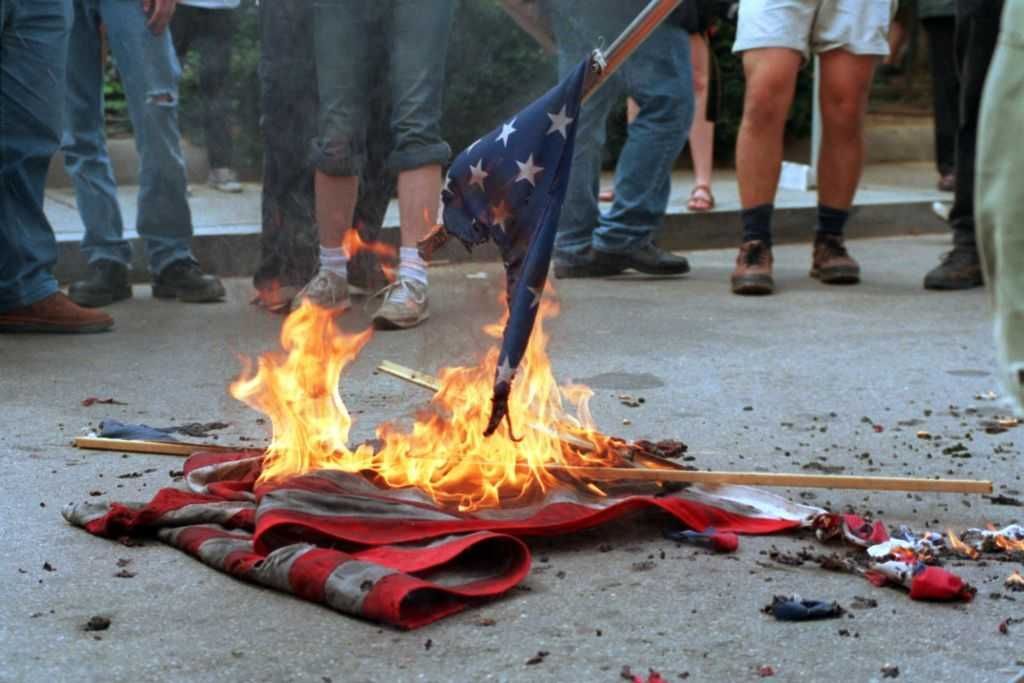

 Carl Trueman's latest book, 'To Change All Worlds,' examines how critical theory became the dominant ideology and what can be done about it.
 A UN’s agency redefinition of what’s considered “peace” or “violence” is designed to push its harmful education agenda.
 In J. Michael Waller's book, Big Intel, a veteran intelligence analyst tells the worrisome tale of how Marxist ideas such as DEI and critical theory corrupted the CIA and FBI.
 Fearmongering about ‘fascism’ is designed to distract Americans from recognizing the ideological poison that has infected our education system.
 There is a lot that the people holding the budget pen can do to rein in colleges beholden to critical theory and DEI ideologues.
 In Critical Dilemma, Neil Shenvi and Pat Sawyer have co-authored a survival guide for churches and Christians looking to fend off the influence of critical theory and social justice ideology.
 thefederalist.com
 www.theblaze.com