

The socialists want a new Constitution. Believe them.
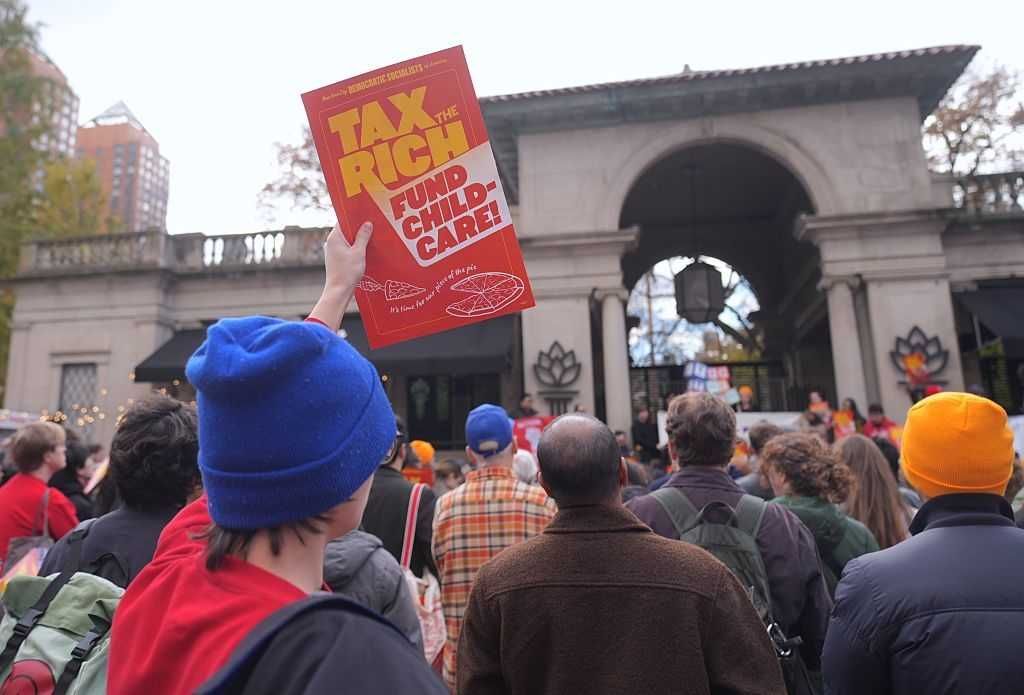
As the midterm elections approach, democratic socialism is attracting renewed attention as an alternative to America’s constitutional order. Recently elected officials in Seattle, Colorado, and New York City, along with dozens of others, identify as democratic socialists. Membership in the Democratic Socialists of America has surged, and a recent CNN poll found that a third of Democrats now identify with the movement’s political program.
The goals of the DSA and the promises made in campaign rallies should be understood by all Americans for exactly its aim: a complete overhaul of the U.S. Constitution and the governing laws that have ensured our freedoms for the last 250 years.
A ‘new society’ that eradicates the right to religious liberty is a familiar step down an extremely dark path.
This is not an esoteric challenge to our economic system. It’s a threat to our entire republic.
At the core of all socialist movements, historically and contemporarily, is the supremacy of the collective over the individual, where the state assumes the role of controlling guardian to determine what is “best for society,” squelching individual liberties, all in submission to this ideological monopoly.
As such, the one thing totalitarian governments will never allow is an appeal to a higher authority than the government. There can be no authority higher than the state. That is why socialist-controlled governments have always viewed religious liberty as a threat and target it as one of the first freedoms to dismantle.
That’s why Virginia Democrat Senator Tim Kaine’s remarks during a 2025 hearing deserve attention. The former Democratic Party vice presidential nominee said he found "extremely troubling" "the notion that rights don't come from laws and don't come from the government, but come from the Creator."
The American founding says otherwise.
The Declaration of Independence states that “all men are created equal” and “are endowed by their Creator with certain unalienable Rights,” among them life, liberty, and the pursuit of happiness.
That formulation is not ornamental. It establishes a limit on government.
If government grants your rights, government can redefine them or take them away. If rights exist before government, then government is bound to respect them.
That’s why religious liberty is the first right protected in the Bill of Rights. Without the right of conscience, all other liberty disappears.
Members of the DSA counter this assessment by pointing to its Religion and Socialism Working Group outreach to the faith communities. In their own words, “DSA’s Religion and Socialism group is open to DSA members of all faiths whose socialism is in some way inspired by their spiritual identity.” In other words, religion is welcomed and approved only if it agrees with the DSA’s socialist ideology, which in essence, then, is a state-endorsed church. All opposing religious viewpoints need not apply.
RELATED: ‘Reign of terror’: One-third of Democrats give thumbs-up to Trump assassination

In the old Soviet Union, state regulations defined how religious organizations could function, what they could say, and when they could meet. Eventually, church doors were closed, sectarian schools were closed, and religious leaders were incarcerated, all because socialist regimes cannot allow organizations or the populace to appeal to a higher authority than the government.
The commonly repeated pattern with all socialist movements begins with ideological propaganda denouncing all viewpoints that don’t fall in lockstep with its platform. In the case of the DSA, that means throwing out the old and fundamentally changing the very foundations of our government, including religious liberty.
But that’s just the start. In the DSA’s program for the current year, the objective is quite clear: “Our goal is to put workers in charge of the government through a new democratic constitution …” and “Replace the President and Supreme Court with an executive and judiciary chosen by and subordinate to Congress.”
This “new society” would eliminate the three co-equal branches of government that provide essential checks and balances. Gone are the U.S. Constitution and Bill of Rights that protect the rights of all Americans.
Religious liberty is foundational to a country that values individual freedoms. It defines the relationship between citizens and government by limiting the government’s power and protects freedom of conscience. It is inseparably linked to broad civil liberties including free speech, parental rights, academic freedom, and freedom of assembly.
None of these rights can exist without the foundation of the right of conscience: religious liberty. A “new society” that eradicates this most important right is a familiar step down an extremely dark path. What we need instead is a recommitment to a society that understands and cherishes the liberties protected in our founding documents that have defined us as the “land of the free.”
The Wealth Gap Is Real, And Washington Created It
 A warning to my fellow Republicans: Offer Americans the hard truth, or socialists will sell them the easy lie.
The government would like to discuss your allowance

Abdul El-Sayed did Americans a favor when he sat down with Jesse Watters on Fox News this week. The Michigan U.S. Senate candidate gave us a remarkably clear lesson in the philosophy behind America’s growing democratic socialist movement. The real question is simple: Who owns your property — you or the government?
The most revealing moment was not about Sharia law, transgender medicine, or even socialized health care. It came when Watters pressed El-Sayed about his proposal to tax the wealth of Americans with more than $100 million.
Before giving government more power, ask what happens when the people wielding it decide that you, too, have more than you need.
El-Sayed has made the argument before. Billionaires, he says, can surrender a substantial portion of their wealth and still remain billionaires. Their children and grandchildren will still be rich.
Notice the premise. This is not merely an argument that government needs revenue for legitimate functions, nor a dispute over whether the top marginal income-tax rate should be 35% or 39%. The argument is that you possess more than you need — and government gets to decide how much that is.
That is the part Americans need to understand.
Suppose you build a company. You work for decades. You save, invest, and take risks. The company becomes enormously valuable. Under the traditional American understanding, the presumption is that the property is yours. Government may tax under constitutional authority, but it does not acquire an unlimited moral claim on your property because politicians decide you have too much of it.
El-Sayed reverses that presumption. What are you going to do with all that money? Whatever your answer, the socialist argument says it is too much because you have more than you need.
The proper question is not what you intend to do with your property. The proper question is: By what right does the government take it?
That distinction takes us back to 1776. The founders understood that government is necessary to protect life, liberty, property, contracts, and the peaceful exercise of rights.
But precisely because government possesses coercive power, it must be limited. The founders built a constitutional order around the insight that human beings abuse power, so power must be divided, checked, and restrained.
Read the Declaration of Independence. The complaint against George III is repeatedly that political power has exceeded its proper bounds. The king interferes with colonial legislatures, imposes taxes without consent, and seeks to subject Americans to “absolute Despotism.”
The central political problem was not how government could solve every problem. It was how citizens could prevent government from becoming one.
RELATED: The data center mob wants your property rights too

Compare that instinct with New York Mayor Zohran Mamdani’s declaration that there is “no problem too large for government to solve, and no concern too small for it to care about.” That is nearly the photographic negative of the American constitutional tradition.
The founders asked: What powers have we actually given government, and how do we limit them? The new socialists ask: What problem is left for government to solve?
El-Sayed’s wealth-tax argument reveals why. Once we abandon the presumption that your property is genuinely yours, the limiting principle becomes hard to locate. If $100 million is too much, why not $50 million? Why not $10 million? If politicians may determine how much wealth you need, why stop with billionaires?
The issue is not whether anyone should feel sorry for billionaires. The issue is who owns the property.
Redistribution is politically easiest when it begins with somebody almost nobody identifies with. He has plenty. You do not. Why shouldn’t government take some?
Because a government powerful enough to decide how much property another person needs has been given a power that does not become harmless merely because its first target is richer than you.
Then there is the comic assumption beneath the argument: Government will spend the money more wisely.
El-Sayed’s home state offers a useful caution. The state auditor found Michigan’s Unemployment Insurance Agency ineffective during the COVID pandemic. Fraud controls were weakened, billions in improper or fraudulent payments went out, and later audits found serious failures in recovering them.
These are the institutions that will reliably improve on the decisions of people who built billion-dollar companies?
Government has legitimate but limited purposes, and legitimate taxation follows from those purposes. But legitimate taxation does not establish a standing claim to whatever share of your wealth politicians decide you do not need.
This debate is especially important because socialism has found a receptive audience among younger Americans. Harvard’s 2025 Youth Poll found support for capitalism among young Americans at only 39%, while nearly half of young Democrats expressed support for socialism.
That is, in part, a failure of education.
We have spent enormous energy teaching young Americans to critique power and too little teaching them why constitutional government was designed to limit it. Much of contemporary oppression theory condemns authorities who presume to know how others should live, then demands political power to impose its own answers.
The next generation needs a different lesson.
RELATED: The DSA’s history lesson has one big omission

Your life is your responsibility. Your neighbor’s property belongs to your neighbor. Wealth does not become public property when it crosses an arbitrary number selected by a politician. Government exists to protect rights, not to decide how much prosperity citizens are permitted to enjoy.
Freedom includes choices politicians consider foolish or wasteful. Save your money, give it away, invest it, build a business, leave it to your children, support your church, fund a charity, or buy something ridiculous. Within the law, those decisions belong to you.
That is what limited government protects.
The socialist temptation is perennial because it begins with an attractive promise: Give us more power, and we will use it to make life fairer.
The American answer is older and wiser: Before giving government more power, ask what happens when the people wielding it decide that you, too, have more than you need.



 thefederalist.com
 www.theblaze.com
 www.theblaze.com
 www.theblaze.com