Being Nice Instead Of Godly Is A Theology For Losers
 If you’ve ever sat in a pew wondering why your church seems allergic to the culture war, that’s not your imagination. It’s loser theology.
Winn the barber ran a tidy, one-chair shop in an office park off Route 222. That meant a wait — especially since my mother usually brought my two younger brothers as well — but I didn't mind.
Like Winn, who always wore a starched white coat and slicked his hair back with Brylcreem, I was a creature of habit, and I had a ritual for these bimonthly visits. I'd plop down into one of the vinyl-covered seats and catch up on the adventures of Archie Andrews and the rest of the Riverdale High gang.
In the 1970s, evangelical Christianity may not have been culturally dominant, but it was culturally permissible.
Normally, I stuck to more serious fare — "Batman," "Daredevil," maybe the odd "Sgt. Rock" if the spinner rack was looking particularly picked over. But Winn exclusively stocked his waiting room with Archie Comics.
Sophisticated cineastes will cry at "The Notebook" if they watch it on an airplane — something about the altitude. And something about Winn's place — the fake wood paneling on the walls, the smell of Barbicide mingling with the eerie "easy listening" music wafting from a hidden speaker somewhere — lowered my critical defenses. I couldn't get enough of these soothingly repetitive teenage misadventures.
Then, one afternoon I picked up an issue that seemed off. Entitled "Archie's One Way," the cover featured Archie and friends in his "jalopy" — comically overheating and leaking fluid everywhere — getting yelled at by a cop for ignoring the obvious street sign. "Do you know this is ONE WAY?"
So far, so good. Typical Archie setup. But instead of a wisecrack from Reggie or Jughead, we get Betty piping up from the back seat, arms raised in joyful celebration: "This is cool! The officer is WITNESSING to Archie!"
Huh.
I opened the cover and read with a kind of dawning horror, like the lone survivor in a body snatchers movie. The art, the lettering, the bright colors were exactly the same, but somehow, when I wasn't looking, the wholesome yet wholly secular teens I'd come to know and love had been swapped with evangelical Christian duplicates.
I had encountered one of the licensed line of Archie issues put out by Spire Christian Comics from 1973 to 1982.
The idea came from longtime Archie artist Al Hartley, who'd had a born-again experience in 1967 and thought Archie would make a great way to spread the gospel. Although he was Jewish, John Goldwater — who had created Archie along with partner Louis Silberkleit some 30 years earlier — agreed.
The regular Archie books continued unchanged. These proselytizing stories lived in their own lane, distributed through Christian bookstores and churches — although often making it out into the wider world, as I and other unsuspecting readers can confirm.
RELATED: The night of the gun was never-ending — until the day I surrendered to Christ
The message wasn't subtle: In that same issue, the gang ends up in what appears to be Riverdale's never-before-seen version of Times Square, recoiling at marquees advertising movies like "Divorce Any Style" (rated X), "Crime Pays," and "Sex Sex."
In another, Betty helps an injured hippie classmate (a great kid, notes Archie, before she "got into the drug scene") accept Christ into her heart after a bad car accident.
The idea of Archie Comics as Jack Chick tract seems strange now. But is it any stranger than the recent TV series "Riverdale," the requisite "bold" and "subversive" take that turned its Anytown, U.S.A., into a hotbed of conspiracies, crime, and gothic melodrama?
What's really strange to contemplate from today's vantage point is that Archie's conversion didn't inspire any kind of national uproar. Granted, before the internet, it was much harder for outrage to spread; most people not in Spire's audience probably didn't know these comics existed.
But I think it was also something else.
Writer Aaron Renn has described American culture as moving from a “Positive World,” in which Christianity carried social legitimacy, to a “Neutral World,” and now to a “Negative World,” where public Christian identity can carry reputational cost. However one draws the lines, the Archie–Spire experiment clearly belongs to an earlier era.
In the 1970s, evangelical Christianity may not have been culturally dominant, but it was culturally permissible. Just as even liberal Democrat Jimmy Carter could speak of committing adultery "in his heart" (in Playboy magazine, of all places) and still get elected, a mainstream publisher could allow its most recognizable teenager to kneel in prayer and trust that the sky would not fall.
The moment was not confined to Riverdale — or Protestantism. In the '80s, Marvel produced comic book biographies of Pope John Paul II and Mother Teresa.
As late as the early '90s, Marvel launched a joint venture with Christian publisher Thomas Nelson to publish the adventures of the Illuminator — a superhero with explicitly God-given powers — as well as adaptations of "The Pilgrim's Progress" and C.S. Lewis' classic "The Screwtape Letters." The imprint was shut down after only two years.
In 2000, Marvel founder Stan Lee approached Episcopal priest Peter Wallace about creating comics based on a "biblical worldview" for his new online venture Stan Lee Media. In a 2023 article, Wallace recalled his pitch:
This approach would promote belief in God, the example of Christ’s life, the reality of supernatural conflict, strong moral values, and an altruistic lifestyle. Our stories would be fully compatible with the Bible and religious tradition, but without painting ourselves into a corner theologically. The goal of this approach — a goal that’s urgently needed today — is to open young minds to the reality of God, to build a strong case for faith and morality by example, without being preachy or dogmatic. It can help launch youth of all ages on a quest for truth and a personal relationship with God.
When SLM went bust along with many other first-wave internet start-ups, the idea was forgotten.
Also in 2023, Archie Comics introduced its first transgender character, more than a decade after Riverdale's first gay student made the scene. The "queering" of Archie was probably inevitable; comic books, like movies and TV, have embraced 21st-century America's religious zeal for "LGBTQ representation," among other modish concerns loosely falling under the category "woke."
But in his 85-year history, Archie Andrews has seen a lot of trends come and go — from the jitterbug and acid rock, to MTV and even crypto. As the "peak woke" of the Trump/Biden/Trump era recedes, we're apparently seeing a bit of a religious revival among the young. Who's to say our favorite red-headed, perpetual 16-year-old won't get caught up in the spirit too?
I have been church-hopping since the summer of 2020. This means that a lot of “concerned evangelicals” have felt justified in asking, “What are you searching for?”
That first summer, I claimed to be searching for holy ground. However, I already knew that this was wherever a saint steps — wherever God speaks to us and we listen in prayer.
We had spent a wonderful evening with an elderly Latter-day Saints couple who found us hitchhiking, then brought us home to 'show us some literature.'
I have never been searching for anything as much as I have been interested to see what it is that others claim to have found. It thrills me to see that it is all pretty much the same, in minor degrees. Some pastors are more boring than others. Everyone makes claims about the “other” churches in town. Everyone has their rituals, their deeds, the words that are not works. And very few are curious about the others.
“Seek and ye shall find,” they murmur among themselves in the territory of their home church, patting one another on the back because they somehow found truth without seeking it. Why aren’t the others seeking it? They’d be here among them if they sought — if they loved the truth as they loved the Bible.
Not all. Only the majority. Maybe not even that many — only a few loud ones.
I, too, among them, also vocal, a little charismatic, a little opinionated, forgetting what it means to seek before you find.
Now I have dragged my husband in on the game of flirting with the appearance of universalism. And yet we are no more universalist than Paul or St. Francis of Assisi or C.S. Lewis. We are curious, alive, and nonplussed by the promissory comforts of the world. This world is not our home, and neither is a single building.
And yet, if you seek, ye shall find. It matters not that my intentions were no different from those of an atheist — to attend, to observe, to write. I am relating to the woman at the front of the church who is not Catholic but is hired to sign the sermon and songs for the deaf attendees, thus hearing every word of the priest and chorus more thoroughly than any of the parishioners and finding that her job has morphed into a spiritual awakening.
I am finding community, kindred spirits, truth outside my understanding of it, and a narrow path. I am becoming less curious as a larger passion consumes my heart and soul.
We intended to attend Mass while on our honeymoon — something difficult to do when you have no agency over where you will be day to day, as hitchhikers reliant upon the goodwill of strangers and public transit. We joked about putting up a cardboard sign, our thumbs in the air, “TAKE US TO CHURCH.” Maybe someday.
Instead we went where we could.
RELATED: The USA Rail Pass: Across America by train
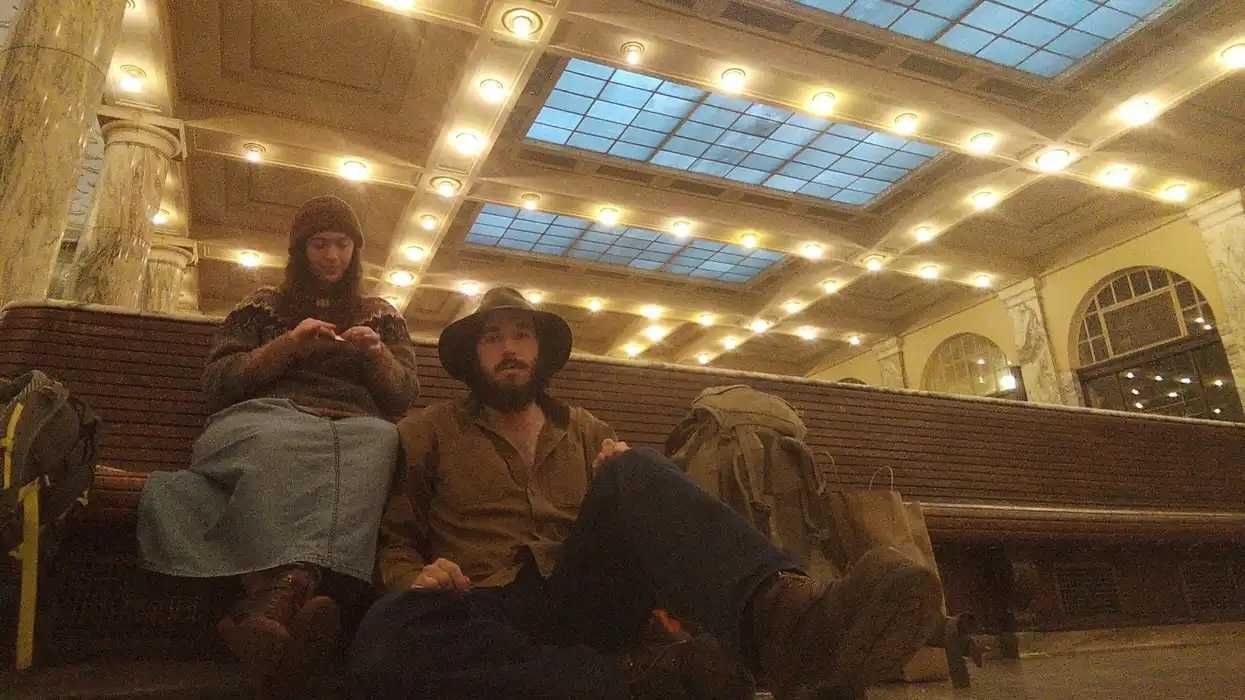
The first place was an Anglican church in Newfoundland that seemed to be run by little old ladies — 30 of them, to be precise, scattered in the pews, in the choir, and at the altar. There were only five men, all of them seated. This did not bode well, we thought.
But it was truly a church for widows, a church that was doing its very best to remain active, putting on plays and picnics even though there were no young people or children. The Spirit was there with those little old ladies. It was comforting them, pushing them forward even though they had lost much. It was reminding them of all that awaited them in paradise. And they were ready.
They gave us cookies and greeted us with forgetful, motherly smiles, as if we were not mere strangers but apparitions of heavenly promises. We were their reminder to keep hoping, and they were our nudge toward charity. We sat, we witnessed, and we listened.
After that we found different Catholic churches to pray in, which somehow always seemed to be far away when Sunday came around. There was a large one — a shrine — on the border of Quebec, Labrador, and Newfoundland, then another a little farther into Quebec, in an Inuit village. This one hearkened to the traditions of these people, too. How beautiful, I remember thinking, the way the Church uses each people's specific culture and history to express the truth.
Then we walked by a window that sported “Seventh-day Adventist” in a French-Canadian Maine town. It was a Thursday, and we had already determined to stay in town for a French-Acadian Mass on Sunday.
“Let’s go there,” I told my husband. “It might be a little frustrating, but it’ll be a good experience for you.”
He agreed, and so we brought ourselves and our backpacks there Saturday morning. The church was new — it looked more like a Main Street business because of its location and the large windows. There were only six or so people inside.
“Can we join you all?” I asked. “No, I am not Seventh-day Adventist, but I’ve attended many services because my family keeps Sabbath on Saturday.”
We put our bags in front of a pile of unopened boxes of "The Great Controversy," and they handed us a booklet on Romans and two pens. The room was ugly, like a warehouse, except for the lace curtains in the windows.
For the next two hours, we “studied the Bible,” mostly discussing how wonderful Jesus is and what it means to pray — how often we should pray and what makes prayer sincere — and how all Protestant churches are basically Catholic because they acknowledge the authority of Rome and the pope to change the Sabbath from Saturday to Sunday.
The church service was bland, hard to follow. I tatted a lace bookmark to try to keep awake. The speaker was likeable, but he droned on about a Bible story, not really recounting it accurately. I don’t think that was the point of his speaking, though — they were simply allowing him a moment to speak, because he was a man and the church had few members and needed participation from everyone in order to keep the spirit alive.
They did not give us cookies, but something better — a meal of various bean and rice dishes. There was fresh homemade hummus, too.
As we ate, everyone continued to ramble on about how awful it was that other churches didn’t care to follow all of the Ten Commandments.
“Evangelicals want the Ten Commandments in schools, and yet they do not want them in their churches.”
“If children came home from school and refused to do their homework on Saturday, most Christian parents would not be happy.”
“There’s a church in town that has the Ten Commandments hanging on the outside of their building,” the pastor began.
So I talked to them about it and asked them why they don’t care about the fourth commandment. Oh, boy! The pastor said he’d get back to me, and let me tell you, oh boy, oh boy, that he finally decided that he could piecemeal a bunch of verses today and how he thinks he can prove that Jesus wants us to keep all the commandments now except that one.
That night the pastor let us stay in his house, and as he showed us all his proof for Saturday Sabbath and how the Catholic Church has duped nearly all mainstream churches, Andy finally confessed, “I am a Roman Catholic, and I believe the Church had the authority to change the Sabbath to distinguish us from the Jewish faith.”
The man started. Then he said, “Well, I think Jesus will save Catholics, too, even though they are only keeping nine of 10 of God’s commandments. But they will be judged for disregarding the Sabbath Day.”
We were friends now.
In the middle of Maine, we attended one other church. All the days leading up to it were edifying. We had spent a wonderful evening with an elderly Latter-day Saints couple who found us hitchhiking, then brought us home to “show us some literature.” It was not the "Book of Mormon." They handed us a glass of orange juice and a box of raisins and played old 1960s and 1970s love songs for us, then told us their love story — of how they had a temple wedding in Switzerland; of their 14 children, 88 grandchildren, and 17 great-grandchildren.
After we played a game of cards, they brought us to our destination, where we stayed with a Quaker-esque hippie Christian family. This family brought us to their church the next day.
It was as if God was answering our longing for Mass. Although the church was small and non-denominational, it felt how an early church might feel or how a Catholic service might feel if it were in someone’s home. They prayed and sang some of the songs you’d hear in a Catholic church, along with songs from an Assemblies of God or Baptist-type non-denominational church. They said the Apostles’ Creed together and took communion as a Catholic church does, with everyone coming up front and receiving it in long lines from the pastor.
The sermon was sound — like a homily — and did not feel as scattered with pieces of scripture as many non-denominational church services are. We were spellbound. If it weren’t for how modern everyone seemed to be dressed, I would have thought we had been transported to an era before the Reformation.
After it was over, I asked the pastor if their church had any Catholic influence.
He laughed and said no, that if there were ex-Catholic members, they would probably oppose these traditional Orthodox inclusions. No, these were things he had included because from his studies and experiences, he had come to believe that there was a lot that Protestantism lost when it spurned tradition and ritualism, and he was slowly trying to incorporate it back into church. “It’s in our roots, too.”
I talked to his wife and told her about my Living Room Academy (she had heard of it) and how it was partially inspired by my travels in woke circles when I realized that many lesbians and liberal women were doing a better job of being women and passing on beauty and skills than Christian women. Her eyes opened wide. “You’re right.” I’ve heard that since we left, she has decided to open her own iteration of the Living Room Academy for the girls in their church.
What I loved about their church was that they didn’t seem to be stuck in their bubble. Their church wasn’t really their “home” as much as it was them trying to find out what home means by looking to the past and looking to paradise. They seem to be doing a very good job at making it work — their church was filled with children, happy-looking teenagers, and a diversity of fashion from very beautiful dresses to jeans with frilly purses. There seemed to be room for expression of faith.
After that we finally made it to a Mass in Fitchburg, Massachusetts. And I must admit, it kind of felt like coming home.
I hadn’t realized how much I had come to love attending Catholic churches with my husband. There are still many questions I have had to sort through about the Church and whether or not I can in good conscience submit myself to its authority. However, being there, surrounded by the beauty of the type that God requested when He detailed the temple He wanted from the Jews, feels like being at home … in paradise.
Everything else feels so earth-like, so business-minded and corporate and mechanical. Even though the “music” of mainstream churches claims to have more life in the show, there’s nothing quite like the chorus in a cathedral. And while you might get a good sermon in a Protestant church, you’re not going to hear near as much scripture read as is read at Mass.
Most Protestants would complain if they had to sit through half of what is read — they want a Bible verse that corroborates a sermon. Meanwhile, you might get about 15 minutes of rich preaching at a Mass — the rest is pure scripture.
It’s almost a hobby now — I will certainly never stop church-hopping, comparing and pondering. I want our children to have these experiences. So many wonderful conversations have sprung up between my husband and me because of these visits, and we are finding ourselves growing more spiritually aligned because of it.
And so I will continue to exhort anyone of any faith: Visit the churches around you, no matter their denomination. Every church has something to offer you and will give you an opportunity to practice humility and charity.
Editor's note: A version of this essay earlier appeared on the Polite Company Substack.
The horrific assassination of Charlie Kirk in September should have united Americans. Instead, it split them even further. Conservatives watched too many of their countrymen on the left openly cheer the murder, and even weak denunciations often suggested Kirk got what he deserved.
For a time, the right rallied — praising Kirk and demanding justice. That unity didn’t last. A furious fight over Kirk’s legacy followed, and that’s worse than politics: It’s destroying the movement he built.
Charlie Kirk’s death was a monstrous crime. Let it not become the occasion for tearing the movement he led to pieces.
George Washington spent much of his Farewell Address warning the young republic about foreign entanglements. He praised American separation from Europe’s great power intrigues and warned that making any foreign state a favored nation would corrupt domestic politics. Washington foresaw factions forming around foreign loyalties and predicted patriots who raised concerns about foreign influence would be branded traitors.
His warning applies now, and the fracture cuts through conservatism itself. The United States has long allied with Israel — sharing intelligence, aid, and military cooperation. Many conservatives, especially evangelicals, treat support for Israel as near-religious obligation. Others point to practical security benefits in the Middle East. That religious devotion makes criticism of the relationship politically perilous. You can denounce Britain or Germany without being vilified. Question our alliance with Israel, and you risk immediate slurs — racist, anti-Semite, bigot.
As Washington warned, centering policy on a foreign nation invites domestic discord and foreign meddling. Qatar and other Gulf states now pour money into U.S. institutions. Diasporas like India attempt to consolidate as a power bloc. None of this would surprise Washington. It was predictable. Still, both sides chatter past his counsel — and refuse the restraint he urged.
Charlie Kirk excelled at coalition building and peacemaking. He united disparate conservatives behind Trump and MAGA. That’s why the civil war over his death is so corrosive. Conspiracy theories swirl. Former allies denounce one another in his name. Private texts between Kirk and fellow influencers have been leaked and used as weapons. The spectacle is inhuman.
The impulse to treat Kirk’s private words as scripture echoes how people now treat the Constitution — stripping context until the document becomes a cudgel for whatever program you prefer. Left and right both reduce texts to proof texts; neither seeks the actual meaning.
Kirk’s position on Israel was complicated. He loved and supported the state and saw biblical significance in its existence, yet he also held America First concerns about military commitments and complained about pressure from Zionist donors who pushed TPUSA to cancel conservatives. He sought to defuse right-wing animosity toward Israel through messaging at home and tempering excesses abroad. His views were nuanced — like most people tend to be when the shouting stops.
Instead of using the outrage over his assassination to crush the left-wing terror network behind it, too many conservatives turned inward and drew long knives. One faction hates Israel so fiercely it would harm America; another treats any deviation from absolute support as treason.
At the moment, conservatives should unify for survival, they trade blows over purity tests.
The reality is simple: Israel will remain. The conservative movement needs a coherent strategy. Religious devotion among evangelicals will persist, but it’s waning among younger Christians. Pro-Israel advocates must make a practical case to younger conservatives if they want broad support. Those who question the tie to Israel will keep growing in number.
If pro-Israel conservatives want to avoid the radicalization they fear, they must tolerate dissent within the coalition without staging public witch hunts. Those who seek to re-evaluate the relationship should keep arguments factual and pragmatic. Washington’s cautions about favored nations and about letting hatred sabotage the country remain relevant.
RELATED: Christians are refusing to compromise — and it’s terrifying all the right people

We saw, after Kirk’s killing, how large segments of the left revealed a murderous contempt for conservatives. That truth cannot be unseen. But within conservatism, the critical question is whether your rival on the right is an opponent to debate or an enemy to be excised. Zionist or skeptic, neither camp is calling for your child to be shot. That low bar — refusing to wish literal violence on fellow citizens — must hold if conservatives hope to form a durable coalition.
This is not an appeal to centrism. I have my views and have argued them plainly. But Kirk wanted a movement that could hold together. He worked to build a broad tent. The conservative civil war must end because the stakes are too high.
If conservatives continue sniping through Kirk’s memory, they will squander their political capital and invite worse divisions. Washington warned us what happens when foreign loyalties and religious fervor distort public life; he warned that factional hatred breaks nations. Conservatives ought to remember that now — not to moderate principle for its own sake, but to preserve the only structure that allows principle to matter: a functioning political majority.
Charlie Kirk’s death was a monstrous crime. Let it not become the occasion for tearing the movement he led to pieces. The left must be opposed forcefully and without mercy in politics, but infighting on the right hands them victory. Put down the knives. Honor Kirk by building the coalition he believed in — or watch the movement dissolve into impotence.
Some pastors and evangelical leaders counsel true believers to rest assured that no matter what happens in November, no matter who wins the presidency, Christians are citizens of heaven, and God, in a very real sense, “has our backs.” The country might end up going to hell, but we are headed, sooner or later, to a better place.
That’s all well and good — to a point.
Pray that God will continue to work miracles and that he will use every one of us, individually and corporately, 'for such a time as this.'
What about the citizens here and globally who will continue to suffer under harmful and reckless policies if one party gains another four years in power? Whether you’re Christian, Jewish, Muslim, Buddhist, or atheist, one critical issue demands your attention: wide-open borders and their impact on your life and family.
For more than three years, millions of people have crossed our southern border without vetting. Many violent criminals and gangs, labeled “newcomers” by this administration, have taken advantage of this crisis. These criminals have terrorized neighborhoods, organized prostitution rings — including the sexual exploitation of children — trafficked deadly drugs like fentanyl, and caused chaos in once-peaceful towns across America.
Don’t the citizens of heaven have a responsibility to love their neighbors and do everything they can to ensure their safety, security, health, and happiness?
The origin of the word “politics” means “affairs of the cities.” Didn’t Jesus command his disciples, then and now, to “go into all the world and preach the good news”? Isn’t “all the world” made up of cities? And isn’t the good news that there is eternal salvation available to all who believe in him? And before rising from the dead, didn’t Jesus prove himself to be God by relieving the physical, mental, and spiritual suffering of many helpless people?
So a true follower of Jesus cannot use the excuse that he is “not political.” That statement in itself declares a political position — whatever happens, good or bad, I have given my consent.
St. Paul shared his opinion and the good news at a place called Mars Hill. He wasn’t afraid to mix it up with pundits and wise guys of his day and age.
The apostles challenged the political status quo of the Sanhedrin, Jewish leaders who themselves had to play ball with the rulers of the Roman Empire.
Reports say more than 70% of Christians calling themselves evangelicals do not vote. How is that possible? Would not an entire country be set aright with participation of godly people? That appears to be a no-brainer.
In Esther’s day, a man name Haman was about to rain hell and death down onto the Jews in the kingdom ruled by King Xerxes. But Esther put her very life on the line to make an appeal to the king. Her bravery resulted in the tables being turned on Haman: The gallows he built to kill the Jews was used to hang him.
It should be overwhelmingly obvious to anyone with even a tiny spark of wisdom that America cannot continue on its current trajectory. Those who follow the living God, the God who truly loves us and who is still involved in “the affairs of the city,” must persist in “storming heaven” with our prayers.
Pray that God will continue to work miracles and that he will use every one of us, individually and corporately, “for such a time as this.”
Believe it or not, the Deep State and its evil schemes can certainly be stopped. They cannot outsmart the God who they insist does not exist.
Our God promises in the Old Testament that he “will hear from heaven, forgive our sins, and heal our land.” But before he does, it is up to us to “humble ourselves, pray, seek his face, and turn from our wicked ways.” Those marching orders can be found in 2 Chronicles 7:14.
The question is, are there big enough remnants of Christians and Jews this day to step up to this critical challenge?
Editor’s note: A version of this article appeared originally at the Stream.



 Christians must resist being spiritually manipulated by warmongering ideologues.
 For the first time in 30 years, Democrats and Republicans are tied 33 percent to 33 percent on the question of who 'cares more for the needs of people.'
 'The Widening of God’s Mercy' lacks a credible defense of its thesis and ignores the most important relevant biblical texts.
 Evangelical leaders have increasingly aligned with the leftist ruling class, while many in the pews maintain more conservative views.
 www.theblaze.com
 thefederalist.com
 www.theblaze.com
Oprah and The Rock are facing MAJOR BACKLASH over THIS