Why 3 kids are easier than 1
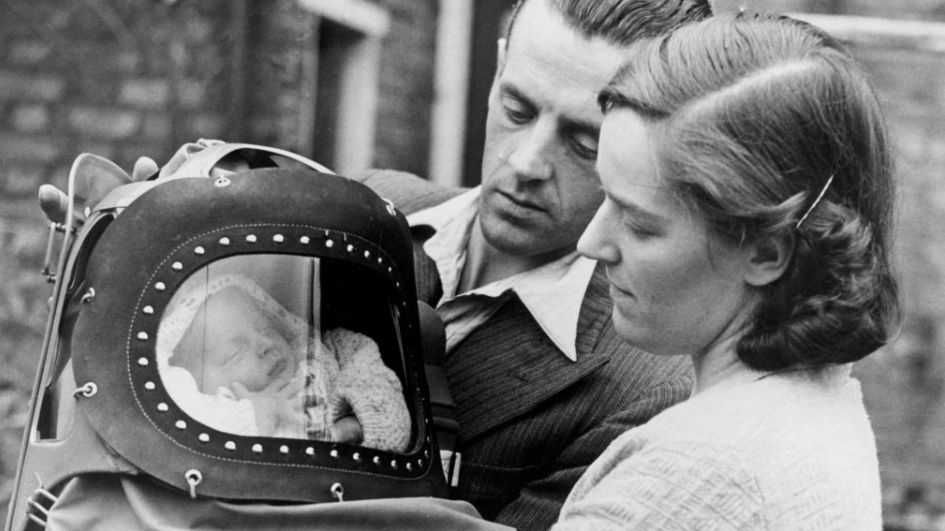


Two of our kids went to visit my parents a couple days ago, so my wife and I are home with just our youngest for a few nights. It’s strange. It kind of feels like it felt when we only had our first. It’s so quiet, so insanely quiet.

In fact, I’m laughing as I write this thinking about just how quiet it is compared to normal (read as: insane) daily life. Babies cry and all, but the truth is once you have older ones, you realize that those little cries and protests are really just cute and kind of pitiful, even if they seem furious.

There is something vital in us that seeks out friction and new horizons, physical and mental.

But of course, they don’t feel like that at the time when you are new to everything with your first kid.

Cry babies

I remember one time, probably two or three days after we left the hospital with our son, we called the 24-hour nurse line because we were concerned he might hurt himself from crying so much. She very kindly assured us that everything was fine and that we shouldn’t worry about him hurting himself due to crying.

My wife and I think about that story probably every six months or so. We laugh so hard about how little we knew, how nervous we were, and how loud those weak, little screams from a 5-day-old mouth must have felt to our uninitiated ears. We weren’t used to crying, we weren’t used to holding a little human screaming his hardest. We genuinely thought he might blow a blood vessel or something.

Now it’s different. When our 5-month-old cries, we aren’t particularly disturbed or shocked. It’s just what they do. We know the kinds of cries (my wife better than I), and it’s just not a big deal. They aren’t even loud, or at least not compared to the cries from a 2-year-old in the throes of an illogical tantrum.

RELATED: My son and daughter are fundamentally different — and it's a beautiful thing
Fox Photos/Getty Images

0 to 1

It felt so hard when we only had our son six years ago. That leap from zero to one is a big one. Up until that point, you have basically spent your life being selfish. In your quiet, organized, little apartment where nothing is moved unless you move it, where no one screams for no reason, and where you actually have time to relax, life is very easy. So that leap with your first is big, and the chaos feels like a lot.

But now? This brief return to life as a family of three feels like a vacation. There are no messes unless my wife or I make them. I don’t have to admonish someone every 10 minutes for not doing what they should be doing. I can get so much done, we have so much extra time, and everything is so quiet.

It’s funny how easy that thing that seemed so hard feels now. As we have more kids, we adapt to more chaotic circumstances. We are able to take on more stuff. We are able to manage more people. Our love expands, and so does our bandwidth.

The thing is, we don’t feel it happening when it’s happening. The stress keeps right up, following a straight line so we don’t realize we are becoming more competent, and it isn’t until we are able to visit ourselves in our prior situation for a few days that we are able to really see how far we have come.

Sink or swim

This phenomenon doesn’t only apply to raising a family. It applies to our work, our adventures, and all of everything we do. We adapt to our environment, rise to the occasion, and our capacities expand when needed. If we stop, look back at our lives, and really think about how we have grown, we see that often we’ve grown the most when we have been forced to.

We grow when we take on things we don’t think we can handle. We don’t know how we are going to do it — whatever it is — but we jump in, do it, and two years later, it’s just what we consider to be normal, and we are ready again for a new challenge. There is something vital in us that seeks out friction and new horizons, physical and mental. And so we keep doing that over and over again throughout our lives, and we keep getting stronger and more capable as the years pass, even if we still feel kind of like we don’t know anything at all.

It’s possible to try to avoid struggle and the growth that comes with it. It’s possible to try to take the easy way out. But life finds a way of demanding more of us. Whether we like it or not, we are thrown overboard and told to swim, and more often than not, we find that we can swim quite well.

Why Prudes Are The Only Ones Consistently Having Good Sex

Human flourishing consists less of discovering who we are than of becoming who we ought to be.

Step Into Dunder Mifflin At ‘The Office Experience DC’

'The Office Experience' is a little slice of the comedy and comfort Americans so loved the original show for.
Horowitz: Coronavirus cases, hospitalizations soar in Hawaii since indoor and outdoor mask mandates

At what point do results and outcomes begin to matter? On the current political trajectory, we will be stripped of our humanity and forced to wear face burkas indefinitely without any debate, votes, benchmarks, or transparency. Not only are there no randomized clinical trials showing evidence that mask-wearing in the general populace works to stop the spread of respiratory viruses, but the reality of these mandates in practice for the past few months shows they are worthless and that the virus spreads as it spreads, regardless of human input. The latest example is Hawaii.

Just like in the Philippines and Peru, Hawaii’s government has imposed a long, strict lockdown and has never emerged from it beyond a modified phase one reopening. Additionally, the state has had an indoor mask mandate in place since April 20 and an outdoor mandate (even while jogging!) since July 7. It is the model for what the political elites believe to be the key to stopping the spread. Yet the results are the same as they have been in every place that tried to put up a cloth in front of the inexorable spread of viral particles that can only be seen with an electron microscope.

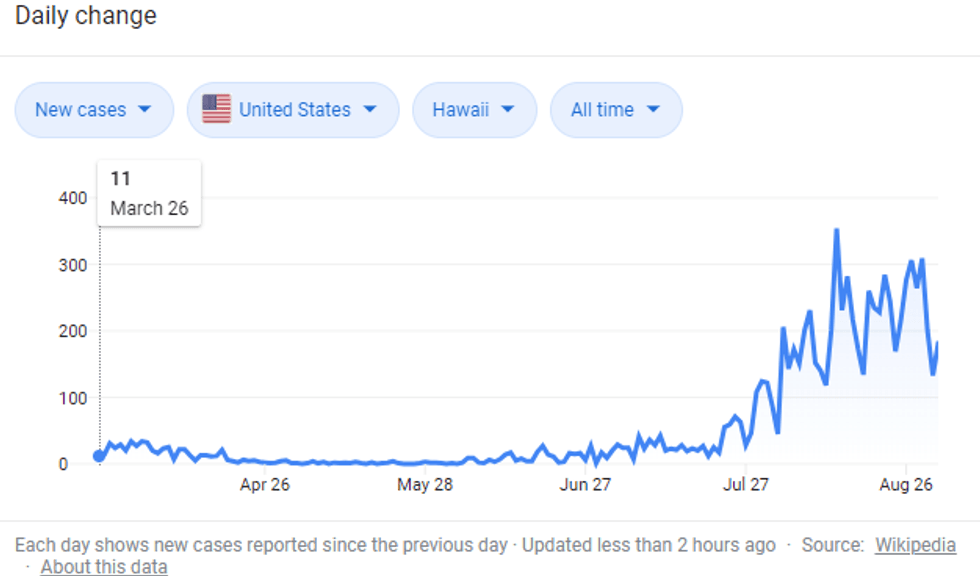
As you can see, Hawaii’s daily case count grew more than tenfold in July and August. All along, state officials thought they were steering this ship cleanly throughout the spring and that their draconian efforts avoided the spread of the virus. Instead, it has become clear that the virus simply arrives at southern latitudes several months later and spreads for six to eight weeks, as it does everywhere else.

If mask-wearing were as effective as the cult-like devotion to it claims and the strict legal enforcement of it were justified, then this result would be impossible. Let’s not forget that Hawaii is the most isolated state and has essentially choked off tourism and commerce. In addition, Hawaiian Airlines has the strictest mask policies among all airlines.

Hospitalizations have also increased eightfold since mid-July. And as my friend Ian Miller shows, this occurred long after mask-wearing became a universal requirement.

“Face coverings are one of the easiest ways to prevent the spread of COVID-19,” said Oahu’s Mayor Kirk Caldwell in a July 3 order expanding the city’s mask mandate to outdoors. Well, Mr. Mayor, facts and data don’t care about your opinion.

And it’s not as if the edict is not being complied with. According to the New York Times, Hawaii has a high degree of compliance. The few people caught without masks have not only be cited, but arrested too. Then again, you can’t beat the mandate in the Philippines, where residents were threatened with getting shot for violating coronavirus orders, yet as in all southern latitudes, the country is experiencing a late spread. Ditto for Peru, which had a universal mask mandate for months but has the most COVID-19 deaths per capita in the world.

Now we know why Dr. Fauci said in July that there are no plans to conduct a randomized clinical trial to asses the effectiveness of universal mask-wearing in stopping the spread. We have a better litmus test than clinical studies: We have the reality of human experience in every corner of the world.

Just how confident is our government in the effectiveness of mask-wearing? The CDC recommends that someone who has come into contact with a person who has the virus for at least 15 minutes should quarantine, “irrespective of whether the person with COVID-19 or the contact was wearing a mask or whether the contact was wearing respiratory personal protective equipment (PPE).”

So, when it comes to actually making life decisions based on the mask cult, suddenly the science is as cheap and flimsy as the cloth itself. Yet in July, Dr. Robert Redfield, the CDC’s own director, said, "If we could get everyone to wear a mask right now, I think in four, six, eight weeks, we could bring this epidemic under control.”

Well, Dr. Redfield, I’ll do you one better. Hawaiians were wearing masks for nearly 20 weeks in an island state before the virus spread much at all. Yet it still appeared with a vengeance in July.

You can’t blame the CDC for not putting its money where its director’s political mouth now is, because as late as May, the CDC was citing the 10 randomized controlled trials that showed "no significant reduction in influenza transmission with the use of face masks."

How much longer will we allow this flat-earth science to trump our liberty, human dignity, and right to breathe unrestricted air? Many states are mandating this even on small kids. Typically, in order to issue such a draconian and personal regulation of one’s person – to the extent that could ever be constitutional – the government must produce substantial evidence that the restriction is necessary and effective and propose its implementation through the least restrictive means for the minimal amount of time necessary. Sadly, the Constitution has been cast aside as callously as common sense and years’ worth of science on the spread of respiratory viruses.