Jason Whitlock: WNBA owner crashout was scripted to BREAK Caitlin Clark


Was the latest Caitlin Clark controversy genuine outrage — or a staged production? After two teenage girls sitting courtside at a WNBA match were publicly screamed at for using signs to thank Sophie Cunningham for standing up for women in sports, BlazeTV host Jason Whitlock believes the answer is obvious.

“Here’s what the cameras won’t show you,” he begins. “Sitting courtside almost shoulder to shoulder with those two teenage girls, there’s this older woman with her own pre-printed sign. ‘No hate in these United States.’ A counterprotester planted, and yes, I’m using the word ‘planted.’”

“In the same frame, rebuttal already made, ready for the shot. Two kids thank an athlete. And there’s a grown activist positioned right next to them with the comeback in hand,” he says.


“Spontaneous fan moments don’t come staged like that,” he adds.

Whitlock doesn’t even believe the presence of the teenage girls was organic.

“This whole thing seems staged, including the two cute little teenage girls juxtaposed against this tatted up, angry, unattractive older woman. This is like a movie script. All of this stuff feels scripted,” he says.

“The media will run the owner’s apology all day,” he continues. “They will not show you that sign. They will not show you all the casting that was done here. The owner got punished. A five-game suspension. She can’t come back to the arena … for five games. There’s some sort of fine.”

“But the coverage still pivoted to ‘why won’t the golden goose, why won’t Caitlin Clark apologize for this?’” he says, adding, “Somebody assigned these roles before the ball went up. The owner plays the heel, the media plays the prosecutor, and Caitlin Clark is cast as the defendant in a trial where the verdict was tight before she woke up.”

Want more from Jason Whitlock?

To enjoy more fearless conversations at the crossroads of culture, faith, sports, and comedy with Jason Whitlock, subscribe to BlazeTV — the largest multi-platform network of voices who love America, defend the Constitution, and live the American dream.

Never AI. Always reality. Only film: The 6-word promise that's building a worldwide community.


What is real?

I know that sounds like I'm trying to "blow your mind, man." But I don't mean it in some kind of hippy-dippy, dorm-room philosophizing kind of way.

They want a place where they know they'll be seeing the world as it is, where they can drop their defenses against being fooled.

In 2026, "What is real?" is a very pressing question.

Won't get fooled again

If you've spent any time on X, Instagram, or Facebook, you've probably gotten used to thinking about reality. Namely when coming across the countless AI-generated photos and videos flooding your timeline.

Some, of course, are obviously fake. A penguin shaking hands with a polar bear on a dock while a moose looks on from a sailboat? Most likely AI. But with others it's not so easy.

Take that photo of the beautiful sunrise over those shining snow-covered mountains. Looks real ... but it isn't. Neither is that perfectly convincing woman talking about the scheduling app that helped her organize her life.

Unless you are exceedingly discerning, you've probably been fooled by AI, even if just for a few seconds. You shouldn't feel bad, and you shouldn't feel like a dupe, even though you probably do. We weren't made for this world of images that look 99.99999% real but are 0% so. What in our past would have ever prepared us for this world? Seeing is believing? That may have been true once upon a time, but no more.

Shutter island

There are a lot of implications here for society. How do we live in a half reality, half anti-reality world? How do we organize a society around truth when the truth is constantly muddied by false images and videos? How do we even talk to each other if we can't reach a consensus on what's in front of us? These are big questions without clear answers.

But on a smaller, more granular, human level, I think something interesting is happening: People find themselves aching for more truth, more reality. Not everyone, of course. Some are going full steam into the Kafkaesque world of reality-nihilism. But others see the trap, the chaos, and the shallow ugliness of anti-reality.

Earlier this year, I started a project by the name of Film 20. Essentially, it’s a place of pure reality in the form of film photography. It’s an archive of photos from real people and real places all around the world. No iPhone photos are allowed, no digital photos from DSLRs either. Only film; only reality.

RELATED: The Kids Are Outside

O.W. Root

Reality hunger

At first, our followers were mostly film photographers and film aficionados. But an interesting thing happened in the past few months. The account blew up in a substantial way. There are now nearly 29,000 people following Film 20, an account dedicated to documenting reality through the eyes of film photographers.

Those 29,000 people aren't all photographers, though some are — our DMs are flooded with submissions from wonderful photographers from all over. They aren't just following for the nice photos either. I know because the primary sources of growth have been derived from posts underscoring the purpose of Film 20.

"Never AI. Always reality. Only film."

People — 29,000 people — want a feed of reality and only reality. They want a place where they know they'll be seeing the world as it is, where they can drop their defenses against being fooled.

Cultivating authenticity

I know that everyone doesn't have this same kind of yearning for reality. I understand that these 29,000 are not representative of the general population in 2026. But I don't think this desire is going away, and I don't think the awareness of the shallow falseness of digital AI imagery is a short-term blip. The further we move into the AI world, the stronger this yearning for reality will be.

The bleed of fake video and imagery into every corner of our digital world will continue for the foreseeable future. It will be annoying. Next year you will only see more fake videos than the last.

So whether it is film photography, live music, local food, or real people with real emotions, the future of reality is one that will need to be cultivated and earnestly sought out. Just like we try to eat healthy and read good books, we will need to consciously make the choices that lead us toward reality in every way we can.

Reality is good for the body, mind, and soul.

How Spanberger managed to hit record-low approval rating in 80 days


House Democrats' loss of 14 seats to Republicans in the 2020 election was apparently an eye-opening experience for then-Congresswoman Abigail Spanberger (D), who blamed the ease and effectiveness with which critics branded her party as a bunch of radical leftists.

"We need to not ever use the word 'socialist' or 'socialism' ever again," Spanberger said on a post-action House Democratic Caucus phone call. "Because while people think it doesn't matter, it does matter, and we lost good members because of that."

Years after acknowledging the importance of concealing radical impulses from voters, the former undercover CIA officer who participated in the anti-Trump "resistance" after the 2016 election ran for governor of Virginia, campaigning in 2025 as an even-keeled and unifying pragmatist. The liberal media then forwarded that narrative.

'She's just a bot for the Democratic Party.'

It is now painfully obvious, however, that the supposed moderate who defeated former Lieutenant Governor Winsome Earle-Sears (R) in November in a landslide is — as the GOP of Virginia and others had warned — not as advertised.

A damning new Washington Post-Schar School poll revealed on Monday that Virginians, realizing only too late how Spanberger really operates, have largely soured on the Democratic governor. In fact, her approval rating is so low, it set a record in Post polling.

When asked how Spanberger is handling her job as governor, 47% of respondents signaled approval, 36% signaled disapproval, and 7% expressed no opinion. The Post noted that approval rating is 13 percentage points lower than the average for Spanberger's predecessors going back to the 1990s.

Political analyst Larry Sabato told WJLA-TV, "A drop of that margin is stunning, and it should be greatly disturbing to the governor and the governor's staff if it's repeated in other surveys."

There is no shortage of clues in the poll's cross tabs as to why the people of the Old Dominion are less than enthused about their new governor.

When asked about the supposed moderate's views, a plurality of respondents — 45% — said they were "too liberal." Broken down by party affiliation, 91% of Republicans, 44% of independents, and 6% of Democrats said so. Nearly 10% of Virginians who voted for Spanberger were among those who rated her as "too liberal."

For starters, Spanberger dropped the moderate mask in her approach to immigration.

Weeks after rescinding former Gov. Glenn Youngkin's order requiring state law enforcement agencies to cooperate more fully with federal immigration authorities, Spanberger directed state police and other state agencies to terminate any such agreements with U.S. Immigration and Customs Enforcement.

Department of Homeland Security Deputy Assistant Secretary Lauren Bis grouped Spanberger with those "sanctuary politicians" who have "tried to slow ICE down and chosen to release criminals from their jails into our communities to perpetrate more crimes and create more victims."

Virginians are already dealing with the fallout of Spanberger's virtue-signaling.

The DHS noted on Monday that "so far in 2026, illegal aliens have allegedly committed 75% of all murders" in Fairfax County, Virginia.

The supposed moderate also committed all state agencies to rejoining the Regional Greenhouse Gas Initiative, a regional cap-and-trade program covering power sector emissions that Youngkin — who completed his term with a 50% approval rating — removed Virginia from and dubbed a hidden tax on ratepayers.

While previously a critic of partisan gerrymandering schemes, Spanberger has come out in support of a proposed constitutional amendment that would all but ensure that 10 out of the state's 11 congressional seats go to Democrats, thereby disenfranchising Republican voters in Virginia.

RELATED: Parents enraged over adult illegal alien allegedly molesting Virginia high school girls

Al Drago/Bloomberg/Getty Images

Although consistent on the issue of abortion — she routinely voted in Congress to deprive the unborn of protections and to advance abortion ideology — her continued activism as governor may read as "too liberal" for some residents.

In February, for instance, she signed a partisan constitutional amendment that, if approved by voters later this year, would codify the "right to reproductive freedom, including the ability to make and carry out decisions relating to one's own prenatal care, childbirth, postpartum care, contraception, abortion care, miscarriage management, and fertility care."

In addition to taking an extreme approach to so-called reproductive rights, Spanberger is expected to help her fellow Virginia Democrats in waging war on the Second Amendment. She did, after all, vow not to veto gun-grab laws as Youngkin had and express support for a ban on sales of so-called assault-style weapons.

Among the various gun-control bills awaiting her signature are bills that would:

  • Ban gun possession within 100 feet of locations used for election-related activities;
  • Require a "handgun shooting" course as opposed to an NRA-affiliated safety course;
  • Create a Class 1 misdemeanor for anyone who imports, sells, manufactures, purchases, or transfers a so-called assault firearm or magazines that hold over 15 rounds;
  • Prohibit the carrying of loaded "assault firearms" in public spaces;
  • Bar anyone convicted of a misdemeanor "hate crime" assault from possessing or carrying any firearm; and
  • Prohibit Americans younger than 21 from buying a handgun or "assault firearm."

Spanberger faces an April 13 deadline to ratify these and other gun control bills.

Gregory Roddy, a self-identified independent voter from Fairfax County, told the Post that while always skeptical of Spanberger's presentation as a bipartisan candidate, it was clear once she was elected that "she's just a bot for the Democratic Party."

Mason Necci, another independent voter, this time from rural Culpeper County, suggested that Spanberger is attempting "to make herself into a Democratic icon."

"Virginia is already regretting electing a governor who stands for illegal immigrants over her constituents," Rep. Ralph Norman (R-S.C.) wrote. "Spanberger's alarming disapproval rating is telling. And she's been in office a mere three months."

Like Blaze News? Bypass the censors, sign up for our newsletters, and get stories like this direct to your inbox. Sign up here!

'Photo tells the story': Democrat senator uses fake image of Pretti shooting featuring headless agent


Illinois Sen. Dick Durbin (D) gave a speech Wednesday on the Senate floor expressing both his intention to help starve the Department of Homeland Security of funds and his outrage over anti-Immigration and Customs Enforcement agitator Alex Pretti's fatal shooting on Saturday by a U.S. Customs and Border Patrol agent.

When discussing Pretti's demise, Durbin relied on a large visual aid — a supposed photograph of the incident.

However the Democratic senator appears to have overlooked glaring indications that the image was significantly doctored. For starters, one of the federal agents depicted in the image appears to be missing his head.

'AI enhancement tends to hallucinate details.'

"I'm going to show a photo of that scene, which is graphic, but I'm afraid is necessary to appreciate the horror of the moment," Durbin said as he set the image for all to see on an easel. "This photo shows the last second before the ICE agent killed Alex Pretti on the streets of Minneapolis."

After citing the image as evidence that it was "obvious" Pretti had made "no effort to resist" — a claim contradicted by footage taken from multiple vantages — and emphasizing that "the photo tells the story," Durbin criticized the Trump administration for encouraging skepticism about the initial narrative surrounding the shooting.

"What was the Trump administration's immediate response when they heard of this second killing in Minneapolis? Not to bring down the temperature but instead to rush to the American people with one message: 'Don't believe your eyes. Don't believe what you see,'" said Durbin, pointing at the image, which is apparently an AI interpretation of a blurry still from footage taken of the incident.

RELATED: 'Gentle nurse' narrative cracks: New video appears to show Pretti spit toward federal agents and kick out taillight

Photo by Octavio JONES / AFP via Getty Images

There are numerous other signs of AI "hallucinations" in the image used by Durbin besides the absence of one agent's head.

There are, for instance, confusing shadows; a seemingly impossible configuration of fingers on Pretti's right hand; an unnatural bend in one of the legs of the headless agent kneeling next to Pretti; and a fantastical weapon in the possession of the agent depicted behind Pretti.

Hany Farid, a professor at the University of California, Berkeley's School of Information, told the Agence France Press, "The issue with these images is that the AI enhancement tends to hallucinate details."

According to IBM, "AI hallucination is a phenomenon where, in a large language model (LLM) often a generative AI chatbot or computer vision tool, perceives patterns or objects that are nonexistent or imperceptible to human observers, creating outputs that are nonsensical or altogether inaccurate."

Peter Adams, senior vice president of research and design at the News Literacy Project, told the Minnesota Star Tribune that such AI-generated images "are an example of how synthetic visuals can spread confusion and further divide Americans about important issues."

Durbin was evidently not the only liberal duped by the image.

In fact, it went viral on multiple social media platforms, including X, where it netted tens of millions of impressions and was shared widely. Even retired Gen. Raymond Thomas III, the former commander of U.S. Special Operations Command, and MSNBC legal analyst Jill Wine-Banks appear to have been fooled by it.

Like Blaze News? Bypass the censors, sign up for our newsletters, and get stories like this direct to your inbox. Sign up here!

Say no to synthetic: America needs real meat, not lab slop


The push for lab-grown and artificial meat is no accident. It is a coordinated campaign to reframe how Americans think about food. From glowing media coverage to celebrity endorsements, the message is clear: Ranching is destructive, eating real meat is backward, and the future belongs to synthetic substitutes.

Beneath the glossy propaganda lies a troubling experiment — one that threatens the livelihoods of ranchers, undermines food security, and hands more control of the food supply to corporate and global elites.

What ‘fake meat’ really means

Plant-based “meat” products like Beyond Meat and Impossible Foods use plant matter mixed with additives to mimic the flavor and texture of beef. Lab-grown “meat” is even more radical: animal cells cultivated in bioreactors through a chemical process, then marketed as the real thing.

These companies aren’t simply offering another option at the grocery store. They are trying to redefine what counts as food — and consolidate who controls it.

Both are ultra-processed concoctions. They imitate rather than nourish, raising serious questions about their long-term effects on human health.

Under normal circumstances, such products would remain niche novelties. But with heavy investment from billionaires like Bill Gates, development has accelerated. Gates has argued that “all rich countries should move to 100% synthetic beef” and poured millions into the industry. At the same time, mainstream media outlets have worked overtime to present lab-grown and plant-based meats as inevitable, urgent, and morally superior.

Follow the money

The driving force is not consumer demand. It is financial interest. These companies aren’t simply offering another option at the grocery store. They are trying to redefine what counts as food — and consolidate who controls it.

Consumers are told they are “saving the planet.” In reality, they are enriching investors and empowering corporations that want to dominate the food supply chain.

What’s in it?

The supposed “better” alternatives raise their own health concerns. Plant-based burgers are not vegetables pressed into patties but chemical cocktails that include methylcellulose, a laxative additive, and soy leghemoglobin, a genetically engineered substance designed to mimic myoglobin, the protein in meat that people often mistake for blood.

Lab-grown meat, even less tested, relies on processes with no precedent at scale. Regulators are barely beginning to study safety issues. Meanwhile, we already know ultra-processed foods shorten lives. A 19-year study linked high consumption of such foods to a 31% higher mortality rate, along with increased rates of obesity, diabetes, and heart disease.

To assume that fake meat will escape these dangers is wishful thinking.

The attack on ranchers

If this were merely a matter of consumer choice, the stakes would be lower. But the movement does more than promote itself. It vilifies ranching, branding cattlemen as climate villains.

That message lands hardest when ranchers are already under siege. U.S. cattle numbers have fallen to 86.7 million head — the lowest since 1951. Since 2017, more than 100,000 beef operations have closed, a 15% decline. Rising feed costs, volatile markets, and the dominance of giant packers already squeeze small producers. Fake meat could finish the job.

RELATED: Florida bans lab-grown ‘meat.’ Who’s next?

Photo by Nick Otto for the Washington Post
When family ranches collapse, food production falls even more under the control of corporate giants and investors with little connection to rural America. Transparency disappears. Communities lose their anchor. Consumers end up beholden to whoever controls the labs.

This push isn’t about “helping the planet.” It’s about gaining control and consolidating power.

What policymakers can do

Markets work only when buyers get honest information and producers compete on equal footing. State and federal officials should:

  • Require clear labels (“plant-based” or “cell-cultivated”) so shoppers know what they are buying.
  • Police false environmental or health claims.
  • Enforce competition laws to keep big buyers from crushing small ranchers.
  • Improve price transparency.
  • Help local producers connect with consumers and earn fair value for sustainable grazing.

Supporting ranchers and strengthening antitrust enforcement would do more for food security and public health than subsidizing experimental startups.

Keep food real

Fake meat is sold as progress. In reality, it risks damaging our health, weakening our food supply, and destroying the ranchers who have long fed the nation.

Even if lab-grown meat proves harmless, centralizing control over food erodes transparency, accountability, and community. The future of food should not be synthetic. It should be local, rooted in real ranching, and kept in the hands of Americans who have nourished this country for generations.

You were built for meaning, not cheap pleasure


For most of human history, scarcity was the enemy. Territory, calories, energy, and land all had to be fought for, hoarded, and rationed. Wars were waged and innovations forged to survive deprivation. But the material hardship that once united societies in common struggle has largely faded in the affluent world.

Now we face a different enemy: artificial abundance.

The future belongs to those who reject the simulacrum and embrace reality.

In the wealthiest nations, human beings are no longer selected for resilience in the face of scarcity. They’re selected for their ability to resist the seductions of abundance — synthetic food, fake relationships, dopamine on demand. The danger isn’t hunger or want, but the numbing comfort of simulated satisfaction.

Loaded with empty calories

Once, entire civilizations rose or fell depending on their ability to produce and preserve food. Famines routinely devastated societies, and most people spent their lives just trying to eat.

Now, calories come cheap and easy. Factory farming, food science, and global logistics mean even the poorest Americans can gorge on processed junk. A trip to McDonald’s or a few bucks at Walmart buys a week’s worth of empty calories.

But artificial flavorings and chemical fillers are no substitute for real food. They simulate nourishment, but slowly poison the body. Calories are now so available that obesity, not hunger, is the largest threat to the well-being of the poor. The need has been met — and subverted.

Sex and glory, sold cheap

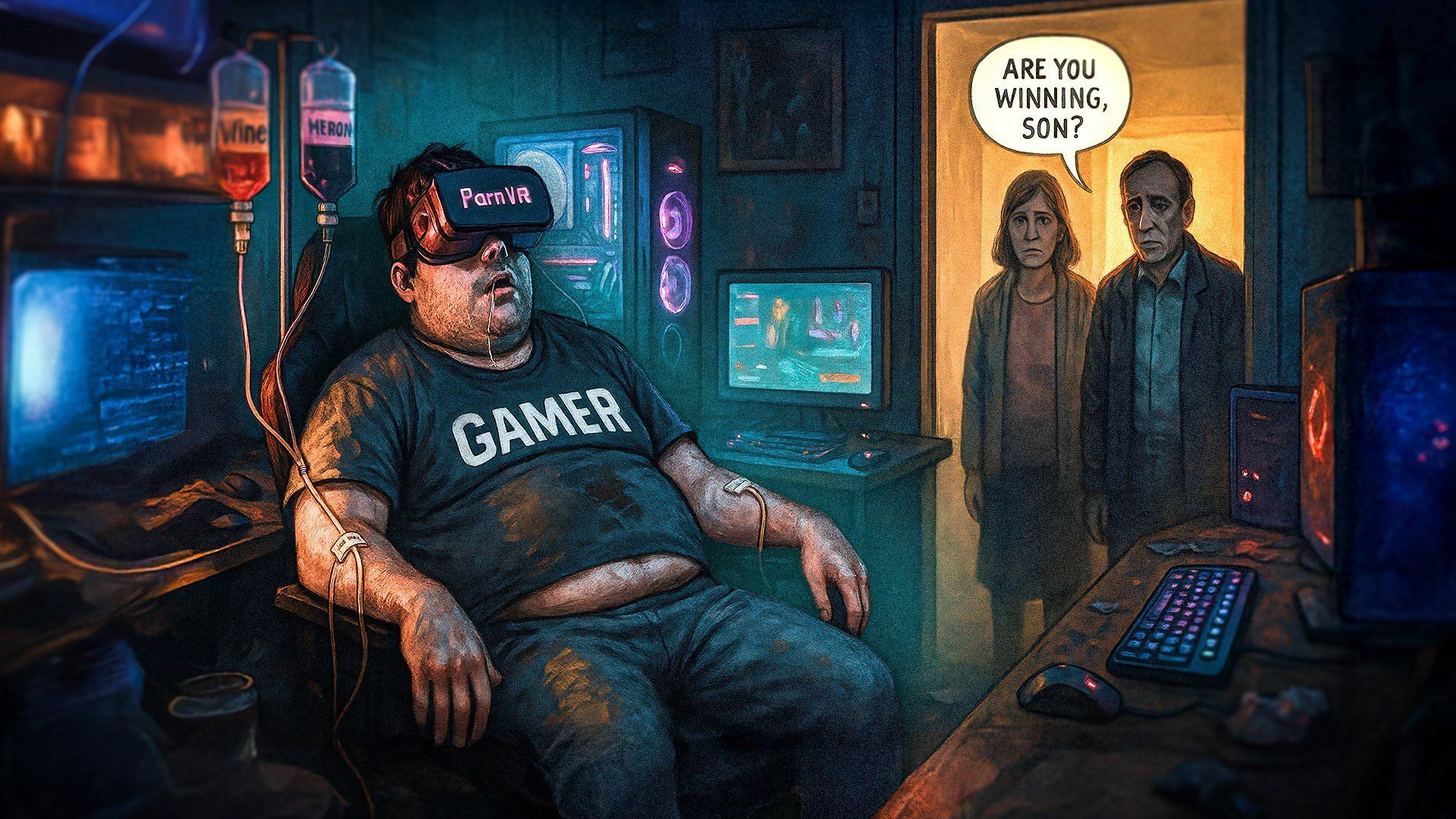
The same dynamic has corrupted sexual desire. Historically, sex drove men to build civilizations, conquer enemies, win wealth, and rise in status. Today, that drive is short-circuited. Men can now simulate conquest and fulfillment without risk, pain, or purpose — through pornography and video games.

Why fight for honor or love when you can get the illusion of both from a screen? Instead of greatness, many young men settle for a life of digital masturbation — and that’s how the system likes it. Young men remain trapped in a kind of eternal adolescence: satisfied just enough to avoid rebellion, addicted just enough to stay quiet.

Fake attention, real loneliness

Social media and dating apps have similarly distorted the lives of young women. Women crave connection, validation, and community — roles they once fulfilled in family, faith, and friendship.

Now they chase attention online, deluding themselves into believing that likes and comments are the same as love and loyalty. Social media simulates female community and male desire, but gives neither. Depression rises. Real-life relationships crumble. Women fear male attention in person but crave it online, where they feel in control.

RELATED: Rule by the people? Not anymore in the Western world

Blaze Media Illustration

What results is a dysfunctional, hypergamous dating market. Men won’t approach. Women hold out for the fantasy of the “perfect man” who never arrives. Both sexes lose.

Lockdowns revealed the lie

COVID-19 lockdowns showed us the true danger of attempting to simulate every aspect of human experience.

During the lockdowns, social interactions from school, church, work, and even bonding with friends over a meal became impossible. School, church, work, friendship — all of it was forcibly digitized.

The results were catastrophic: soaring depression, stalled childhood development, and broken education.

But the worst part? People stayed in their digital cages even after the doors opened. Simulated connection became easier than real interaction. And easier won.

The real thing is harder — and worth it

Reality demands effort. Family, community, faith, and responsibility are hard. They hurt. They risk rejection. But they matter.

Left alone with simulated choices, most people will pick the path of least resistance. That’s why society must rethink what it rewards. Because the simulations aren’t harmless distractions — they’re traps.

The French philosopher Jean Baudrillard called this phenomenon the “simulacrum” — a copy with no original. A cheeseburger that isn’t food. AI “friends” that aren’t human and virtual “communities” that cannot possibly relieve loneliness. A porn star who looks and behaves nothing like a real woman. Online attention that ruins offline romance. Video game violence that replaces true heroism.

An evolutionary filter

We face an evolutionary bottleneck as serious as any in human history. But instead of favoring the strong, smart, or adaptable, survival now depends on who can say no.

Can you say no to simulated sex? Simulated success? Simulated community? Can you hunger for meaning, not just comfort?

Those who make it through this filter will be the ones who choose austerity over ease — who hunger for the real thing. The future belongs to those who reject the simulacrum and embrace reality.

Artificial intelligence will only make these temptations worse. But those who refuse to be pacified will also be the ones who endure.

Choose meaning. Teach your children to do the same. The future depends on it.

Harvard dishonesty expert stripped of tenure and fired over alleged data falsification, rampant plagiarism


Harvard University has many problems these days, but one of the biggest still appears to be academic dishonesty.

Francesca Gino — a professor of business administration who has long studied the psychology of organizations, dishonesty, and how people justify unethical behavior — was called out in 2021 for alleged data falsification, then later for apparent plagiarism. Her years-long fight to keep her job appears to have come to an end.

The Harvard Corporation, the university's governing board, decided earlier this month to both revoke the prominent professor's tenure and give her the boot.

The revocation of Gino's tenure — which was first reported by the public radio station GBH, then confirmed to the Harvard Crimson by a university spokesperson — appears to be the first time that the university has stripped an instructor of tenure since at least the 1940s.

In 2021, business professors Uri Simonsohn, Leif Nelson, and Joseph Simmons — all affiliated with other universities — and anonymous researchers began exposing Gino's apparent academic dishonesty on the blog Data Colada, highlighting "evidence of fraud in papers spanning over a decade," as well as in papers as recent as 2020.

The Data Colada sleuths shared their findings with Harvard Business School in October 2021. The university launched an 18-month probe shortly thereafter.

According to the investigation completed by the Harvard Business School in 2023, Gino, a professor at the university for over a decade, "committed research misconduct intentionally, knowingly, or recklessly."

In 2023, several of Gino's papers were retracted and slapped with notices indicating that HBS' investigation found "discrepancies" between her records and the published data, reported Science.

'Some passages duplicate text from news reports or blogs.'

Gino reportedly tried passing the discrepancies off as errors made by her research assistants. She also suggested that someone might have been trying to sabotage her. The university investigators did not buy what Gino was selling.

The HBS noted that Gino's "repeated and strenuous argument for a scenario of data falsification by bad actors across four different studies, an argument we find to be highly implausible, leads us to doubt the credibility of her written and oral statements to this committee more generally."

RELATED: Kristi Noem’s bombshell letter hits Harvard where it hurts

Photo by Zhu Ziyu/VCG via Getty Images
The university investigators concluded that the dishonesty professor had "engaged in multiple instances of research misconduct, across all four studies at issue."

After Gino was placed on unpaid administrative leave and barred from campus in June 2023, Simonsohn, Nelson, and Simmons indicated that they found additional papers Gino had authored that allegedly contained fraudulent data.

Besides churning out apparent fakeries, it turns out Gino was also apparently appropriating other people's writing and ideas and passing them off as her own.

After Gino sued Harvard and Data Colada for defamation, claiming she had "never falsified or fabricated data," University of Montreal psychologist Erinn Acland took a closer look at the Harvard professor's writing, comparing Gino's work on Google Scholar against other works.

Acland told Science that she immediately found plagiarism, noting that the first sentence of a 2016 chapter Gino had written about dishonesty was lifted "word for word" from a 2010 paper.

Science confirmed Acland's findings and found at least 15 additional passages of plagiarized text in two of Gino's books.

"Some passages duplicate text from news reports or blogs. Others contain phrasing identical to passages from academic literature," reported Science. "The extent of duplication varies between passages, but all contain multiple identical phrases, as well as clear paraphrases and significant structural similarity."

While a federal judge dismissed Gino's defamation claims against Harvard and Data Colada, U.S. District Court Judge Myong Joun reportedly enabled her breach of contract claim to move forward.

RELATED: Harvard president Claudine Gay resigns in disgrace, paints herself as a victim of 'racial animus'

Former Harvard University president Claudine Gay. Photo by Kevin Dietsch/Getty Images

Gino is hardly the first big name at Harvard University outed for academic dishonesty.

Claudine Gay resigned her post in disgrace as Harvard's 30th president on Jan. 2, 2024, after nearly 50 complaints had been filed against her implicating seven of her 17 published works, including her 1997 doctoral thesis.

That same month, Sherri Ann Charleston, the university's chief diversity and inclusion officer, was slapped with a complaint identifying 40 examples of alleged plagiarism in two of her academic works, including her 2009 dissertation.

Harvard Medical School assistant professor Dipak Panigrahy was accused of plagiarism in April 2024 by a federal judge, reported the New York Post.

U.S. District Court Judge Roy Dalton Jr. granted a motion to toss a report submitted by Panigrahy as evidence in a class action case against Lockheed Martin, stating, "The plagiarism is so ubiquitous throughout the report that it is frankly overwhelming to try to make heads or tails of just what is Dr. Panigrahy’s own work."

Blaze News previously reported that four research scientists with faculty appointments at Harvard Medical School — Laurie Glimcher, William Hahn, Irene Ghobrial, and Kenneth Anderson — were accused last year of manipulating data in their published research.

Like Blaze News? Bypass the censors, sign up for our newsletters, and get stories like this direct to your inbox. Sign up here!

FACT CHECK: ‘Kuki Militants’ Video Is From December 2023 And Deceptively Edited

A video shared on X claims to show Kuki militants threatening Imphal, India. 🚨 Breaking News: #KukiMilitant issues warning of potential attacks on Imphal city within the next week. Authorities are urged to heighten security measures and ensure the safety of residents. Stay vigilant and report any suspicious activity.#AbrogateSoO #IndiaUnderAttack pic.twitter.com/tewHM4382Y — Pirthiviraj Shougrakpam (@Pirthivira35839) February […]

Fake massage therapist charged after molesting woman in illegal New York office: Report


A 45-year-old man from New Rochelle has been charged after pretending to be a professional masseur and sexually assaulting a woman. The incident reportedly took place in the man's illegal home massage and therapy office, according to the New York Post.

Ascencion Rojas-Quinterio has been charged with a third-degree criminal sex act and unauthorized practice of a profession, both of which are felonies. The authorities showed up at his home Friday night and arrested Rojas-Quinterio.

However, the authorities are investigating whether other clients have fallen victim to the man's scheme.

New Rochelle police said Rojas-Quinterio has been "accused of performing a criminal sex act on an unsuspecting victim during a session."

“Rojas-Quinterio is believed to have developed a client base for his unlicensed business and was preying on female clients out of his Church Street home that he utilized for his business,” the authorities said.

Rojas-Quinterio is reportedly being held at the Westchester County Jail on $1,000 bail. He is due back in court on March 22.

In 2021, a former North Nashville massage therapist was arrested after pretending to be a licensed professional, according to the Tennessean. Tarek Mentouri had his massage license taken away in August 2020 by the Tennessee Massage Licensing Board after he was accused of multiple instances of sexual misconduct.

He was ultimately released from jail soon after the arrest.

However, in 2022, Mentouri was sentenced to six years in prison after 25 women went to the police about being sexually assaulted by him. He admitted to the sex crimes in November 2021.

While Mentouri attempted to weasel his way out of a prison sentence, he ultimately agreed to spend six years behind bars after 12 charges were dropped in the case.

Peyton Parker — one of the victims in the case — said she did not accept Mentouri's attempt at an apology because it did not seem genuine.

Throughout the trial, Mentouri seemed to joke about what he had done, eventually saying, "I don't speak English," when he was asked to apologize to the women he assaulted.

Mentouri also suggested that he had started taking yoga classes while behind bars and was trying to find "inner peace." He went on to note that he had found a Christian halfway house to move into if he was released early.

“I’ve been trying to better myself in many ways since I’ve been in jail, finding God again,” Mentouri said.

Like Blaze News? Bypass the censors, sign up for our newsletters, and get stories like this direct to your inbox. Sign up here!

Play along with Glenn Beck in a game of two truths & a lie – discover just HOW outrageous the world has become


Glenn Beck has been on vacation. And good for him. Surely we can all agree he deserved a respite from the chaos he’s constantly submerged in.

But here’s an interesting detail: While away, Glenn avoided ALL news. He didn’t watch anything, read anything, discuss anything. He just rested and spent time with his family.

But he’s back now, and he joins Stu Burguiere in a game of two truths and a lie to learn what all he missed while traveling.

Let’s see if your decoding skills are on par with Glenn’s.

Most of us can remember the game from grade school: Three statements are given, two of which are true and one of which is false. The contestant must guess which of the three statements is the lie.

Round one begins, and Stu presents three headlines:

1. “Biden laughs off ‘damning evidence’ in House GOP investigation, says ‘Where’s the money?’”

2. “Paramount secures movie rights to Hunter Biden memoir ‘Beautiful Things’ in bidding war.’”

3. “Biden says he plans to build a ‘railroad from the Pacific all the way across the Indian Ocean.’”

Glenn guesses correctly for round one.

The game continues, with Glenn and Stu covering an astonishing range of topics, including a Joe Biden scandal involving Eva Longoria, an accidental rug factory bombing in Syria, sexually explicit books in California schools, Chinese spies, and drag queen nuns, just to name a few.

Although the game is certainly entertaining, it reveals a dark truth about the world we live in. The fact that it’s remarkably challenging to identify the false statement indicates the lunacy and chaos that characterize the world today.

“All three of those are absolutely believable,” Beck says during one round of the game.

To test your knowledge and discernment, play along with Glenn in a game of two truths and a lie. Watch the video here.

And by the way, the answer to round one is #2. Paramount does not own the rights to produce Hunter Biden’s memoir. Yet.


Want more from Glenn Beck?

To enjoy more of Glenn’s masterful storytelling, thought-provoking analysis and uncanny ability to make sense of the chaos, subscribe to BlazeTV — the largest multi-platform network of voices who love America, defend the Constitution, and live the American dream.