![]()
Despite numerous setbacks, President Donald Trump remains committed to ending the war between Russia and Ukraine — a war that has resulted in over a million casualties and turned much of Eastern Ukraine into drone-netted wasteland.
To this end, his administration has drafted a 28-point peace plan that would give both warring parties something they want: for Russia, concessions to much of the land it presently occupies in Eastern Ukraine; and for Ukraine, a NATO-style security guarantee from the United States.
'We're back to square one.'
Ukrainian President Volodymyr Zelenskyy initially expressed a willingness to work with the administration on the plan, which was presented to him in writing on Thursday by U.S. Army Secretary Dan Driscoll, but he has since joined others in casting doubt on its workability.
The plan
Secretary of State Marco Rubio noted on Wednesday evening, "Ending a complex and deadly war such as the one in Ukraine requires an extensive exchange of serious and realistic ideas. And achieving a durable peace will require both sides to agree to difficult but necessary concessions."
"That is why we are and will continue to develop a list of potential ideas for ending this war based on input from both sides of this conflict," Rubio added.
RELATED: Zelenskyy's hold on power uncertain as criminal charges reach his inner circle
![]() Photo by Nicolas Economou/NurPhoto via Getty Images
Photo by Nicolas Economou/NurPhoto via Getty Images
The following day, White House press secretary Karoline Leavitt acknowledged that Rubio and U.S. special envoy Steve Witkoff "have been working on a plan quietly for about the last month."
"They have been engaging with both sides, Russia and Ukraine equally, to understand what these countries would commit to in order to see a lasting and durable peace," Leavitt continued. "That's how you get to a peace negotiation."
The plan's 28 points as of Thursday are as follows, according to Axios and Agence France-Presse:
- Ukraine's sovereignty will be affirmed.
- A comprehensive non-aggression agreement between Russia, Ukraine, and Europe will be established, thereby settling all ambiguities of the last 30 years.
- The expectations that Russia will not invade neighboring countries and that NATO will not continue its expansion will be codified.
- A U.S.-mediated dialogue will be scheduled between Russia and NATO in order "to resolve all security issues and create conditions for de-escalation in order to ensure global security and increase opportunities for cooperation and future economic development."
- Ukraine will receive an explicit security guarantee — apparently from the United States.
- Ukraine's military will be limited to 600,000 personnel.
- Ukraine will codify in its constitution a prohibition on its joining NATO, and NATO will agree to statutorily forbid Ukraine's admission in the future.
- NATO will agree not to station troops in Ukraine.
- European fighter jets will be stationed in neighboring Poland.
- The U.S. will receive compensation for its guarantee; invalidate the guarantee if Ukraine invades Russia or fires a missile at Moscow or St. Petersburg without cause; and revoke recognition of the new territory and respond both militarily as well as with global sanctions if Russia invades.
- Ukraine will be eligible for membership to the European Union and enjoy special access to the European market in the meantime.
- The U.S. and other parties will help rebuild Ukraine.
- Russia will be reintegrated in the the global economy.
- Frozen Russian assets will be poured into American-led efforts to rebuild Ukraine — a venture from which the U.S. will receive 50% of profits.
- A U.S.-Russian working group on security issues will be established to ensure compliance with all provisions of the agreement.
- Russia will codify a policy of non-aggression toward Europe and Ukraine.
- The U.S. and Russia will "agree to extend the validity of treaties on the non-proliferation and control of nuclear weapons, including the START I Treaty."
- Ukraine will agree not to acquire or develop nuclear bombs.
- The Zaporizhzhia Nuclear Power Plant will be launched under the supervision of the International Atomic Energy Agency and distribute electricity equally between Russia and Ukraine.
- In addition to both nations implementing educational anti-discrimination programs and guaranteeing the rights of Ukrainian and Russian media and education, Ukraine will deal with its Nazi infestation and adopt EU rules on religious tolerance and the protection of linguistic minorities.
- The U.S. will recognize Crimea, Luhansk, and Donetsk as de facto Russian; Kherson and Zaporizhzhia will be divided along the current line of contact; Russia will cede other territories under its control outside the five regions; and Ukrainian forces with abandon the part of Donetsk Oblast currently under their control, which will become a neutral demilitarized buffer zone.
- Once the territorial arrangements are settled, neither Russia nor Ukraine will attempt to change them by force.
- Russia will not prevent Ukraine from using the Dnieper River for commercial activities, and agreement will be made on the free transport of grain across the Black Sea.
- A humanitarian committee will be established to deal with prisoner exchanges as well as the return of remains, hostages, and civilian detainees. A family reunification program will also be implemented.
- Ukraine will hold elections in 100 days.
- All parties involved in the conflict will receive full amnesty for their actions during the war and agree not to consider any complaints in the future.
- The agreement will be legally binding, and sanctions will be imposed for violations.
- The ceasefire will take effect immediately after both sides retreat to agreed points and begin implementing the terms of the agreement.
Flies in the ointment
European diplomats and other establishmentarians immediately began clutching pearls over the plan, apparently convinced that there is yet a better way to resolve or win what is effectively an 11-year-old war.
"We're back to square one," one senior European official told the Financial Times.
Another European diplomat working on a response to Trump's plan said, "It basically means capitulation [to Moscow]."
"For any plan to work, it needs Ukrainians and Europeans on board," said European Union foreign policy chief Kaja Kallas. "We haven't heard of any concessions on the Russian side."
RELATED: Orbán emphasizes to Trump that Hungary survives today as Christian 'island of difference in a liberal ocean'
![]() Photo by Anna Moneymaker/Getty Images
Photo by Anna Moneymaker/Getty Images
French Foreign Minister Jean-Noel Barrot said, "Peace cannot be a capitulation."
'Our red lines are clear and unwavering.'
Former House Speaker Newt Gingrich, for instance, suggested that the plan was a "surrender agreement," adding that "Ukrainian courage and patriotism should not be betrayed by Americans growing tired of stopping evil."
Douglas Murray, a gay neoconservative who complained last year that the West was "drunk on peace," wrote in his New York Post column, "Perhaps this is just an opening gambit, but it must be clear to any observer that these are not terms that any Ukrainian government could agree to."
The Institute for the Study of War said that "the stipulations of the reported 28-point Russia-U.S. peace plan amount to Ukraine's full capitulation to Russia's original war demands."
Zelenskyy, whose presidential term officially ended 18 months ago, initially broke from the naysayers, tweeting on Thursday, "Our teams — of Ukraine and the United States — will work on the provisions of the plan to end the war. We are ready for constructive, honest and swift work."
However, in a 10-minute address on Friday to his beleaguered nation, Zelenskyy framed the choice of accepting the peace plan in dire terms.
"Now the pressure on Ukraine is one of the most difficult. Now Ukraine may find itself facing a very difficult choice: either the loss of dignity or the risk of losing a key partner," Zelenskyy said. "Either [Trump's] 28 points or an extremely difficult winter, the most difficult and further risks — life without freedom, without dignity, without justice."
The previous day, Zelenskyy stated, "It is important that the outcome be a dignified peace."
Kristina Gayovishin, Ukraine's deputy permanent representative to the U.N., effectively told the globalist body's security council that concessions to Moscow and military reductions were off the table.
"While Ukraine stands ready to engage in meaningful negotiations to end this war, our red lines are clear and unwavering," Gayovishin said. "There will never be any recognition, formal or otherwise, of Ukrainian territory temporarily occupied by the Russian Federation as Russian. Our land is not for sale."
"We will not accept any limits on our right to self-defense or on the size and capabilities of our armed force," the Ukrainian diplomat continued. "Nor will we tolerate any infringement on our sovereignty, including our sovereign right to choose the alliances we want to join."
Gayovishin added, "Nothing about Ukraine without Ukraine. And nothing about Europe without Europe."
American officials have emphasized that the 28-point peace plan is a working document and therefore prone to change.
Like Blaze News? Bypass the censors, sign up for our newsletters, and get stories like this direct to your inbox. Sign up here!

 Tom Williams/CQ-Roll Call, Inc via Getty Images
 Tom Williams/CQ-Roll Call, Inc via Getty Images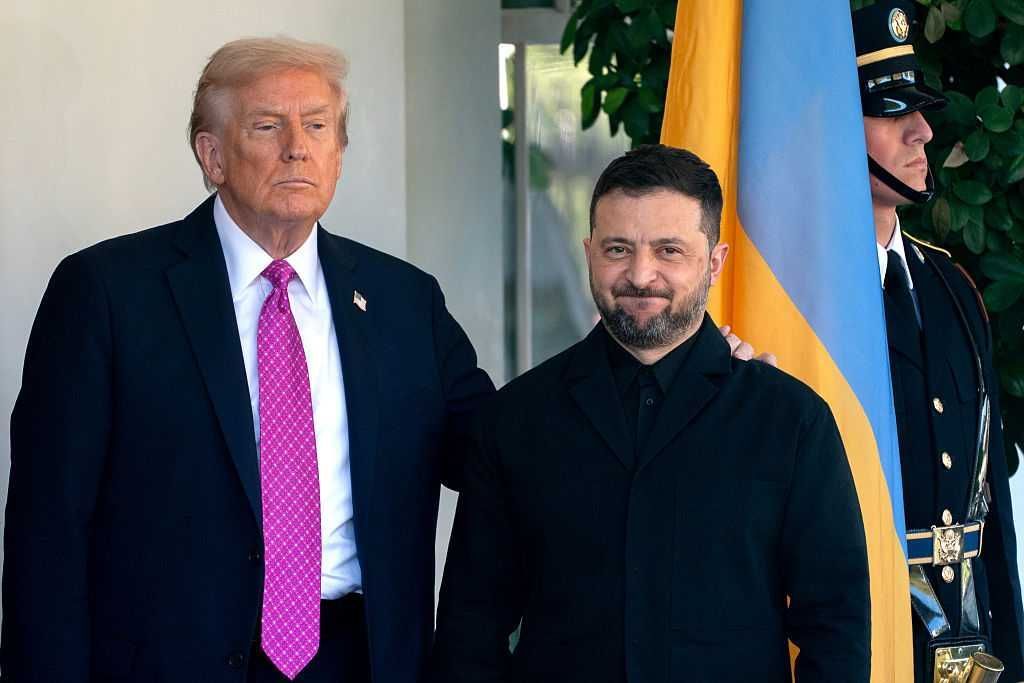
 Photo by Nicolas Economou/NurPhoto via Getty Images
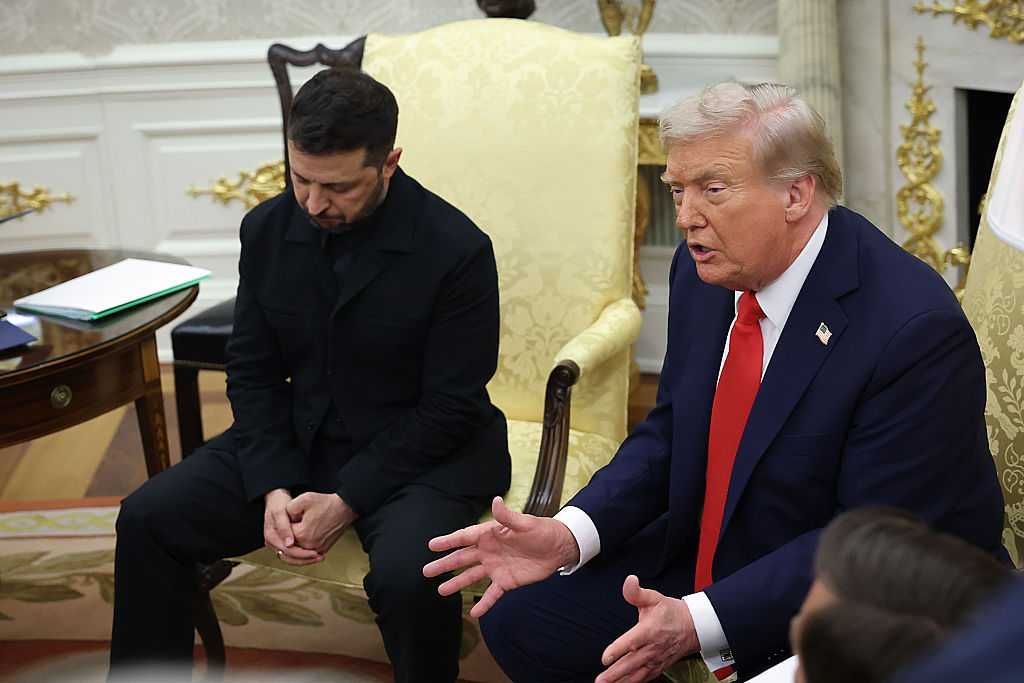 Photo by Anna Moneymaker/Getty Images
 You don't have to be a Putin stooge to see that dumping endless U.S. funds into Kyiv without proper oversight is a terrible idea.
 www.theblaze.com
 www.theblaze.com
 www.theblaze.com