EXCLUSIVE: GOP Senator Introducing Bill To Yank Passports From Fraudsters Accused Of Swindling Taxpayers
'Fugitive fraudsters are fleeing justice and the country with stolen taxpayer dollars in tow'
The Department of Justice on Tuesday unveiled the results of the 2026 National Health Care Fraud Takedown, which resulted in criminal and civil charges against hundreds of defendants and billions in allegedly stolen taxpayer funds.
The enforcement effort involved 56 federal districts, 45 U.S. states and territories, and 455 defendants, including 90 doctors and other medical professionals, tied to more than $6.5 billion in alleged fraud.
'The government seized over $30 million in bank accounts, a $594,000 Ferrari 296 GTS, seven other high-end vehicles, an $865,000 custom Bulgari necklace, and $1 million worth of other luxury jewelry.'
The DOJ accused the defendants of participating in numerous schemes, including opioid abuse, submitting false claims to Medicare and Medicaid, and causing patient harm, including death. The department also claimed that 10.7 million pills of controlled substances were illegally distributed.
The alleged stolen taxpayer funds were used to purchase high-end vehicles, jewelry, and real estate, among other luxury items. The federal government has seized $182 million in cash and other assets.
“This announcement marks the greatest combined federal and state effort in combating health care fraud in history,” acting Attorney General Todd Blanche stated. “This team is working tirelessly to take down fraudsters who steal from taxpayer funded programs and prey on vulnerable Americans.”
The DOJ highlighted that charges were filed against 11 individuals allegedly tied to billions of dollars in fraudulent claims for amniotic wound allografts, a wound treatment made from donated placental tissue typically used to repair hard-to-heal injuries.
RELATED: Trump DOJ charges illegal aliens in Boston with nearly $1.5 million in welfare fraud
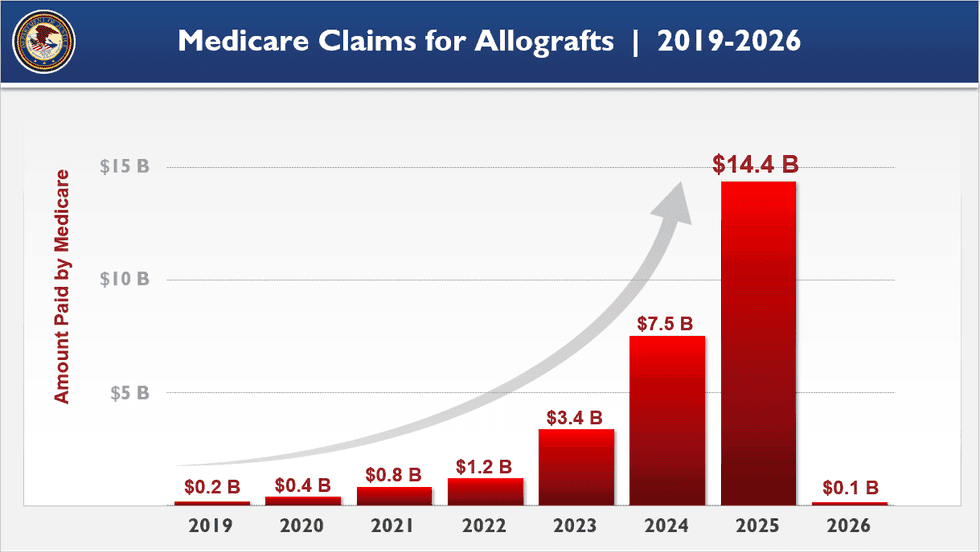
In the District of Arizona, the vice president of sales for a company was charged in an alleged kickback scheme after providers allegedly billed Medicare over $4 billion from Dec. 2021 to June 2024 for his company’s allografts.
“The company did not manufacture allografts and instead acquired allografts from tissue banks and relabeled them for sale at a 2,000% mark-up, charging up to $1,450 per square centimeter,” the DOJ stated.
The defendant and others allegedly targeted hospice patients to apply allografts to superficial wounds and treat areas that exceeded the size of the wound.
The defendant was accused of receiving $24 million from the company and spending the funds on “multi-million-dollar houses, million-dollar life insurance policies, luxury vehicles, including a $135,000 Maserati, and luxury watches.”
RELATED: JD Vance is ending the Medicaid gravy train

In the Southern District of Texas, the DOJ also charged a nurse practitioner who allegedly billed Medicare $906 million for medically unnecessary allografts.
“As alleged, the defendant used the fraud proceeds to purchase high-end vehicles, real estate, and luxury jewelry, and to fund the construction of a $4.6 million ... beach resort in the Philippines,” the DOJ stated. “The government seized over $30 million in bank accounts, a $594,000 Ferrari 296 GTS, seven other high-end vehicles, an $865,000 custom Bulgari necklace, and $1 million worth of other luxury jewelry.”
The DOJ reported that Medicare claims for allografts skyrocketed from $1.2 billion in 2022 to $14.4 billion in 2025.
Like Blaze News? Bypass the censors, sign up for our newsletters, and get stories like this direct to your inbox. Sign up here!
The controversy surrounding the recent Los Angeles mayoral election could become one of the most consequential political battles of President Trump’s second term — and BlazeTV host Liz Wheeler believes it’s time for the president to do something about it.
“The Democrats have in a chokehold the election system. They have taken it away. They have stolen the election system from the people, and it is now in their control. So the outcome of these elections is essentially predetermined,” she begins.
And Republicans, Wheeler says, “have a very big, daunting job to clean up our election systems.”
“The American people voted for Trump because they want justice, because we want justice for all of the things that were done to us,” she explains, pointing out that the stolen election in Los Angeles is now a “golden opportunity” for Trump to take action.
“And you should do that because it’s the right thing to do. You should do that because it’s your constitutional duty to make sure that we have free and fair elections,” she adds.
And if Trump does take action after the outcome of the Los Angeles election, Wheeler predicts his base support will “balloon” and “increase exponentially.”
“That energy will come roaring back if you pursue justice in the L.A. elections. What will happen is, you will have enormous midterm turnout because nothing motivates the base like justice does,” she says.
“And this time, this is different than 2020. This time we have actual evidence that crimes were committed. We have evidence of how the Democrats stole this election,” she continues, explaining that there’s proof of election fraud via video.
In the videos, which Wheeler plays, L.A.'s “homeless” tell reporters that they were paid to cast votes for Democrats.
“This is not speculation. The fact that the majority of the fraud that happened happened on Skid Row with these 43,000 drug addicts who the left calls homeless, but we know they’re addicted, most of them,” Wheeler says.
“What the Democrats did and are doing is wrong,” she says, adding, “but it is also a golden opportunity. And for this, Spencer Pratt seems to understand, and I’m very appreciative of that.”
To enjoy more of Liz’s based commentary, subscribe to BlazeTV — the largest multi-platform network of voices who love America, defend the Constitution, and live the American dream.
Rep. Ilhan Omar, a radical Minnesota Democrat who has in recent years been accused of immigration-related fraud, is facing renewed scrutiny over her finances in the wake of a new filing claiming that she and her current husband, former Democratic consultant Tim Mynett, might have a negative net worth.
Republicans remain dissatisfied with the explanation provided by Omar's office — that the dramatic fluctuations in the congresswoman's alleged net worth is the result of an "accounting error" that has since been rectified.
'Voters see right through the corrupt lies of Ilhan Omar.'
The Somalia-born ethno-nationalist raised eyebrows last year with a financial disclosure report claiming that in 2024 — the same year that the U.S. attorney's office in Washington, D.C., and the DOJ's public integrity unit reportedly launched an investigation into the congresswoman's finances — she and her husband held assets of between $6 million and $30 million.
The couple's sudden fortune was linked in the filing to Mynett's venture-capital management firm, Rose Lake Capital LLC, as well as to his now-defunct winery, eStCru LLC.
In addition to contradicting Omar's previous assertion that she was "not a millionaire," the May 2025 filing prompted House Oversight Committee Chairman James Comer (Ky.) and other Republicans to question "how her husband accumulated so much wealth over the past two years."
After all, she reported assets valued at no more than $208,000 in 2023, and a year earlier, Rose Lake Capital reportedly had only $42.44 in its bank account.
"There is no way such wealth could have been accumulated, legally, while being paid the salary of a politician," President Donald Trump said in a Truth Social post on Jan. 22.
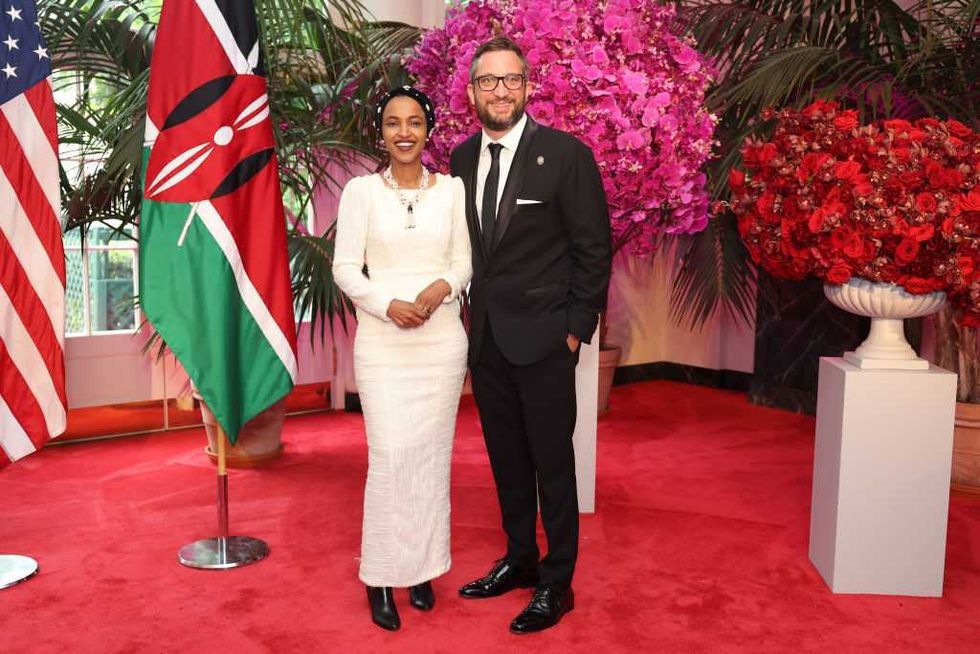
The congresswoman subsequently filed an amended disclosure for 2024 claiming that the value of the assets she and her husband held was between $18,004 and $95,000. The Wall Street Journal highlighted that in the amended disclosure filed on March 26, Mynett's businesses were shown as having no value once liabilities were factored in.
"The amended disclosure confirms what we've said all along: The congresswoman is not a millionaire," Jacklyn Rogers, a spokeswoman for Omar, stated at the time. "The congresswoman amended her disclosures voluntarily as soon as the discrepancy was identified."
Days before Vice President JD Vance claimed last month that Omar was under investigation by the Justice Department, the foreign-born congresswoman filed her financial disclosure for fiscal year 2025.
According to the new filing first detailed by the New York Post, Mynett made no income last year from Rose Lake Capital.
The only money Mynett allegedly earned last year was $201 to $1,000 from eStCru, which filed for termination in April — roughly one week after Omar filed her amended financial disclosure stating the winery was effectively worthless.
Omar claimed that the total value of her and her husband's assets last year was somewhere in the range of $20,000 to $125,000 and that their liabilities — student loans and credit card debt — were between $30,000 and $100,000. On the basis of Omar's financial allegations, her net worth is between -$80,000 and $95,000.
A spokesperson for Omar told Blaze News in a statement, "The amended disclosure confirms what we've said all along: The congresswoman is not a millionaire."
"The original filing was based on incomplete information from Mr. Mynett's businesses' accountants in good faith and deference to professional judgment. It listed assets without liabilities, and it significantly overstated her husband’s net worth," the spokesperson continued. "The accounting error created a misleading picture of far greater wealth. The congresswoman amended her disclosures voluntarily as soon as the discrepancy was identified. The amended disclosure is now complete and accurate."
Delanie Bomar, spokeswoman for the Republican National Committee, told the Post, "Voters see right through the corrupt lies of Ilhan Omar."
"Omar has spent her entire career covering up Democrat-enabled fraud that cost taxpayers billions, so it's no surprise that she would do the same for her husband," Bomar continued.
House Majority Whip Tom Emmer (R-Minn.) stated, "Ilhan Omar and her husband need to be held accountable for their sketchy financial disclosures. They're clearly lying and trying to game the system."
Like Blaze News? Bypass the censors, sign up for our newsletters, and get stories like this direct to your inbox. Sign up here!The Trump Justice Department announced on Thursday in the Democrat-run sanctuary city of Boston that it has charged 11 illegal aliens and four Americans with over $1.4 million in alleged benefit fraud.
The defendants — at least six of whom are illegal aliens from the Dominican Republican and at least one of whom is from India — are accused of defrauding various welfare programs, including the Supplemental Nutrition Assistance Program and MassHealth.
'They allegedly stole tens of thousands of dollars each in benefits for which they are not entitled.'
"These cases highlight a broader, deeply troubling pattern: the exploitation of America’s safety-net by illegal aliens," Assistant Attorney General Colin McDonald for the National Fraud Enforcement Division said in a statement.
The Trump administration, which has in recent months ramped up its crackdown on fraud, has long sought to eliminate the monetary incentive for foreign nationals to steal into the country and to pressure those noncitizens presently taking advantage of citizen supports to wean off them or hit the road.
In his Feb. 19, 2025, executive order titled "Ending Taxpayer Subsidization of Open Borders," President Donald Trump tasked agencies with taking meaningful steps "to prevent taxpayer resources from acting as a magnet and fueling illegal immigration to the United States, and to ensure, to the maximum extent permitted by law, that no taxpayer-funded benefits go to unqualified aliens."
One of the agencies that promptly took action was the U.S. Department of Agriculture, which beefed up the minimum expectations for eligibility verification to prevent "ineligible aliens" from participating in the program.
While the USDA and other agencies were making it more difficult for those who would exploit citizen welfare programs, the DOJ is nabbing numerous fraudsters across the country who have already unlawfully enjoyed a fortune in benefits.
U.S. Attorney Leah Foley, who established a benefit and voter fraud team in March devoted to flushing out fraudsters in Massachusetts, said, "Today’s announcement is just the beginning."
"The defendants charged today stole from a number of programs, including SNAP and MassHealth — which are designed to assist U.S. citizens in need of food and health care," continued Foley. "They allegedly stole tens of thousands of dollars each in benefits for which they are not entitled."
The Massachusetts defendants charged this past week included:
If convicted, these and other similarly charged defendants could do some hard time.
SNAP fraud over $100 can result in a sentence of up to five years in prison, and SNAP fraud exceeding $5,000 can result in a sentence of up to 20 years in prison. Both also carry a potential fine of $250,000.
A report published last week by the Center for Immigration Studies provided some startling insights into welfare use and abuse by noncitizens, about half of whom are apparently illegal immigrants.
Citing Current Population Survey Annual Social and Economic Supplement data, the report said that 47% of households headed by noncitizens use one or more traditional welfare programs — 19 percentage points higher than the 28% for U.S.-born households.
"Noncitizens use traditional welfare or are EITC/ACTC eligible at higher rates than the U.S.-born in states with generous welfare systems, such as Massachusetts (61% vs. 36%) and Illinois (51% vs. 30%); and in states with less generous systems, like Arizona (60% vs. 30%) and Florida (53% vs. 30%)," said the report.
Like Blaze News? Bypass the censors, sign up for our newsletters, and get stories like this direct to your inbox. Sign up here!
 Across the country, the DOJ charged a total of 455 defendants with over $6.5 billion in alleged health care fraud.
 In avoiding political discomfort for decades, Congress and presidents have set the nation up for an economic and social catastrophe.
 Legacy media would rather report on algae than anything that actually matters to the American people.
 Democrats want voting that is deliberately designed for post-election manipulation by political insiders to achieve desired outcomes.
 www.theblaze.com
 www.theblaze.com
 www.theblaze.com
 www.theblaze.com
 thefederalist.com
 thefederalist.com