America can’t afford to lose Britain — again


The Labour government that rules the United Kingdom is hardly a year old, but its time is already coming to an end. Its popular legitimacy has collapsed, and it is visibly losing control of both the British state and its territories.

Every conversation not about proximate policy is about the successor government: which party will take over, who will be leading it, and what’s needed to reverse what looks to be an unalterable course. What is known, however, is that the next government will assume the reins of a fading state after what will likely be the final election under the present, failed dispensation.

We should equip our friends on the other side of the Atlantic with the lessons of the new right’s ascendancy and of a nation-first government in America.

The Britain birthed by New Labour three decades ago, deracinated and unmoored from its historic roots, is unquestionably at its end. Its elements — most especially the importation of malign Americanisms like propositional nationhood — have led directly to a country that is, according to academics like David Betz of King’s College London, on the precipice of something like a civil war. That’s the worst-case scenario.

The best case is that a once-great nation made itself poor and has become wracked with civil strife, including the jihadi variety. It is a prospect that will make yesteryear’s worst of Ulster seem positively bucolic.

American policymaking is curiously inert in the face of the dissolution of its closest historic ally. This is not because Britain’s decline is anything new: the slow-motion implosion of that nation’s military power has been known to the American defense establishment for most of the past 20 years. Ben Barry’s excellent new book, “The Rise and Fall of the British Army 1975–2025,” offers many examples to this end, including the 2008 fighting in Basra in which American leadership had to rescue a failing British effort.

The knowledge that Britain is facing a regime-level crisis has remained mostly confined to the establishment. Outside of it, the American right has mostly dwelled on an admixture of Anglophilia and special-relationship nostalgia, obscuring the truth of Britain’s precipitous decline.

The American left, of course, entirely endorses what the British regime has done to its citizenry — from the repression of entrepreneurialism and the suppression of free speech to the ethnic replacement of the native population — and regards the outcomes as entirely positive.

It is past time for that inertia to end. The last election will redefine the United Kingdom — and therefore America’s relationship with it. Even before it comes, the rudderless and discredited Labour government has placed Britain into a de facto ungoverned state that may persist for years to come.

The United States has an obligation to protect its own citizenry from the consequences of this reality. It also has what might be called a filial duty to assert conditions for Britain to reclaim itself.

That duty means taking a series of actions, including denying entry to the United States to British officials who engage in the suppression of civil liberties. American security and intelligence should focus on the threats posed by Britain’s burgeoning Islamist population. The U.S. should give preferential immigration treatment to ethnic English, Scottish, Welsh, and Northern Irish who are seeking to escape misgovernance or persecution in the United Kingdom.

Furthermore, the United States should make it clear that the robust Chinese Communist Party penetration and influence operations in U.K. governance will result in a concurrent diminishment of American trust and cooperation.

Also necessary is the American government’s engagement with pro-liberty and pro-British elements within the U.K. This means working with Reform U.K., which presently looks to gain about 400 parliamentary seats in the next election. Its unique combination of a dynamic leader in Nigel Farage, intellectual heavyweights like James Orr and Danny Kruger, and operational energy in Zia Yusuf makes it a compelling and increasingly plausible scenario.

RELATED: Cry ‘God for England’

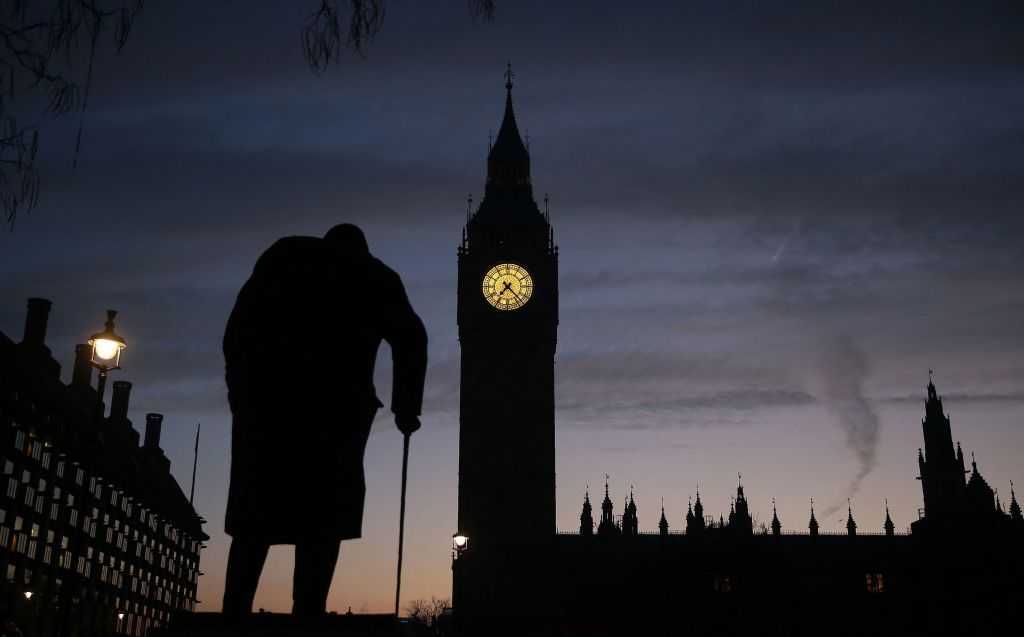
Photo by Christopher Furlong/Getty Images
Although the Tories are polling poorly and have had their reputations battered by their substandard record in government over the past decade, they nonetheless merit American engagement.

America’s role here is not to endorse, and still less to select, new leadership for Britain, which would be both an impossibility and an impropriety. However, we should equip our friends on the other side of the Atlantic with the lessons of the new right’s ascendancy and of a nation-first government in America.

In the fraught summer of 1940, the American poet Alice Duer Miller wrote, “In a world where England is finished and dead, I do not wish to live.” The island nation has not feared its own end at foreign arms for a thousand years. But its crisis today is from within, carrying existential stakes.

The current British regime is nearing its end, and the last election is coming. So too is our decision on how to engage it in the years ahead.

Editor’s note: A version of this article appeared originally at the American Mind.

The Man Makes the Clothes

WESTERHAM, U.K.—I traveled the distance from New York City to this little town in the county of Kent in southern England—by airplane, then train, then local taxi—just to see a grown man's onesie.

The post The Man Makes the Clothes appeared first on .

Britain’s Big Brother ID law is the globalist dream for America


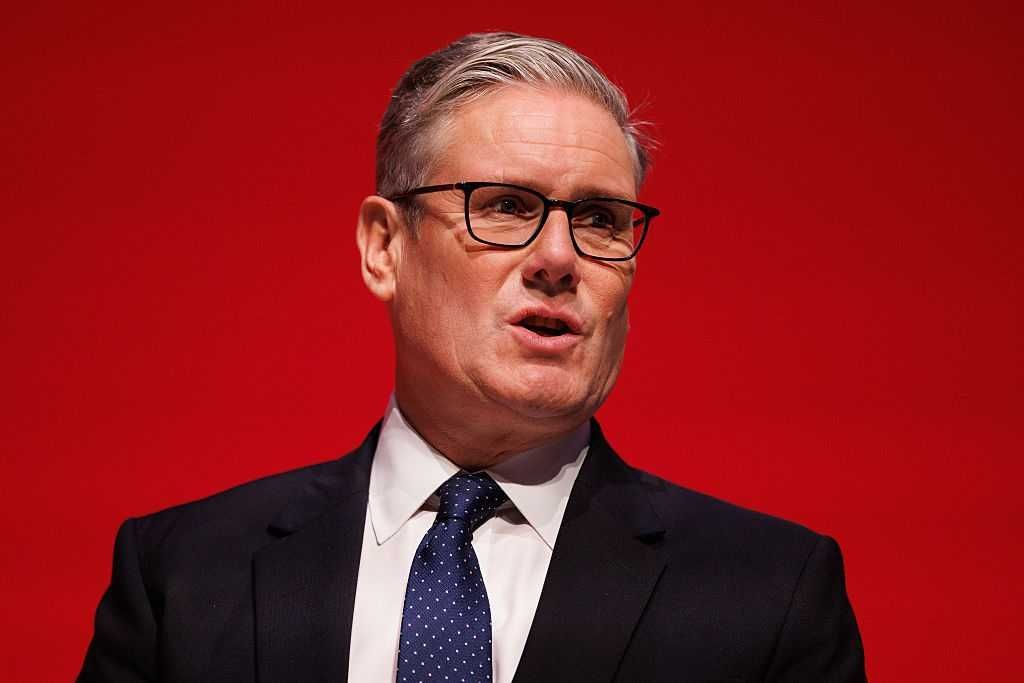
On Friday, British Prime Minister Keir Starmer stood at the podium at the Global Progressive Action Conference in London and made an announcement that should send a chill down the spine of anyone who loves liberty. By the end of this Parliament, he promised, every worker in the U.K. will be required to hold a “free-of-charge” digital ID. Without it, Britons will not be able to work.

No digital ID, no job.

The government is introducing a system that punishes law-abiding citizens by tying their right to work to a government-issued pass.

Starmer framed this as a commonsense response to poverty, climate change, and illegal immigration. He claimed Britain cannot solve these problems without “looking upstream” and tackling root causes. But behind the rhetoric lies a policy that shifts power away from individuals and places it squarely in the hands of government.

Solving the problem they created

This is progressivism in action. Leaders open their borders, invite in mass illegal immigration, and refuse to enforce their own laws. Then, when public frustration boils over, they unveil a prepackaged “solution” — in this case, digital identity — that entrenches government control.

Britain isn’t the first to embrace this system. Switzerland recently approved a digital ID system. Australia already has one. The World Economic Forum has openly pitched digital IDs as the key to accessing everything from health care to bank accounts to travel. And once the infrastructure is in place, digital currency will follow soon after, giving governments the power to track every purchase, approve or block transactions, and dictate where and how you spend your money.

All of your data — your medical history, insurance, banking, food purchases, travel, social media engagement, tax information — would be funneled into a centralized database under government oversight.

The fiction of enforcement

Starmer says this is about cracking down on illegal work. The BBC even pressed him on the point, asking why a mandatory digital ID would stop human traffickers and rogue employers who already ignore national insurance cards. He had no answer.

Bad actors will still break the law. Bosses who pay sweatshop wages under the table will not suddenly check digital IDs. Criminals will not line up to comply. This isn’t about stopping illegal immigration. If it were, the U.K. would simply enforce existing laws, close the loopholes, and deport those working illegally.

Instead, the government is introducing a system that punishes law-abiding citizens by tying their right to work to a government-issued pass.

Control masked as compassion

This is part of an old playbook. Politicians claim their hands are tied and promise that only sweeping new powers will solve the crisis. They selectively enforce laws to maintain the problem, then use the problem to justify expanding control.

RELATED: Europe pushes for digital ID to help 'crack down' on completely unrelated problems

Photo by Flavio Coelho via Getty Images

If Britain truly wanted to curb illegal immigration, it could. It is an island. The Channel Tunnel has clear entry points. Enforcement is not impossible. But a digital ID allows for something far more valuable to bureaucrats than border security: total oversight of their own citizens.

The American warning

Think digital ID can’t happen here? Think again. The same arguments are already echoing in Washington, D.C. Illegal immigration is out of control. Progressives know voters are angry. When the digital ID pitch arrives, it will be wrapped in patriotic language about fairness, security, and compassion.

But the goal isn’t compassion. It’s control — of your movement, your money, your speech, your future.

We don’t need digital IDs to enforce immigration law. We need leaders with the courage to enforce existing law. Until then, digital ID schemes will keep spreading, sold as a cure for the very problems they helped create.

Want more from Glenn Beck? Get Glenn's FREE email newsletter with his latest insights, top stories, show prep, and more delivered to your inbox.

UK government makes digital ID mandatory to get a job: 'Safer, fairer and more secure'


Prime Minister Keir Starmer said on Friday that digital ID will become mandatory in order to be employed in the United Kingdom.

The new ID is part of a government plan to allegedly help fight illegal immigration. The idea is that illegal employment is what is attracting many migrants to make the treacherous trip across the English Channel to move to the U.K.

'You will not be able to work in the United Kingdom if you do not have digital ID.'

Starmer said the IDs would not only make it more difficult to work in the U.K. illegally but that it would offer "countless benefits" to citizens. The BBC reported that senior minister Darren Jones claimed the IDs could also be "the bedrock of the modern state."

The prime minister made the announcement at the Global Progressive Action Conference in London on Friday, stating, "Our immigration system does need to be fair if we want to maintain that binding contract that our politics is built on."

Starmer continued, "And that is why today I am announcing this government will make a new, free of charge digital ID mandatory for the right to work by the end of this parliament. Let me spell that out: You will not be able to work in the United Kingdom if you do not have digital ID."

"It's as simple as that," the leader sternly stated, before making a moral argument. "Because decent, pragmatic, fair-minded people, they want us to tackle the issues that they see around them. And, of course, the truth is, we won't solve our problems if we don't also take on the root causes."

RELATED: Europe pushes for digital ID to help 'crack down' on completely unrelated problems

The knighted leader continued to claim that the move was an attempt by the government to have "control over its borders."

"We do need to know who is in our country," Starmer added.

"It is not compassionate left-wing politics to rely on labor that exploits foreign workers and undercuts fair wages."

Jonathan Brash, a member of parliament from Hartlepool and politician in Starmer's party, said that it was important to "explode the myths and conspiracy theories being spread on Digital ID."

"It will make our country safer, fairer and more secure," Brash said on his X page, along with an image of a political poster that said the same.

RELATED: Trump's new AI Action Plan reveals our digital manifest destiny

— (@)

"This is a battle for freedom," English reporter Lewis Brackpool told Blaze News. "Liberalism is to blame. This attitude of 'live and let live' caused this freedom-robbing policy. It's time for Brits to take a stand."

Brackpool called for peaceful resistance while pointing to his work with Restore Britain, which has already begun investigating the government's intentions behind the project.

"The British public deserves full transparency on Digital ID drifting into surveillance and financial control," he wrote on X.

In early September, Blaze News reported that both French President Emmanuel Macron and former U.K. Prime Minister Tony Blair were urging Starmer to consider making digital IDs mandatory.

The Daily Mail reported that Blair was pushing the idea in backroom conversations, continuing his early-2000s attempt to push the IDs on the country's citizenry.

Like Blaze News? Bypass the censors, sign up for our newsletters, and get stories like this direct to your inbox. Sign up here!

Unite the kingdom: Tommy Robinson leads historic 100,000-strong march to save Britain


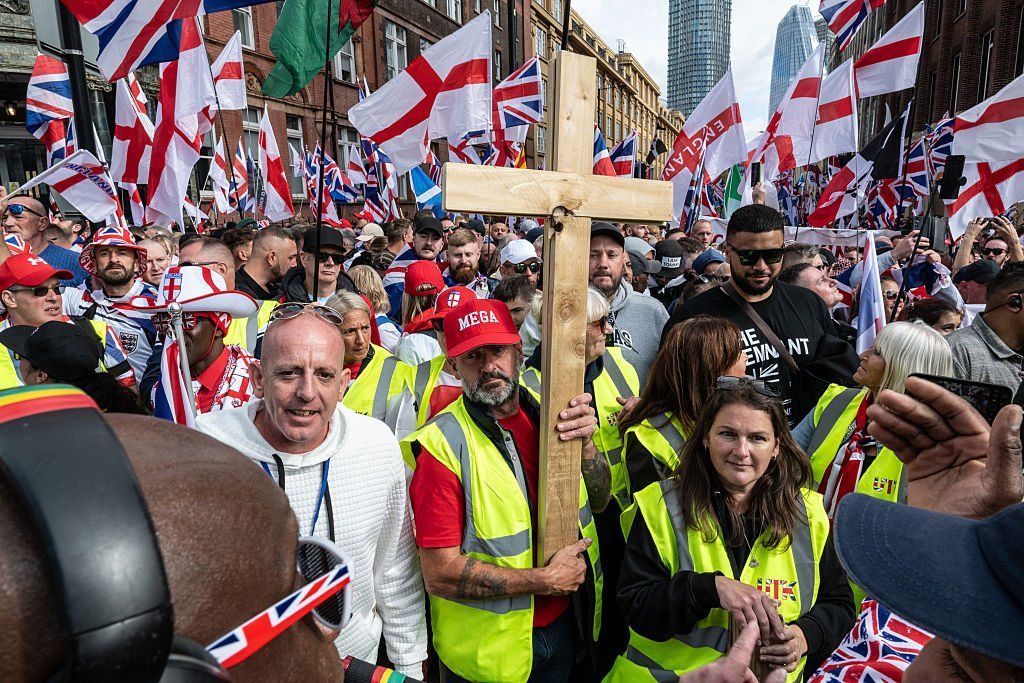
Over 100,000 demonstrators packed the streets of London on Saturday afternoon for a "Unite the Kingdom" march led by British independent journalist Tommy Robinson.

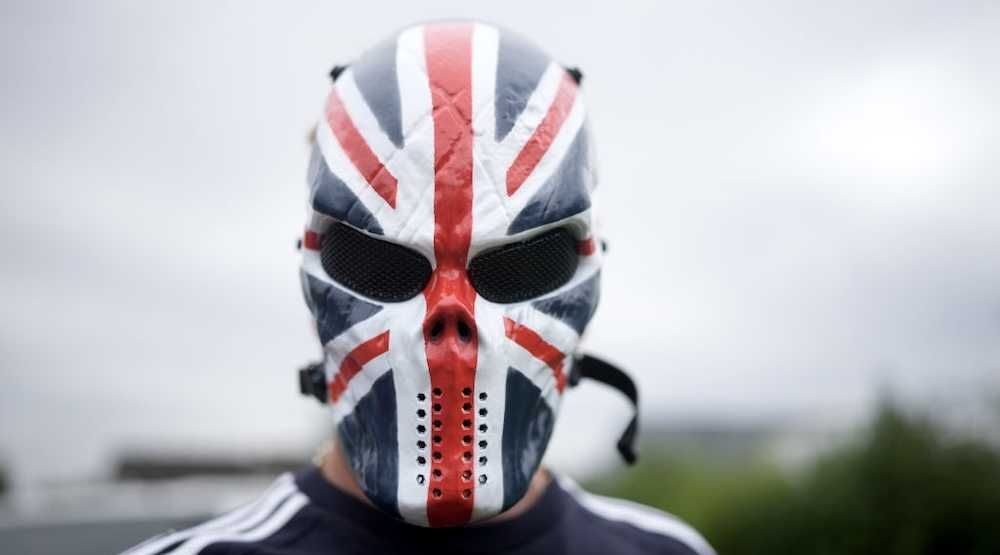
The march, featuring people holding the English flag aloft, comes as local councils across the United Kingdom are taking down English flags flown by Britons. Some politicians are calling the mere flying of the English flag a rallying point for "hate."

'You either fight back, or you die.'

Robinson live-streamed his festival on X, which opened with a prayer and featured musical performances, as well as speeches from actor Laurence Fox, Rebel News journalist Ezra Levant, and activist Sammy Woodhouse. His supporters packed the blocks around Whitehall, waving the Union flag of Britain and the red and white St. George's Cross of England. Some in the audience around the stage held photographs of Turning Point USA Founder Charlie Kirk, who was assassinated earlier this week.

"This is the biggest demonstration in Britain's history!" Robinson told the crowd. "This is your community. These are your brothers and your sisters. We today are united. Today is the spark of a cultural revolution in Great Britain."

"They've managed to silence us for 20 years with labels: racist, Islamophobe, far-right. They don't work anymore," Robinson declared. "The silent majority will be silent no longer."

He slammed the "globalist revolution" for attacking the family, Christianity, and opening the borders.

Robinson connected Elon Musk to speak to the attendees via video chat. He thanked the billionaire for supporting freedom of speech by purchasing X.

RELATED: 'Christ is king!' chants break out at large memorial for Charlie Kirk in London

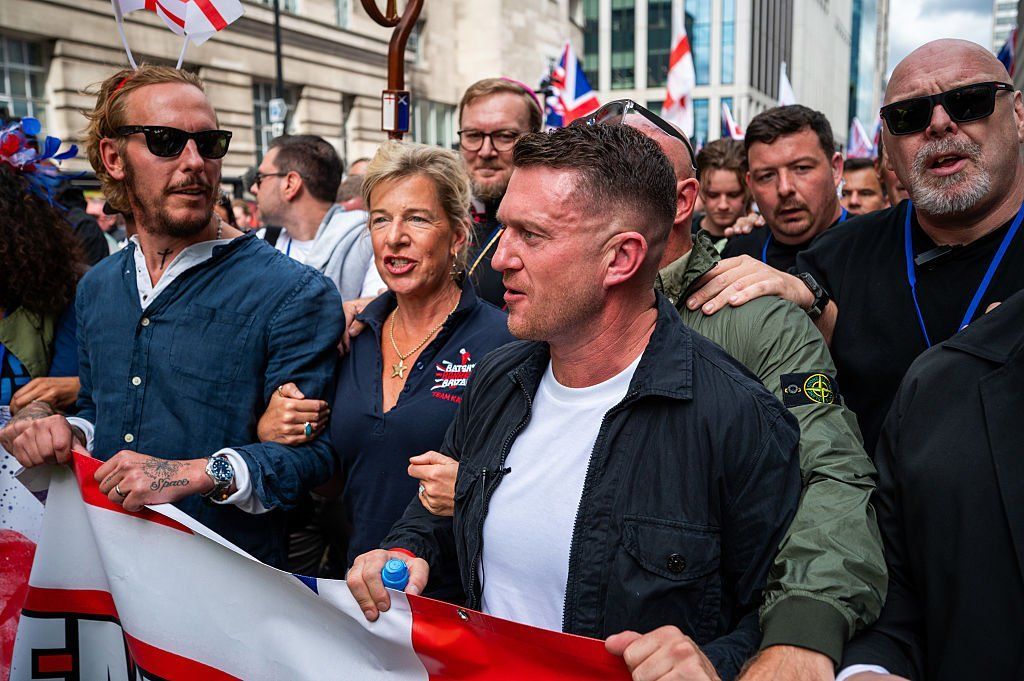
Laurence Fox, Kate Hopkins, and Tommy Robinson attend the Unite The Kingdom rally on September 13, 2025 in London, England. Photo by Ben Montgomery/Getty Images
"What I see happening is a destruction of Britain," Musk stated. "The government has failed in its duty to protect its citizens, which is a fundamental duty of government."

Musk had a message for those in the "reasonable center," who "ordinarily wouldn't get involved in politics."

"Look carefully around and say, 'If this continues, what world will you be living in?'" he said. "If this continues, that violence is going to come to you. You will have no choice."

"You either fight back, or you die," Muck concluded.

RELATED: Why the English flag now terrifies the regime

Photo by Guy Smallman/Getty Images

A counterprotest, "March Against Fascism," formed nearby, organized by the Stand Up To Racism group. Those demonstrators held up signs reading, "Oppose Tommy Robinson. Stop fascists & the far right."

Left-wing media outlets labeled Robinson's march as an anti-immigration protest.

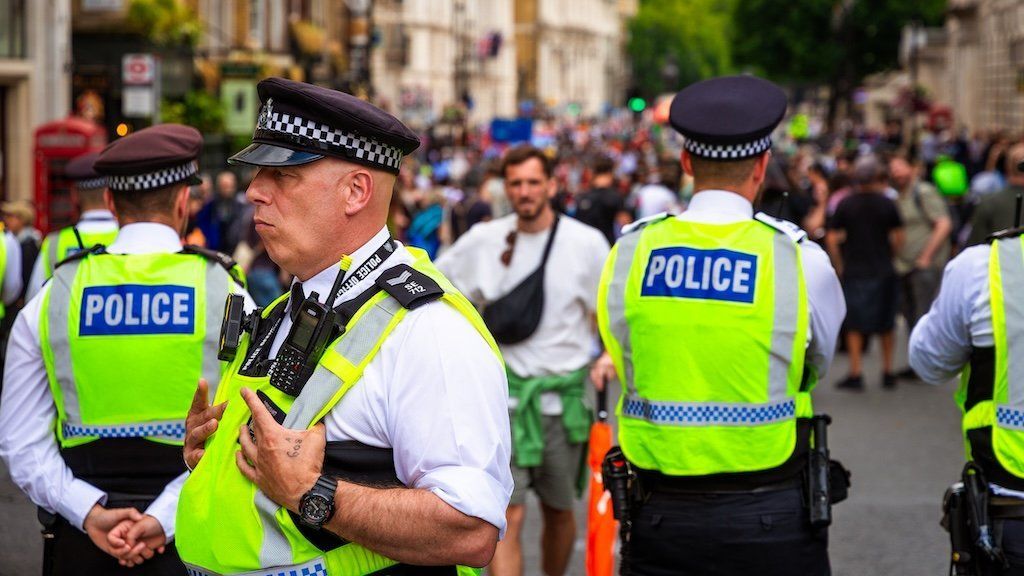
Metropolitan Police claimed that the crowd was "too big to fit into Whitehall."

The deparment further added, "We have deployed additional officers with protective equipment in multiple locations, supported by police horses, to deal with the disorder," via a social media post.

Like Blaze News? Bypass the censors, sign up for our newsletters, and get stories like this direct to your inbox. Sign up here!

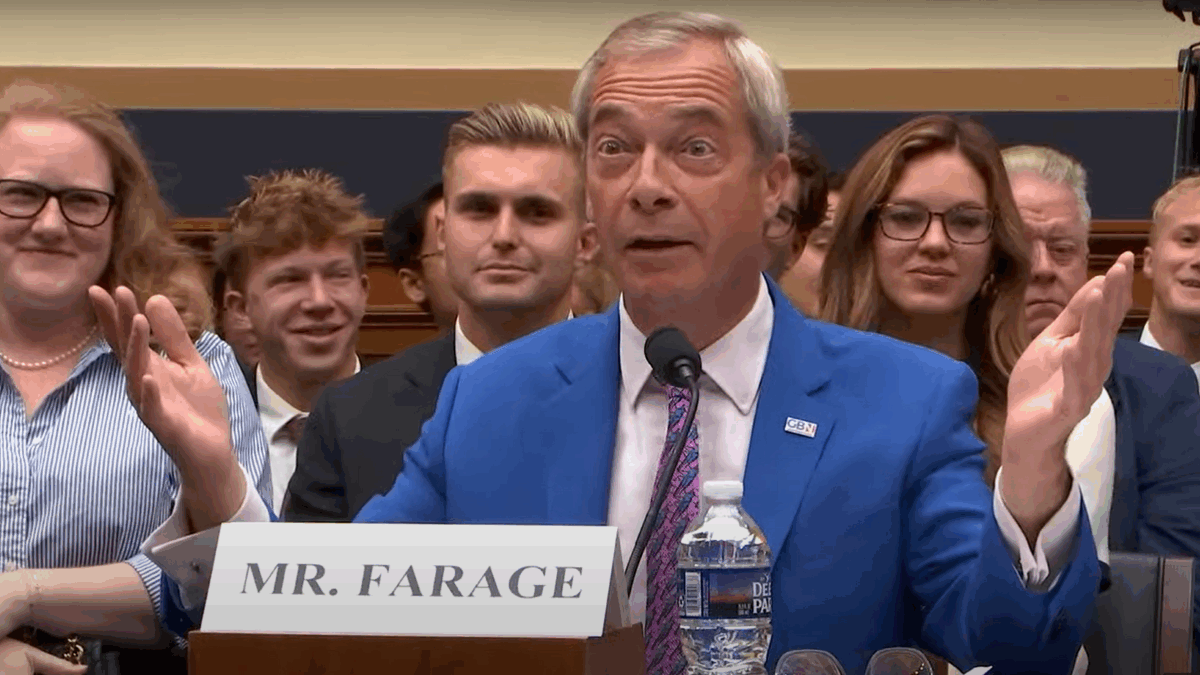
Farage Warns U.K. Censorship ‘Sledgehammer’ Could Come For Americans Next

'You can say what you like. I don't care, because that's what free speech is, isn’t it?' Nigel Farage responded to rude Rep. Jamie Raskin.
Locked up for a joke. It can’t happen here ... can it?


A comedian lands at Heathrow and finds himself met by officers as though he posed a terrorist threat. His offense? A social media joke about trans people. He’s released on bail on the condition he doesn’t post on X.

Another man prays silently outside the “safe zone” of an abortion clinic and is hauled off, given a two-year conditional discharge, and fined £9,000 (just over $12,000).

We hope Britain pulls up from its nosedive, but let’s not delude ourselves. America faces the same temptations.

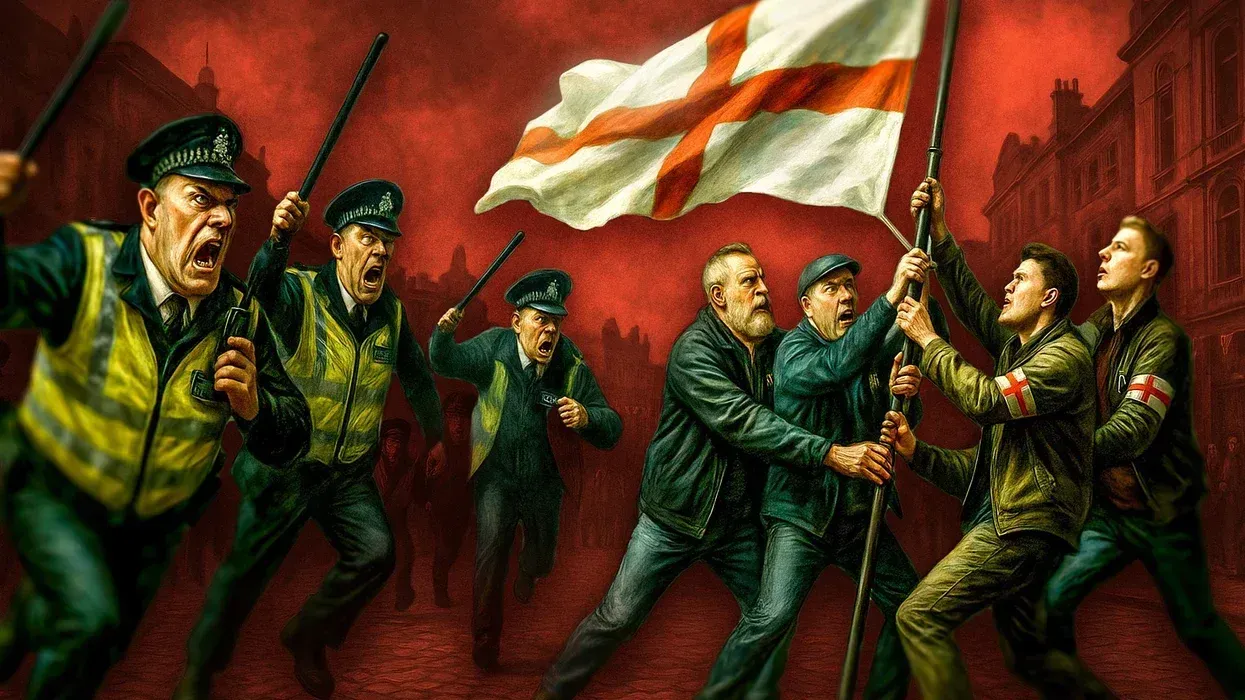
A third man waves the Union Jack at a pro-Palestinian march in England — only to be arrested. Reuters quickly ran interference: not for the flag, they said, but for a “racially aggravated public order offence” and “homophobic abuse.” As if that makes it better.

And we’re still not mentioning the Islamic child-rape scandal that grows worse with every new revelation. The United States watches Britain collapse into a kind of Reformation-era persecution, this time in the name of Islam, paganism, and sexual license. Americans shake their heads, maybe reassure themselves: We fought a revolution to escape this. Charles II jailed Christians. Charles III praises Islam. And we have the First Amendment. Case closed.

Not so fast. We may be on the same road. Once you begin policing speech to protect feelings, the end point looks very much like the UK. And we have plenty of warning signs.

The university test case

Universities may be the clearest early indicator. Professors tell us every profession must “look like” society — except their own. If a field is 97% male, they call it systemic bias. But in the academy itself, where atheists and leftists dominate, they see no problem.

The numbers don’t lie. At Arizona State University, a December 2024 survey found just 19 Republicans among 544 faculty members. At the University of Arizona, only eight Republicans out of 369. Entire departments lacked a single Republican. A 2023 Harvard Crimson study found only 2.5% of Harvard faculty identify as conservative. If any other profession looked this skewed, professors would scream about bias. In their case, they call it “normal.”

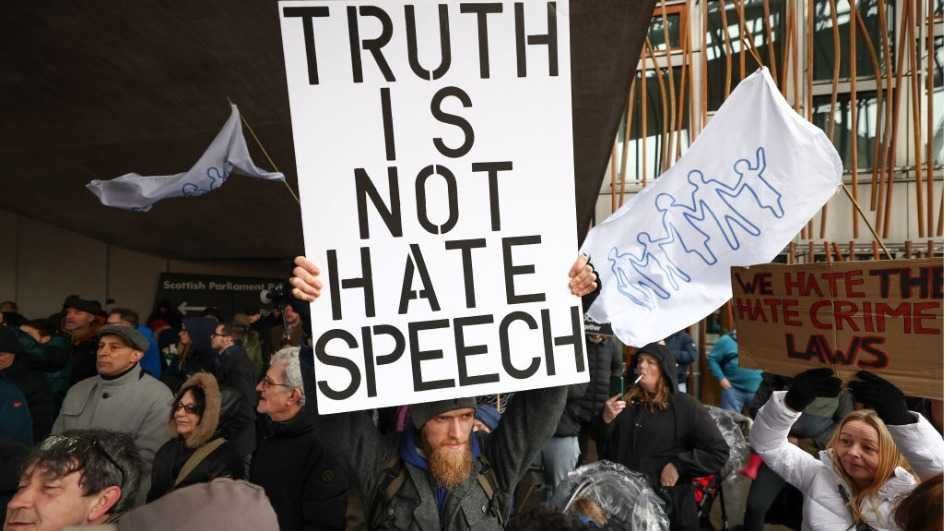
And the consequences? They’ll defend freedom of speech for burning an American flag. Burn a trans flag, and suddenly you’ve committed a hate crime. That is one step removed from Graham Linehan’s arrest in the UK for an X post.

Censorship in practice

Students already know what this means. A 2022 FIRE survey found they self-censor in class. They parrot leftist slogans on gender and race, not because they believe them, but because they want the grade. We are teaching them to lie to advance. No one is being asked to confess Christ; they are being asked to confess Ibram Kendi and John Money.

I’ve seen it firsthand. At ASU’s Honors College, faculty blocked Charlie Kirk, Dennis Prager, and Robert Kiyosaki from speaking, smearing them as “white supremacists.” That label alone was enough to push the event off campus. These professors weren’t interested in argument. They wanted silence.

RELATED: Why the English flag now terrifies the regime

Blaze Media illustration

Truth vs. lies

How do they justify it? With “hate crimes.” Not crimes that incite violence, but crimes of opinion. Disagree with LGBTQ ideology? That’s hate. Straight to jail. Professors sleep well at night because we’ve accepted their framework: society divided into oppressors and oppressed. Bad outcomes aren’t the result of choices, but of systemic injustice. Victims must be coddled, even at the expense of truth.

Once you accept that, feelings erase the First Amendment.

We need a spine. Sexual sins are real and destructive. Abortion ends a life. A comedian may say this through jokes; a philosopher may say it through essays. Either way, it’s the truth. The mob can gnash its teeth, plug its ears, strip away free speech, and jail comedians, but reality doesn’t change.

We hope Britain pulls up from its nosedive, but let’s not delude ourselves. America faces the same temptations. We must pray for the end of abortion, speak plainly about the damage sexual ideology inflicts on children, and reject the false frame of “oppressors and oppressed.” The real categories are truth and lies. Choose wisely, while you still can.

Mail-in ballots need to go


“I am going to lead a movement to get rid of MAIL-IN BALLOTS,” President Trump declared last week in a Truth Social post.

Later that Monday, he promised an executive order “to end mail-in ballots because they are corrupt. You know that we are the only country in the world, I believe — I may be wrong — but just about the only country in the world that uses them because of what's happened: massive fraud all over the place.”

Mail-in voting reopens the door to the fraud and vote-buying America worked so hard to eliminate a century ago.

Trump has remained consistent; even before the 2020 election, he warned: “There is a lot of dishonesty going along with mail-in voting.”

Europe rejects mail-in voting

Trump doesn’t need to hedge about voting rules abroad. Poland was the only other country that considered conducting its 2020 presidential election by mail during the pandemic, but it also abandoned the attempt.

Countries don’t use the kind of mass mail-in voting now used in eight states, where all registered voters receive ballots automatically and then mail them back. That system differs from absentee ballots, which require a request and traditionally demand a reason, such as being out of town on Election Day.

The United States doesn’t just stand out for its use of mail-in ballots — it’s also distinct for its unusually broad use of absentee ballots. Of 47 European countries, 35 — including France, Italy, the Netherlands, Norway, and Sweden — ban absentee voting for citizens living in the country. Ten others — including England, Ireland, Denmark, Portugal, and Spain — allow it only if voters pick up their ballots in person and present photo ID.

Six of those restrict absentee ballots to the military or hospitalized voters, and they require verification from the military or hospital itself. The United States, by contrast, lets anyone claim he will be out of town and receive a ballot by mail.

England once followed rules similar to America’s. But in 2004, officials uncovered a massive fraud in Birmingham City Council races. Six winning Labour candidates had acquired about 40,000 fraudulent absentee votes, mainly from Muslim neighborhoods. England responded by ending the mailing of absentee ballots and requiring in-person pickup with photo ID.

France once had similarly loose rules. But in 1975, authorities exposed large-scale fraud on the island of Corsica, where dead people “voted” in the hundreds of thousands and widespread vote-buying flourished. France responded by banning absentee voting altogether.

From bipartisan to rampant

Concerns over absentee ballots once united both Democrats and Republicans. “Absentee ballots are the largest source of potential voter fraud.” That warning doesn’t come from Trump but from the bipartisan 2005 Commission on Federal Election Reform, led by Democrat President Jimmy Carter and Republican Secretary of State James Baker III.

Voters across the spectrum still share those worries. A Rasmussen poll at the end of last year found that 59% of likely voters believe mail-in voting makes cheating easier. Majorities of black, Hispanic, and white voters agreed, along with both young and old. Only Democrats, liberals, graduate-school alumni, and those earning more than $200,000 disagreed. Earlier surveys saw similar results.

Even the New York Times once raised alarms. In 2012, the paper warned that the increased use of absentee ballots “will probably result in more uncounted votes, and it increases the potential for fraud.” But these days, that same newspaper insists voter-fraud claims for absentee ballots are “baseless” and “without evidence.”

RELATED: 'Conspiracy theorists' right again? FBI reveals MASSIVE alleged Chinese voter fraud plot

Photo by Element5 Digital/Getty Images

American history reinforces these concerns. Between 1888 and 1950, widespread vote-buying led states to adopt the secret ballot. Once voters could no longer prove to buyers how they had voted, the payments stopped. As one state after another started using secret ballots, turnout immediately fell by 8% to 12%, according to my research with the late Larry Kenny at the University of Florida — evidence of just how rampant the practice had been.

The Carter-Baker commission also highlighted how absentee voting enables coercion.

Citizens who vote at home, at nursing homes, at the workplace, or in church are more susceptible to pressure, overt and subtle, or to intimidation. Vote-buying schemes are far more difficult to detect when citizens vote by mail.

The problem is that both the buyer and seller have an incentive to hide the purchase.

The risks are real

Recent cases confirm the risks. Earlier this year, prosecutors indicted six Texans for harvesting ballots and buying votes by collecting absentee ballots. Absentee voting lets sellers prove how they voted, and ballot harvesting lets buyers ensure that the votes count — guaranteeing they get what they paid for.

Just this month, investigators in Hamtramck, Michigan, opened a fraud case after surveillance video showed a city council candidate’s aide stuffing three stacks of ballots into a drop box. The candidate had won by only a few dozen votes.

Mail-in voting reopens the door to the fraud and vote-buying America worked so hard to eliminate a century ago. That’s why countries such as Norway and Mexico prohibit absentee ballots for citizens voting domestically. Americans deserve the same safeguard — a voting system they can trust.

Editor’s note: This article was originally published by RealClearPolitics and made available via RealClearWire.

Global elites think you’re too stupid for soda and beer


The latest wheeze from global public health elites? Jack up taxes on tobacco, alcohol, sugary drinks, and processed food by 50% to raise $3.7 trillion in new revenue. They call it “health policy.” In plain English, it’s government-sanctioned theft.

This isn’t about curing disease. It’s about expanding state power. These so-called health taxes, pushed by academic ideologues and international bureaucrats, are little more than economic punishment disguised as progress. They won’t meaningfully reduce illness, but they’ll absolutely hit working people the hardest.

Sin taxes don’t foster well-being — they weaponize economic pain against the people who can least afford it.

The new push for massive taxes on soda, smokes, beer, and snacks is social engineering with a hefty price tag. The goal isn’t better health so much as behavioral compliance. And who pays for it? Not corporations. Not policymakers. Regular people. Especially those already stretched thin.

The promise of $3.7 trillion in new revenue tells you everything you need to know. This is about cash, not caring. You’re not going to fix the obesity crisis by making a Coke cost $4. You’re just making life worse for the guy who wants a cold drink after work.

These aren’t just products. They’re small pleasures — a beer at dinner, a smoke on break, a soda on a hot afternoon. Legal, affordable, familiar. Stripping them from people’s lives in the name of “health” doesn’t uplift anyone. It makes life more miserable.

And this plan doesn’t educate or empower. It punishes. It uses taxes to bludgeon people into compliance. That’s not public health — that’s moral authoritarianism.

Proponents claim that higher prices discourage consumption, especially among young people. But that’s not smart policy — it’s an admission that the entire strategy relies on pricing people out of their own choices.

That’s not a sign of sound policy; it’s a confession that the aim is to price people out of their own choices. It’s hard not to see this as profoundly elitist. A worldview in which an ignorant public must be nudged, coerced, and taxed into making decisions deemed acceptable by a distant class of arrogant policymakers.

Sin taxes don’t foster well-being — they weaponize economic pain against the people who can least afford it. The more someone spends on a drink or a cigarette, the less they can spend on rent, groceries, or gas. In the U.K., economists found that sin taxes cost low-income families up to 10 times more than they cost the wealthy. That holds true in the United States as well. These are regressive by design.

History offers a warning. Prohibition didn’t end drinking — it empowered criminals. Today, in places like Australia, black markets for vapes and other restricted products are booming. When governments overregulate, people continue to consume. They just go underground, and quality, safety, and accountability go with them.

Public health bureaucrats love to talk about the “commercial determinants of health,” blaming industry for every social ill. But they ignore the personal determinants that matter even more: freedom, dignity, and the right to make informed decisions.

RELATED: Cigarettes and beer: The heady perfume that transports me to my childhood

guruXOOX via iStock/Getty Images

People already know the risks of smoking, drinking, and sugar consumption. They’ve seen the labels and heard the warnings for years. They don’t need lectures from bureaucrats, government ministers, or international agencies. What they need is respect — and the freedom to live as they choose.

These new tax schemes don’t offer support or alternatives. They rely on coercion, not persuasion. The state becomes the enforcer, not the helper. It’s a government model that punishes pleasure and equates restriction with virtue.

The sinister core of this health tax agenda lies in its relentless condescension. It assumes people are too stupid, too reckless, or too addicted to choose what’s best for themselves, and so government must intervene forcefully and repeatedly.

This is control, not compassionate governance.

A better path exists — one rooted in harm reduction, not prohibition. Encourage low-sugar drink options. Expand access to safer nicotine alternatives. Support moderate alcohol consumption. Respect the people you’re trying to help.

If public health advocates truly want to improve outcomes, they should abandon these regressive, punitive proposals. They should promote innovation, not punishment. Education, not enforcement.

Because real public health doesn’t treat people like problems to be managed. It treats them like citizens — free to live, choose, and thrive.