Convicted hacker twins who landed jobs as federal contractors nabbed for allegedly deleting government databases


Muneeb and Sohaib Akhter, a pair of convicted hackers based in Alexandria, Virginia, were arrested on Wednesday over an alleged conspiracy to destroy government databases and other crimes.

After doing prison time for wire fraud and conspiring to hack into the U.S. State Department, the Akhter twins, one of whom previously served as a cybersecurity contractor with the State Department, managed to secure jobs as federal contractors — working as engineers for Opexus.

'Their actions jeopardized the security of government systems.'

Opexus, a company that handles sensitive data for most federal agencies and has received over $50 million in contracts from various agencies over the past decade, determined earlier this year that it had been compromised in February by two employees.

A Bloomberg investigation revealed in May that after one of the agencies with which Opexus was working, the Federal Deposit Insurance Corporation, flagged the twins as possible threats on account of their criminal records, the duo were fired on Feb. 18.

The company later discovered that while being fired and immediately afterward, the twins allegedly accessed sensitive documents and compromised or scrubbed dozens of databases, including those containing data from the General Services Administration and the Internal Revenue Service.

The FBI, FDIC Office of Inspector General, Department of Homeland Security Office of Inspector General, and Homeland Security Investigations investigated the case.

The brothers were indicted on Nov. 13 for allegedly working to harm Opexus and its U.S. government clients "by accessing computers without authorization, issuing commands to prevent others from modifying the databases before deletion, deleting databases, stealing information, and destroying evidence of their unlawful activities," the DOJ said in a release.

RELATED: Could hackers target your car's tires?

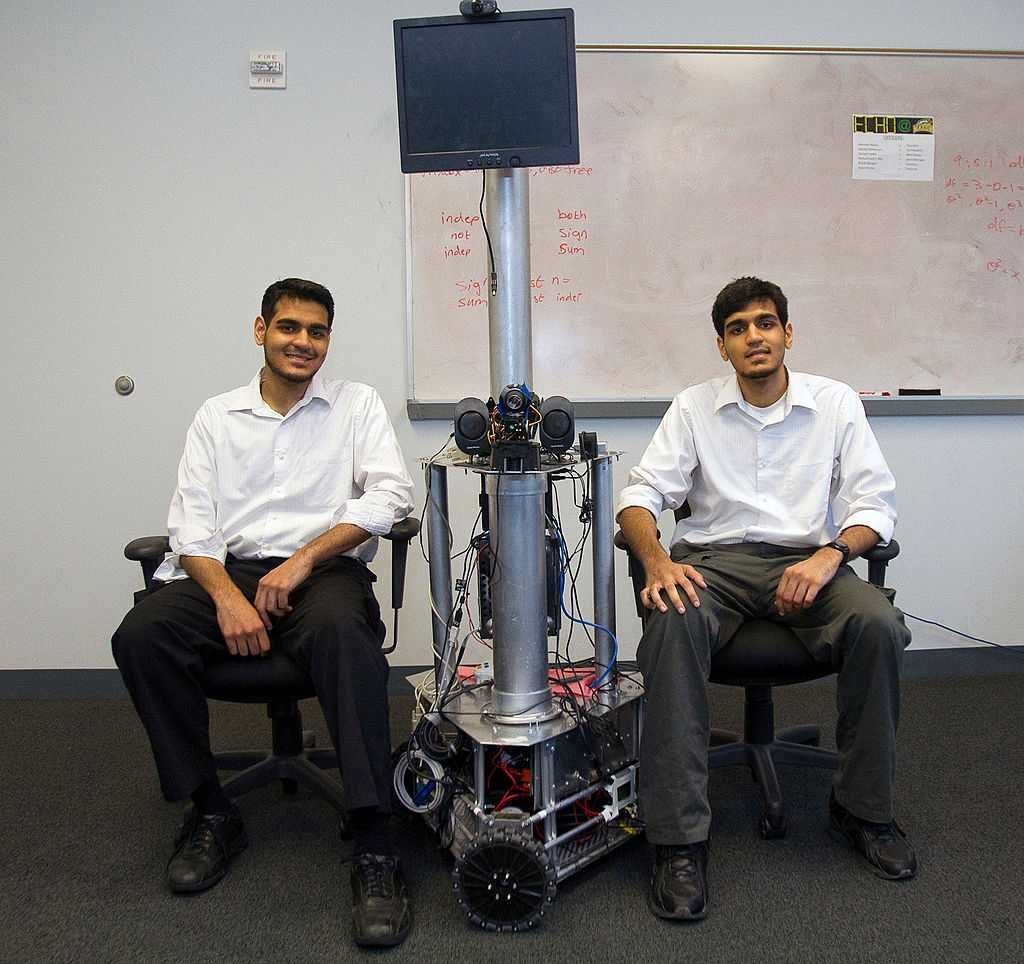
Muneeb Akhter. Photo by Evelyn Hockstein/Washington Post via Getty Images

According to the indictment, Muneeb Akhter allegedly deleted approximately 96 databases storing U.S. government information — including databases containing records and documents related to Freedom of Information Act matters as well as sensitive federal investigative files.

Muneeb Akhter is also accused of asking an artificial intelligence tool how they could cover their tracks after deleting a DHS database.

After he got fired from Opexus, Muneeb Akhter allegedly obtained data from the U.S. Equal Employment Opportunity Commission and is accused further of stealing copies of IRS information including federal tax information and other identifying information for at least 450 individuals.

Opexus did not respond to a request for comment from Blaze News.

"These defendants abused their positions as federal contractors to attack government databases and steal sensitive government information," said Matthew Galeotti, acting assistant attorney general at the Department of Justice's Criminal Division, in a statement. "Their actions jeopardized the security of government systems and disrupted agencies’ ability to serve the American people."

Muneeb Akhter has been charged with conspiracy to commit computer fraud and to destroy records, two counts of computer fraud, theft of federal records, and two counts of aggravated identity theft. His twin, Sohaib Akhter, was charged with conspiracy to commit computer fraud and to destroy records and computer fraud.

While Sohaib Akhter faces a maximum penalty of six years in prison, Muneeb Akhter faces a mandatory minimum penalty of two years of prison time for each aggravated identity theft count and a maximum penalty of 45 years for the other charges.

The duo pleaded guilty in 2015 to a different set of crimes.

Muneeb Akhter hacked into the website of a cosmetics company and stole thousands of customers' credit card and personal information. He and his brother used the stolen data to pay for flights, hotel stays, various goods, and attendance at professional conferences. Muneeb Akhter proceeded to hand off the stolen data to a "dark net" operator who cut him in on the profits from the sales.

The other brother, meanwhile, used his contract position at the State Department in 2015 to steal personally identifiable data belonging to various people including co-workers and a federal law enforcement agent who was investigating him.

According to the Justice Department, Sohaib Akhter later hatched a scheme to ensure perpetual access to various State Department systems and, with the help of his twin, attempted to install an electronic collection device inside a State Department office, which would have enabled the hackers to remotely steal federal data.

Years earlier, Muneeb Akhter hacked into a Maryland-based private data aggregation company that he was performing contract work for, giving his brother access to a database of federal contract information to give their technology company an upper hand when bidding for contracts and clients.

Like Blaze News? Bypass the censors, sign up for our newsletters, and get stories like this direct to your inbox. Sign up here!

Trump's DOJ nabs Chinese agent accused of global CCP plot to steal COVID research


Amid the Trump administration's efforts to curb the Chinese Communist Party's influence in the U.S., the Department of Justice announced the arrest of a CCP agent accused of worldwide computer intrusions related to COVID-19 research.

Xu Zewei, 33, and Zhang Yu, 44, are facing a nine-count indictment for allegedly "hacking and stealing crucial COVID-19 research at the behest of the Chinese government while that same government was simultaneously withholding information about the virus and its origins," stated Nicholas Ganjei, U.S. Attorney for the Southern District of Texas.

'Through HAFNIUM, the CCP targeted over 60,000 U.S. entities, successfully victimizing more than 12,700 in order to steal sensitive information.'

Federal authorities alleged that the Ministry of State Security's Shanghai State Security Bureau directed Xu to perform computer intrusions between February 2020 and June 2021.

Xu allegedly targeted American universities, immunologists, and virologists to obtain information on COVID-19 research related to vaccines, treatment, and testing.

In February 2020, Xu informed the SSSB that he had breached the "network of a research university located in the Southern District of Texas," the DOJ reported. An SSSB officer then reportedly instructed him to target email accounts belonging to certain virologists and immunologists.

Brett Leatherman, the assistant director of the FBI's Cyber Division, explained that Xu and his co-conspirators later operated as a group known as HAFNIUM, which "exploited zero-day vulnerabilities in U.S. systems to steal additional research."

"Through HAFNIUM, the CCP targeted over 60,000 U.S. entities, successfully victimizing more than 12,700 in order to steal sensitive information," Leatherman said.

RELATED: Chinese official avows Beijing is behind cyberattacks on US, identifies motive: Report

Photo Illustration by Budrul Chukrut/SOPA Images/LightRocket via Getty Images

In late 2020, HAFNIUM allegedly breached the Microsoft Exchange Server, impacting computers worldwide, including a law firm and another university in the Southern District of Texas.

Microsoft announced the breach in March 2021, describing HAFNIUM as a "state-sponsored" group "operating out of China." It noted that the hackers had targeted "infectious disease researchers, law firms, higher education institutions, defense contractors, policy think tanks, and NGOs."

RELATED: Agriculture secretary unveils plan to stop China’s farmland grab, bio-material smuggling threats

Feature China/Future Publishing via Getty Images

Xu was arrested in Milan, Italy, on July 3 at the request of the U.S. government and now awaits extradition proceedings. He was charged with wire fraud, conspiracy to commit wire fraud, conspiracy to cause damage to and obtain information by unauthorized access to protected computers to commit wire fraud and to commit identity theft, obtaining information by unauthorized access to protected computers, intentional damage to a protected computer, and aggravated identity theft.

Ganjei stated, "The Southern District of Texas has been waiting years to bring Xu to justice and that day is nearly at hand. As this case shows, even if it takes years, we will track hackers down and make them answer for their crimes. The United States does not forget."

The DOJ reported that Zhang remains at large.

Like Blaze News? Bypass the censors, sign up for our newsletters, and get stories like this direct to your inbox. Sign up here!

Trump campaign says Iranian group hacked internal communications


Former President Donald Trump’s campaign confirmed Saturday that an Iranian group hacked its internal communications in June, Politico reported.

Politico and the Washington Post stated that they received emails in July from an anonymous account that shared a campaign research paper on Trump’s running mate, vice presidential nominee, Sen. JD Vance (R-Ohio). The 271-page document listed publicly available information about Vance, including his previous criticisms of Trump, which it labeled as “potential vulnerabilities.” Additionally, the sender provided the news outlets with part of a research document on Florida Sen. Marco Rubio (R), who was one of Trump’s top contenders for running mate.

'Intended to interfere with the 2024 election and sow chaos.'

The hack coincides with a Microsoft report released Friday that claimed an “Iranian group, this one connected with the Islamic Revolutionary Guard Corps, or IRGC, sent a spear phishing email in June to a high-ranking official on a presidential campaign.”

Microsoft did not identify the presidential campaign targeted in the attack.

Politico asked the anonymous sender how it obtained the documents, to which the individual responded, “I suggest you don’t be curious about where I got them from. Any answer to this question, will compromise me and also legally restricts you from publishing them.”

Trump campaign spokesperson Steven Cheung told Politico, “These documents were obtained illegally from foreign sources hostile to the United States, intended to interfere with the 2024 election and sow chaos throughout our Democratic process.”

“The Iranians know that President Trump will stop their reign of terror just like he did in his first four years in the White House,” Cheung added. “Any media or news outlet reprinting documents or internal communications are doing the bidding of America’s enemies and doing exactly what they want.”

Trump wrote on social media in response to the attack, “We were just informed by Microsoft Corporation that one of our many websites was hacked by the Iranian Government - Never a nice thing to do! They were only able to get publicly available information but, nevertheless, they shouldn’t be doing anything of this nature. Iran and others will stop at nothing, because our Government is Weak and Ineffective, but it won’t be for long. What Iran doesn’t realize is that I will make the World a better and safer place, and that’s good for them, also!”

The FBI told NBC News that it is “aware of the media reporting” but declined to provide further comments about the matter. Microsoft also declined to provide additional details about its report.

A spokesperson for the Permanent Mission of the Islamic Republic of Iran to the United Nations told the news outlet, “We do not accord any credence to such reports. The Iranian Government neither possesses nor harbors any intent or motive to interfere in the United States presidential election.”

Like Blaze News? Bypass the censors, sign up for our newsletters, and get stories like this direct to your inbox. Sign up here!