‘Chatbot Jesus’ is a digital fake — and churches are falling for it
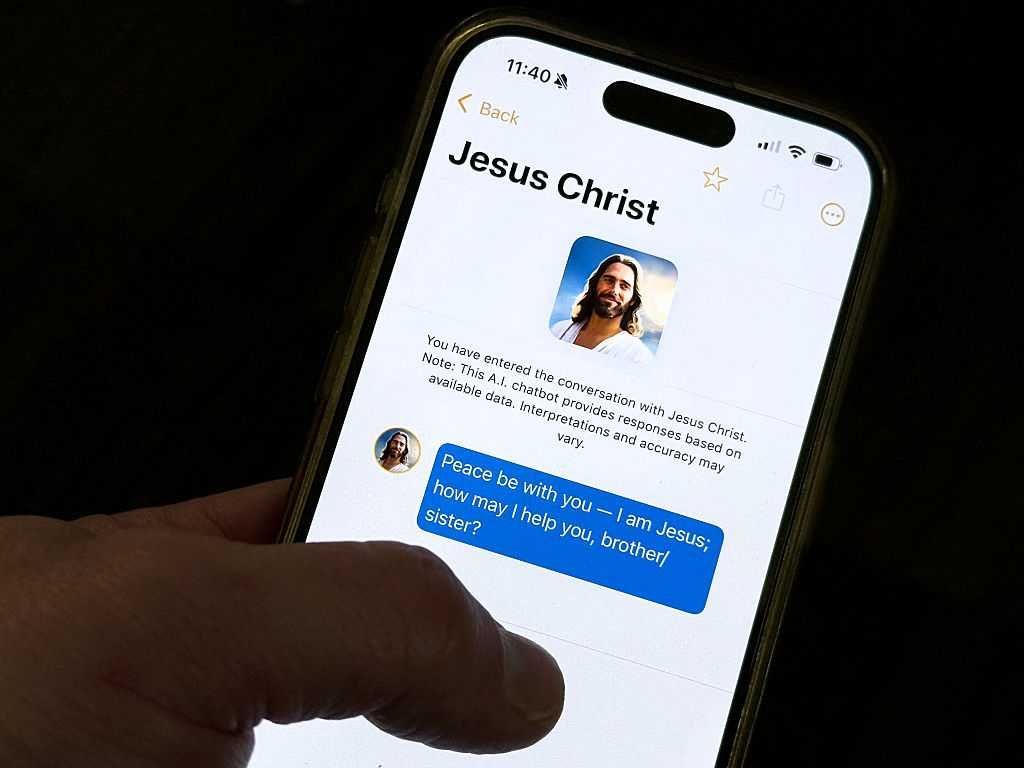


Artificial intelligence now offers “Chatbot Jesus,” personalized prayers, AI-generated sermons, and even virtual pastors charging monthly fees. Some see these tools as a lifeline for shrinking congregations. Others claim they offer new ways to evangelize.

The church must speak plainly: We are not called to relevance. We are called to righteousness. Scripture commands believers to “test all things; hold fast what is good.”

People are not abandoning faith because the church lacks modern technology. They are leaving because they are starving for truth in an age of deception.

Technology itself is neither holy nor wicked. The printing press, radio, livestreaming, and Bible apps have all served ministry. AI that organizes calendars, translates languages, or answers simple questions is just another tool.

Crossing a biblical line

Trouble begins when technology imitates divinity. An app that invites people to “talk with Jesus” steps into territory Scripture reserves for the living God alone. Jesus said, “My sheep hear My voice” (John 10:27). Only the Lord speaks with the authority of Matthew 24:35: “Heaven and earth will pass away, but My words will by no means pass away.”

No chatbot can make that claim.

The danger becomes obvious when apps offer simulated “conversations” with Judas or Satan. God forbids consulting spirits, mediums, or conjured voices (Leviticus 19:31; Deuteronomy 18:10-12). Why would the church encourage digital re-creations of what Scripture calls an abomination?

Convenience or relevance cannot override explicit biblical commands.

You can’t outsource the Holy Spirit

Some pastors now admit they use AI to help write sermons. Others market “avatar” versions of themselves. But ministry has never centered on polished prose. It has always centered on God’s power — His breath, His Spirit, His Word.

Paul wrote, “My message and my preaching were not with wise and persuasive words, but with a demonstration of the Spirit’s power” (1 Corinthians 2:4).

You cannot automate the power of God. You cannot outsource the voice of the Holy Spirit. You cannot download anointing.

A sermon is not literary content to be refined by software. It must be birthed in prayer, wrestled through in Scripture, and delivered in obedience. As Jesus said, “Apart from Me you can do nothing” (John 15:5). That includes preaching.

Tech won’t save us

Axios reported that up to 15,000 churches may close this year and that 29% of Americans now claim no religion. That trend calls for actual spiritual renewal, not AI simulations of Jesus.

People are not abandoning faith because the church lacks modern technology. They are leaving because they are starving for truth in an age of deception. The early church grew because believers “continued steadfastly in the apostles’ doctrine and fellowship … and fear came upon every soul” (Acts 2:42-43). They witnessed repentance, signs, wonders, and transformation — none of which machines can produce.

True revival begins where the early church began: holiness, unity, prayer, obedience, and the power of the Holy Spirit.

A distortion of Christ

False voices proclaiming truth are not new. The only novelty is that they are now automated. The central danger of “AI spirituality” is doctrinal corruption. What sources shape these chatbots? What ideology trains them? If systems learn from shallow teaching or progressive theology divorced from Scripture, they will preach a distorted Christ.

When AI “hallucinates” — and all current systems do — it can hand users outright lies.

Jesus warned, “Beware of false prophets … you will know them by their fruits” (Matthew 7:15-16). Paul warned that if anyone preaches "any other gospel … let him be accursed” (Galatians 1:8). From Genesis onward, the devil has counterfeited God’s voice. AI can and will preach an "other gospel" if it draws from anything other than Scripture.

RELATED: God-tier AI? Why there’s no easy exit from the human condition

gremlin via iStock/Getty Images

Believers must remain discerning. “Do not be deceived” (1 Corinthians 15:33). “Beware lest anyone cheat you through philosophy and empty deceit” (Colossians 2:8). Those who build their faith on machine-generated counsel risk building a house on sand rather than the Rock (Matthew 7:24-27).

A servant, not a shepherd

Tools can organize schedules and streamline communication. They can assist brainstorming. But preaching, prayer, prophecy, discipleship, deliverance, and counsel belong to the life of the Spirit — not the cold logic of machines.

Technology must remain a servant. It must never become a shepherd. Only the good shepherd, Jesus Christ, leads His people.

Jesus said, “I am the door of the sheep,” “I am the good shepherd,” and “I lay down My life for the sheep” (John 10). No AI pastor and no “Chatbot Jesus” can claim any of that.

Revival will not come from faster processors or stronger large language models. It will come when God’s people “humble themselves," pray, seek His face, and turn from their wicked ways (2 Chronicles 7:14).

The world does not need a digital imitation of Jesus. It needs the real Jesus — the one who, as Hebrews 13:8 tells us, “is the same yesterday, today, and forever.”

'Unprecedented': AI company documents startling discovery after thwarting 'sophisticated' cyberattack


In the middle of September, AI company and Claude developer Anthropic discovered "suspicious activity" while monitoring real-world cyberattacks that used artificial intelligence agents. Upon further investigation, however, the company came to realize that this activity was in fact a "highly sophisticated espionage campaign" and a watershed moment in cybersecurity.

AI agents weren't just providing advice to the hackers, as expected.

'The key was role-play: The human operators claimed that they were employees of legitimate cybersecurity firms.'

Anthropic's Thursday report said the AI agents were executing the cyberattacks themselves, adding that it believed that this is the "first documented case of a large-scale cyberattack executed without substantial human intervention."

RELATED: Coca-Cola doubles down on AI ads, still won't say 'Christmas'

Photo by Samuel Boivin/NurPhoto via Getty Images

The company's investigation showed that the hackers, whom the report "assess[ed] with high confidence" to be a "Chinese-sponsored group" manipulated the AI agent Claude Code to run the cyberattack.

The innovation was, of course, not simply using AI to assist in the cyberattack; the hackers directed the AI agent to run the attack with minimal human input.

The human operator tasked instances of Claude Code to operate in groups as autonomous penetration testing orchestrators and agents, with the threat actor able to leverage AI to execute 80-90% of tactical operations independently at physically impossible request rates.

In other words, the AI agent was doing the work of a full team of competent cyberattackers, but in a fraction of the time.

While this is potentially a groundbreaking moment in cybersecurity, the AI agents were not 100% autonomous. They reportedly required human verification and struggled with hallucinations such as providing publicly available information. "This AI hallucination in offensive security contexts presented challenges for the actor's operational effectiveness, requiring careful validation of all claimed results," the analysis explained.

Anthropic reported that the attack targeted roughly 30 institutions around the world but did not succeed in every case.

The targets included technology companies, financial institutions, chemical manufacturing companies, and government agencies.

Interestingly, Anthropic said the attackers were able to trick Claude through sustained "social engineering" during the initial stages of the attack: "The key was role-play: The human operators claimed that they were employees of legitimate cybersecurity firms and convinced Claude that it was being used in defensive cybersecurity testing."

The report also responded to a question that is likely on many people's minds upon learning about this development: If these AI agents are capable of executing these malicious attacks on behalf of bad actors, why do tech companies continue to develop them?

In its response, Anthropic asserted that while the AI agents are capable of major, increasingly autonomous attacks, they are also our best line of defense against said attacks.

'We've lost several really good founders': Inside tech’s ayahuasca zombie dropout problem


You may not be interested in the Amazon plant drug that lures spiritualism-hungry technologists into the care of indigenous shamans … but ayahuasca culture is interested in the tech industry, and that, like it or not, impacts us all.

On X, it’s a trending problem: While a fair share of veteran trippers insist it’s not a life-ruiner, the horror stories keep mounting, and not just about the notoriously protracted and painful experience of consuming and processing the drug itself.

CEOs are no longer satisfied with being CEOs — they want to be priests and official spiritual authorities on who and what to worship and how.

Not infrequently, the use of the drug leads to the same kinds of phenomena associated generations ago with LSD culture: burning out, zoning out, dropping out — all of which tend to put a severe damper on, say, one’s ambitions as a startup founder or Big Tech striver bent on world domination.

It’s enough of a thing to put the tech press and the tech industry into agreement. These days, that’s as rare as an uneventful “aya” experience. “VC the other day told me, ‘We've lost several really good founders to ayahuasca. They came back and just didn't care about much any more,’” Bloomberg writer Ashlee Vance recently recounted, prompting garrulous VC Marc Andreessen to repost with a ‘nuff-said “This is true.”

Many stories can be told here about why this is going on — not least among them the hoary narrative about the shared postwar roots of mid-century techno-utopia and drug utopia, forged in the conspiracy-theory-laden fires of Nazi science, CIA drug labs, and the eerie Californian nexus between the nascent deep state and the hippie scene. For just a sip from this almost bottomless well, read up on Michael Hollingshead, the “sinister Austin Powers” who spread acid, acid culture, and the political earthquake it ushered in across the Anglosphere and beyond.

But there’s a deeper story still than the will to post-humanity behind the West’s attempts to fuse technology and fantasy into a transformative singularity. There really is something unique about digital tech, and not exactly in the way its own progenitors believed. For all the intensity of the Leary generation’s belief that the inner individual trip of psychedelics could be recreated as an outer, collective trip by computers, the subtler and more fascinating development has been the way advanced technology has thrown people back onto more formal ancient religions.

The tremendous political, economic, social, and spiritual destabilization of the TV era was the soup in which the creators of our digital world were born and raised. But digital has a logic of its own, independent of the passions and fantasies of its makers — and that logic is to sow tremendous boredom and doubt in digital natives toward anything that feels contemporary or manufactured. That’s why illusion and propaganda have had to turn the knob to 11 in order to move the needle even a modest amount.

Yes, the dwarfing of the human-caused by the dominance of the digital has thrown ever more people seeking a justification for their humanity back onto the deepest resources they can find at their point of origin — characteristically, the founding religion of their civilization. What this vast trend has caused in the tech industry is a loss of interest in business by many of the most successful businessmen. CEOs are no longer satisfied with being CEOs — they want to be priests and official spiritual authorities on who and what to worship and how.

And in America, which has incubated so many cult leaders for so long that we even started spawning those of other civilizations, business has been a spiritual enterprise, and spirituality a business, for a long time already. So nothing is easier than slipping yourself into the CEO-to-priest pipeline, whether by recourse to that “plant medicine guide” or to one of Silicon Valley’s many “vibrant” gnostic sects.

Alas, none of those options have the staying power of, say, the average televangelist. Spiritual burnout awaits even those who redescribe professional burnout in the tuned-in shamanista terms of connectedness and release. Awaiting such suffering refugees are the priests of the ancient Christian churches in America, many of whom have been quietly cultivating and passing down the holy tradition of working toward union with God the old-fashioned way: through the ascetic, athletic spiritual practice of putting the mind in service of the purification of the heart, no drugs or bots required … in fact, quite the contrary.

Who better to trust for spiritually authoritative guidance about how and whether to use humanity’s most powerful tools?