The founders demanded the Bill of Rights. AI also needs one.


In September 1787, the Constitutional Convention in Philadelphia came to a close. Delegates had spent months debating and negotiating the structure for a new American government. When the final document was presented for signatures, most of the delegates agreed to support it. But one of the most influential figures in the room refused.

George Mason of Virginia would not sign the Constitution.

Mason’s refusal did not stem from radical opposition to the new proposed government. In fact, he played a major role in shaping America’s early political philosophy. Yet when the convention concluded, Mason believed something essential was missing. The proposed Constitution created a powerful federal government, but it contained no explicit protections for individual liberty. Without a Bill of Rights, Mason warned, citizens would have little protection against abuses of power.

If artificial intelligence is going to help shape the future of our society in profound ways, should it not also be built to respect the same freedoms that Americans have fought for since the founding of the republic?

History ultimately proved his concerns justified. Mason’s refusal helped spark the debate that led to the adoption of the Bill of Rights a few years later. His message was simple. When a new, powerful institution is created, the protection of liberty cannot be an afterthought.

A new power is emerging

More than two centuries later, we find the United States again standing at the edge of a transformative moment. Today, the institution taking shape is artificial intelligence. And this institution may end up being just as consequential to society as the shaping of the country in the late eighteenth century.

The most advanced AI systems are already beginning to shape our culture and how people access information, businesses make decisions, institutions function, and public discourse unfolds. These systems are being integrated into everything from banking and education to media and health care. In many cases, AI models act as intermediaries between humans and the world of information around them.

This development carries enormous promise. Artificial intelligence could accelerate medical research, improve productivity, and unlock scientific discoveries that once seemed impossible.

At the same time, the growing influence of AI raises an important question. What values will guide the systems that increasingly shape our society?

AI is not neutral by default. Every model reflects decisions made by its designers. The data used to train it, the rules used to filter its responses, and the priorities embedded in its algorithms all influence how it interacts with users. Beyond just answering questions and responding to prompts, these systems influence what information people encounter and how issues are understood.

In other words, the institutions building AI today are quietly creating the informational infrastructure of the future.

Where are the safeguards for freedom?

George Mason understood that powerful institutions require clear limits. His concern centered on ensuring that a strong central government would respect the rights of the people it serves.

Artificial intelligence deserves the same scrutiny.

Recent controversies surrounding AI tools have revealed how easily political or ideological assumptions can shape technological systems. A growing body of studies has found that many leading AI models tend to reflect left-leaning political assumptions in their outputs, raising concerns about viewpoint bias. Major AI platforms have faced backlash for producing historically inaccurate outputs to satisfy modern ideological expectations, as seen in widely publicized image-generation failures.

Social media platforms, powered by similar AI-driven algorithms, already curate what users see, amplifying certain viewpoints while quietly burying others. Even leaders within the AI industry have acknowledged the risk that these systems could influence public discourse in ways that are difficult for users to detect.

More egregious examples can be seen with Chinese AI models, such as DeepSeek, which have been shown to avoid or redirect discussion on topics that conflict with official government positions, reflecting the priorities of the state rather than the pursuit of truth.

Taken together, these examples demonstrate how AI can be shaped to filter reality itself, whether by governments, corporations, or the assumptions embedded by developers.

These examples illustrate a basic reality. Artificial intelligence can either serve as a tool for expanding human freedom or as an instrument for shaping and controlling public discourse and, by extension, society. The outcome will depend on the values embedded in these systems today.

A meaningful step forward would be the adoption of clear, principled guidelines for building and deploying these systems. At minimum, AI development should prioritize truth-seeking over narrative-shaping, ensuring that systems are designed to inform rather than steer users toward predetermined conclusions.

Developers should also commit to transparency in training data sources, so the public has a clearer understanding of what informs these models.

Just as important, developers should resist coercion from governments or corporations seeking to suppress lawful speech or manipulate outcomes. They should reject internal policies that seek to bury dissenting views under the vague banner of “safety,” a term that too often masks subjective judgment.

These principles may not solve every problem, but they would begin to align AI with the values of a free society.

George Mason’s warning for the AI age

George Mason refused to sign the Constitution because he believed liberty needed stronger protection before a new federal government was enacted. His insistence on a Bill of Rights helped ensure that the American experiment would endure longer by providing explicit protections for individual freedom.

The United States now faces a similar moment as artificial intelligence becomes woven into the fabric of modern life. AI will influence how people learn, communicate, and understand the world. The values guiding these systems will shape society in ways that are difficult to predict.

Before this technological infrastructure becomes fully embedded in our daily lives, it is worth asking a question that George Mason would likely recognize.

If artificial intelligence is going to help shape the future of our society in profound ways, should it not also be built to respect the same freedoms that Americans have fought for since the founding of the republic?

The founders believed liberty required clear protections before a new, powerful structure was fully unleashed. As we enter the age of artificial intelligence, their lesson remains as relevant as ever.
Shock poll: America’s youth want socialism on autopilot — literally


Growing up during the fall of the Berlin Wall and the collapse of the Soviet Union, I remember when socialism was a universal punch line. It stood for failure, repression, and economic ruin.

Not any more. Today, socialism is the ideological spearpoint of the left. Many young Americans now insist that socialism is the cure for the affordability crisis squeezing them. They believe it with a fervor that would have stunned earlier generations.

The evidence is overwhelming, and the verdict is final: Socialism fails everywhere it is tried. Now imagine that system fused with an all-seeing AI.

New polling from Rasmussen Reports and the Heartland Institute’s Emerging Issues Center shows that a majority of likely voters ages 18 to 39 want a Democratic Socialist to win the White House in 2028.

Nearly 60% of young Americans say they support more government housing, a nationwide rent freeze, and government-run grocery stores in every town.

These numbers aren’t anomalies. They reflect a deeper reality: Many young Americans know little about socialism’s actual history, consequences, or track record — and they have been conditioned to believe it can fix the challenges in front of them.

One reason for that ignorance is uncomfortable but obvious. It’s not only the schools — it’s the parents. According to the polls, parents were the most influential voices shaping their children’s support for Democratic Socialism. More than half of respondents said their parents held a favorable view of it.

That alone explains a great deal. And unsurprisingly, more than half also said teachers and professors viewed Democratic Socialism favorably. After decades of ideological drift, even parents who grew up after the USSR’s collapse now believe socialism “might work.”

Based on my own experience teaching in public schools, that rings true. Most of my colleagues openly sympathized with the socialist cause and were hostile to free-market capitalism.

This didn’t happen by accident. It reflects a long march beginning in the Progressive Era. My own postgraduate experience at a prestigious teaching college felt less like preparation for the classroom and more like a Cultural Revolution struggle session — conformity required, dissent punished.

As the public education system drifted leftward, it taught generation after generation that socialism is benevolent and capitalism is predatory. The result is predictable. Many young people now see the free market as the enemy, not the mechanism that lifted billions out of poverty. Cronyism and the explosion of government power only blur the picture further.

Layer onto this the collapse of basic literacy and numeracy. When students can’t read well, struggle with math, and can’t write a coherent paragraph, they are more vulnerable to ideological manipulation — and more likely to lean on machines to think for them.

So it shouldn’t shock anyone that almost half of young Americans surveyed want an advanced AI system to create society’s laws, rules, and regulations. Nearly 40% want that AI system to determine human rights and control the world’s most powerful militaries.

RELATED: Almost half of Gen Z wants AI to run the government. You should be terrified.

Yurii Karvatskyi via iStock/Getty Images
How did this happen? Watch how many parents are glued to screens, outsourcing daily life to devices. Is it any wonder their children grow up thinking technology is omnipotent?

Parents should start with something simple: a family movie night featuring the "Terminator" franchise. Let the kids see where blind faith in machines tends to lead.

Better yet, teach them the truth about socialism. Teach them what it does to human beings. Share the books, documentaries, and testimonies exposing socialism’s century of famine, repression, forced labor, and mass murder — horrors still unfolding in Cuba and North Korea.

The evidence is overwhelming, and the verdict is final: socialism fails everywhere it is tried. Now imagine that system fused with an all-seeing AI — a surveillance state that Stalin could only dream of. The thought of an AI-run socialist regime is not dystopian fiction. It is what many young Americans say they want.

They should be careful what they wish for.

Democrats pick Beijing over Trump in shocking trade war poll


In a development that would have shocked most Americans just a decade ago, a new poll shows more Democrats now hope China wins the trade war with the United States than want their own country to come out ahead. That’s not exaggeration. It’s not spin. It’s a brutal fact.

A national survey I co-authored for the Heartland Institute and Rasmussen Reports found that 32% of likely Democratic voters want China to prevail, while just 30% say they support the Trump administration in the conflict. Another 38% say they’re unsure.

The poll should serve as a wake-up call. We are not just facing a battle over policy. We’re engaged in a war over the very soul of our country.

By comparison, 88% of likely Republican voters support the Trump administration in the trade war. Among voters who identify as politically unaffiliated, just 16% favor China over the United States.

Think about that. A growing number of Democrats would rather see a repressive communist regime — one that jails political dissidents, censors speech, and persecutes religious minorities — defeat America in an economic showdown, simply to spite Donald Trump.

This isn’t just disturbing. It’s un-American.

The poll results reveal a troubling reality about today’s left. Partisan hatred has overtaken even the most basic sense of national loyalty. It’s no longer about what helps America — it’s about what hurts Donald Trump, even if that means handing a strategic victory to our greatest geopolitical adversary.

This debate isn’t about tariff policy. Reasonable people can disagree on trade. This is about cheering on a totalitarian regime simply because it opposes a U.S. president. That’s not ideology — it’s pure partisan spite. And it should alarm every American who values country over party.

Some might dismiss this as ignorance. But the survey suggests something deeper. Everyone understands what the Chinese communist regime represents. This is the government that covered up the COVID-19 outbreak, steals hundreds of billions worth of U.S. intellectual property annually, and props up its economy with forced labor.

Yet, a large share of Democratic voters would still rather see China win a trade war than watch Trump succeed.

This is the rot at the core of the modern progressive movement: a deep, pathological loathing for everything that even resembles traditional American values — capitalism, strength, independence, and yes, national pride. That’s why so many on the left can’t bring themselves to cheer for a U.S. victory in a confrontation with a foreign adversary.

The poll should serve as a wake-up call. We are not just facing a battle over policy. We’re engaged in a war over the very soul of our country.

It’s no longer enough to assume that all Americans, no matter how fiercely they disagree, are on the same team when it comes to defending our national interest. That assumption is now demonstrably false.

The fight for the future of the United States is not just happening in Washington — it’s happening in the hearts and minds of our fellow citizens. And based on this data, that fight is far from over.

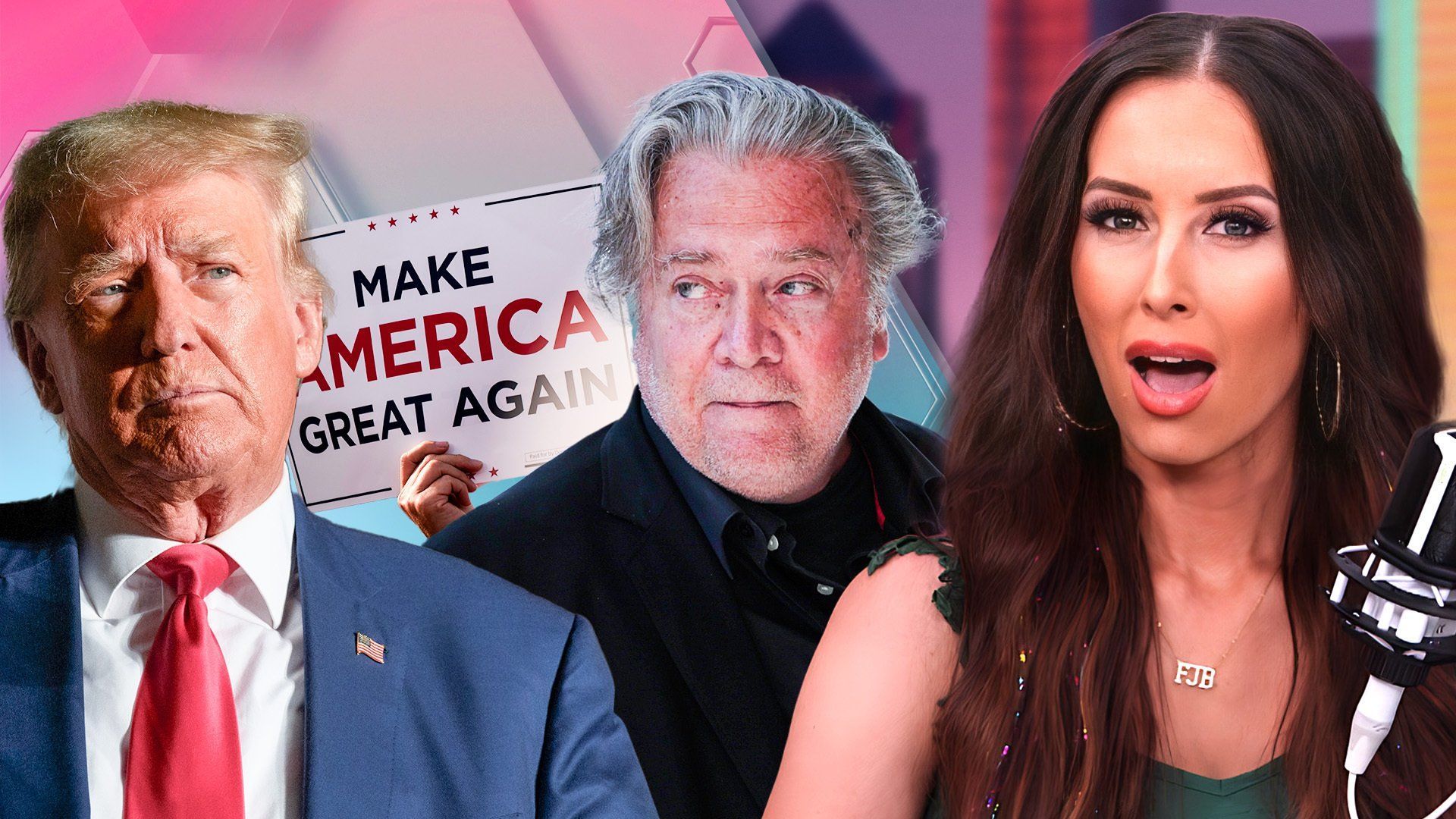
Steve Bannon sentenced to prison; says ‘look at the rise of MAGA’


Former Trump advisor Steve Bannon has been ordered to report to prison on July 1 due to contempt of Congress charges after defying the subpoena from the January 6 committee.

His sentence is set to last four months, which Sara Gonzales notes is suspicious.

“It’s not lost on me, shouldn’t be lost on you — it’s July 1. It’s a four-month prison sentence, ok? So, July, August, September, October, November. So, Steve Bannon will now be sidelined until November during campaign season,” she says wearily.

The judge had previously paused the sentence when it was handed down in October 2022 while Bannon appealed his conviction, but the judge has just ruled that the original reasons behind the postponement no longer apply after the Circuit Court of Appeals ruled unanimously against his position.

But Bannon could not have made it clearer that he’s not giving up and that Trump supporters have a lot to look forward to as the election nears.

“I’ve got great lawyers, and we’re going to go all the way to the Supreme Court if we have to,” Bannon said after his bail was revoked.

Bannon then addressed the Justice Department: “They’re not going to shut up Trump. They’re not going to shut up Navarro. They’re not going to shut up Bannon, and they’re certainly not going to shut up MAGA.”

“Look at the rise of MAGA. Look at the rise of Donald Trump. If the election was held today, according to Harry Enten over at CNN, President Trump would win in a landslide,” he added. “This is about one thing. This is about shutting down the MAGA movement, shutting down grassroots conservatives, shutting down president Trump.”

“Not only are we winning, we are going to prevail, and every number and every poll shows that. There’s nothing that can shut me up, and nothing that will shut me up. There’s not a prison built or jail built that will ever shut me up.”

“All victory to MAGA, we’re going to win this, we’re going to win at the Supreme Court, and more importantly we’re going to win on November 5 in an amazing landslide with the Senate, the House and also Donald J. Trump back as President of the United States,” he concluded.

Like Gonzales, Stu Burguiere is well aware that this has everything to do with the upcoming election.

“It would be great if the people in Washington trusted us to make the decision that is really our decision to make. They keep trying to take it away from us in every way possible,” Stu Burguiere says. “They want to do everything except let this jury of 330 million people, and you know, millions of those voters, make the decision ourselves.”


Want more from Sara Gonzales?

To enjoy more of Sara's no-holds-barred take to news and culture, subscribe to BlazeTV — the largest multi-platform network of voices who love America, defend the Constitution, and live the American dream.