If You Didn’t Get A Great Education, It’s Never Been Easier To Repair It
 Those of us in the majority of Americans who have been deprived of an excellent education have never had more opportunities to remediate ourselves.
Every August, families spend tens of thousands of dollars on college tuition, housing, meal plans, and textbooks. They compare degree requirements, graduation rates, and campus amenities. Yet many never ask the most basic consumer question: What is actually inside the classes they are buying?
Colleges already label the price. It’s time to label the product.
Americans would not buy food without reading the ingredients or take medicine without knowing something about the possible side effects. College courses, however, are often sold by title and catalog description alone. Students register for “Introduction to History,” “Ethics,” or even a science requirement with little idea of the intellectual assumptions the professor will bring into the lecture hall.
That information can be consequential. A course may pursue knowledge through evidence and argument. It may also subordinate the subject to diversity, equity, and inclusion programs, critical theory, gender ideology, Marxist assumptions, or some other political project.
Ideological activism is not confined to philosophy, literature, or religious studies. It increasingly appears across the curriculum, including in professional programs and “hard” scientific fields.
Parents and students have every right to know whether a professor intends to teach the advertised subject, examine competing arguments, and permit disagreement — or use the classroom to promote a political worldview.
The concern is especially urgent at public universities. Faculty members at state institutions are government employees paid by taxpayers. In Arizona, for example, they undertake obligations to uphold the United States and state constitutions. Taxpayers are therefore entitled to ask whether professors are educating students for citizenship in a constitutional republic or teaching theories fundamentally hostile to it.
That’s why I developed what I call the “Intellectual Nutrition Label.”
The idea is simple. A nutrition label does not order shoppers to buy or reject a product. It tells them what the product contains so they can decide for themselves. The Intellectual Nutrition Label would do the same for college professors and courses.
Using public information — university biographies, curricula vitae, books, articles, interviews, lectures, and course materials — each label would summarize the intellectual content students are likely to encounter. Families should not need graduate training or weeks of research to understand what a professor openly teaches.
RELATED: Trump’s Justice Department is shining a light on woke universities — finally
A useful label might ask:
A label could also rate qualities such as intellectual honesty, knowledge, virtue, beauty, meaningfulness, and piety. A professor might rank highly for candor and scholarship while receiving a low rating for piety because he publicly rejects belief in God. The point would not be to uncover private opinions or publish anonymous accusations. The ratings would summarize what professors already say about themselves and their work.
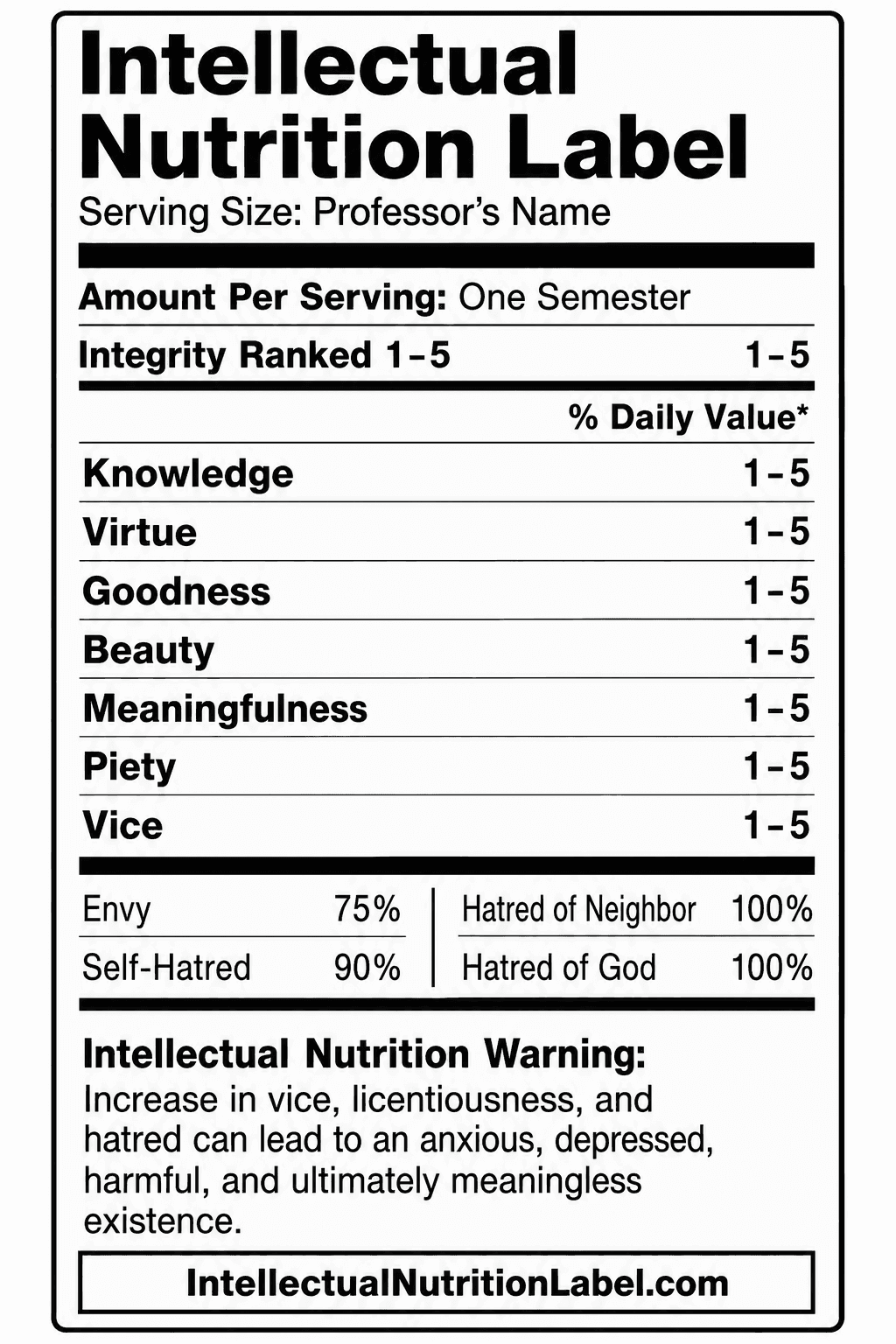
That distinction is essential. An Intellectual Nutrition Label should not become a blacklist, an invitation to harassment, or a substitute for reading a professor’s work. It must rely on verifiable public evidence, represent a professor’s position fairly, and provide enough sourcing for readers to check the judgment for themselves.
The concept has predecessors. David Horowitz’s 2006 book, “The Professors: The 101 Most Dangerous Academics in America,” documented ideological activism in higher education. The David Horowitz Freedom Center continues to track left-wing activists and organizations. Turning Point USA’s Professor Watchlist sought to alert students to professors who brought political activism into the classroom and briefly maintained a list of recommended faculty.
The Intellectual Nutrition Label would have a narrower purpose: consumer disclosure. It would tell students and parents what intellectual ingredients a professor publicly advertises, in a format ordinary people can understand before registration day.
If a professor teaches that the United States is inherently oppressive, advocates Marxist critical theory, rejects biological sex as fixed, or treats Christianity principally as an instrument of domination, those positions should be documented in the professor’s own publications, biography, lectures, or course materials. An accurate summary of publicly stated beliefs is not censorship.
RELATED: Universities won’t give back the land — but they will bury history
The more serious objection may be that parents and taxpayers were never expected to notice. Academic language often conceals radical assumptions behind specialized vocabulary. Professors can signal their commitments to colleagues while students discover the course’s real content only after enrollment.
That arrangement is losing its protection. Parents increasingly ask what their children are learning. Taxpayers increasingly ask whether public universities are educating students or recruiting them into political movements. Those are legitimate questions, especially when a single semester can cost more than many families earn in months.
Throughout the coming semester, I will publish Intellectual Nutrition Labels evaluating professors from publicly available evidence. The labels will not decide which courses students may take. They will help families make that decision with their eyes open.
Readers can follow the project on my Substack and at intellectualnutritionlabel.com (coming soon).
When families spend tens of thousands of dollars on a college education, they deserve to know who is teaching, what that professor believes, and which intellectual ingredients will be placed before their children. Colleges already label the price. It’s time to label the product.
With the signing of the Declaration of Independence 250 years ago, America’s founders accomplished something new under the sun: They brought into existence a nation rooted in the belief that individuals are by nature free and equal.
This year marks another achievement for the Declaration: Never before has a nation dedicated to securing its citizens’ unalienable rights — the rights inherent in all human beings — persevered for 250 years. Notwithstanding the social and political turmoil currently roiling the nation, America has done much more than persevere.
The American journey from 1776 to 2026 has been marked by the struggle to honor more fully the Declaration’s promise of equality in fundamental rights.
No multireligious, multiracial, and multiethnic nation-state in history has more successfully established freedom and equality under law, promoted economic prosperity, and developed the capabilities to defend itself by projecting military power around the world.
America’s perseverance and flourishing — as presidents including Abraham Lincoln, Calvin Coolidge, and Franklin Delano Roosevelt have affirmed and as venerable reformers such as Elizabeth Cady Stanton, Frederick Douglass, and Martin Luther King Jr. have demonstrated — owe much to the nation’s founding on universal principles and to its enduring dedication to them.
The self-evident truths proclaimed by the Declaration of Independence start with the conviction that human beings are by nature free and equally endowed with unalienable rights. They include the belief that government’s first purpose is to secure citizens’ unalienable rights, that just power stems from the consent of the governed, and that citizens by right may replace a government that destroys the conditions for securing their unalienable rights.
These universal principles inform the 27 grievances — abuses of executive power, lawless legislation, and acts of war — that the Declaration spells out against King George III and the British Parliament. Some argue that the Declaration’s primary significance lies in these grievances and downplay the historic document’s opening paragraphs about universal principles as Enlightenment commonplaces. But it was revolutionary for a people to claim the authority of unalienable rights to throw off one form of government and institute another.
Indeed, according to the Declaration’s logic, American colonists’ specific grievances justified their break with Britain and the establishment of free and independent states because taken together the grievances violated rights that the colonists shared equally with all persons.
In recent years, critics on both left and right have subjected the truths that the Declaration holds to be self-evident to harsh criticism. Eminent figures associated with the postmodern-progressive left accuse these principles of obscuring if not empowering the evil institution of slavery. Prominent members of the postliberal right charge that the Declaration’s self-evident truths are neither true nor beneficial but rather constitute the chief source of the multifarious maladies afflicting the nation.
RELATED: 1776, not 1608: What the Supreme Court got wrong on birthright citizenship
Whereas postmodern progressives blame those principles for the perpetuation of systemic racism, postliberals condemn them for the systemic degradation of men and women of all religions, races, and ethnicities.
Both find in the Declaration’s affirmation of universal rights a baleful pretext for colonizing foreign countries and imposing America’s ways and rules on other peoples and nations. And both indulge extravagant speculations about establishing new forms of government in the United States untainted by the basic rights and fundamental freedoms promised by the Declaration.
The American journey from 1776 to 2026 has been marked by the struggle to honor more fully the Declaration’s promise of equality in fundamental rights. America has benefited from a common language; abundant natural resources; vast, protective oceans to the east and west; peaceful and stable borders to the north and south for much of its history; and a moral and political heritage entwining biblical faith, classical thought, and the modern tradition of freedom.
At the same time, America has been compelled to grapple with the legal institutionalization of slavery and, after the Union’s victory in the Civil War and the subsequent ratification of the 13th, 14th, and 15th Amendments, slavery’s poisonous legacy; to wage war abroad repeatedly; and to reckon with the constant churn and turbulence generated by free peoples and free markets.
American citizens’ appreciation of this complex, rocky, and inspiring journey is waning. The nation’s educational system bears heavy responsibility for the diminished understanding of the American experiment in ordered liberty and for the popularity of extreme criticism emerging from both sides of the political spectrum. All levels of the American educational system have been derelict in their duties. But higher education is especially to blame because it also trains K-12 teachers.
American colleges and universities advance the public interest in a variety of ways. They furnish pre-professional and professional education. They provide a credentialing service for employers. They train scholars. They conduct vital scientific research. And, not least, they offer liberal education.
Liberal education is the least successful part of higher education. In recent years, reformers have justly focused on colleges’ and universities’ impairment of free speech and imposition of ideological monocultures. The corruption of the curriculum also deserves scrutiny.
In most cases, colleges and universities believe themselves to comply with the imperatives of liberal education by requiring students to fulfill distribution requirements. Rarely do the nation’s leading institutions of higher education mandate courses that all students must complete or identify substantive bodies of knowledge that all students must master.
The application of a method designed to account for matter in motion has been decidedly less successful in illuminating the moral and political world.
Instead, students meet their obligations by taking a few courses in the humanities, the social sciences, and the sciences, often picking and choosing among dozens of offerings if not more in each of the three main divisions. Two students can fulfill their distribution requirements without reading a single book in common. This, from our colleges’ and universities’ point of view, is not a problem but rather a source of pride.
They believe that they demonstrate concern for students’ individuality by allowing them to choose their own courses and design their own curricula. At the same time, by exposing students to a variety of disciplines and approaches to knowledge, institutions of higher education claim to produce open-minded and well-rounded graduates expertly trained to lead in changing the world.
The traditional aim of liberal education is to cultivate students capable of thoughtfully exercising the rights and discharging the responsibilities of freedom. However, far from exemplifying liberal education at its finest, colleges and universities typically betray it by failing to structure the curriculum coherently, to give it suitable content, and to ensure that students master contending arguments.
Few students these days receive an organized, historically informed introduction to American ideas and institutions: the nation’s religious and political inheritance, founding principles, constitutional traditions, cultural crosscurrents, economic arrangements, and diplomatic and national-security requirements. Few students examine the great books and seminal events of the larger Western tradition out of which the United States emerged and to which it has made a decisive contribution.
Few students undertake the serious study of other peoples and nations, which is essential to a proper assessment of America’s achievements and failings. And few students have impressed upon them the importance in studying morality and politics of appreciating the strong points of the arguments with which they disagree.
America’s colleges and universities have debased liberal education under the compulsion of three ideals. One is political. A second is methodological. A third is professional. When suitably refined, each is worthy. However, contemporary academic life has radicalized all three to the great detriment of liberal education.
First, contrary to liberal education’s imperatives, many faculty members believe that their job is to instill correct views about the pursuit of social justice and enlist students in the cause of progressive political transformation.
Liberal education in America should not be neutral toward fundamental political principles: It assumes the goodness of individual freedom and human equality. But to prepare students for freedom and democratic self-government, liberal education must both refrain from treating partisan political views as academic orthodoxies and foster appreciation of contending opinions and competing ideas.
Yet many of today’s classroom crusaders recognize no pedagogical duty to present fairly the other side of the argument. Some believe themselves obliged to ignore, dismiss, or deride views — often despite little conscientious exploration of them and regardless of their historical significance and relevance to contemporary politics — that they deem distasteful, demeaning, or destructive.
They are unaware of or unmoved by John Stuart Mill’s indispensable observation in “On Liberty” that a person “who knows only his own side of the case, knows little of that.”
RELATED: America’s classrooms are feeding the red wave — socialist red
Second, contrary to liberal education’s imperatives, many faculty members in the social sciences believe that the scientific method represents the one true approach to understanding. While the application of the scientific method to the natural world since the 17th century has produced astounding increases in knowledge and know-how, the application of a method designed to account for matter in motion has been decidedly less successful in illuminating the moral and political world inhabited by self-interpreting human beings.
The conduct of moral and political animals, whose beliefs are shaped by custom, experience, reason, interests, and passions and whose actions are informed by fallible judgments about right and wrong, cannot be fully captured by methods designed to describe matter in motion.
Nevertheless, setbacks in illuminating morality and politics have only driven many social scientists to double down on the study of method. Mesmerized by techniques for counting, measuring, and weighing and transfixed by elegant theories for describing rational conduct, they churn out mounds of research that shroud the substance and texture of human affairs.
Political scientists’ bewitchment by method produces disciplines that have less and less to say to citizens about self-government and justice as they elaborate more and more mathematically sophisticated approaches to the study of moral and political life.
And third, contrary to the imperatives of liberal education, many professors operate on the assumption that the purpose of educating undergraduates is to train the next generation of scholars.
Instead of transmitting to students the knowledge about America, the West, and the world needed for good citizenship, professors commonly provide intellectual tools and socialization into the sensibility required to succeed in the professoriate, though the vast majority of students have no intention of pursuing the scholarly life.
Curricula that honored the imperatives of liberal education would put the Declaration of Independence at the core. They would expose students to serious study of the constitutional system that institutionalized the Declaration’s fundamental principles and of the nation-defining political struggles to realize them. They would explore the seminal ideas and major events of Western civilization of which the American experiment in ordered liberty forms a crucial chapter. And they would examine the culture, economic system, language, politics, and religious beliefs of other civilizations, without which a well-rounded assessment of the United States is impossible.
Not least among the costs of colleges’ and universities’ betrayal of liberal education is that it produces graduates ignorant of the Declaration of Independence’s enduring principles and inspiring legacy and oblivious to the costs of that ignorance to themselves and the nation.
Editor’s note: This article was originally published by RealClearPolitics and made available via RealClearWire.

 With this change, Texas becomes one of several states that now accept the CLT for public university admissions.
 For half a century foreigners could enter graduate programs and take many years, far more than four, to complete their doctoral programs while remaining in the U.S. without any deadline to leave.
 That a court with six Republican-appointed justices could hand down such a patently un-American decision is an indictment of America's rogue legal system.
 AI and social media should not take the brunt of the blame for students’ increased cheating on exams.
 www.theblaze.com
 www.theblaze.com
 thefederalist.com
 www.theblaze.com
 www.theblaze.com
 www.theblaze.com