JD Vance is right to hope his wife becomes a Christian
You wouldn't expect interfaith marriage to cause controversy in 2025. In the professional class, shared religion ranks well below shared ambition. The modern couple’s creed is compatibility — career, education, politics, lifestyle.
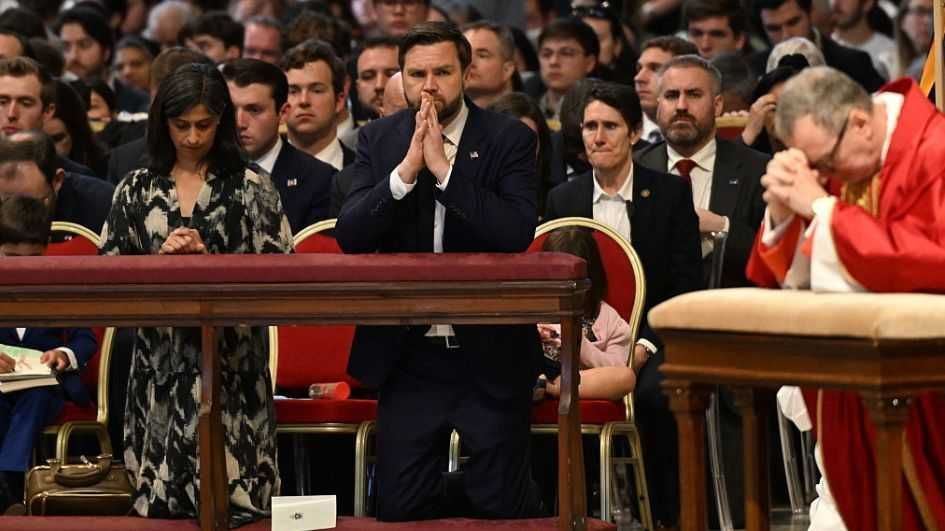
So when JD Vance — a Catholic convert who once moved easily through the meritocratic elite — said he hoped his wife might one day share his faith, it struck many as strange, even retrograde. But that’s only because he meant it. Vance shows what happens when someone in our secular meritocracy takes faith seriously — when belief stops being a cultural accessory and becomes a claim on the soul.
Where Hinduism says you are born to your station, Christianity says you are born again. Where one sanctifies hierarchy, the other sanctifies humility.
Keep it mind that Vance's language was hardly that of a wild-eyed zealot.
Do I hope, eventually, that she is somehow moved by the same thing I was moved in, by church? Yeah, honestly, I do wish that, because I believe in the Christian gospel. … But if she doesn’t, then God says everybody has free will and so that doesn’t cause a problem for me.
Yet that ordinary expression of devotion triggered extraordinary backlash. The Hindu American Foundation accused Vance of implying that his wife’s faith was "not enough," while a Hindu-American professor and author suggested that his remarks were somehow suggestive of "these larger politics of anti-immigration, anti-migrants, replacement theory and white Christian nationalism.”
But the controversy sidestepped the real issue: Vance dared to suggest that Christianity was true.
Usha Vance was raised in Southern California by Hindu immigrant parents, part of the Telugu Brahmin community from Andhra Pradesh. Her family background emphasizes scholarly achievement as much as Hindu tradition. Yet she herself — even while acknowledging and respecting her heritage — comes across as culturally Hindu but not deeply religious. In her words:
My parents are Hindu … and that’s one of the things that made them such good parents.
She and Vance agreed that their children would be raised Catholic; she often attends Mass with the family but remains Hindu by identity.
The credentialed caste
When Vance and Usha met at Yale Law School — the quintessential temple of American meritocracy — they were both first and foremost striving “elite” Americans: she from a high-achieving immigrant-Brahmin background, he a white working-class “deplorable” turned law student turned best-selling author. In that arena, nothing except success mattered.
Unlike Christianity, which erects an inconvenient standard that challenges worldly success, Hinduism (at least in its cultural shape) aligns neatly with the American worship of credentials and achievement. The traditional Indian caste system is less flexible but analogous to America’s unspoken caste system of education, networks, and privilege.
JD Vance began near the bottom of America’s merit hierarchy, where the elite track was something aspirational — a ladder to be climbed. For Usha, raised by highly educated immigrant parents (her father is a professor of aerospace engineering; her mother teaches molecular biology), it was a natural progression — a path expected and prepared for from childhood. But both shared the same fundamental assumption: that the track itself was worth striving for.
Born again
Christianity’s radical proposition — that worth is inherent and not earned, inherited, or compiled — challenges this assumption in a way that Usha’s native religion does not. Hinduism, in its cultural form, may not command conversion, but its social logic is deeply gradated. Whereas Christianity says, “You are born again; status is no barrier,” the caste-and-credential structure says: status defines you from birth, and mobility is uncertain.
Christianity’s radical proposition — that worth is inherent and not earned, inherited or compiled — challenges this assumption in a way Usha's native religion does not. Hinduism (in its cultural form) may not command conversion, but its social logic is deeply gradated. Whereas Christianity says, “You are born again; status is no barrier,” the caste/credential structure says that status defines you from birth and mobility is uncertain.
Birth as moral destiny
Hinduism, to the uninitiated, is often sold as incense and enlightenment — a smiling guru on a yoga mat quoting Rumi out of context. But beneath the linen and lotus flowers lies one of the oldest and most enduring social hierarchies on earth.
While Hinduism contains many schools of thought and not every community treats caste the same way, in much of Indian cultural Hinduism, the caste hierarchy has been deeply embedded and justified through ideas of karma, dharma, and rebirth.
In lived experience, the caste system functions like spiritual software running the faith’s social order: You are born ranked, your worth preloaded. Brahmin, Kshatriya, Vaishya, Shudra — and for those left off the list, the Dalits, the “untouchables.” A Dalit doctor may save a Brahmin’s life yet still not be welcome at his dinner table.
Caste is theology in action — the idea that birth itself is moral destiny. It tells the poor they earned their poverty, the oppressed that they deserve it, and the powerful that they were born benevolent. It turns suffering into a kind of divine bookkeeping, where pain is a balance due and injustice merely interest accrued. Once suffering is justified, compassion becomes optional. Why help the beggar if he’s merely working off last life’s bad karma?
RELATED: Slate goes low, attacks Vance's wife with race-based insult

Grace against gradation
Christianity, particularly Catholicism, stands as the great heresy against that logic. Where Hinduism says you are born to your station, Christianity says you are born again. Where one sanctifies hierarchy, the other sanctifies humility. The Church’s saints were lepers, paupers, slaves — not because they were unlucky in the reincarnation lottery, but because God works through what the world despises.
That reversal is radical. It upends the whole karmic calculus. In Catholicism, your worth is inherent, not inherited or earned.
That’s what draws men like JD Vance to the Church. The incense and Latin are beautiful, but it’s the promise of undeserved mercy that matters — that the son of a drug addict from Ohio can kneel beside a trust-fund heir, both equally fallen and equally forgiven. That is Catholicism’s great equalizer: every soul on its knees, bowing not to someone higher on the ladder, but to what stands above every rung and rank.
Sanctified servitude
Vance’s faith, like his politics, offends the meritocrats because it dismantles their favorite fiction — that purity and privilege share a pedigree. Hinduism built that fiction into its bones; America has simply rebranded it. We call it “achievement.” You see it in Silicon Valley’s spiritual tourism — billionaires chanting mantras between board meetings, preaching mindfulness while outsourcing misery. Caste has gone corporate. The modern Brahmin doesn’t bless your crops; he manages your data.
There’s dark comedy in watching America’s tech elite flirt with the same faith that once sanctified servitude. From Steve Jobs and Mark Zuckerberg’s pilgrimages to the Indian ashram Kainchi Dham — founded by the late guru Neem Karoli Baba — to the adaptation of Vipassana meditation as the ultimate productivity hack, the fascination is real.
Yes, the Hindu American Foundation describes caste as “one of the most complicated and misunderstood concepts” and denies that it is intrinsic to Hinduism. And the former tech exec drawn to Indian culture as the peak of "progressive, enlightened thinking" may be inclined to take them at their word.
But the actual Indians toiling in Silicon Valley have a different experience. Dalit tech workers report widespread discrimination from those in higher castes, to the extent that California lawmakers passed the nation's first anti-caste discrimination bill in 2023. Governor Gavin Newsom (D) subsequently vetoed it.
The scandal of Christianity
When Vance expressed hope that his wife might share his faith, critics saw coercion. But Catholicism teaches the opposite: that redemption can’t be inherited or imposed. You can’t inherit salvation the way you inherit caste or credentials. You have to choose it.
That’s the scandal of Christianity and also its comedy. In a world obsessed with genetics, code, and status, it says the drunk can stumble into heaven as long as he repents before he throws up. Try pitching that in Silicon Valley or New Delhi and see how far you get before being escorted back to reality.
That’s why my fiancée squirms when Western progressives romanticize Hinduism as a tolerant, mystical faith. You can admire the temples and still condemn the theology that built them. Her rejection isn’t of India or its culture, but of the cruelty embedded in its cosmology.
She still lights candles for her ancestors, still loves the poetry of her heritage, but she refuses to bow to its hierarchy. In a world that worships status, she has chosen dignity instead. And in that quiet defiance lies a truth older than any temple or text: Faith, real faith, doesn’t chain you to the past — it sets you free from it.

 Preparations for the Diwali festivalPhoto by Parveen Kumar/Hindustan Times via Getty Images
 This is not simply a question of educational best practices; it’s a battle over worldview.
 Harris’ religious beliefs embody a syncretistic pluralism that appeals to the left’s perversely manipulative obsessions with identitarianism.
 www.theblaze.com
 www.theblaze.com
 www.theblaze.com