A caregiver’s Christmas


A Christmas or two ago, we arrived in Denver just after Thanksgiving for my wife’s long-awaited surgery — one of a series of complex procedures that could only be done at the teaching hospital there. The hospital was already dressed for the season, garlands hung and trees lit, but I barely noticed. All I could see was the next hurdle in a long medical journey.

After eight days in the ICU, Gracie was transferred to the neuro floor. I wanted her to feel something of Christmas, so I slipped out to a store and returned with a small tree, poinsettias, battery candles for the window, and stockings I hung by the nurses’ message board. A friend loaned me a keyboard, which I tucked into the corner. Music has steadied us through many storms, and I hoped it would do so again.

Christmas felt sharper there. Simpler. More honest. When life strips away what doesn’t matter, what does matter finally comes into view.

When the nurses wheeled her into that room, she entered a tiny Christmas world carved out of tile and fluorescent light. The cinnamon-scented broom was no match for the Montana pines behind our home, but it still brought a smile.

Gracie sometimes sang from her hospital bed as I played familiar carols. You’ll be relieved to know that when a staffer requested Mariah Carey’s “All I Want for Christmas,” I politely declined and stayed with the classics. Her song gets ample airplay as it is.

Learning the language of hospital life

I have been a caregiver for a long time. We have spent nearly every major holiday in a hospital, along with most minor ones — birthdays, anniversaries, and the days in between.

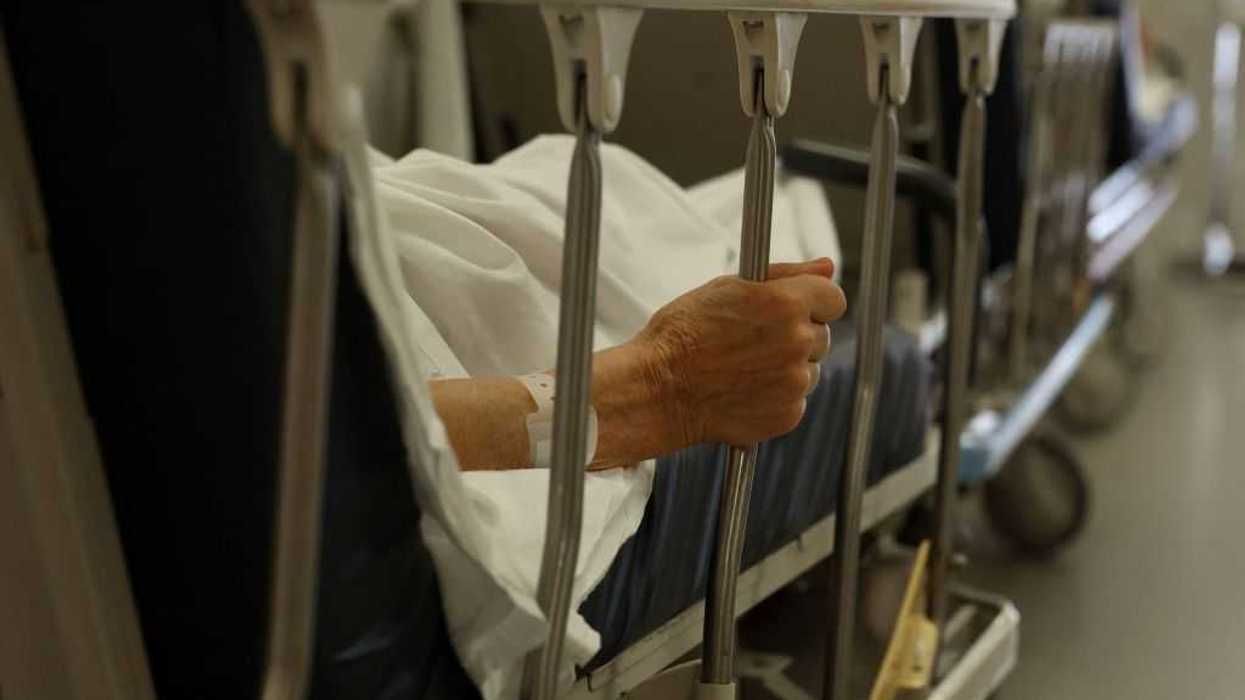
Hospitals, however harsh, have become familiar enough that they no longer disorient me. In the last three years alone, we spent nearly 11 months in that same Denver hospital over three difficult stretches. Over the decades, Gracie has been inpatient in 13 different hospitals. After that many years, you learn the rhythms, the noises, the hush, and the hidden grief of those hallways.

At night, before crossing the street to the extended-stay hotel where I lived during that long stretch, I often stopped at the grand piano in the massive lobby and played Christmas hymns. Patients and their families drifted nearby or stood quietly along the balcony with IV poles and wheelchairs. Their faces carried the loneliness, fear, and disbelief that appear when life tilts without warning. When I played “Silent Night,” you could see the change. Shoulders dropped. Eyes softened. A few wiped away tears.

We lived in Nashville for 35 years before moving to Montana, and the only time I felt a lump in my throat at that piano was when I played “Tennessee Christmas.” When I reached the line about Denver snow falling, it hit me harder than I expected. Being far from home — and yet exactly where we needed to be — settled heavily on me in that moment.

Spending Christmas Eve in a hospital is unlike any other day. For a few minutes that night, the music gave all of us a place to breathe. While I’ve grown somewhat used to that world, I could tell my impromptu audience had not. So I played for them.

Not home, but holy

Our youngest son flew in, and a close friend joined us for Christmas Eve. In that small room upstairs, we shared meals, prayed, and laughed through the kind of tears that form when joy and exhaustion sit side by side. It was not home, but it was holy.

On Christmas morning, we filled stockings, opened gifts, and played more music. To our surprise, that hospital Christmas became one of the most meaningful we’ve ever known. We have enjoyed plenty of postcard holidays in the Montana Rockies, with snowy woods and trees cut from behind our cabin. Yet none of those scenes compared to the quiet radiance of that hospital room.

RELATED: What we lose when we rush past pain

nathamag11 via iStock/Getty Images

Christmas felt sharper there. Simpler. More honest. When life strips away what doesn’t matter, what does matter finally comes into view.

God stepped into a harsh world, not a perfect one. The first Christmas came in conditions far cruder than ours, yet Heaven filled that stable. That is the story we remember every year: Emmanuel — God with us.

I thought of that as I looked up from the piano in the lobby, seeing the sadness on the faces around me and those watching from above. It brought to mind the crowds Jesus saw when Scripture says He was “moved with compassion” for the afflicted. Unlike me, He did not merely observe sorrow. He stepped into it. He came to bear it, redeem it, and ultimately remove it.

The light that still shines

That night reminded me that the holiness of Christmas is not found in perfect scenes but in God drawing near to people who are hurting. Being in a hospital on Christmas Eve was a fitting picture of how needy we truly are — and how miraculous it is that Christ entered our sorrow, suffering, and loneliness. Emmanuel means God with us, not in theory, but in the raw places where we feel most alone.

I left Denver with a truth I needed to keep close: Joy does not depend on scenery. Any place can become a sanctuary when Christ is worshipped — even a hospital room where monitors beep and nurses whisper through the night.

If you’re facing a season you never would have chosen, may this Christmas meet you with that same comfort. The promise of Emmanuel — God with us — has not changed.

“Yet in thy dark streets shineth the everlasting light; the hopes and fears of all the years are met in thee tonight,” Phillips Brooks wrote in 1868, steadying his people with the truth that Christ walks into dark streets as readily as bright ones.

Glenn Beck works to save pain-racked Canadian woman left at euthanasia dead end by broken socialist health care system


Blaze Media co-founder Glenn Beck and his team are desperately trying to save a woman in the Canadian prairie province of Saskatchewan who has been failed by her country's socialist health care system.

Jolene Van Alstine of Regina has for eight years suffered from a rare parathyroid disease called normocalcemic primary hyperparathyroidism, which causes nausea and vomiting and draws calcium from the bones into the blood, resulting in extreme bone pain, weakened bone density, and fractures.

'I've been alone lying on the couch for eight years, sick and curled up in a ball, pushing for the day to end.'

Van Alstine has undergone three surgeries but still requires a specialized procedure to remove her overactive parathyroid gland.

The problem, according to Canadian state media, is that there is presently no surgeon in the province able to perform the operation. While there are apparently capable and available surgeons elsewhere in Canada, Van Alstine has indicated that she must first obtain a referral — and cannot secure one, as none of the endocrinologists in her region are accepting new patients.

Until this week, Van Alstine was running short on hope.

"My friends have stopped visiting me. I'm isolated. I've been alone lying on the couch for eight years, sick and curled up in a ball, pushing for the day to end," she told state media.

Glenn Beck noted Wednesday on his show, "She's riddled with pain. Yesterday, we found out that she was in the ER because she's having all kinds of complications because of this. And she can't take it any more."

"This one is so grotesque," continued Beck, "because the state would rather have her die."

'We expect to see more than 16,500 "medical assistance in dying" or euthanasia deaths.'

The prospect that her treatable disease might go untreated prompted Van Alstine to contemplate state-facilitated suicide, which is euphemistically referred to in Canada as Medial Assistance in Dying.

RELATED: 'Pro-death legislators' want euthanasia in Illinois — Canada reveals why that's a terrible idea

Photo by ROMAIN PERROCHEAU/AFP via Getty Images

"I understand how long and how much she's suffered, and it’s horrific, the physical suffering, but it's also the mental anguish," Miles Sundeen, Van Alstine's partner, said late last month. "No hope — no hope for the future, no hope for any relief. I don't want her to do it, but I understand where she's at."

George Carson, a MAID approval doctor, indicated this week that he assessed Van Alstine and provided her with his approval. Since she has apparently also received approval from a nurse practitioner, she now requires only one more approval in order to secure a spot among the tens of thousands of Canadians who will be snuffed out in the new year by their socialist health care system, which was originally founded by the eugenicist Tommy Douglas.

MAID is among the top five leading causes of death in Canada and accounted for 4.7% of all deaths in the country in 2023.

Rebecca Vachon, health program director at the Canadian think tank Cardus, recently told Blaze News that "based on current reporting from the most populous provinces, we expect to see more than 16,500 'medical assistance in dying' or euthanasia deaths in 2024, which is an increase from the 15,343 deaths reported in 2023. This will likely result in MAID deaths constituting 5% of total deaths in Canada that year."

MAID — which Canada's Office of the Parliamentary Budget Officer boasted in October 2020 would, with expanded access, "result in a net reduction in health care costs for the provincial governments" — appears to be fast becoming a relief valve for a health care system that has come under great strain in part because of an aging population but largely because of the immigration-driven population gains overseen by the Trudeau Liberals.

'Imagine saving a woman's life for Christmas.'

Average annual immigration from 2000 to 2015 was 617,800. Under the Trudeau Liberals, average annual immigration was 1.4 million from 2016 to 2024.

As of April 1, 2025, Canada had an estimated population of just over 41.5 million people. According to the 2021 census, over 8.3 million people — 23% of the total population — "were, or had ever been, a landed immigrant or permanent resident in Canada." This, however, appears to be a gross undercount.

A new government report revealed that 38% of non-permanent residents — roughly another 576,000 — were potentially "missed" by the 2021 census.

According to the Canadian Institute for Health Information, there were 2.41 physicians per 1,000 people. The United States, by comparison, reportedly has at least 3.6 doctors per 1,000. An estimated 5.9 million Canadians — around 14% — don't have regular access to a primary care provider.

"This is your socialized health care, gang," Beck said on Wednesday of Van Alstine's case.

"This is the reality of compassionate, progressive health care. Canada has to end this insanity. And Americans must never let it spread here."

After Van Alstine's last-ditch plea for help to Canadian lawmakers and officials failed to immediately produce the desired results, an American got involved.

"If there is any surgeon in America who can do this, I'll pay for this patient to come down here for treatment," Beck wrote Tuesday on X.

RELATED: JD Vance to Canada: Stop blaming Trump for your decline

Photo by Artur Widak/NurPhoto via Getty Images

Beck revealed in a series of announcements first, that multiple surgeons reached out with an interest in helping; second, that his team made contact with Van Alstine and Sundeen; and third, that his team had connected with the U.S. State Department after discovering that Van Alstine lacked a passport to gain legal entry into the United States.

"I'll fly her down. I'll put her up. I'll get her the doctors," Beck said on his show. "We need to get her the surgery."

"Imagine saving a woman's life for Christmas," added Beck.

"Is there anything better that we could do?"

Sundeen told Canadian state media after Beck's team spoke with him, "For us to have it done in the States would be financially impossible otherwise."

An Ipsos poll conducted last year for Global News found that 42% of Canadians would travel to the U.S. and personally pay for more routine health care if needed — up 10 percentage points over the previous year — and 38% would travel to the U.S. and pay out of pocket for emergency care — up 9 points over the previous year.

Sean Simpson, vice president of Ipsos Public Affairs, noted, "I think the increase is happening because of the increasing level of frustration that Canadians have in the health care system."

"It's not the quality of care that people are upset about; it is the timely access to care, meaning wait times in emergency rooms, wait times to see specialists, to get appointments, for screening," continued Simpson. "As a result, we have a significant chunk of the population say if they can get that service elsewhere, such as the United States, they may consider doing so."

Like Blaze News? Bypass the censors, sign up for our newsletters, and get stories like this direct to your inbox. Sign up here!

Repeat offender allegedly strikes again — this time beating up female doctor in hospital parking garage in unprovoked attack


A rampant repeat offender who reportedly was arrested a dozen times this year alone is accused of beating up a female doctor in a Chicago hospital parking garage elevator in an unprovoked attack.

According to a Sunday CWB Chicago report, prosecutors said 39-year-old Sean Popps followed a 42-year-old cardiologist into the elevator in the parking garage at Northwestern Memorial Hospital’s Streeterville campus just after 1:30 p.m. Nov. 2 and began repeatedly punching her in the head as she stumbled backward and covered her face with her hands.

Popps also was arrested seven times in 2024, again in almost every case mostly on or near the hospital grounds, the outlet said.

A Chicago police report said the victim suffered multiple bruises, scrapes, and hematomas to her face, head, arm, and hand, the outlet reported.

What's more, officials said she had no prior contact with Popps and that the attack was completely unprovoked, according to CWB Chicago.

More from the outlet:

A Northwestern security officer instantly recognized Popps from surveillance video, citing “approximately 30 plus prior incidents at the hospital where [Popps] had to be removed,” a detention petition stated. Another Northwestern officer reported having “incidents with [Popps] approximately two times a day over the last 19 months.”

At the time of the attack, Popps was on pretrial release for allegedly trespassing at a Streeterville residential building in October and attempting to escape from the police station lockup afterward.

RELATED: Thugs on parole, probation thrown behind bars after allegedly repeating same crimes that got them in trouble previously

Photo by Scott Olson/Getty Images

CWB Chicago reported that police have arrested Popps a dozen times this year — and in almost every case for allegedly trespassing or damaging property on or near the hospital.

Popps also was arrested seven times in 2024, again in almost every case mostly on or near the hospital grounds, the outlet said. He also was arrested at the hospital two times in 2020, twice in 2021, once in 2022, and once in 2023, CWB Chicago added.

Judge Anthony Calabrese ordered Popps detained on a charge of aggravated battery in a public place, the outlet said. Jail records indicate his next court date is Dec. 30 and he has no bond.

Like Blaze News? Bypass the censors, sign up for our newsletters, and get stories like this direct to your inbox. Sign up here!
'Pro-death legislators' want euthanasia in Illinois — Canada reveals why that's a terrible idea


Democratic lawmakers in the Illinois legislature have passed a bill that would legalize doctor-assisted suicide across the state.

The bill now awaiting Democratic Gov. JB Pritzker's signature, SB 1950, originally started out as a measure concerning sanitary food preparation. The bill was, however, hollowed out then repurposed. Instead of keeping consumers healthy, the language was changed to expedite death — authorizing a qualified patient with a terminal disease to demand that their doctor prescribe a lethal dose of medication, thereby ending "the patient's life in a peaceful manner."

Catholic leaders in the state are among the bill's loudest critics.

'Now, they can prescribe death.'

In May, Cardinal Blase Cupich, the archbishop of Chicago, wrote, "I have to ask why, in a time when growing understanding of the deteriorating mental health of the U.S. population — and particularly among our youth — caused the country to create the 988 mental health crisis line, we would want to take this step to normalize suicide as a solution to life's challenges."

Cupich stressed that the Illinois legislature should explore options that instead "honor the dignity of human life and provide compassionate care to those experiencing life-ending illness."

Bishop Thomas John Paprocki of the Diocese of Springfield stated after legislators ignored Cupich's counsel and passed the bill in a 30-27 vote on Friday, "It is quite fitting that the forces of the culture of death in the Illinois General Assembly passed physician-assisted suicide on October 31 — a day that, culturally, has become synonymous with glorifying death and evil."

RELATED: The total state will kill you for being old

Blaze Media Illustration

"It's also ironic that these pro-death legislators did it under the cloud of darkness at 2:54 a.m. Make no mistake: killing oneself is not dying with dignity. Doctors take an oath to do no harm. Now, they can prescribe death," the bishop continued. "Physician assisted suicide undermines the value of each person, especially the vulnerable, the poor, and those with disabilities."

The Illinois Catholic Conference warned on Wednesday that the legalization of assisted suicide in Illinois will put the "state on a slippery path that jeopardizes the well-being of the poor and marginalized, especially those in the disability community and have foreseeable tragic consequences."

The dangers and fallout of legalized assisted suicide are hardly hypothetical.

North of the border, Canada is weeks away from publishing its sixth annual report on so-called medical assistance in dying. While the official numbers have yet to be released accounting for all MAID deaths in 2024 nationwide, provincial data appear to indicate another year-over-year increase in state-facilitated slayings.

The federal government under former Prime Minister Justin Trudeau passed the Medical Assistance in Dying Act in 2016, legalizing euthanasia nationwide. Originally, applicants had to be 18 or older and suffering from a "grievous and irremediable medical condition" causing "enduring physical or psychological suffering that is intolerable" to them.

The state-facilitated suicide program has since been grossly liberalized such that the country's eugenicist-founded health care system can now effectively execute those struggling with anxiety, autism, depression, economic woes, PTSD, and other survivable issues.

In its first year, MAID offed 1,108 Canadians. That number tripled the following year, and by 2021, the number had climbed to over 10,000 assisted-suicide deaths in a single year.

The Canadian think tank Cardus revealed last year that "MAiD in Canada is no longer unusual or rare. Federal predictions about the expected frequency of MAiD have significantly underestimated the numbers of Canadians who are dying by this means."

As of 2022, MAID was tied with cerebrovascular diseases as the fifth leading cause of death in the country. The following year, state-facilitated suicide claimed the lives of 15,343 individuals, accounting for 4.7% of all deaths in the country.

'Feeling like a burden can play on a patient's decision to request and receive a MAiD death.'

Authorities in Nova Scotia, a province of just over 1 million souls, indicated to Blaze News that it saw a drop in completed MAID slayings last year. Whereas there were 380 slayings in 2023, there were allegedly only 169 in 2024, with 286 active cases and 71 recorded natural deaths prior to MAID.

This appears to be the exception, not the rule.

The nation's more populous provinces have alternatively seen continued increases in MAID slayings.

British Columbia's 2024 euthanasia data, for instance, indicate that there were 3,000 state-facilitated suicides in the province last year. While most of the victims were over the age of 65, 1.5% of those slain were between the ages of 18 and 45 and individuals who were not dying. In fact, among the conditions cited as reasons and/or contributing reasons for MAID were "frailty," dementia, mental disorders, and unstated neurological conditions.

The Euthanasia Prevent Coalition noted that MAID deaths in B.C. were up over 8% from the previous year and accounted for 6.7% of all deaths in the province last year.

Alberta, a province of just over 5 million souls, recorded 1,117 deaths in 2024, representing a year-over-year increase of 14.3% and making its total MAID kill count 5,646 victims since 2016.

Data obtained by the MAiD in Canada Substack indicate that in 2024, Ontario had 4,957 deaths, representing an increase of 6.8% and making its grand total 23,333 victims since 2016.

Quebec reportedly had 6,058 MAID deaths last year, representing an increase of 6.4% and making its grand total over 26,000 victims since 2016. In addition to the growing number of deaths, there is apparently a growing cohort of doctors willing to dish out lethal doses in Quebec. A recent government report indicated that over 2,000 physicians were involved in the slayings, representing an 11% increase over the previous year.

Rebecca Vachon, health program director at Cardus, told Blaze News that "based on current reporting from the most populous provinces, we expect to see more than 16,500 'medical assistance in dying' or euthanasia deaths in 2024, which is an increase from the 15,343 deaths reported in 2023. This will likely result in MAiD deaths constituting 5% of total deaths in Canada that year, which, as Cardus discussed in a report released last fall, is a far cry from the expectations set by the courts that MAiD would be for exceptional cases only."

RELATED: ‘Stone-cold communism’: Canadian government seizes hospice center when staff refuses to allow euthanasia

Photo by Scott Olson/Getty Images

The Canadian government released a report in 2020 indicating that the previous year, MAID resulted in a net cost reduction of over $86 million for provincial governments. The report additionally noted that further liberalization of the MAID program under Bill C-7, which was passed in March 2021, would result in an additional $62 million reduction in costs.

When asked whether MAID is being championed in part as a way to cut costs for Canada's immigration-strained health care system, Vachon told Blaze News, "Regardless of intentions, the pressure that feeling like a burden can play on a patient's decision to request and receive a MAiD death should not be understated."

"For instance, Canadian MAiD providers report that almost 50% of the patients they helped die in 2023 reported feeling they were a burden on others — up 10% from the previous year," Vachon said.

'Illinois should be a state that offers compassion, care, and hope — not death — as the answer to human suffering.'

Polls conducted by Cardus in partnership with the Angus Reid Institute found that 62% of Canadians fear that those who are financially or socially vulnerable may consider state-facilitated suicide because of difficulties accessing adequate care, Vachon indicated.

The fear is justified given that 42% of all MAID deaths from 2019 to 2023 involved people who required disability supports. Of those victims, over 1,017 never received those supports.

"Canadians deserve care that alleviates their suffering and prevents it from becoming 'unbearable,'" Vachon said.

Blaze News has reached out for comment to Prime Minister Mark Carney's office as well as to the leaders of the New Democratic Party and Conservative Party, Don Davies and Pierre Poilievre.

While the slope has been greased in Canada and in states such as California, Colorado, Hawaii, Maine, Vermont, and Washington, there's still hope that Pritzker may reconsider, especially after he noted on Monday, "It was something that I didn't expect and didn't know it was going to be voted on, so we're examining it even now."

Rather than sign the bill, the Illinois Catholic Conference has implored Pritzker to "expand and improve on palliative care programs that offer expert assessment and management of pain and other symptoms."

Bishop Paprocki noted, "Pray for Gov. Pritzker to reject this legislation. Illinois should be a state that offers compassion, care, and hope — not death — as the answer to human suffering."

Like Blaze News? Bypass the censors, sign up for our newsletters, and get stories like this direct to your inbox. Sign up here!

When God’s light hits hard, don’t flinch — stand firm


In the intensive care unit, the room went still except for the hum of the monitors and the shallow rise and fall of my wife’s chest. She lay pale from anesthesia, her body marked by decades of procedures.

Mike Tyson famously said, “Everybody has a plan until they get punched in the face.” I knew what I believed — or thought I did — until reality landed its blow. The light of Christ still shone, but in that moment it felt blinding as I strained to process what was right before me.

Headlines trumpet confusion as wisdom, cruelty as strength, and lies as truth. God’s light exposes all of it.

Christian, what do you believe?

That question often barges in under fluorescent lights at zero-dark-thirty, in the antiseptic air of another hospital ward. I have carried it for four decades. The answers I had given in calmer moments felt almost foreign. What felt solid now seemed strange in the glare of suffering — like when our surgeon told Gracie to shield her eyes before flipping on the switch during early rounds.

Light can blind — at first

The light can be startling — even blinding. Nathan’s words to David were blunt: “Thou art the man” (2 Samuel 12:7, KJV). In an instant, the light of God’s truth flooded David’s soul. He wasn’t confused by darkness — he was undone by holiness.

That first rush of light leaves us blinking, unsure of our next step. I’ve watched how often believers steady one another in those moments. Many recall stumbling in the dark, but fewer notice how many flounder in the light.

Paul did. On the road to Damascus, he was blinded by Christ’s light. For three days, he couldn’t see, eat, or drink — helpless until another believer, Ananias, prayed over him. Paul didn’t start his ministry standing tall; he began flat on the ground, unable to move without help.

Step from a dark room into sudden brightness, or bask in sunlight only to move into shade, and your eyes scramble to adjust. The same happens when God’s word exposes what we’d rather not see or illuminates what we can’t easily process. As C.S. Lewis once said of the sun, “By it, I see everything else.”

But learning to live in the light takes time. Lewis captured that same disorientation in “The Last Battle,” when Eustace stepped unwittingly into Aslan’s country through a terrifying portal. What lay ahead looked strange and even jarring, though it opened to something unimaginably wonderful. But as friends came alongside him, his fear gave way to awe.

The beauty hadn’t changed; only his ability to stand in it had.

The man in Mark 8 felt this too. When Jesus touched his eyes, he blinked into daylight and said, “I see people, but they look like trees, walking.” He knew the light was real, but the world inside it looked strange. He needed another touch before he could see clearly.

Are we willing to be light?

Our culture knows the disorientation but refuses the cure. Headlines trumpet confusion as wisdom, cruelty as strength, and lies as truth. God’s light exposes all of it. Which is why we must ask: Christian, what do we believe?

And am I willing to live as light in a world stumbling in darkness? Am I willing to be Nathan, speaking truth that wounds in order to heal — first to myself and then to others? Am I willing to be like Ananias, walking toward a Saul who once hated the faith and offering the touch that restores his sight?

What I’ve seen is that Christ’s call doesn’t stop with stepping into the light; it presses us to keep walking in it — and to carry it to others.

The psalmist wrote, “Your word is a lamp to my feet and a light to my path.” Not a floodlight for the road — just a lamp for the next step. Step by step, not sprinting.

RELATED: When the soul flatlines, call a ‘Code Grace’

Marco VDM via iStock/Getty Images

Some, like Paul, even knew ahead of time what he would suffer. Yet God gave grace — and even a glimpse of glory. The vision didn’t erase the hardship but rather reshaped how Paul endured it.

The famed hymn writer Fanny Crosby understood this better than most. Blinded as a baby, she said, “When I get to heaven, the first face that shall ever gladden my sight will be that of my Savior.”

Until then, Christ’s call remains: “You are the light of the world. A city set on a hill cannot be hidden.” A lamp doesn’t hide under a basket. A beacon shines so that others can find safety.

A call to stand firm

On this four-decade journey as a caregiver, I must preach to myself daily: “Stop floundering in the light!” Take a breath. Stand firm on the ground it reveals.

And once I’ve found my footing — usually with another steadying me — I’m called to help the next person who’s still blinking in the brightness.

Male accused of shooting wife amid argument — then running ill-advised errand while taking her to hospital


Police said they responded to a shooting call in the 3000 block of Fostoria Road in southwest Memphis last month, WREG-TV reported.

Police responded to the location after the July 19 call and "made a forced entry into the residence, but the house was empty," according to a complaint affidavit that Law & Crime obtained.

'I told you to stop playing with me.'

The outlet said investigators soon learned about a shooting victim at a nearby hospital.

"In a statement to officers, [the wife] reported that she and her husband, defendant Decarlo Pitchford, had a verbal argument," according to the affidavit, Law & Crime reported. "She attempted to leave the home with her belongings, but defendant Decarlo Pitchford became aggressive and tried to prevent her from leaving. She stated that he had a black handgun in his possession throughout the argument. As she walked near the bathroom, Defendant Decarlo Pitchford stood in the hallway, pointed the handgun, and fired one round, striking her in the abdomen. She stated that the shooting was intentional, despite the suspect claiming it was an accident."

Amid the shooting, Pitchford allegedly told the victim, "I told you to stop playing with me," WREG reported.

Pitchford, 51, allegedly admitted to police that he was in possession of a gun despite being a felon, Law & Crime said, citing the affidavit, and also allegedly said "his gun was jammed, and he was trying to clear it, and it went off accidentally shooting his wife."

Police said Pitchford took his wife to a hospital — but on the way, allegedly stopped for a beer, WREG reported. It's not clear where he allegedly stopped and for how long.

Pitchford is charged with attempted second-degree murder, domestic assault, and felon in possession of a firearm, the station said.

The Shelby County District Attorney's Office last week highlighted the case, noting that a judge found probable cause for the charges against Pitchford.

He remained behind bars Monday morning, and there is no court date listed for him, according to jail records.

WREG said Pitchford is being held on a $350,000 bond.

The Shelby County Sheriff's Office on Monday didn't immediately respond to Blaze News' inquiries regarding other information noted on Pitchford's jail records — namely that his marital status is listed as single, and his total bond is listed as $700,000.

Like Blaze News? Bypass the censors, sign up for our newsletters, and get stories like this direct to your inbox. Sign up here!

Man gunned down in ER after he, girlfriend had altercation with shooter outside hospital: Police


A man is dead, and a woman was wounded after a shooter opened fire at them Wednesday night in a hospital emergency room in Tacoma, Washington, KIRO-TV reported.

Tacoma police said the apparent targeted attack took place just after 7 p.m. inside the emergency room of MultiCare Allenmore Hospital on South Union Avenue, the station said.

'I know that she's pretty shaken up because her boyfriend, I guess, like, pushed her out of the way, so she just watched him get shot pretty bad, you know.'

The female victim — a 21-year-old — was grazed by gunfire and is recovering, but her boyfriend was killed in the shooting, KIRO reported.

Medical workers attempted lifesaving efforts before the man was pronounced dead, the Seattle Times reported.

Police said the couple got into a fight with the suspect outside the hospital prior to the shooting, the station said, after which the suspect followed them into the ER and opened fire.

It's not clear if the fight prior to the shooting was verbal, physical, or both.

RELATED: Homeowner fights knife-wielding, would-be burglar who escapes with stunt right out of 'Batman'

"I know that she's pretty shaken up because her boyfriend, I guess, like, pushed her out of the way, so she just watched him get shot pretty bad, you know," the female victim's uncle told KIRO in an exclusive interview. "I'm more worried about her mental and emotional state right now, more than anything."

In a statement released Wednesday night, a MultiCare Allenmore official told the station the hospital was on restricted access due to the shooting; by Thursday morning, the hospital was operating normally.

"The emergency department is open for walk-ins, but the waiting room remains closed due to a police investigation," the statement reads, according to KIRO. "Ambulances are still being diverted."

RELATED: Biological male who identifies as female crushes competition in HS girls' 400m dash state championship

No hospital workers were hurt in the shooting, police told the Times.

Detectives and crime scene technicians were actively investigating the shooting as a homicide, police told the station, adding that no arrests have been made as of early Thursday morning.

Police on Thursday didn't immediately reply to Blaze News' questions regarding the shooter's physical description, if the couple knew the shooter, what sparked the altercation before the shooting, or what kind of gun the shooter used.

Like Blaze News? Bypass the censors, sign up for our newsletters, and get stories like this direct to your inbox. Sign up here!

Hospital responds to claim Vance's young relative was denied heart transplant over vaccination status


Cincinnati Children's Hospital issued a statement Wednesday following backlash over the claim it denied a 12-year-old relative of Vice President JD Vance a spot on its heart transplant waiting list over her vaccination status.

The hospital, which alternatively has no qualms subjecting kids to dangerous sex-change drugs and mutilations, suggested that its vaccine requirement is informed by its responsibility "to ensure that every donated organ is used in a way that maximizes successful outcomes for children in need."

Adaline Deal, whose mother is related to the vice president's half-siblings through marriage, suffers from two heart conditions, Ebstein's anomaly and Wolff-Parkinson-White syndrome. The Cincinnati Enquirer reported that after nearly a decade receiving treatment from the Cincinnati hospital, the girl was informed on Jan. 17 that her heart was failing, functioning at just 42%.

While Deal's heart cannot be fixed, it can be replaced.

'You're just going to let my child die?'

Jeneen Deal, the girl's mother, told WKRC-TV that doctors at the hospital "taught us about the different testing that they need to do and then the vaccinations that they need to do."

The Organ Procurement and Transplantation Network, which oversees the organ transplant list, does not issue policies requiring transplant centers to use specific criteria when determining the suitability of a given candidate for transplantation. Transplant hospitals can, however, establish their own policies.

In the case of Cincinnati Children's, candidates must have flu and COVID-19 vaccinations — vaccinations Deal's parents decided not to get her on the basis of religious and medical beliefs.

"I'm like, so if we don't do the vaccinations, you're just going to let my child die?" recalled Jeneen Deal. "And she's like, 'I am so sorry.' She goes, 'This is just our policy.'"

"We approach every transplant evaluation with a focus on long-term success, guided by medical science and an unwavering commitment to patient safety," the hospital noted in its Wednesday statement, which made no explicit reference to the Deal family. "Because children who receive a transplant will be immunosuppressed for the rest of their life, vaccines play a critical role in preventing or reducing the risk of life-threatening infections, especially in the first year."

The family is now reportedly considering taking Adaline to a transplant center in Pittsburgh in hopes of making the list without having to compromise on their beliefs.

A spokesperson for the vice president did not respond to Blaze News' request for comment.

Vance's relative is not the first American to be rejected as a patient for a lifesaving transplant due to vaccination status.

In 2022, DJ Ferguson, a father in his thirties, was removed from the heart transplant list at Brigham and Women's Hospital in Boston because he refused the COVID-19 vaccine, which has ironically been linked to risks of heart damage. His mother told NPR that Ferguson was not against vaccinations but was wary about the COVID-19 vaccine because he was diagnosed with atrial fibrillation.

"He wants to be assured by his doctors that his condition would not be worse or fatal with this COVID vaccine," said Tracy Ferguson.

Michelle Vitullo of Ohio was in desperate need of a liver transplant, then discovered her daughter was an exact match. Vitullo, suffering from advanced cancer, reportedly underwent multiple treatments to stabilize her health with the goal of undergoing the surgery in September 2021. The Cleveland Clinic canceled the procedure at the last minute, citing its COVID-19 vaccination requirement.

That same year, the University of Colorado's hospital kicked Leilani Lutali of Colorado Springs off its active transplant list for refusing the COVID-19 vaccine. Lutali had a donor lined up who was similarly unvaccinated.

"The shot's relatively new, and as a consumer, I'm not an early adopter," Lutali told KDVR-TV. "I wait and see what's going on. I feel like I'm being coerced into not being able to wait and see and that I have to take the shot if I want this life-saving transplant."

Like Blaze News? Bypass the censors, sign up for our newsletters, and get stories like this direct to your inbox. Sign up here!

Federal Civil Rights Complaint Accuses Cleveland Clinic Of Racial Discrimination

The complaint, which alleges the Cleveland Clinic excludes white patients in favor of minorities, may trigger a federal investigation.

VAERS chart shows a shocking result of COVID vaccines


For the longest time, anyone – including medical professionals and scientists – who dared to challenge the effectiveness of the COVID vaccine was censored, silenced, and banished to the realm of crazy anti-vaxxers.

However, now the tides are turning as more and more evidence surfaces about the reality of the rapidly developed COVID vaccine. The same companies that once shoved the vaccine down our throats, swearing that it was 100% safe and effective, are now backtracking.

“Last week we talked about the Pfizer scientists admitting the heart disease coming from the vaccine. This week the biggest study so far ever done on the global safety of the vaccine has just been released, and [the CDC] too is now admitting to severe illness, death, and lingering long symptoms,” says Pat Gray.

No longer can these companies deny that the vaccine is “causing problems neurologically … blood problems, and heart-related conditions.”

“I've got a chart here that's going to blow your mind, Pat,” says Keith Malinak before displaying the following data from VAERS (Vaccine Adverse Event Reporting System), managed by the CDC and the FDA.

“These are VAERS’ reported deaths by vaccine between the years 1988 and 2021 … over thirty years of data,” says Keith. “All of the deaths from vaccines (not the COVID one) are on the left,” while the COVID vaccine “accounts for half the deaths” even though by 2021, it had only been in circulation for one year.

What’s perhaps most upsetting is that despite this data, the CDC continues to tell people “to go get it,” says Pat.

To hear more, watch the clip below.


Want more from Pat Gray?

To enjoy more of Pat's biting analysis and signature wit as he restores common sense to a senseless world, subscribe to BlazeTV — the largest multi-platform network of voices who love America, defend the Constitution, and live the American dream.