GOP Bill Aims To Bring Back Common Sense To Election Day And Mail-In Ballots
 The bill, introduced by two Florida Republicans, follows this summer's feckless 5-4 Supreme Court ruling that kept the chaos in place.
Owing to their nation's Temporary Protected Status, hundreds of thousands of Haitian migrants have avoided deportation despite greatly adding to the strain on American resources in places such as the blue-collar city of Springfield, Ohio, where they were accused by then-presidential candidate Donald Trump of "eating the pets of the people that live there."
After a protracted legal battle that went all the way to the U.S. Supreme Court, the activist judge who initially held up the process has finally conceded that the Trump administration can start giving Haitian migrants the boot.
The Trump administration announced last summer that Haiti's TPS was, after 16 years, finally coming to an end, having determined that the Caribbean nation no longer meets the conditions for special status, owing largely to significant improvements in domestic safety and stability.
'You don't have status inside this country any more.'
The revocation was, however, held up in the courts.
In Washington, D.C., U.S. District Judge Ana Reyes — a foreign-born, Biden-appointed, lesbian judge who previously worked as a lawyer to fight the first Trump administration's immigration policy and helped the U.N. secure asylum for so-called refugees — gave her fellow immigration activists cause to hope on Feb. 2, blocking the revocation of Haiti's TPS.
Reyes, originally from Uruguay, claimed that former DHS Secretary Kristi Noem not only violated the Administrative Procedure Act and the Fifth Amendment's Due Process Clause when terminating the TPS designation for Haiti but had likely done so "because of hostility to non-white immigrants."
RELATED: Trump-hating Republican governors conspire with Democrats to smuggle in even more migrants
After the U.S. Court of Appeals for the District of Columbia declined in March to block Reyes' ruling and kept Haiti's special status in place, the government kicked the matter up to the nation's highest court.
In late June, the U.S. Supreme Court delivered the Trump administration a huge victory, overturning the lower court's ruling.
In the majority opinion, Justice Samuel Alito rejected the suggestion that race was a motivating factor behind the TPS revocation and emphasized that the "TPS statute plainly bars consideration of respondents' non-constitutional claims."
In the wake of the Supreme Court making mincemeat out of her ruling, Reyes issued an order on Wednesday acknowledging the reversal of her judgment and what it necessarily entails.
The foreign-born judge, who previously had a great deal to say about the matter, kept her admission of defeat brief, noting that her stay of termination "is no longer in effect."
Despite Reyes' insinuation that the government was waiting on her say-so, James Percival, general counsel of the Department of Homeland Security, noted, "Haiti TPS ended when the Supreme Court mandate issued on July 27. I will give Judge Reyes kudos though for taking the L with grace and not doing something bonkers like many of her colleagues."
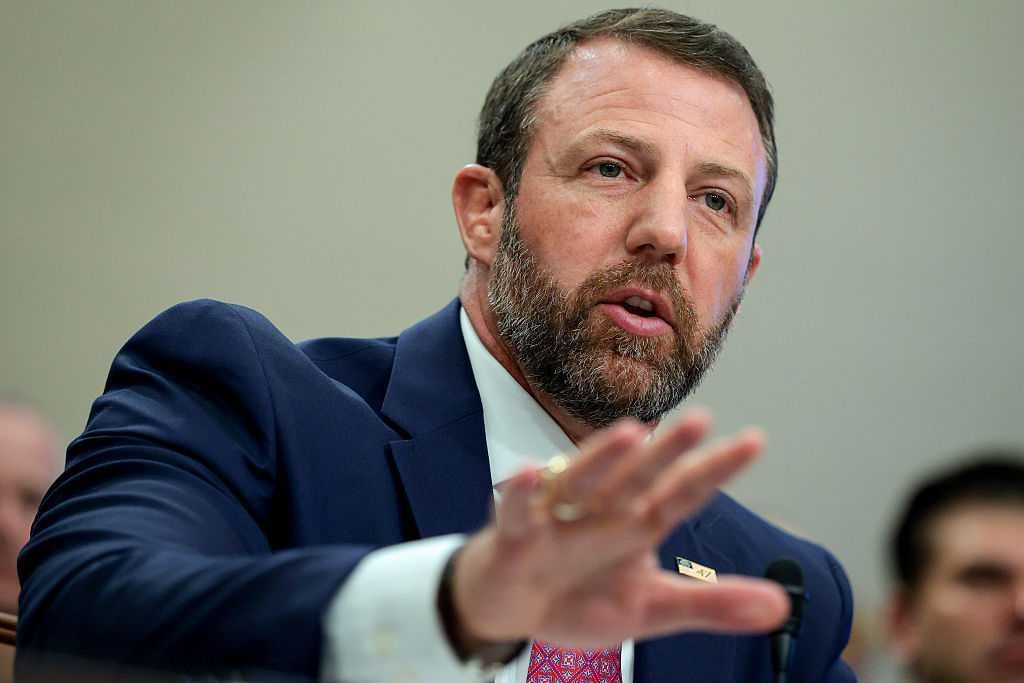
DHS Secretary Markwayne Mullin issued a message to Haitians with suspended special statuses: "We're going after them right now. We are giving them an opportunity to either leave on their own, and we'll help you, or we'll arrest you and send you back."
"Either way, you don't have status inside this country any more," continued Mullin. "That has been litigated. The courts spoke very clearly. We knew that we were going to win this because in its name itself it says, 'Temporary Protected Status.'"
Steve Foster, the immigration policy coordinator for the Institute for Justice and Democracy in Haiti, told ABC News, "Haitians with TPS, regardless of whether they have a pending asylum claim, have gotten a 'DHS Call-In Letter' to appear at ICE offices in person."
Foster said that some Haitians have reportedly been assigned future court dates and given ankle monitors.
These efforts are reportedly under way in Springfield — an Ohio city that has in recent years heard allegations of Haitians eating pets and wildlife and seen a significant spike in Haitian-caused traffic accidents.
In 2024, Springfield Mayor Rob Rue admitted that the tens of thousands of Haitians who had recently poured into his city — a city that had a population of just over 58,000 in 2020 — "taxed" the "infrastructure of the city, our safety forces, our hospitals, our schools." According to the city, there were more than 15,000 migrants presently residing in Clark County alone.
Viles Dorsainvil, the head of a Haitian support group in Springfield, confirmed the government's efforts to get the ball rolling on Haitian migrants' ouster.
"We are just helping these folks to go to this appointment, and when they get there, they interview them and eventually put [an] ankle monitor on them," said Dorsainvil.
Like Blaze News? Bypass the censors, sign up for our newsletters, and get stories like this direct to your inbox. Sign up here!
The Supreme Court has ruled in favor of Homeland Security Secretary Markwayne Mullin and the Trump administration regarding when asylum-seekers officially "arrive" in the U.S.
In a 6-3 decision split along ideological lines, the Court held that aliens seeking asylum do not “arrive in the United States” until they physically cross the border into the country and therefore are not entitled to inspection by border officials until they have entered onto U.S. soil.
'An alien "arrives in the United States" only when he crosses the border.'
The case stems from the federal government’s “metering” policy — first adopted in 2016 amid a surge of migrants at the southern border — that limited the number of aliens whom Customs and Border Patrol agents would inspect each day for asylum. When a port of entry reached capacity, officials physically prevented additional aliens from entering until capacity became available again.
In 2017, asylum-seekers and Al Otro Lado, an immigration advocacy organization, brought forward a class-action lawsuit arguing that the federal government was unlawfully denying aliens access to asylum procedures.
The federal district court in Southern California granted summary judgment in favor of the noncitizens and declared the government’s policy unlawful.
The metering policy was then discontinued in November 2021, though the second Trump administration has attempted to revive it.
A divided Ninth Circuit panel affirmed the summary judgment, ruling that an alien “arrives in the United States” when said alien — even while standing on the Mexico side of the border — encounters a U.S. official and thus must be inspected for asylum claims.
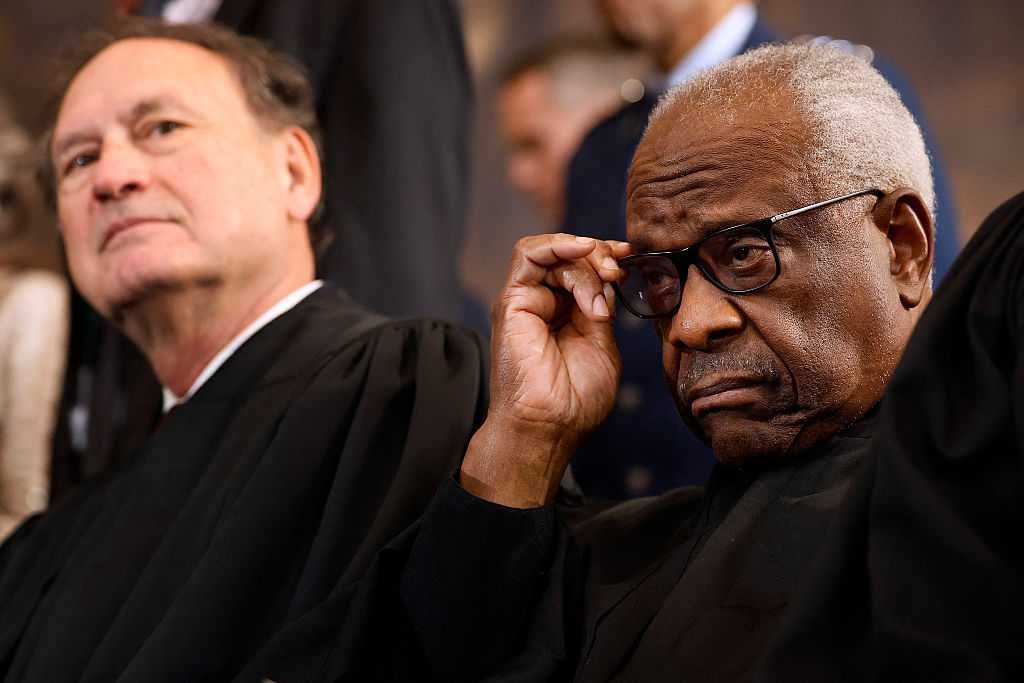
Writing for the majority, Justice Samuel Alito reversed the lower court’s ruling. The court held that the meaning of “arrives in the United States” requires physically entering the country. Therefore, under the Immigration and Nationality Act of 1952, an alien standing on the Mexico side of the border is not entitled to inspection by a U.S. official.
“We hold that an alien who is standing in Mexico does not ‘arriv[e] in the United States’ by attempting, and failing, to set foot in this country. An alien ‘arrives in the United States’ only when he crosses the border,” Alito wrote.
The court highlighted the text of other INA provisions and subsequent amendments to the statute to indicate that Congress intended asylum and inspection rights to apply only after an alien enters the country.
“That Congress amended §1158(a) in IIRIRA to replace ‘at a land border or port of entry’ with ‘arrives in the United States’ suggests that we should not read those phrases — which carry different ordinary meanings — to have the same meaning.”
Justice Sonia Sotomayor, joined by Justices Elena Kagan and Ketanji Brown Jackson, dissented, arguing that Congress intended border officials to inspect and process all aliens who present themselves at ports of entry, regardless of whether they have physically stepped into the U.S. The dissent contended that the majority’s decision “ignores the statutory context and history” of the INA and weakens the asylum protections Congress created for people fleeing persecution.
"The Court today holds that the Executive Branch may circumvent all these mandatory procedures by having U.S. immigration officers stand at the border and physically block noncitizens from setting a foot onto U.S. soil.”
Sotomayor added, "The Court's illogical interpretation is driven almost entirely by a fixation on a single word: 'in.'"
Like Blaze News? Bypass the censors, sign up for our newsletters, and get stories like this direct to your inbox. Sign up here!
The U.S. Supreme Court issued a hugely consequential 6-3 ruling in Louisiana v. Callais last week, striking down the Bayou State's controversial 2024 congressional map as an unconstitutional racial gerrymander and providing some much-needed clarity on "whether compliance with the Voting Rights Act can indeed provide a compelling reason for race-based districting."
Democrats and other liberals — including Justice Elena Kagan — condemned the ruling, construing it as a gutting of the Voting Rights Act of 1965 and a setback for racial minority representation in American politics.
Less than a week after its monumental ruling, the high court gave critics another reason to rend their garments.
'The dissent's rhetoric ... lacks restraint.'
While it customarily waits 32 days after a ruling to issue its judgment, the Supreme Court on Monday granted Louisiana Republicans' request to fast-track the process and immediately finalize its opinion in the case, thereby enabling the Bayou State to draw a new congressional map favoring the GOP in time for the 2026 midterm elections.
The court noted in its unsigned order that the usual 32-day delay ordinarily affords the "losing party time to file a petition for rehearing"; however, in this case, the defenders of the unconstitutional gerrymander "have not expressed any intent to ask this Court to reconsider its judgment."
RELATED: Obama, Mamdani, other Democrats throw ugly tantrums after SCOTUS strikes racial gerrymander
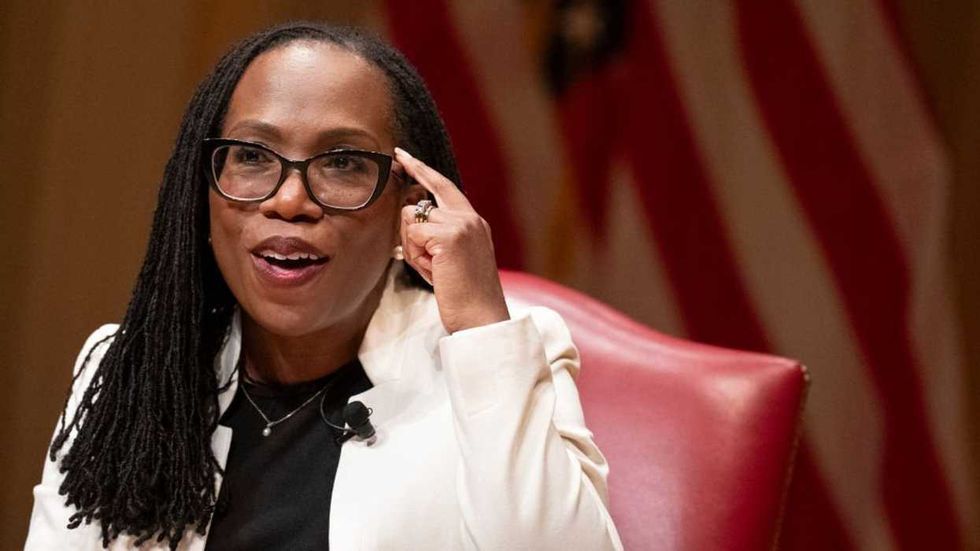
Absent that expression of intent or any opposition from Louisiana, the court allowed its ruling to go into effect immediately, prompting Justice Ketanji Brown Jackson to lash out at her colleagues in an unhinged four-page dissent.
"The Court's decision in these cases has spawned chaos in the State of Louisiana," Jackson said in her opening salvo.
After criticizing Louisiana's eagerness to ditch its unlawful congressional map in the wake of the Callais ruling, Jackson said that "to avoid the appearance of partiality here, we could, as per usual, opt to stay on the sidelines and take no position by applying our default procedures. But, today, the Court chooses the opposite."
Jackson said further that the court's expedited certification of the ruling "is tantamount to an approval of Louisiana's rush to pause the ongoing election in order to pass a new map" and represents an abandonment of constraints and principles that is "unwarranted and unwise."
Evidently it was Justice Samuel Alito's turn to dunk on Jackson over the latest in her series of trademark screeds.
Alito underscored in an opinion joined by Justices Clarence Thomas and Neil Gorsuch that the charges leveled in Jackson's dissent "cannot go unanswered."
The conservative justice pointed out that if Jackson had her way, the 2026 congressional elections in Louisiana would be "held under a map that has been held to be unconstitutional," and that the Biden-nominated justice had failed to make the case for why it is somehow now too late for Louisiana to adopt a new, constitutionally compliant map and "not feasible for the elections to be held under such a map."
In response to the two reasons Jackson did provide for dooming Louisiana to use an unconstitutional map in the midterm elections — first, that the court should observe the customary 32-day delay, and second, that the court should do so to avoid the appearance of bias — Alito wrote that "one is trivial at best, and the other is baseless and insulting."
Turning on its head the assertion by Jackson that an expedited ruling-certification process screams bias, Alito noted that the Biden-nominated justice failed to explain why "unthinking compliance" with the custom "does not create the appearance of partiality (by running out the clock) on behalf of those who may find it politically advantageous to have the election occur under the unconstitutional map."
Alito called Jackson's claim that the decision represents an unprincipled use of power "a groundless and utterly irresponsible charge."
The conservative justice concluded, "The dissent accuses the Court of 'unshackl[ing]' itself from 'constraints.' It is the dissent's rhetoric that lacks restraint."
Like Blaze News? Bypass the censors, sign up for our newsletters, and get stories like this direct to your inbox. Sign up here!Pro-life advocates were handed a minor blow by the Supreme Court after access to an abortion drug was restored by a conservative justice.
The Fifth Circuit Court of Appeals originally ordered a halt to the sale of mifepristone, but on Monday Justice Samuel Alito blocked the order and restored access.
'This is NOT a reversal of Friday's decision. Rather, it's the run-of-the-mill pause that the Justices typically use to consider the issues.'
Pro-life activists have sought the restriction of the drug based on safety concerns and claim the U.S. Food and Drug Administration rushed its approval in 2000 and then proceeded to relax restrictions on it.
Alito halted the ban through May 11 so the court can consider the issue fully. Alito's intervention restores access to the drug by mail after a telehealth appointment.
The Fifth Circuit panel had found that the drug "injures Louisiana by undermining its laws protecting unborn human life and also by causing it to spend Medicaid funds on emergency care for women harmed by mifepristone."
"Mifepristone sends 1 in 10 women who use it to the emergency room with life threatening conditions. Now it’s time for Congress to ban it completely for use in abortion," Sen. Josh Hawley (R-Mo.) said in a post on social media on Monday.
Critics say the 1 in 10 figure comes from a conservative think tank and misrepresents the full data available on mifepristone.
"To be clear: This is NOT a reversal of Friday's decision. Rather, it's the run-of-the-mill pause that the Justices typically use to consider the issues raised in an emergency application," reads a statement from the Alliance Defending Freedom, a religious freedom legal nonprofit.
"We respect the Court's desire to have time to consider the issues and will continue our fight to uphold this victory that protects women and babies across the country from FDA's unlawful and destructive mail-order abortion-drug scheme," the nonprofit added.
RELATED: Pro-life activists celebrate victory after Costco announces policy on abortion drug
The Supreme Court ruled unanimously in 2024 against a lawsuit intending to block mifepristone access on the basis that the plaintiffs lacked standing to sue the FDA.
Alito had also previously dissented against the majority ruling in 2023 to allow access to mifepristone while the case continued.
Like Blaze News? Bypass the censors, sign up for our newsletters, and get stories like this direct to your inbox. Sign up here!

 The John Roberts-written ruling on birthplace citizenship marks a chief justice who has sacrificed judicial courage at the altar of comity.
 Far from being the bold MAGA court that Trump supporters campaigned so hard to attain, this court has retreated to near irrelevancy.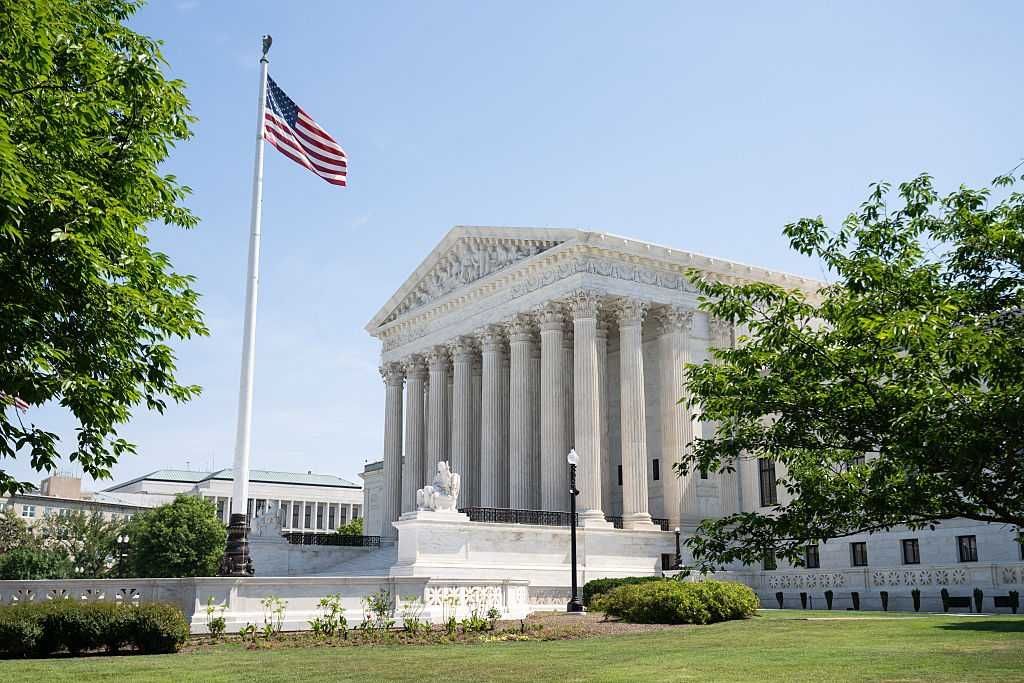
 Speaker Jon Burns looked pretty shameless in announcing Republicans won't take up redistricting in special session.
 'This is not the time for half measures,' said Marshall Yates, director of the REPAIR Initiative gearing up to challenge race-based districts.
 After The Federalist's Mollie Hemingway's new book exposed the dangerous delay of Dobbs, the liberal justices appear to have stalled again.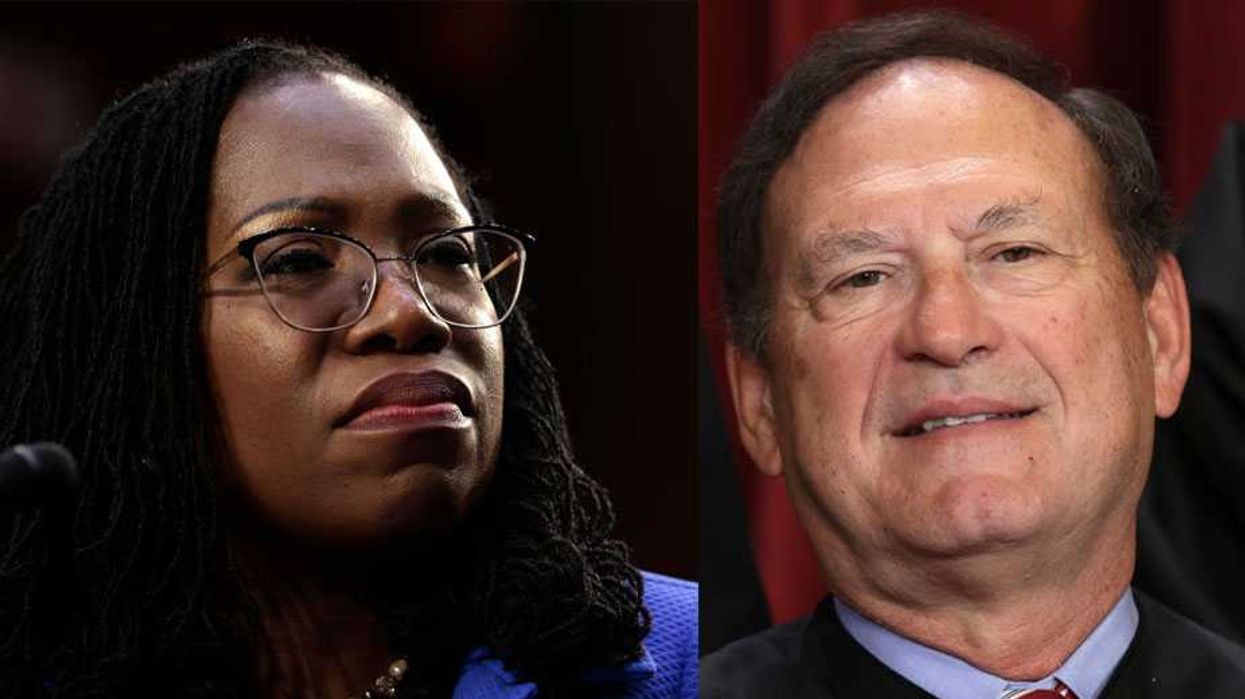

 www.theblaze.com
 www.theblaze.com
 thefederalist.com