Watchdog: From Fake Students To Disney Cruises, K-12 Fraudsters Stole $225 Million From Taxpayers Over 7 Years
 'When school administrators with access to funds go unchecked, embezzling and misusing public money, it’s a loss for the students.'
With the signing of the Declaration of Independence 250 years ago, America’s founders accomplished something new under the sun: They brought into existence a nation rooted in the belief that individuals are by nature free and equal.
This year marks another achievement for the Declaration: Never before has a nation dedicated to securing its citizens’ unalienable rights — the rights inherent in all human beings — persevered for 250 years. Notwithstanding the social and political turmoil currently roiling the nation, America has done much more than persevere.
The American journey from 1776 to 2026 has been marked by the struggle to honor more fully the Declaration’s promise of equality in fundamental rights.
No multireligious, multiracial, and multiethnic nation-state in history has more successfully established freedom and equality under law, promoted economic prosperity, and developed the capabilities to defend itself by projecting military power around the world.
America’s perseverance and flourishing — as presidents including Abraham Lincoln, Calvin Coolidge, and Franklin Delano Roosevelt have affirmed and as venerable reformers such as Elizabeth Cady Stanton, Frederick Douglass, and Martin Luther King Jr. have demonstrated — owe much to the nation’s founding on universal principles and to its enduring dedication to them.
The self-evident truths proclaimed by the Declaration of Independence start with the conviction that human beings are by nature free and equally endowed with unalienable rights. They include the belief that government’s first purpose is to secure citizens’ unalienable rights, that just power stems from the consent of the governed, and that citizens by right may replace a government that destroys the conditions for securing their unalienable rights.
These universal principles inform the 27 grievances — abuses of executive power, lawless legislation, and acts of war — that the Declaration spells out against King George III and the British Parliament. Some argue that the Declaration’s primary significance lies in these grievances and downplay the historic document’s opening paragraphs about universal principles as Enlightenment commonplaces. But it was revolutionary for a people to claim the authority of unalienable rights to throw off one form of government and institute another.
Indeed, according to the Declaration’s logic, American colonists’ specific grievances justified their break with Britain and the establishment of free and independent states because taken together the grievances violated rights that the colonists shared equally with all persons.
In recent years, critics on both left and right have subjected the truths that the Declaration holds to be self-evident to harsh criticism. Eminent figures associated with the postmodern-progressive left accuse these principles of obscuring if not empowering the evil institution of slavery. Prominent members of the postliberal right charge that the Declaration’s self-evident truths are neither true nor beneficial but rather constitute the chief source of the multifarious maladies afflicting the nation.
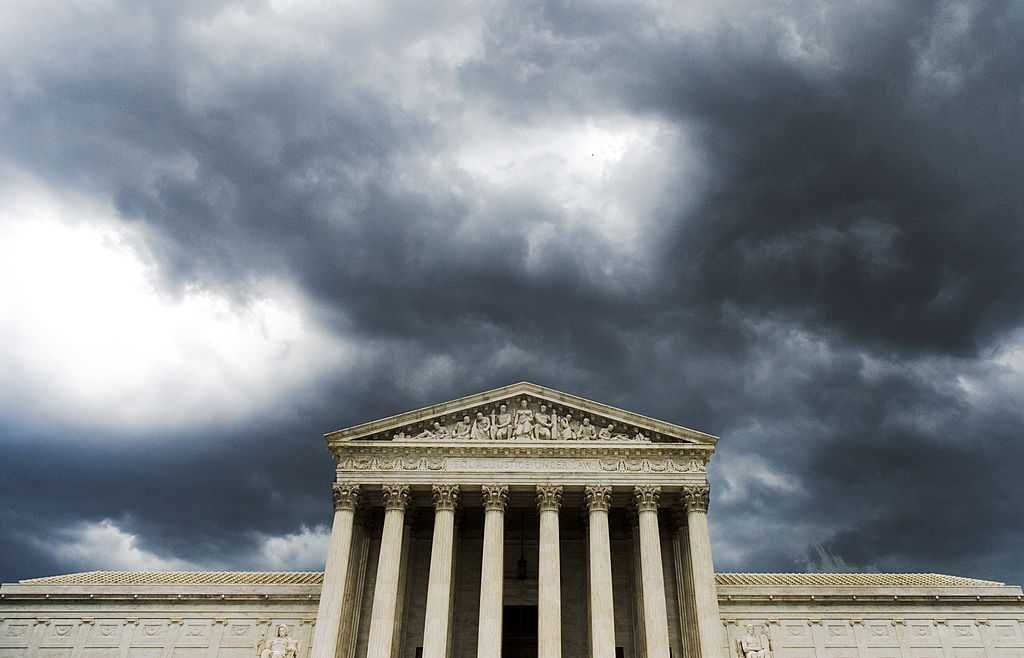
RELATED: 1776, not 1608: What the Supreme Court got wrong on birthright citizenship
Whereas postmodern progressives blame those principles for the perpetuation of systemic racism, postliberals condemn them for the systemic degradation of men and women of all religions, races, and ethnicities.
Both find in the Declaration’s affirmation of universal rights a baleful pretext for colonizing foreign countries and imposing America’s ways and rules on other peoples and nations. And both indulge extravagant speculations about establishing new forms of government in the United States untainted by the basic rights and fundamental freedoms promised by the Declaration.
The American journey from 1776 to 2026 has been marked by the struggle to honor more fully the Declaration’s promise of equality in fundamental rights. America has benefited from a common language; abundant natural resources; vast, protective oceans to the east and west; peaceful and stable borders to the north and south for much of its history; and a moral and political heritage entwining biblical faith, classical thought, and the modern tradition of freedom.
At the same time, America has been compelled to grapple with the legal institutionalization of slavery and, after the Union’s victory in the Civil War and the subsequent ratification of the 13th, 14th, and 15th Amendments, slavery’s poisonous legacy; to wage war abroad repeatedly; and to reckon with the constant churn and turbulence generated by free peoples and free markets.
American citizens’ appreciation of this complex, rocky, and inspiring journey is waning. The nation’s educational system bears heavy responsibility for the diminished understanding of the American experiment in ordered liberty and for the popularity of extreme criticism emerging from both sides of the political spectrum. All levels of the American educational system have been derelict in their duties. But higher education is especially to blame because it also trains K-12 teachers.
American colleges and universities advance the public interest in a variety of ways. They furnish pre-professional and professional education. They provide a credentialing service for employers. They train scholars. They conduct vital scientific research. And, not least, they offer liberal education.
Liberal education is the least successful part of higher education. In recent years, reformers have justly focused on colleges’ and universities’ impairment of free speech and imposition of ideological monocultures. The corruption of the curriculum also deserves scrutiny.
In most cases, colleges and universities believe themselves to comply with the imperatives of liberal education by requiring students to fulfill distribution requirements. Rarely do the nation’s leading institutions of higher education mandate courses that all students must complete or identify substantive bodies of knowledge that all students must master.
The application of a method designed to account for matter in motion has been decidedly less successful in illuminating the moral and political world.
Instead, students meet their obligations by taking a few courses in the humanities, the social sciences, and the sciences, often picking and choosing among dozens of offerings if not more in each of the three main divisions. Two students can fulfill their distribution requirements without reading a single book in common. This, from our colleges’ and universities’ point of view, is not a problem but rather a source of pride.
They believe that they demonstrate concern for students’ individuality by allowing them to choose their own courses and design their own curricula. At the same time, by exposing students to a variety of disciplines and approaches to knowledge, institutions of higher education claim to produce open-minded and well-rounded graduates expertly trained to lead in changing the world.
The traditional aim of liberal education is to cultivate students capable of thoughtfully exercising the rights and discharging the responsibilities of freedom. However, far from exemplifying liberal education at its finest, colleges and universities typically betray it by failing to structure the curriculum coherently, to give it suitable content, and to ensure that students master contending arguments.
Few students these days receive an organized, historically informed introduction to American ideas and institutions: the nation’s religious and political inheritance, founding principles, constitutional traditions, cultural crosscurrents, economic arrangements, and diplomatic and national-security requirements. Few students examine the great books and seminal events of the larger Western tradition out of which the United States emerged and to which it has made a decisive contribution.
Few students undertake the serious study of other peoples and nations, which is essential to a proper assessment of America’s achievements and failings. And few students have impressed upon them the importance in studying morality and politics of appreciating the strong points of the arguments with which they disagree.
America’s colleges and universities have debased liberal education under the compulsion of three ideals. One is political. A second is methodological. A third is professional. When suitably refined, each is worthy. However, contemporary academic life has radicalized all three to the great detriment of liberal education.
First, contrary to liberal education’s imperatives, many faculty members believe that their job is to instill correct views about the pursuit of social justice and enlist students in the cause of progressive political transformation.
Liberal education in America should not be neutral toward fundamental political principles: It assumes the goodness of individual freedom and human equality. But to prepare students for freedom and democratic self-government, liberal education must both refrain from treating partisan political views as academic orthodoxies and foster appreciation of contending opinions and competing ideas.
Yet many of today’s classroom crusaders recognize no pedagogical duty to present fairly the other side of the argument. Some believe themselves obliged to ignore, dismiss, or deride views — often despite little conscientious exploration of them and regardless of their historical significance and relevance to contemporary politics — that they deem distasteful, demeaning, or destructive.
They are unaware of or unmoved by John Stuart Mill’s indispensable observation in “On Liberty” that a person “who knows only his own side of the case, knows little of that.”
RELATED: America’s classrooms are feeding the red wave — socialist red
Second, contrary to liberal education’s imperatives, many faculty members in the social sciences believe that the scientific method represents the one true approach to understanding. While the application of the scientific method to the natural world since the 17th century has produced astounding increases in knowledge and know-how, the application of a method designed to account for matter in motion has been decidedly less successful in illuminating the moral and political world inhabited by self-interpreting human beings.
The conduct of moral and political animals, whose beliefs are shaped by custom, experience, reason, interests, and passions and whose actions are informed by fallible judgments about right and wrong, cannot be fully captured by methods designed to describe matter in motion.
Nevertheless, setbacks in illuminating morality and politics have only driven many social scientists to double down on the study of method. Mesmerized by techniques for counting, measuring, and weighing and transfixed by elegant theories for describing rational conduct, they churn out mounds of research that shroud the substance and texture of human affairs.
Political scientists’ bewitchment by method produces disciplines that have less and less to say to citizens about self-government and justice as they elaborate more and more mathematically sophisticated approaches to the study of moral and political life.
And third, contrary to the imperatives of liberal education, many professors operate on the assumption that the purpose of educating undergraduates is to train the next generation of scholars.
Instead of transmitting to students the knowledge about America, the West, and the world needed for good citizenship, professors commonly provide intellectual tools and socialization into the sensibility required to succeed in the professoriate, though the vast majority of students have no intention of pursuing the scholarly life.
Curricula that honored the imperatives of liberal education would put the Declaration of Independence at the core. They would expose students to serious study of the constitutional system that institutionalized the Declaration’s fundamental principles and of the nation-defining political struggles to realize them. They would explore the seminal ideas and major events of Western civilization of which the American experiment in ordered liberty forms a crucial chapter. And they would examine the culture, economic system, language, politics, and religious beliefs of other civilizations, without which a well-rounded assessment of the United States is impossible.
Not least among the costs of colleges’ and universities’ betrayal of liberal education is that it produces graduates ignorant of the Declaration of Independence’s enduring principles and inspiring legacy and oblivious to the costs of that ignorance to themselves and the nation.
Editor’s note: This article was originally published by RealClearPolitics and made available via RealClearWire.
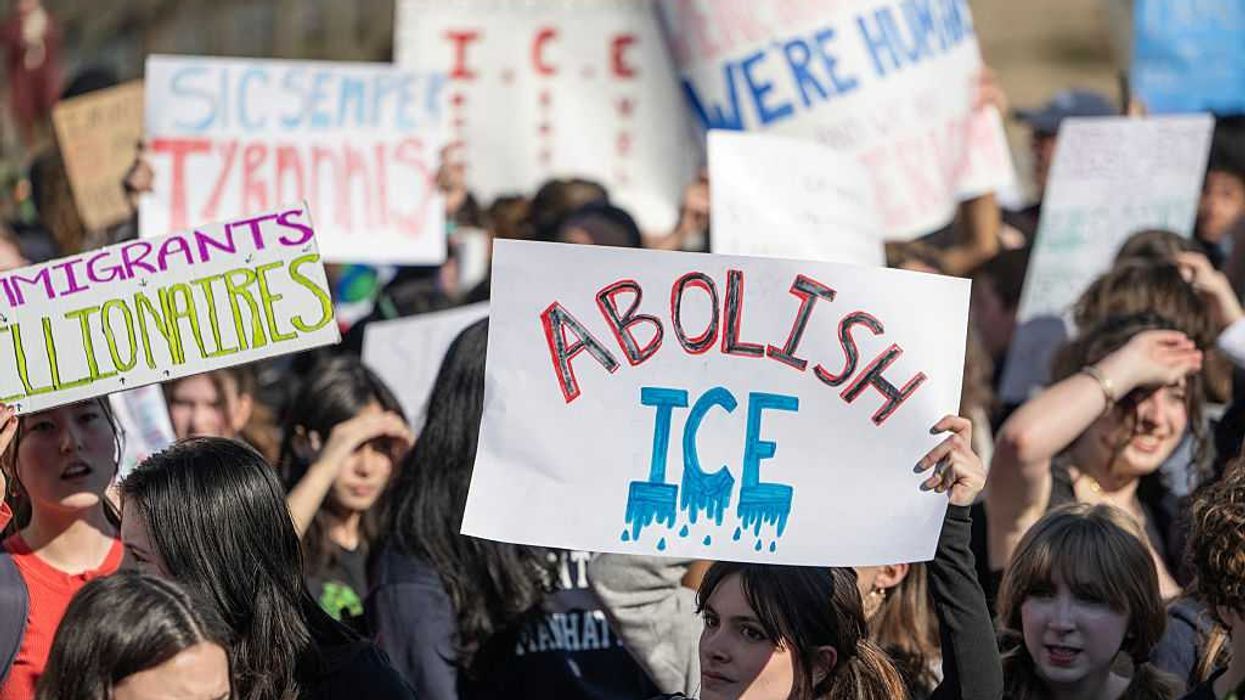
For weeks, students at hundreds of schools across the country have walked out of class to protest Immigration and Customs Enforcement actions. At Rincon High School in Arizona, leaders of the Latino Student Union organized a walkout to oppose the Trump administration’s immigration policies.
The next week, some of those same students demanded the removal of a Turning Point USA club from the Tucson Unified campus. Members of the Latino Student Union petitioned the school board to bar the conservative club from meeting on school property, claiming its presence made them feel “unsafe” and accusing it of a “track history of presenting hate and presenting fear.”
As American life grows more polarized, young people face mounting pressure to treat opposing speech not as something to answer, but as something to silence.
Arizona was not a one-off.
Last fall, students at Royal Oak High School in Michigan walked out over the formation of a Turning Point chapter. One protest organizer complained that the club “spreads conservative views ... and those aren’t things that we promote in our school.”
That statement tells you plenty. Students increasingly invoke the language of safety and inclusion not to protect their own right to speak, but to suppress the speech of others.
Royal Oak Schools says the district aims to provide “an inclusive, diverse, safe, and student-first environment” in which students will be “embraced, accepted, challenged, and prepared.” Yet schools cannot claim to challenge and prepare students while teaching them that disagreement itself amounts to harm.
These incidents may still be relatively few, but they point to a broader problem: the spread of speech intolerance from college campuses into K-12 education.
A report released in September by the Foundation for Individual Rights and Expression found alarming attitudes on college campuses. Among roughly 70,000 students surveyed, 34% said violence to stop someone from speaking can be acceptable, while 72% supported shouting down speakers in rare cases.
College pathologies do not stay on college campuses for long.
Through social media, ethnic-studies curricula, school speech codes, and the influence older students exert on younger ones, the campus habit of treating dissent as danger has moved into elementary and secondary education.
The results have already turned ugly.
RELATED: How liberals let America’s colleges collapse into illiberalism
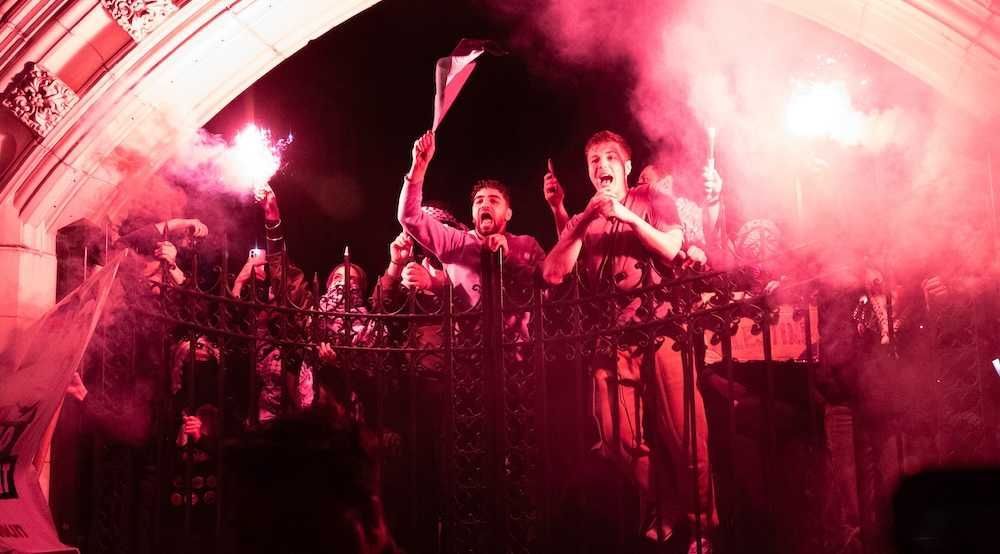
After a walkout at Hayes High School in Ohio in February, one senior said the protest “went as peaceful as it could have gone with the amount of anger that we have.” In reality, an altercation between several protesters and one dissenter ended with three students charged with disorderly conduct. The confrontation appears to have begun when walkout participants repeatedly blew whistles in the student’s face.
In Kansas, student counterprotesters from Olathe Northwest High School were attacked while demonstrating across the street from an anti-ICE protest. Their offense? They merely supported the administration and current immigration enforcement.
Thankfully, these incidents remain uncommon. But the trend should concern parents, teachers, and communities. As American life grows more polarized, young people face mounting pressure to treat opposing speech not as something to answer, but as something to silence.
Whatever one thinks of school walkouts, defenders of these protests usually justify them as exercises in civic engagement and First Amendment expression. Fine. But civic engagement does not mean demanding a microphone for yourself and a muzzle for everyone else.
Students need to learn that free speech cuts both ways. They have every right to voice their convictions. They also have a responsibility to defend the rights of people whose views they dislike, distrust, or even find offensive.
If they do not learn that lesson now, student activism will become less about persuasion than coercion. And young Americans will be trained not to practice liberty, but to imitate the tyranny they claim to oppose.
Defending Education has launched a protest tracker of K-12 student walkouts, Blaze News has learned. The national grassroots organization released the tracker amid a surge of student protests against immigration enforcement efforts.
Defending Education estimated that the number of school protests has significantly increased since 2022. The organization gathered this information from social media posts, news articles, and press releases.
'By allowing these protests, school leaders are increasing the chance of harm befalling students and decreasing much-needed instructional time in the classroom.'
The K-12 Student Walkout and Protest Tracker estimated 21 demonstrations in 2022, 10 in 2023, 13 in 2024, and 43 in 2025. So far, in 2026, Defending Education calculated that there have been 269 protests at U.S. schools.
Walkouts were recorded in 48 states and the District of Columbia and involved approximately 421 schools, including 33 middle schools.
“The total listed is on the low end of the overall number of schools that had student walkouts/protests due to many news articles not listing names of specific schools that participated,” Defending Education noted.
A number of the total protests, 74, were organized or assisted by activist clubs or nonprofits.
RELATED: Defending Education gives parents tools to fight leftist indoctrination
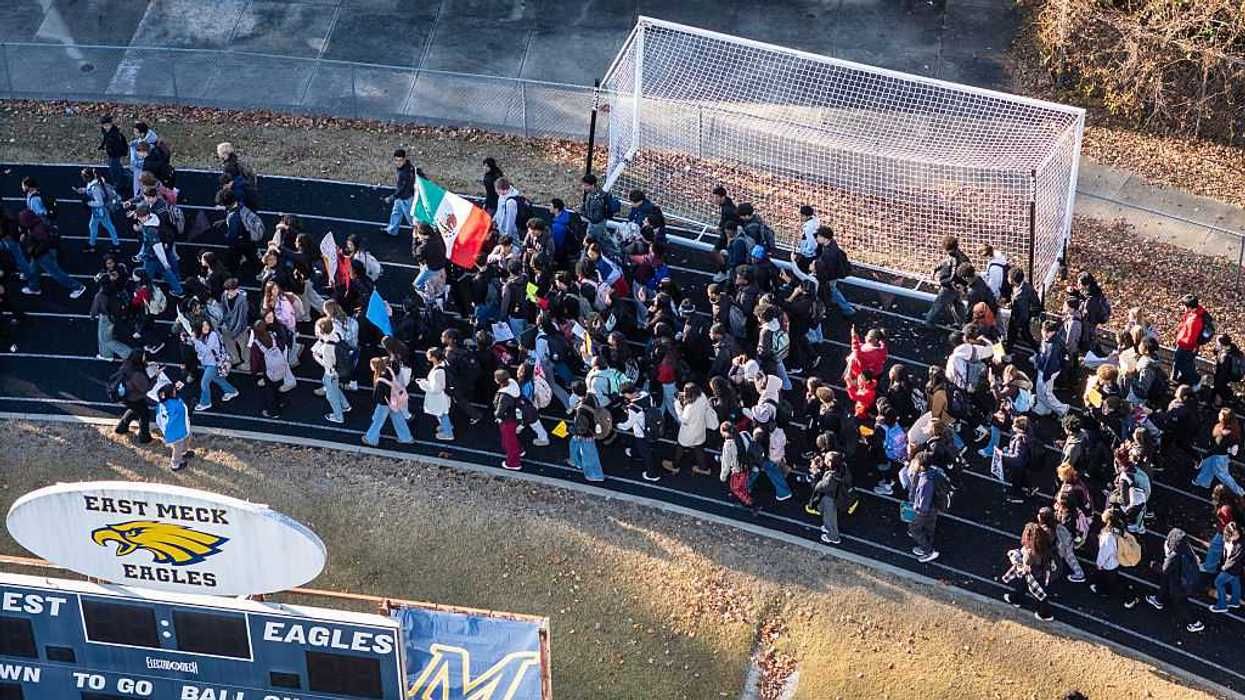
Defending Education’s tracker provided a list of those protests by state and district, noting in each instance the cause behind the walkouts.
The reasons for the demonstrations included disapproval of Immigration and Customs Enforcement actions and President Donald Trump, as well as support for the LGBT community and Palestine. Students organized marches to raise awareness about climate change, for school funding, and to call for stricter gun laws.
Defending Education noted that its current list is not comprehensive and will be updated as the organization receives additional information.
“This data shows a multiyear trend of student walkouts for the latest far-left political cause. By allowing these protests, school leaders are increasing the chance of harm befalling students and decreasing much-needed instructional time in the classroom. Administrators need to put an end to these acts of ‘civil disobedience’ before they lose complete control,” Rhyen Staley, the research director at Defending Education, stated.
Like Blaze News? Bypass the censors, sign up for our newsletters, and get stories like this direct to your inbox. Sign up here!
For decades, U.S. education has been dominated by the American left. Its stranglehold was highly visible during the Biden administration, with countless stories about wildly inappropriate books in school libraries, critical race theory being taught in classrooms, and national associations calling for parents to be designated domestic terrorists.
How did our public school systems — including those in red states, from Iowa to Alaska — become infected with radical leftist ideology? The answer is education consulting groups.
As long as Republicans continue to outsource their governance and expertise to thinly veiled activist groups, nothing will change.
Most Americans don’t realize that every aspect of governance, from parks and wildlife departments to the curriculum in kids’ schools, has been outsourced to a coalition of nameless, faceless NGO consulting groups that are funded by millions of taxpayer dollars funneled through the government. One of the worst offenders is the American Institutes for Research.
AIR is currently under contract with at least 25 states, with the majority involving contracts to develop state standards. For those unfamiliar with education policy, standards determine what students need to learn and when they need to learn it. Lesson plans, curriculum, and textbooks are required by law to be aligned with standards.
AIR’s tentacles stretch from D.C. into health care and counseling policy — and education. It has long been entrenched in most red-state education departments to “facilitate” standards revisions. Take its influence in Alaska as a recent example.
Alaska has had multiple contracts with the nonprofit, including the School Climate and Connectedness Survey, which focuses on social-emotional learning and adult education content standards. AIR is also cited as a teaching resource for curriculum implementation.
On the Alaska Department of Education’s social studies website, AIR is listed as a source multiple times, including in the HQIM Rubric and in a PowerPoint presentation that was given to the state board, which was co-presented with an AIR employee. The presenters insisted that standards must have an equity focus and touted a shift from learning about social studies to student activism, or “action civics.”
These standards were implemented in Alaska’s new social studies curriculum, and the results are predictably a mess. Developed by a panel selected by race rather than merit, the standards are chock-full of land acknowledgments and other progressive claptrap. Alaska is now training its kids to be activists rather than teaching them about the American founding.
Worse yet, Alaska is also a partner with AIR for its Indigenous Student Identification Project, headed by Nara Nayar. On her LinkedIn account, she proudly lists her work “on comprehensive sexuality education for elementary and middle school students.”
This is where Alaskan taxpayer dollars are going: equity education, activism training, and filling the pockets of far-left education consultants who teach sex ed to elementary students.
Turning to the Midwest, Iowa’s social studies overhaul is in consultation with Stefanie Wager, a former AIR employee who is a glorified activist. She lists “racial justice, equity, and inclusion” as top priorities. Wager has an extensive list of extremist views that influence her work as an education consultant.
Wager was once president of the National Association for the Social Studies, a left-wing outfit that has shaped red-state history instruction. She has also worked as the education partner manager for Bill Gates’ personal office. Wager began as an AIR employee embedded within the Iowa Department of Education. When news broke about her involvement, she left AIR and joined the Iowa Department of Education full-time.
These aren’t just one-off examples — they are emblematic of the reach and influence of shadow consultant organizations that control public education. Peruse nearly any state department of education, and you will find rubrics with equity focuses, social studies curriculum full of progressive ideology, and AIR-linked content on state websites. Nebraska, for example, contracted AIR for a social studies report that is spotlighted on AIR’s website.
RELATED: Trump admin takes major step toward dismantling the Department of Education
The worst part is that state taxpayers are unknowingly funding all of this. South Dakota signed a nearly quarter-million-dollar contract with AIR to facilitate work-group meetings to revise the state’s social studies standards, which produced standards laced with wokeness. The blowback was so swift that then-Gov. Kristi Noem (R) had to intervene and force South Dakota’s Education Department to restart its standards revision work from scratch.
The result was some of the best standards in the country.
Alaska has likely paid millions for its various studies and surveys, but the cost of only one project, at $350,000, is publicly available. Iowa awarded AIR a $31 million contract for testing assessments. This is a patronage scheme using taxpayer dollars to fund pet leftist programs. To make matters worse, most red states keep all of this hidden. In Alaska, you have to pay the state for a contract to be disclosed.
As long as Republicans continue to outsource their governance and expertise to thinly veiled activist groups, nothing will change. Schools will continue to be breeding grounds for left-wing extremism, school libraries will be filled with radical propaganda — and taxpayers will keep funding all of it.
Red-state legislatures and governors need to look to trusted alternative providers that reflect their states’ values. They should create and fund parallel structures that put outcomes above partisan dogma and properly vet each person to whom they give their constituents’ money. This is the only way to begin countering the efforts of the shadow government in our states.
Editor’s note: A version of this article appeared originally at the American Mind.
Jim Simons’ mathematical skills helped transform him from a prize-winning academic at Harvard and MIT into a legendary financier whose algorithmic models made Renaissance Technologies one of the most successful hedge funds in history. After his death last year, one of his consequential bequests went to his daughter, Liz, who oversees the Heising-Simons Foundation and its nearly billion-dollar endowment.
What Liz Simons has chosen to do with that inheritance might have surprised her father. Jim Simons devoted much of his charitable giving to basic research in mathematics and science, but his daughter’s foundation is moving in a very different direction. The Heising-Simons Foundation and similar organizations are supercharging a movement to remake K-12 mathematics education according to social justice principles.
Students are placed at a disadvantage when mathematical instruction is embedded in critical theory.
The revamp is profound. They reject well-established practices of math instruction while infusing lessons with racial and gender themes. The goal is to motivate disadvantaged students while dispensing with the traditional features of math — like numerical computation, which they struggle with on standardized tests — considered an oppressive feature of white supremacist culture.
In many quarters, including corporations and universities, diversity, equity, and inclusion programs are in retreat due to pressure from the Trump administration and the courts. Not so in public education, with curricula that are locally controlled and largely insulated from the dictates of Washington.
That allows progressive foundations and like-minded charitable trusts to continue to pour millions of dollars into reshaping math education for black and Latino kids — including an $800,000 grant this year from the Heising-Simons Foundation — even though no credible research exists showing that the social justice approach improves their performance.
“Politicians and legislatures, even school boards,” are often too “hamstrung” to get things done, Bob Hughes, the director of K-12 education at the Gates Foundation, said at an online symposium on the need for racial equity policies in America's classrooms. Philanthropy, he added, faces fewer barriers in making rapid changes.
The Gates Foundation has been a leader in the promotion of anti-racist math instruction. It supported a project called “A Pathway to Equitable Math Instruction.” The project discards basic tenets of learning, like asking students to “show their work” and find the “right” answer as vestiges of “white supremacy culture.” The pathway is promoted by EdTrust West, which also receives support from the Spencer Foundation, the Heising-Simons Foundation, and other major donors.
The Gates and Heising-Simons foundations have both supported TODOS Mathematics for All, an Arizona-based organization that calls for elevating diversity, equity, and inclusion practices and anti-racist activism into all math instruction, with over $553,750 in grants in recent years. “We can no longer believe that a focus on curriculum, instruction, and assessment alone will be enough to prepare our children for survival in the world. We need anti-racist conversations for ourselves and for our children,” TODOS President Linda Fulmore announced in 2020.
Last year, the group hosted an hour-long webinar on “2SLGBTQIA+ identity in mathematics education.” During the event, a speaker expounded at length on various queer and indigenous identity groups while spending virtually no time on math-related curriculum or instruction.
At one point, the presenter erroneously claimed that there are “15.3 billion students in U.S. high schools” — a figure that would require the entire global population to be enrolled in American secondary education twice over. The speaker likely meant to say million.
The foundations similarly fund practical lessons that put race at the center of math instruction. In Alexandria, Virginia, for example, the Heising-Simons Foundation supported a public-school program that encouraged kindergartners through second-graders to count the characters in picture books by race. At the end of each session, teachers guided students in creating racial scorecards for each book, then voting to select those with the fewest white characters. The exercise was presented as mathematics education.
Jo Boaler, a controversial professor of education at Stanford University who championed the push to remove eighth-grade algebra from San Francisco’s public schools in the name of equity, traces her support to this network of foundations. The Gates Foundation and Valhalla Foundation, which was founded by Scott Cook, the co-founder of tech firm Intuit, have long funded her math education project called YouCubed.
These deep-pocket donors also fund Danny Bernard Martin, a professor of math education at the University of Illinois at Chicago and a leading voice of what critics call “woke math.”
Over the past six years, the Racial Justice in Early Mathematics Project, which Martin co-leads at the Erikson Institute in Chicago, has received nearly $2.5 million from the Heising-Simons Foundation. This year, the foundation announced an additional $800,000 grant to help the project develop tool kits for wider implementation among teachers, administrators, and researchers.
Martin’s views extend far beyond typical calls for educational equity. He regards mathematics instruction as fundamentally a “white supremacist construct” that inflicts “epistemological violence” on black students. In his estimation, even DEI programs are too conservative — mere accommodations “rooted in the fictions of white imaginaries” and designed to appease “white logics and sensibilities.”
The solution Martin proposes is radical: Black students should seek instruction exclusively from black teachers at “independent black institutions.” They should resist the temptation of “advanced coursework and mathematics-related employment” and instead engage in “walkouts and boycotts” to protest against mathematics education as it currently exists.

The very structure of math instruction, Martin contends, has dehumanized black students through low test scores and failing grades.
The ideas of the Racial Justice in Early Mathematics Project and its leaders have reverberated through America’s classrooms. California’s new mathematics curriculum framework, which guides K-12 education statewide, repeatedly cites Martin.
Educators have sharply criticized the framework for leaning heavily on politicized concepts of math. The document suggests, for instance, that teachers “take a justice-oriented perspective” when providing instruction and discourages the use of “tracking” — or the practice of separating students into different classrooms based on their abilities.
Williamson Evers, a former assistant secretary of education and a fellow at the conservative-leaning Independent Institute, has been monitoring what he calls the “woke math” movement for years. “It’s very important to have math skills,” he told RealClearInvestigations.
Evers rejects the identity-based claims made by Martin and others who have called for minority students to abandon math education over alleged racism. “There are mathematicians and scientists on every continent from every background, and this idea of boycotting education would harm black schoolchildren.”
Elizabeth Statmore, a math teacher at the elite Lowell High School in San Francisco and a critic of social justice math, says the way to improve the performance of black and Latino students lies in the nitty-gritty, such as better teaching, holding students accountable, and providing them with more academic and emotional support.
Critics say the emphasis on prose over calculation will exacerbate the very disparities that social justice advocates claim to address.
“But it’s not sexy; they’re not on the keynote circuit like Danny Bernard Martin and Jo Boaler,” Statmore said. “They’re building a brand, not doing the kind of math education research that is helping to improve outcomes for disadvantaged children.”
Representatives of the Heising-Simons Foundation, the Erikson Institute, and Martin did not respond to requests for comment.
The Heising-Simons Foundation’s focus on racializing math education reflects its broader ideological commitments. Like many progressive foundations, it uses its significant funds to advance a range of left-wing policies that might have a hard time establishing themselves without billionaire support.
The foundation has also donated to PolicyLink, the organization behind DefundPolice.org, and to the Anti-Police Terror Project, which advocates for abolishing police departments in high-crime cities like Oakland, California. Liz Simons was also among a small clique of California megadonors behind the push to elect progressive prosecutors such as George Gascón in Los Angeles and Chesa Boudin in San Francisco. They declined to pursue felony charges against a range of violent offenders over concerns about racial equity.
The attempt to reimagine mathematics through the lens of critical race theory isn’t new — scholars have been working along these lines since the 1980s. They argue that historical racial oppression continues to influence everything from geometry curricula to standardized testing. Traditional emphases on objectivity, rigorous standards, and subject-matter mastery should be replaced, the scholars argue, with ideological exercises designed to promote racial and social consciousness.
What is new is the scale and speed of adoption. As America has grappled with questions of racial justice in recent years, billionaire foundations have provided the resources to implement these ideas widely in both public and private schools.
The donors appear motivated by a deep sense of ideological commitment to righting past wrongs related to racial injustice.
At the 2020 education donor symposium, Liz Simons recalled her experience working briefly as a Spanish bilingual teacher in an impoverished community in Oakland. “The much larger systemic problems,” she witnessed, Simons said, guided her to the goal of shaping early childhood education.
Na’ilah Suad Nasir, president of the Spencer Foundation, noted that she previously worked as the vice chancellor of “equity and inclusion” at the University of California, Berkeley. Expanding racial equity in education, she said, has been her “life’s work.”
When it comes to math instruction, social justice means stripping it of basic features like numbers. In workshops hosted by the Racial Justice in Early Mathematics Project in 2023, the group promoted “numberless word problems” — mathematical exercises stripped of numerical computation. The method, instructors explain, is designed to counter “European ways of knowing and doing.”
Sisa Pon Renie, one presenter, spoke of wanting to challenge the “persistent myth that math is just abstract and without any cultural relevance.” The project champions this numberless approach as essential for “helping children understand how mathematics might be an important tool to understand social issues and promote justice.”
But critics say the emphasis on prose over calculation will exacerbate the very disparities that social justice advocates claim to address.
“Imagine you’re a Cambodian refugee, and you get some math problem that’s loaded with prose,” Evers, of the Independent Institute, said. “Maybe you’re very good at the figures part, the calculating part, the mathematical part.”
Such students, he argued, are placed at a disadvantage when mathematical instruction is embedded in critical-theory frameworks and dense with English text. “They unnecessarily load these things down, make it harder, and it’s not even math. It’s an inadequate mode of teaching.”
The real-world consequences of these approaches have played out most dramatically in San Francisco. A decade ago, officials removed Algebra 1 from middle schools, arguing that the change would give black and Latino students, who were underrepresented in the math class, more time to prepare while avoiding placing them in lower-level tracks.
David Margulies, a parent involved with the San Francisco community, observed that families wanting their children to take Algebra 1 in eighth grade shifted away from public to private schools, online learning, and homeschooling. Students who don’t take the math class in middle school find it more difficult to take calculus in high school.
RELATED: Major university caught in new DEI cover-up
“Families figured out how important this is, and they are looking elsewhere,” he noted.
A 2023 Stanford study found that San Francisco’s Algebra 1 experiment did little to close racial achievement gaps. Black enrollment in Advanced Placement math classes remained unchanged, while Latino participation increased by 1%.
Meanwhile, education systems that have increased rather than decreased academic rigor have seen notable improvements in black student performance. In 2019, Dallas public schools began automatically enrolling students who performed well on state exams in middle-school algebra. The program increased black participation in advanced mathematics from 17% in 2018 to 43% in 2023.
Last year, during a Racial Justice in Early Mathematics Project webinar titled “Who Is Labeled Smart?” Martin addressed the backlash against San Francisco’s push for educational equity. He toned down his scathing critique of merit-based advanced education programs that he believes harm black and Latino students and made a surprising statement about his own son’s schooling.
“I’m guilty, I’m guilty,” Martin said, almost sheepishly. “My son is, quote unquote, in one of those tracks.”
Editor’s note: This article was originally published by RealClearInvestigations and made available via RealClearWire.

 This is just the most recent example of states adding religion back into public school curriculum.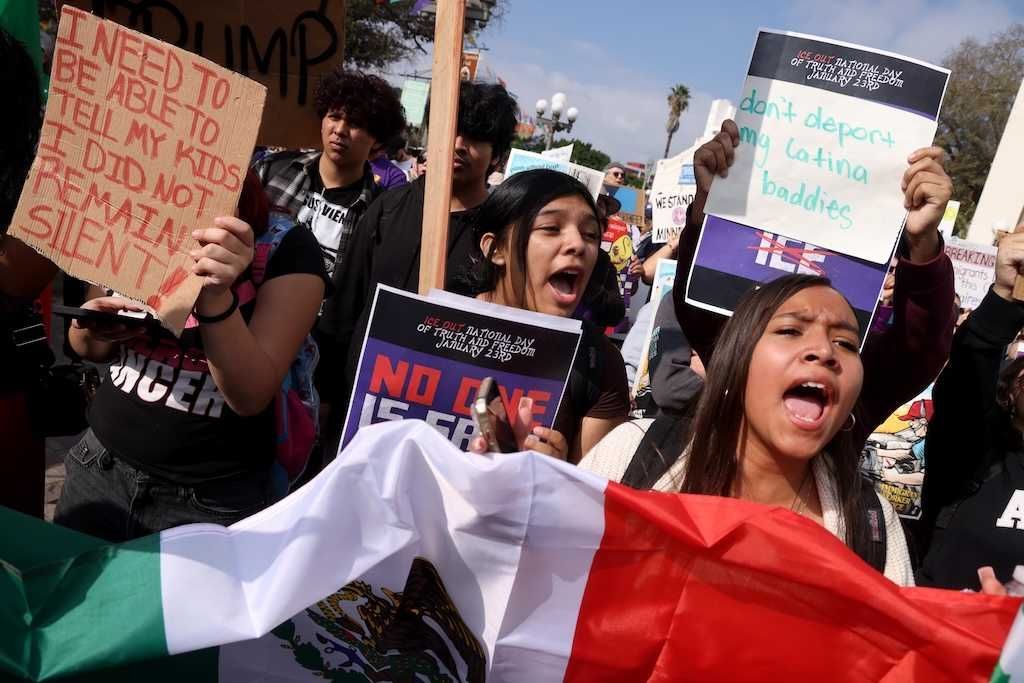
 FOIA results exposed a middle school allegedly hosting 'student equity assemblies' in which students were 'segregated' according to race, according to Defending Education.
 Schools' mindfulness meditation programs come with a hidden cost — the collection of children’s data, which could potentially be misused.
 The U.S. Department of Education recently released test results of the National Assessment of Educational Progress, showing that American high school seniors’ math and reading scores have dropped to a new historical low. According to The Wall Street Journal, “Twelfth-graders’ average math score was the worst since the current test began in 2005, and reading […]
 www.theblaze.com
 www.theblaze.com
 thefederalist.com