Second chances kill innocents


Republicans might finally take me seriously after years of warning: America suffers not from mass incarceration, but from mass under-incarceration. The system needs tougher sentences, not softer ones.

The brutal murder of 23-year-old Ukrainian refugee Iryna Zarutska, allegedly at the hands of career criminal Decarlos Brown Jr. on a Charlotte commuter train, didn’t reveal anything new. It shocked the nation precisely because it put on camera what has become routine in our cities since the bipartisan “criminal justice reform” wave dismantled Reagan-era tough-on-crime policies.

Legislators will have a choice when they reconvene: Pass strong reforms like these or watch more innocent people die.

For every man like Brown who slipped through the cracks, at least 10 more walk free when they should be locked up for life.

Brown had been arrested 14 times since 2007. His record included assault, felony firearms possession, robbery, and larceny. He didn’t see the inside of a prison until 2014, when an armed robbery conviction earned him a mere four years. He racked up more arrests after his release in 2020, but neither prison nor psychiatric commitment followed. The justice system looked the other way.

The result was predictable. Brown’s obvious mental instability made him even more dangerous than an ordinary criminal. Yet over the last 15 years, Republicans and Democrats alike embraced “reform” that made second chances for the violent and insane a top priority. They weakened sentencing, gutted mandatory minimums, downgraded juvenile crimes, eased up on drugs and vagrancy, and abandoned broken-windows policing. Hard-won gains against crime and homelessness evaporated.

The final insult: Brown was last released on cashless bail by North Carolina Magistrate Judge Teresa Stokes, allegedly affiliated with a pro-criminal “second chances” group. But violent offenders don’t just get second chances. They get third, fourth, and 15th chances. Most criminals never even face charges. Prosecutors downgrade cases. Convicts skate on early release. The cycle spins on.
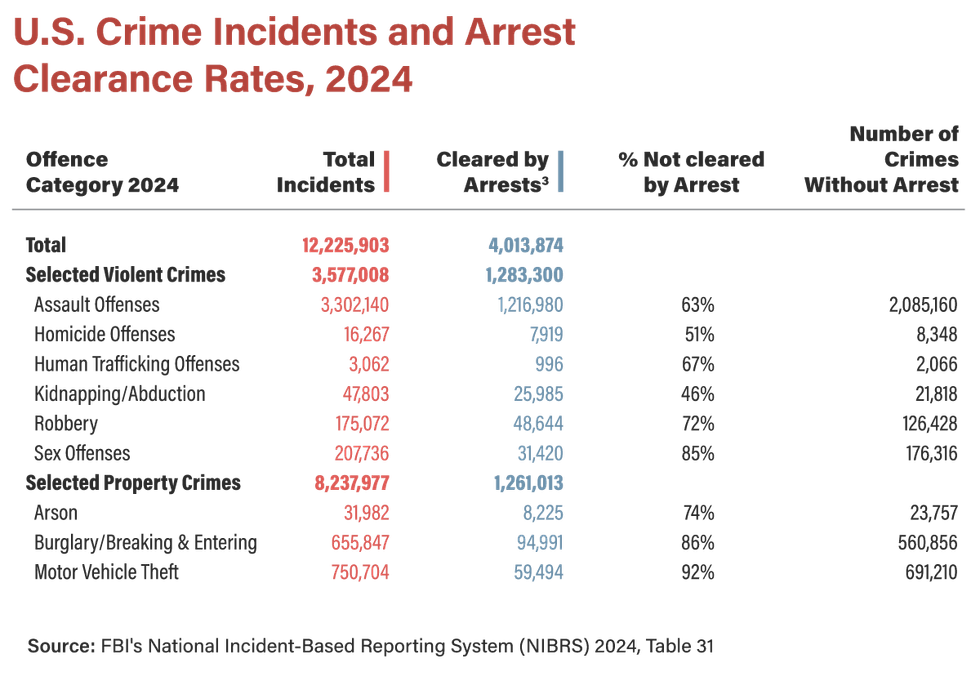
Look at the numbers. In 2024, the FBI’s incident-based reporting system logged over 12.2 million crimes. Strip away drug and gun cases, and the picture remains grim: 2.4 million violent crimes with no arrest. Another 1.25 million serious property crimes — arson, burglary, motor vehicle theft — with no arrest. Every year, more than a million offenders escape justice. Meanwhile, the nation’s prison and jail population sits at roughly 1.9 million.

Even when police make arrests, punishment rarely follows. In 2021, only 15,604 people went to prison for robbery despite 121,000 reported incidents. Just 4,894 went away for car theft out of 550,000 cases. Even homicide convictions lag far behind — just 6,081 murderers entered prison against more than 15,000 killings.

This isn’t a statistical fluke. It’s a system that fails to punish violent crime year after year.

RELATED: Iryna Zarutska’s name should shame the woke
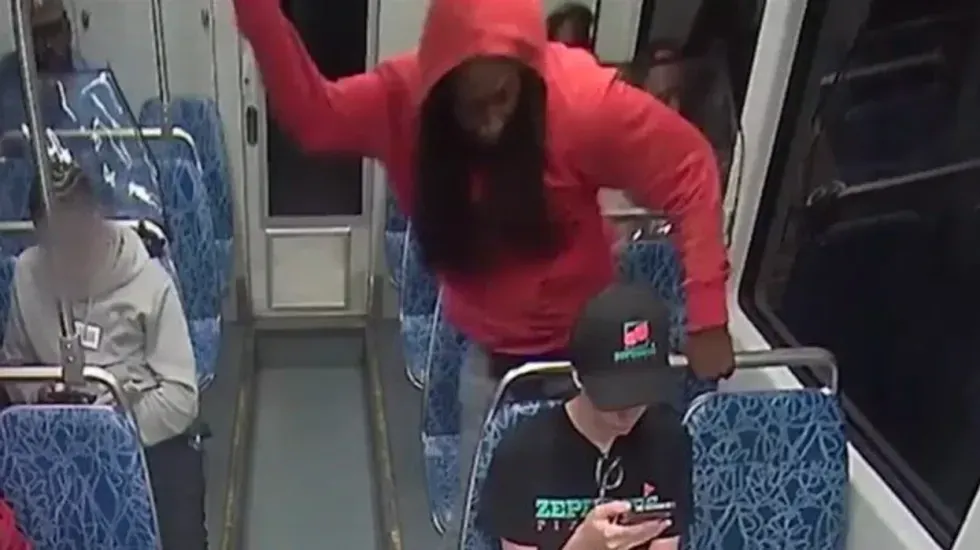
Screenshot/Charlotte Transit Authority

So what needs to change? Here’s a checklist every state legislature should adopt in the next session:

  1. Ban public encampments on streets, sidewalks, and public property; allow lawsuits against localities that fail to enforce.
  2. Elevate porch piracy penalties, following Florida’s lead.
  3. Impose stiff punishments for organized retail theft and flash mobs.
  4. Tighten “truth-in-sentencing” laws to ensure violent offenders serve their full terms.
  5. Pass anti-gang statutes that cross county lines, fund prosecutions, and mandate enhanced sentences for gang-related crimes.
  6. Let prosecutors, not judges, decide whether to try violent juveniles as adults.
  7. Set mandatory minimums for carjackings, especially for repeat offenders.
  8. Impose harsh sentences on felons caught with firearms, and harsher still when they use them.
  9. Require parole violators to finish their sentences.
  10. Hold repeat offenders without bond; revoke pretrial release when new crimes are committed.
  11. Fund prosecutors’ offices to clear the backlog of violent felony cases.
  12. Strengthen “three strikes” laws to eliminate loopholes.
  13. Apply the death penalty to fentanyl traffickers.
  14. Mandate quarterly public reporting of judges’ sentencing records in a searchable database.
  15. Criminalize squatting and streamline removal.

Legislators will have a choice when they reconvene: Pass strong reforms like these or watch more innocent people die.

Social media outrage won’t fix this crisis. Neither will empty calls for “accountability.” As Iryna’s grieving family warned, “This could have been anyone riding the light rail that night.”

That’s the truth — and unless lawmakers act, it will be the truth again tomorrow.
Target to shutter 9 stores in Democrat-run cities on account of unrelenting crime


Target is pulling up stakes on select stores in crime-ridden, Democratic cities, joining the host of other retailers looking for greener pastures.Evidently the company's efforts to lock aisles of products behind security glass wasn't a winning solution.

The company is shuttering nine stores across four states: one in New York City's East Harlem neighborhood; three in the San Francisco Bay Area; three in Oregon's increasingly anarchical city of Portland; and two in Seattle, Washington.

A combined 150 stores will remain in the geographies affected by the Oct. 21 closures, reported ABC News.

According to Neighborhood Scout, the chances of becoming a victim of a property crime in these areas is: 1 in 51 in New York City; 1 in 20 in San Francisco and 1 in 17 in Oakland, CA; 1 in 17 in Portland; and 1 in 18 in Seattle.

The company made clear that the reason behind the closure was crime, reported CNN.

"We cannot continue operating these stores because theft and organized retail crime are threatening the safety of our team and guests, and contributing to unsustainable business performance," the company said in a statement. "We know that our stores serve an important role in their communities, but we can only be successful if the working and shopping environment is safe for all."

In May, the woke company's CEO Brian Cornell said he expected theft "will reduce our profitability by more than $500 million compared with last year."

ABC News indicated losses for the company could top $1.2 billion this fiscal year.

The National Retail Federation, the largest trade group for the retail industry, said Tuesday that shrink — a catch-all term for internal and external theft and fraud — cost retailers $112.1 billion in losses last year. In 2021, the cost of shrink was $93.9 billion.

This appears to be an aggressively worsening trend.

"Retailers are seeing unprecedented levels of theft coupled with rampant crime in their stores, and the situation is only becoming more dire," said NRF vice president of asset protection and retail operations David Johnston. "Far beyond the financial impact of these crimes, the violence and concerns over safety continue to be the priority for all retailers, regardless of size or category."

Ever-worsening crime has similarly chased other stores and companies out of Democrat-run cities.

For instance, AT&T announced in June that it would be closing its flagship store in San Francisco — where police have indicated there have been 24,018 reports of larceny theft, 2,039 robberies, 4,186 burglaries, 1,789 assaults, and 40 murders so far this year — citing changing "shopping habits."

TheBlaze previously noted that consumer shopping habits in San Francisco have changed drastically since leftists successfully passed proposition 47 in 2014 — a leftist California ballot initiative that effectively decriminalized thefts under $950.

Cinemark Holdings, Inc. similarly revealed this summer that it too was ditching the crime-ridden and excrement-littered city, shuttering its theater in the downtown Westfield San Francisco Centre mall.

Nordstrom's chief store officer indicated in May it was closing its anchor location in the Westfield mall, citing dramatic changes in the "dynamics of the downtown San Francisco market." Whole Foods also cut and ran.

Crime statistics in neighboring Oakland, which has also done a great job repelling business, paint just as bleak a picture. As of Aug. 27, violent crime was up 19% this year over last year. Robberies are up 30%; rapes, 6%; burglaries, 44%; and motor vehicle thefts, 52%.

Portland too has seen an exodus of business in recent months.

In March, Walmart announced it was closing its last two remaining stores, not long after CEO Doug McMillon warned the company had seen a significant spike in thefts, reported the New York Post.

McMillon told CNBC, "Theft is an issue. It's higher than what it has historically been."

According to the Portland Police Bureau, there were 5,998 burglary, 24,675 larceny offenses, 1,407 robberies, 340 arson, 10,026 assault offenses, and 104 murder reports between August 2022 and August 2023.

Hundreds of businesses, including Starbucks and Nike, have fled Democrat-run Seattle in recent years, again owing to unchecked crime and violence.

So far this year, Seattle had over 25,000 property crimes and 3,470 violent crimes, including 42 murders and 205 rapes, according to the Seattle Police Department crime dashboard.

Police reckon Democratic policies barring judges from jailing or requiring bail for thieves, regardless of how many times the crooks have committed the act, have largely contributed to this problem, reported CNN.

The vast majority of respondents to the NRF's 2023 National Retail Security Survey appeared to agree with this assessment by police, with 72% claiming that they had seen an increase in the average value per incident in localities that raised minimum felony thresholds and another 67% reporting an increase in repeat offenders in geographies where cash bail was reduced or eliminated.

Like Blaze News? Bypass the censors, sign up for our newsletters, and get stories like this direct to your inbox. Sign up here!

AT&T announces it's shuttering its flagship store in Democrat-controlled San Francisco, citing change in 'consumer shopping habits'


AT&T revealed Thursday it is joining the host of companies that have already shuttered their anchor stores in the Democrat-controlled city of San Francisco.

The company's 24,000-square-foot flagship store, a prominent fixture in the downtown's Union Square, will be closing August 1.

Chris Collins, a spokesman for the telecommunications giant, told the San Francisco Standard, "Consumer shopping habits continue to change, and we're changing with them. ... That means serving customers where they are through the right mix of retail stores, digital channels and our phone-based care team."

Consumer shopping habits have changed drastically since leftists successfully passed Proposition 47 in 2014 — a leftist California ballot initiative that effectively decriminalized thefts under $950.

Collins noted, "All retail employees affected by this change will be offered jobs at one of our other many retail locations within the city."

AT&T will still have a presence in the city, where it still has over 10 stores and licensed retailers.

The news of the closure broke just hours after Cinemark Holdings, Inc., revealed it too was ditching the crime-ridden and excrement-littered city, shuttering its theater in the downtown Westfield San Francisco Centre mall, which has seen 46% of its stores close since the pandemic.

A spokesman for the company told Fox Business, "Cinemark can confirm it has decided to permanently close the Century San Francisco Centre 9 and XD theater shortly before the conclusion of its lease term following a comprehensive review of local business conditions."

Months after announcing it would peel back its Banana Republic presence in Union Square and shutter the Atheleta store on Sutter Street, Gap announced in May that it was closing its 73,000-square-foot Old Navy flagship store, reported the Standard.

Nordstrom's chief store officer also indicated last month it was closing its anchor location in the Westfield Mall, citing dramatic changes in the "dynamics of the downtown San Francisco market."

A spokesman for the mall, which has said goodbye to Office Depot, the Container Store, Anthropologie, and Saks Off 5th flee, noted the Nordstrom closure "underscores the deteriorating situation in downtown San Francisco."

TheBlaze previously reported that number of the businesses still sticking it out, such as Target, have begun locking large sections of their products behind security glass.

When the glass breaks, proprietors are oftentimes reluctant to defend their exposed property from the hordes of thieves who roam the streets in the broad daylight because San Francisco's victims are oftentimes subject to greater scrutiny than the offenders.

Democratic socialist Dean Preston, on the city's board of supervisors, recently threatened legislation to prevent security guards from drawing their weapons in defense of property.

\u201cThe Looting going on in war-torn Kiev is INSANE \u2026. \n\nOh wait, this is Democrat controlled San Francisco. \n\nNo one look or RT please. \n\nhttps://t.co/Rrp2Y61hhw\u201d
— Benny Johnson (@Benny Johnson) 1645984209


San Francisco, which comedian Dave Chappelle recently quipped has become "half 'Glee,' half zombie movie," scores a 2 out of 100 (100 being safest) on Neighborhood Watch's crime index.

The chance of becoming a victim of a violent crime is 1 in 186, and the likelihood of becoming a victim of a property crime is 1 in 20, as filmmaker Eli Steel recently discovered firsthand.

\u201cYou hear about how bad San Francisco is. I was filming a shot of my father , Shelby Steele, and in the ten minutes we were gone our SUV was broken into and nearly $15k of cameras stolen. Called 911 & they hung up twice.\u201d
— Eli Steele (@Eli Steele) 1686767367

According to the SFPD, between Jan. 1 and June 11, there were 131 reports of arson; 13,445 reports of larceny theft; 2,378 burglary reports; 1,070 assaults; 1,150 robberies; 91 rapes; 2,889 motor vehicle thefts; and 22 murders.

The city's crime and decline is not just chasing out businesses.

A comprehensive survey conducted by the San Francisco Chronicle last year found that 37% of current residents plan to be living somewhere beside San Francisco in three-years time. The city had experienced a 7% numeric decline in its population between July 2020 and July 2021.

Like Blaze News? Bypass the censors, sign up for our newsletters, and get stories like this direct to your inbox. Sign up here!