New Film Asks If America Can Survive Without Virtue
 A new documentary asks whether the republic can survive if it loses the very thing the Founders believed made self-governance possible? That is, virtue.
Think back to fourth-grade American history. We learned why the Articles of Confederation failed and why the Constitution replaced them. One major problem was that states struggled to trade with one another and often tried to protect local interests by taxing or restricting goods from other states.
That helps explain why the Constitutional Convention gave Congress the power to regulate interstate commerce in Article I.
The challenge to the machine-gun ban asks more than whether one statute survives. It asks whether the Constitution’s architecture still restrains power at all.
In grade school, the principle sounded straightforward enough. Two centuries of litigation have made it anything but. A basic question still hangs over the Commerce Clause: How much power does it actually give Congress?
Can Congress force you to buy health insurance? Can it stop you from growing wheat in your own garden to bake your own bread? Can it ban you from possessing a firearm?
Not buying a firearm, which plainly involves commerce. Not using one. Just possessing one.
And does the answer change if that firearm happens to be a machine gun?
In 1986, Congress made it illegal “for any person to transfer or possess a machine gun,” with narrow exceptions for military use and for machine guns lawfully possessed before the statute took effect. For everyone else, the ban is absolute.
One might expect Congress to have debated whether the Commerce Clause, or any other constitutional provision, gave legislators the power to ban mere possession of a machine gun. It did not. The only real justification for banning post-1986 machine guns came in a single House floor statement from Rep. William J. Hughes (D-N.J.), the amendment’s sponsor: “I do not know why anyone would object to the banning of machine guns.”
Hughes did not offer a constitutional justification. He simply assumed Congress had the power and never bothered to prove it.
In reality, Congress does not possess a general police power. It cannot create a comprehensive national criminal code simply because it wants to. That authority belongs chiefly to the states. Congress may enact criminal laws only when they rest on one of its few enumerated powers.
That’s the essence of federalism.
RELATED: Want a machine gun? These states might soon make buying one easier

So the real question remains: Does Congress have the power to prohibit mere possession of a machine gun, or does that authority remain with the states and the people?
The U.S. Court of Appeals for the Fifth Circuit has confronted the question before, but it has never answered it.
In 1997, the full court, sitting en banc, split evenly in United States v. Kirk. Sixteen of the 17 judges participated, and the court divided straight down the middle. Half concluded that the machine-gun ban exceeded Congress’ Commerce Clause authority. Half disagreed. Because no majority emerged, the district court’s judgment was affirmed by default, and the written opinions carried no precedential force.
Three months later, the court faced the issue again in United States v. Knutson. This time, the panel included three judges who believed Congress did have the power to ban machine guns. They upheld the law. The full court stayed silent, and Knutson remains binding precedent.
Two months ago, Judge Don Willett raised the issue again in a nonbinding concurrence in United States v. Wilson. Willett expressed serious doubt that Congress has constitutional authority to prohibit mere possession of a firearm. He walked through the Supreme Court’s three recognized categories of Commerce Clause authority: the channels of interstate commerce, the instrumentalities of interstate commerce, and activities that substantially affect interstate commerce. Mere possession of a firearm, he concluded, “fits uneasily within any of these categories.”
Willett’s observation gets to the heart of the problem.
If mere possession counts as interstate commerce, or as something Congress may regulate under the Commerce Clause, then federal power no longer has a meaningful limiting principle. Congress can regulate nearly anything, so long as some lawyer can imagine a downstream economic effect.
That is not constitutional government. It is federal power without a boundary.
Now, nearly three decades after Knutson, the Texas Public Policy Foundation and Temple Gun Club are prepared to press the issue again. Temple Gun Club is made up of law-abiding citizens who want machine-gun ownership made lawful for their members. The organization is not talking about weapons bought on some national market. It is talking about firearms the members would build themselves by converting guns they already lawfully own, firearms that never entered the stream of interstate commerce.
This case is about more than just machine guns. It is about whether the Commerce Clause still has limits. If Congress may ban possession of an item that was never bought, never sold, never exchanged across state lines, and has no substantial effect on interstate commerce, then Congress can regulate virtually every aspect of human life.
RELATED: When good guys carry, killers lose — and the media looks away

Willett made the point well in Wilson:
Far from viewing this sort of incremental, frog-boiling expansion of federal power as legitimate, the Founding generation saw it as the more insidious threat — a quiet, gradual erosion of liberty rather than a sudden seizure of it.
That’s right. The courts should return to first principles. They should revisit the machine-gun ban and ask the question Congress ducked in 1986: Does “regulate commerce” still mean something limited and intelligible, or has the phrase become a blank check for federal control?
The challenge to the machine-gun ban asks more than whether one statute survives. It asks whether the Constitution’s architecture still restrains power at all — or whether the 10th Amendment has been reduced to a historical footnote.
Texas conservatives have long trusted the Republican Party to stand firm on core values: secure borders, parental rights, the Second Amendment, and limited government. We’ve delivered them power in Austin. But too many GOP lawmakers now serve corporate donors and media elites — not the grassroots conservatives who put them in office.
Texas may be a red state, but the last legislative session told a different story. Thirty-six Republican state lawmakers joined Democrats on critical votes that gutted conservative priorities. They campaign as fighters and govern as cowards — folding at the first whiff of media pressure or lobbyist resistance. That’s not leadership. That’s betrayal.
When Texas Republicans falter, they don’t just fail their state — they fail the country.
Governor Greg Abbott’s Operation Lone Star generates headlines, but the border remains wide open. Despite the efforts of the Trump administration, cartels continue to move drugs and people freely across Texas soil. Ranchers continue to live in fear. Families bury loved ones lost to fentanyl. Texans demand action, but Austin delivers press releases.
Yes, regardless of the federal government’s efforts — and the Trump administration is certainly a refreshing change from Joe Biden —Texas has the constitutional authority to act. Where’s the declaration of invasion? Where’s the full mobilization? Leadership doesn’t mean deploying troops for photo ops. It means taking responsibility and enforcing the law.
Parents across Texas want transparency. They want to know what their kids are learning, reading, and hearing in school — especially on issues of sex and gender. Some lawmakers have stepped up. Too many haven’t. They call it “culture war nonsense” while siding with school boards and bureaucrats who treat parents as threats.
Legislators who can’t stop minors from receiving irreversible medical procedures without parental consent don’t belong in conservative office. That’s not compromise. That’s surrender.
After every shooting, moderate Republicans float “reasonable restrictions.” But the Constitution doesn’t hedge. It says “shall not be infringed.”
Texans don’t want red-flag laws. They want their rights respected. When figures like Rep. Dan Crenshaw entertain policies that chip away at due process, they don’t look pragmatic. They look weak. If you won’t defend gun rights without apology, step aside.
Texas Republicans now flirt with speech regulation. One bill would have required registration for anonymous political memes — all in the name of fighting “disinformation.” That’s not governance. That’s control.
Conservatives believe in protecting anonymous speech because we remember what it’s for: dissent. Critique. Satire. These aren’t bugs in the system — they’re essential features. If Austin lawmakers wants to mirror D.C.'s, voters will start treating them the same way.
The real issue isn’t just policy. It’s culture. The GOP establishment in Austin feels more at home with lobbyists than with the voters who knock doors and fund their campaigns. Primary challengers get dismissed as “fringe,” even as the grassroots base grows louder — and angrier.
RELATED: Red state, blue ballot: Dems use direct democracy to flip states
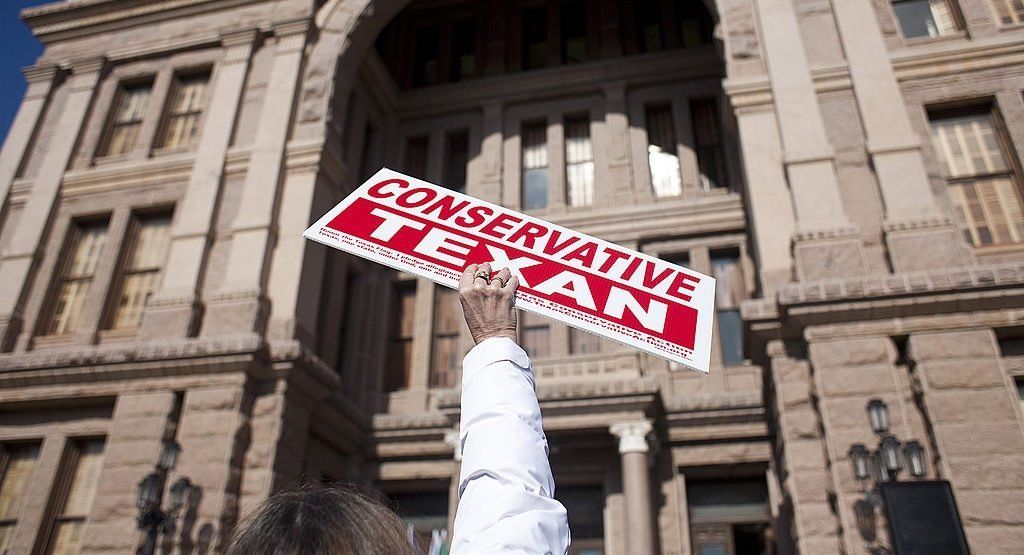
Calls for term limits are rising. The appetite for bold reform is real. If Gov. Ron DeSantis (R) can deliver conservative wins in Florida, why can’t Texas? Why are we still making excuses?
Texas shapes the national Republican Party. It drives presidential races and defines what the GOP stands for. When Texas Republicans falter, they don’t just fail their state — they fail the country.
As state Rep. Brian Harrison has shown, the last legislative session exposed serious cracks in the GOP foundation. Conservatives must respond: organize locally, show up at the Capitol, primary the cowards. An “R” isn’t a free pass. If you govern like a Democrat, expect to be treated like one.
Secure the border. Empower parents. Protect the Second Amendment. Defend free speech. Or get out of the way.
Texas doesn’t need more Republicans. It needs better ones.
Earlier this week, Sen. Rand Paul (R-Ky.) launched a short-lived attempt to block President Trump’s new tariffs. Fortunately, in this case, he lost. Vice President JD Vance cast the tie-breaking vote.
Paul played all of the libertarian greatest hits, from calling tariffs “taxation without representation” to claiming they represent big-government tyranny. He ignored one key fact: Donald Trump ran, and won, on an explicitly pro-tariff platform. The American people voted for this.
If Paul really wants to reduce the size and scope of government, he has no choice but to support Trump’s tariffs.
The reality is that tariffs are the form of taxation most compatible with small government. That’s why America’s founders — and every president on Mount Rushmore — supported them.
Tariffs shrink the power of government in three ways. First, they reduce foreign demand for U.S. debt, limiting borrowing. Second, they promote full employment, reducing welfare dependency. Third, they protect American businesses from foreign state interference.
America has run trade deficits every year since 1974. The cumulative total, adjusted for inflation, approaches $25 trillion. In 2023 alone, the trade deficit in goods and services neared $920 billion.
We didn't pay for that deficit with domestic production. Instead, we sold off assets — real estate, stocks, and bonds. China and its trading partners ship us goods, then buy up our future in return.
That includes our debt. Foreign demand for Treasury bonds has exploded because countries like China must recycle their trade surpluses somewhere. This artificial demand makes it easier — and cheaper — for Washington to borrow without raising yields.
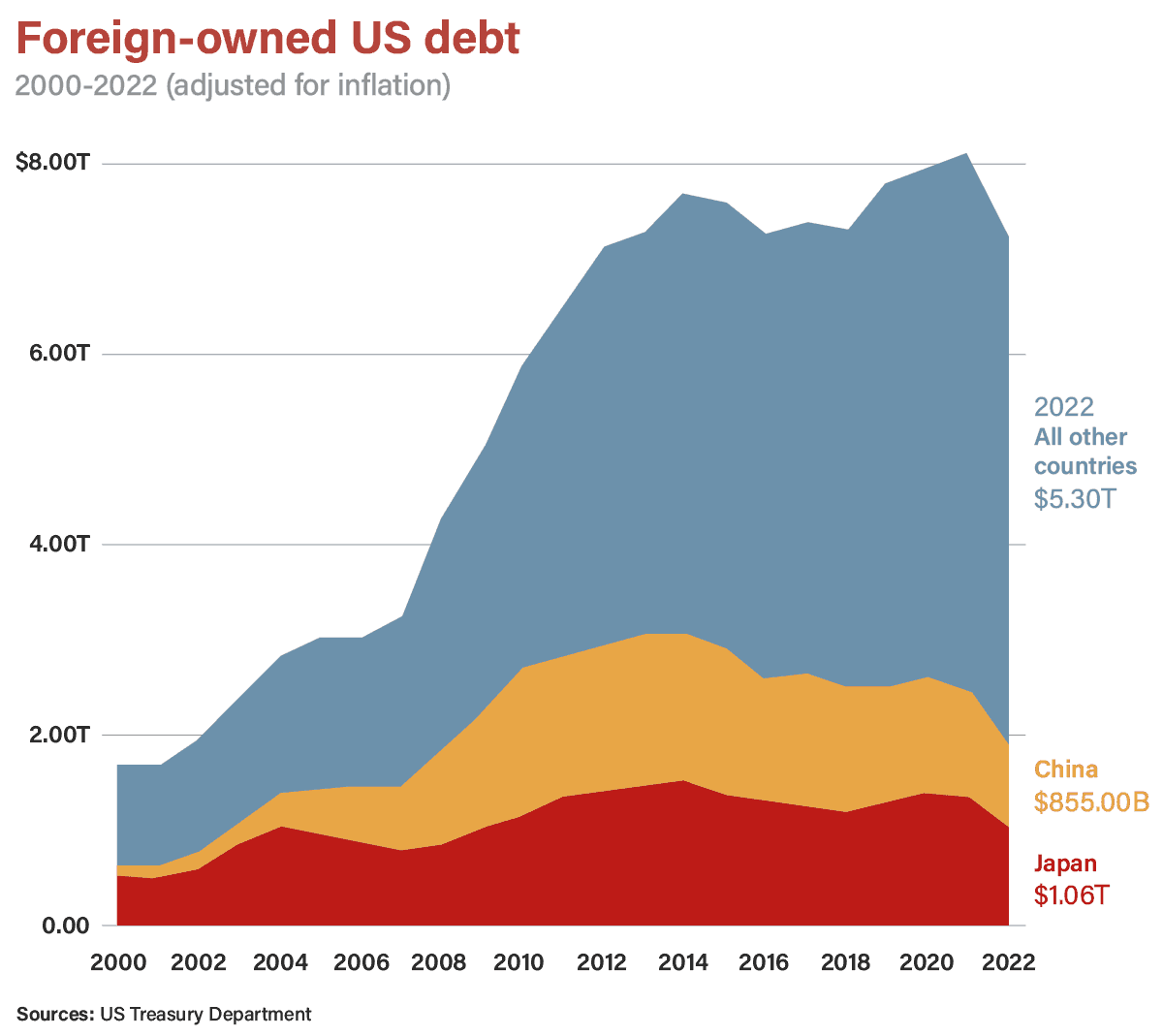
Foreign entities now hold $8.5 trillion in U.S. public debt, about 29% of the total. The explosion started in 2001 when China joined the World Trade Organization, and our deficits soared.
The result? Washington spends recklessly. And the cost of servicing that debt — over $300 billion in interest payments to foreign creditors — bleeds out the economy. That’s roughly equal to our annual trade deficit with China.
Higher tariffs would shrink the trade deficit and lower foreign demand for American debt. That would limit Washington’s access to cheap credit — exactly what fiscal conservatives should want.
Long term, if tariffs replaced the income tax as the government’s primary revenue source, federal borrowing would face a hard cap. Unlike the income tax, tariffs are avoidable. If rates rise too high, people buy domestic. That reality places a natural limit on tax revenue and borrowing capacity.
In short: Tariffs enforce fiscal restraint.
Since 2001, the U.S. has lost more than 5 million manufacturing jobs — along with the service jobs that depended on them.
Offshoring gutted labor’s bargaining power. When employers can threaten to send jobs to China, wages stagnate. Productivity no longer guarantees compensation. Workers take what they can get, or they’re replaced.
This “race to the bottom” helped erode middle-class wages and drive up welfare dependency. Over 10 million Americans now qualify as chronically unemployed, with many dropped from the labor force entirely.
As I explain in my book “Reshore,” mass job loss carries political consequences. Unemployed citizens are more likely to vote for higher taxes, expanded social programs, and even socialist policies. Poverty breeds dependency — and dependency fuels government growth.
Even if you buy the libertarian argument that tariffs “distort” markets, the result still favors liberty. The jobs tariffs protect are real. They preserve dignity, reduce welfare rolls, and shrink government.
Work is cheaper — and better — than welfare.
Paul argues that tariffs let government “pick winners and losers.” He wants the market to decide.
Well, sure. That would make sense — if America competed on equal footing. But we don’t. Chinese businesses don’t operate under free market conditions. They’re backed by the Chinese Communist Party, which props them up with subsidies, below-market financing, land-use preferences, and outright theft — up to $600 billion per year in American intellectual property.
U.S. small businesses can’t compete with state-sponsored enterprises. That’s why entire American industries, towns, and families have disappeared.
Tariffs serve as economic fences. They shield American firms from foreign governments — not just foreign competitors. That protection restores actual market competition inside the United States, where private companies can go head-to-head without facing a communist superstate.
And economic competition isn't just about firms. It happens at every level: workers vying for jobs, companies for customers, nations for global influence. Globalism collapses these layers into a single, rigged marketplace where the biggest government wins — and right now, that’s Beijing.
Tariffs restore order by separating national economies enough to maintain fair play. They enhance domestic competition while preserving international boundaries. Most importantly, they keep the CCP — the world’s largest and most authoritarian government — from dominating American markets.
If Rand Paul really wants to reduce the size and scope of government, he has no choice but to support President Trump’s tariffs.

 'It's fitting that we are launching the West Virginia Freedom Caucus on the 250th anniversary [of our nation] to restore those same rights to West Virginia,' WVFC Chair Chris Anders told The Federalist.

 Many pro-life advocates face stiff penalties due to the DOJ's use of the FACE Act.
 What Donald Trump told Joe Rogan is correct: tariffs are the best way to raise federal revenue in a constitutional system like ours.
 During a major economic speech on Thursday, former President Donald Trump pledged to create a “government efficiency commission” spearheaded by X owner Elon Musk if elected this November. This commission will be “tasked with conducting a complete financial and performance audit of the entire federal government and making recommendations for drastic reforms,” the 2024 GOP […]
 www.theblaze.com
 thefederalist.com
The Simple Rule That Would End Career Politicians in Congress