Seth Moulton Said He Would Return ‘Any’ AIPAC Donations. He’s Kept Tens of Thousands of Dollars From the Pro-Israel Group

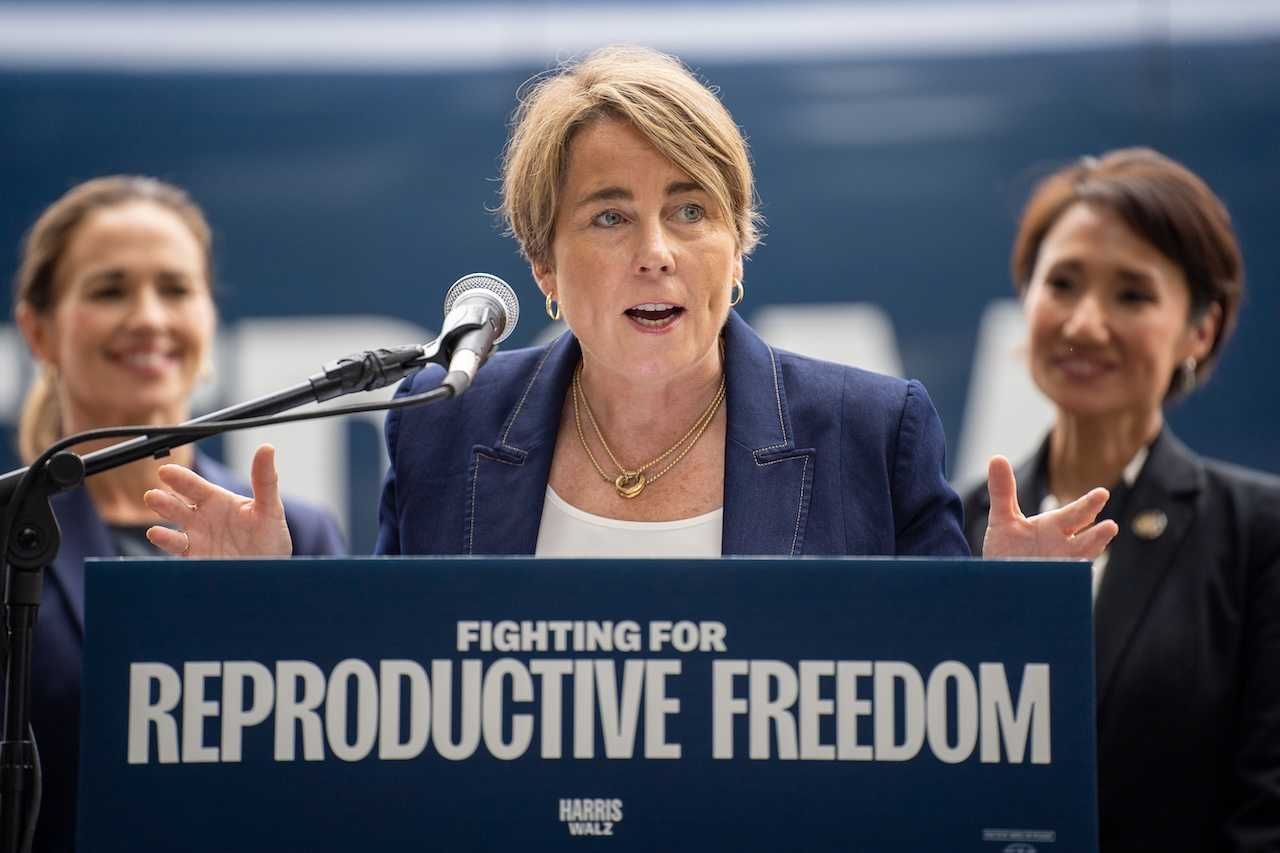
Rep. Seth Moulton (D., Mass.), who is challenging Sen. Ed Markey in the Democratic primary, pledged in October to return "any AIPAC donations" to his campaign. But Moulton has held onto tens of thousands of dollars in AIPAC donations, refunding only around half of what the group has given him since 2024, a Washington Free Beacon analysis found.

The post Seth Moulton Said He Would Return ‘Any’ AIPAC Donations. He’s Kept Tens of Thousands of Dollars From the Pro-Israel Group appeared first on .

Teachers’ Unions Sue To Block Tax Cut Referendum From Appearing on Ballot

Massachusetts teachers’ unions are suing to block residents from being able to vote on a statewide tax cut, asking the state’s supreme court to keep it off the ballot in November.

The post Teachers’ Unions Sue To Block Tax Cut Referendum From Appearing on Ballot appeared first on .

Massachusetts on track to set mileage limits for drivers


A bill advancing through the Massachusetts Senate would make reducing how much people drive an explicit goal of state transportation policy. It is called the Freedom to Move Act.

The bill, SB 2246, does not impose mileage caps on individual drivers. There is no odometer check, no per-driver limit, and no new fines or taxes written into the legislation. Instead it directs the state to set targets for reducing total vehicle miles traveled statewide — targets that would be incorporated into transportation planning, infrastructure investment, and long-term emissions policy.

When reducing driving becomes a formal state objective, personal mobility inevitably becomes something to be managed.

Transportation is the largest source of greenhouse gas emissions in Massachusetts, as it is in many states. From that perspective, lawmakers argue the bill simply aligns transportation policy with existing climate mandates. The state already has legally binding emissions reduction goals, and supporters say those goals cannot be met without addressing how much people drive. SB 2246, they argue, is about planning — not punishment — and about expanding alternatives rather than restricting choices.

Planning ... or punishment?

The bill also establishes advisory councils and requires state agencies, including the Massachusetts Department of Transportation, to factor VMT reduction into project development and funding decisions. In theory, this means greater emphasis on public transit, transit-oriented development, walking and biking infrastructure, and land-use policies designed to shorten commutes. Supporters emphasize that the legislation does not ban cars, restrict ownership, or mandate lifestyle changes. It simply provides a framework for offering residents more options.

The practical implications, however, deserve closer scrutiny — especially outside the state’s urban core. In greater Boston, where transit access is relatively dense, reducing car trips may be feasible for some commuters. In suburban and rural areas, the reality is very different. Many residents drive long distances to work because there are no viable alternatives. Families juggle school, child care, medical appointments, sports, and jobs across multiple towns. Small businesses rely on vehicles for deliveries, service calls, and daily operations. For these drivers, “driving less” is not a preference — it’s a constraint imposed by geography.

Future restrictions

Critics also worry that while SB 2246 does not cap individual mileage today, it lays the groundwork for future restrictions. Once statewide VMT reduction targets are established, pressure will mount to meet them. That pressure could influence everything from road funding and parking availability to congestion pricing, zoning decisions, and the collection of driving data. Even without explicit mandates, policy signals matter. When reducing driving becomes a formal state objective, personal mobility inevitably becomes something to be managed.

There is also the issue of trust and execution. Massachusetts has struggled for years to maintain and modernize its public transportation system. The MBTA’s well-documented reliability problems have eroded confidence among riders and taxpayers alike. Promising expanded transit options while existing systems remain fragile leaves many residents skeptical that alternatives to driving will arrive quickly — or equitably.

RELATED: EPA to California: Don’t mess with America’s trucks

Bob Riha, Jr./Getty Images

National trend

From a broader policy standpoint, SB 2246 reflects a national trend. States and cities across the country are experimenting with VMT reduction as a climate strategy, encouraged by federal guidance and funding priorities. The premise is that cleaner vehicles alone are not enough and that total driving must decline to meet emissions targets. Whether that assumption holds as vehicle technology evolves — including hybrids, plug-in hybrids, and increasingly efficient internal combustion engines — remains an open question.

Supporters argue that thoughtful planning now can prevent more disruptive measures later. By gradually reshaping transportation and development patterns, they believe emissions can be reduced without dramatic lifestyle changes. Opponents counter that history suggests incremental planning often leads to more intrusive policies — especially when initial targets prove difficult to meet.

What makes SB 2246 significant is not what it does immediately, but what it signals about the future of transportation policy. It reframes driving not simply as a personal choice or economic necessity, but as a behavior the state has an interest in reducing.

As the bill moves to the Senate Ways and Means Committee, lawmakers will have to weigh climate goals against economic realities, regional disparities, and personal freedom.

Massachusetts residents should pay close attention. SB 2246 may not tell you how many miles you can drive today — but it helps define who gets to decide how transportation works tomorrow.

Trump States Gaining Population As High-Tax States Lose People, New Census Data Show

Low-tax, Republican-leaning states are gaining people, while higher-tax, Democrat-leaning states are losing them, according to new domestic migration data released this week by the U.S. Census Bureau.

The post Trump States Gaining Population As High-Tax States Lose People, New Census Data Show appeared first on .

Dominican-Born Massachusetts Mayor Can Literally Barely Speak English

'It is here, where Brian interest in entrepreneurship is awakened'

Massachusetts mayor accused of not being able to speak English after requesting a translator during city hearing


During a local hearing, a Massachusetts mayor requested the use of a translator. Now critics are asking if he can even speak English.

Brian A. DePena (D) is the mayor of Lawrence, Massachusetts, a city of nearly 90,000. Approximately 82% of the residents of Lawrence are Latino, according to a 2023 report by WGBH.

'I practice my English because it's very important in America.'

Mayor DePena appeared in court earlier this month for a Peace Officer Standards and Training Commission proceeding, where former Lawrence Police Chief William Castro was facing city officials following the revocation of his credentials. Castro was accused of conducting an improper police chase and falsifying a police report.

According to reports, DePena testified on Castro's behalf and requested a translator for the hearing.

In video of the hearing that has gone viral, a judge is heard considering the request for a translator for the mayor.

DePena has since been accused of not being able to speak English at all. The WGBH report from 2023 also noted that DePena does not speak English on a day-to-day basis.

RELATED: Noncitizen Kansas mayor accused of voter fraud has cast dozens of ballots since 2000, documents show

"I practice my English because it's very important in America,” DePena said, according to WGBH. "For many years, another administration speaks perfect English and [didn't provide] opportunity for better education, for businessmen, for kids, safety [in the] community."

DePena later added, "It's not easy, because every day [I] to need to make a decision about another person, the future of another person. ... If you supported another candidate, no matter. Everyone is equal in my office."

Since taking office in 2021, DePena has appeared in many videos speaking only in Spanish, including in official city materials.

RELATED: Postal worker allegedly tried to help detainee escape from ICE — and she was on duty at the time

In March 2023, an official city of Lawrence YouTube video showed DePena speaking only in Spanish for an "important message" about public schools. The video is labeled as bilingual, but this appeared to refer to the English subtitles.

That October, DePena appeared in a Spanish-only interview for local health care company Vitra Health.

Additionally a Facebook video post from August 2025 from the mayor's official account is also entirely in Spanish.

The accusations come in spite of the Trump administration issuing an executive order designating English as the official language of the United States on March 1, 2025.

Blaze News contacted the mayor's office and the mayor directly about whether he is fluent in English but received no response.

Like Blaze News? Bypass the censors, sign up for our newsletters, and get stories like this direct to your inbox. Sign up here!

Brown University Head of Public Safety on Leave After Janitor Reveals Security Ignored Warnings of Suspicious Actor on Campus

Brown University's head of public safety, Rodney Chatman, was placed on administrative leave Monday after a janitor revealed that he saw a suspicious person lurking around campus in the weeks leading up to the December 13 shooting—a person who ended up being the gunman, Claudio Manuel Neves Valente.

The post Brown University Head of Public Safety on Leave After Janitor Reveals Security Ignored Warnings of Suspicious Actor on Campus appeared first on .

Haitian pair busted for allegedly using their mini-stores as fronts for $7M SNAP fraud scheme


Two Haitian men have been accused of using their small Boston-based retail stores as a front for a $7 million food stamp fraud scheme.

The United States Attorney’s Office in Massachusetts announced charges against 74-year-old Antonio Bonheur and 21-year-old Saul Alisme. Authorities arrested both men on Wednesday and charged them with one count of food stamp fraud, which carries a sentence of up to five years in prison and a $250,000 fine.

'The fraud was shocking and glaring.'

Court documents revealed Bonheur is a naturalized U.S. citizen, and Alisme is a Haitian citizen with lawful permanent residence in the U.S.

Bonheur owned Jesula Variety Store, a 150 square-foot retail space, and Alisme owned Saul Mache Mixe Store, a 500 square-foot location. Both establishments were located in Boston’s Mattapan neighborhood.

Despite the stores’ small footprints, they redeemed millions of dollars’ worth of Supplemental Nutrition Assistance Program benefits, ranging from $100,000 to $500,000 per month. According to the U.S. Attorney’s Office, the redeemed funds outpaced those of a nearby full-service supermarket, which redeems approximately $82,000 per month.

Bonheur was allegedly receiving his own SNAP benefits, which he used to transfer for cash at his store.

RELATED: $500 million in SNAP funds is reportedly spent on fast food because of state program

Jesula Variety Store. Image source: United States Attorney’s Office criminal complaint

Despite 70% of the stores’ SNAP transactions exceeding $95, they stocked “little legitimate food inventory,” the attorney’s office found.

“During undercover operations conducted at both businesses over the course of the investigation, SNAP benefits were allegedly trafficked for cash on four occasions from Jesula Variety Store and on two occasions from Saul Mache Mixe Store,” the attorney’s office wrote. “In each instance, the defendants themselves allegedly worked the cash registers and personally exchanged SNAP benefits for cash. Both stores were also allegedly observed selling liquor in exchange for SNAP benefits.”

Additionally, the stores allegedly sold a donated food product intended for food-insecure children overseas and not authorized for retail sale.

RELATED: Trump admin drops hammer on SNAP scammers after finding 186K dead people collecting benefits

Saul Mache Mixe Store. Image source: United States Attorney’s Office criminal complaint

“To be certain, these were not supermarkets. They were not full-service grocers. It would be a huge stretch to even call them convenience stores,” said U.S. Attorney Leah Foley during a Wednesday press conference. “There is no plausible way SNAP-eligible food could have been purchased from these stores for this long. Yet these two stores are alleged to have illicitly trafficked nearly $7 million in SNAP benefits.”

“The fraud was shocking and glaring,” she added.

Foley explained that the investigation also uncovered alleged “financial manipulations.”

“Because the stores had little legitimate inventory, and almost no lawful income, the defendants relied almost entirely on [U.S. Department of Agriculture]-funded SNAP redemptions,” Foley continued. “To conceal their fraud, they used numerous bank accounts to transfer the SNAP benefits around between the accounts they controlled to create the illusion of legitimate business activity.”

Like Blaze News? Bypass the censors, sign up for our newsletters, and get stories like this direct to your inbox. Sign up here!

Nativity hijacked by woke priest — archbishop sends thoughts and prayers


Instead of the usual Nativity scene this time of year, St. Susanna Catholic Church in Dedham, Massachusetts, featured something far less Christmasy: a sign reading “ICE was here.” Rather than celebrate the joy of the Incarnation, the pastor, Fr. Stephen Josoma, wanted to suggest that Jesus and His family had been abducted by federal agents and couldn’t make it to Bethlehem.

To be fair, this year’s stunt was tame compared with the church’s 2018 display, when the infant Jesus appeared — in a cage. Back then, the leftist narrative insisted that Trump’s “goons” were snatching innocent immigrant families and throwing their kids in cages while deporting the parents.

Fr. Josoma is at least forthright. The pro-immigration bishops, by contrast, wrap their open-borders stance in warm, fuzzy language about ‘compassion’ and ‘Christian charity.’

When complaints poured in, a spokesman for the Archdiocese of Boston offered mild disapproval and asked that the display be removed. One wonders what he would do if a priest used the Nativity to condemn transgenderism — perhaps a bubble of Mary saying, “It’s a boy!” and baby Jesus responding, “Of course I am.” Would the archbishop quietly distance himself again, or would he move to defrock the priest by morning?

The bishops’ real position

By now, it’s no secret that many Catholic bishops share Fr. Josoma’s immigration politics. Their public statements this year made that obvious: endless denunciations of border enforcement and deportations and near-total silence on the humanitarian crises created by Biden’s failed border policies — including the disappearance of some 400,000 migrant children, many of whom ended up in forced labor and sex trafficking.

Pope Leo XIV has only magnified this confusion. Though he recently muttered a few words denying he supports open borders, his actions and rhetoric signal the opposite. He consistently encourages mass migration into the West, especially from the poorer regions of the Global South.

Passive-aggressive rhetoric

All this might be tolerable if it weren’t so passive-aggressive. Fr. Josoma is at least forthright. The pro-immigration bishops, by contrast, wrap their open-borders stance in warm, fuzzy language about “compassion” and “Christian charity.” They never explicitly endorse illegal mass migration, but every message they send clearly communicates support for it.

Worse, they frame the debate as a false dilemma: either welcome millions from the Third World with open arms and open wallets, or turn everyone away and treat them like garbage. In their telling, unrestricted immigration is Christian charity; any attempt at regulation is moral failure. Like the Good Samaritan caring for the mugging victim, Americans are told to fund luxury-hotel stays and generous entitlements for ex-convicts from Haiti.

Little is said about the profound cultural and social challenges posed by non-Christian mass migration. Western Europe’s experience with Muslim migration is well-documented: spikes in crime, poverty, and urban decay.

In the United States, Muslim and Hindu migrants increasingly form self-segregated enclaves, complete with their own customs and sometimes their own informal legal norms — communities where Christian Americans are outsiders in their own towns.

Some progressive Christians claim this is an opportunity for evangelization. Yet no one in the church seems interested in actually evangelizing. Instead the faithful are browbeaten to be more “accommodating,” while bishops host endless interfaith dialogues with leaders who preach backward belief systems fundamentally at odds with liberal democracy.

Follow the money trail

Why then have bishops embraced such a self-destructive position? Two reasons stand out.

First, many bishops are simply committed leftists. Under Pope Francis — for most of the woke era — this meant preaching climate dogma and celebrating the LGBTQ agenda. Under Pope Leo, it means promoting open borders and a global welfare regime. The ideology changes, but the political alignment remains.

Second, mass migration pays. State and federal governments funnel enormous sums to Catholic NGOs for immigrant resettlement. “Caring for the stranger” has become a lucrative business. Vice President JD Vance, himself a Catholic, was blunt when he said much of the bishops’ outrage at border enforcement comes down to the billions of dollars at stake.

By shutting the border and deporting illegal migrants, the Trump administration is threatening a revenue stream.

Lingering hypocrisy

For conservative Catholics, the bishops’ partisan protests have become intolerable — especially after their submissiveness during COVID. Having failed as shepherds when it mattered most, they still presume they possess the moral authority to demand open borders forever.

It feels reminiscent of the Catholic Church’s reaction to the Black Death. As Barbara Tuchman recounts in her excellent history of the 14th century, the Catholic Church ramped up the sale of indulgences to replenish its coffers after the plague. Revenue rose. Respect collapsed. The peasant uprisings that followed eventually swelled into a continent-wide revolt that split Christianity.

RELATED: Viral video shows priest tossing ICE out of his church and mocking Trump — but it’s not what it seems

Photo by Suzanne Kreiter/The Boston Globe via Getty Images

Today’s immigration racket is unlikely to cause that level of destruction, but it is still a serious problem. Younger Catholics — anyone not a Baby Boomer — now tune out the clergy’s homilies about “harsh treatment” of migrants. They know it isn’t true. The Catholic Church in America is already as diverse and welcoming as a religious institution can be.

I was reminded of this recently at a Mass celebrating the feast of the Immaculate Conception. The only service I could attend was the evening Spanish Mass. Among Filipinos, Vietnamese, Latinos, Tejanos, and a handful of fellow gringos, I listened to our Indian priest celebrate the liturgy in Spanish, accompanied by a choir singing mariachi-styled hymns.

Nothing about this scene matched the bishops’ narrative of a hostile, unwelcoming Catholic Church. Perhaps if more of them bothered to attend or celebrate such a Mass, they would drop the sanctimonious posturing and address real problems.

That alone would be a welcome Christmas gift.