Top Michigan Dem Senate Candidate Accused Of Hiding Half-A-Million In Campaign Spending
'That means fully disclosing all the payments her campaign made'
A Democratic nominee for the University of Michigan's Board of Regents defended an alleged ISIS terrorist who is on trial for plotting to shoot up gay nightclubs in a Detroit suburb over Halloween weekend, court records show.
The post Dem Nominee for UMich Board of Regents Defended Alleged Terrorist Charged With Plotting ISIS-Linked Halloween Attack appeared first on .
The other day I drove from the tip of Michigan’s Lower Peninsula to Marquette in the Upper Peninsula.
It was about a three-and-a-half-hour drive through the wilderness. It’s not a terribly confusing trip — there’s about nine turns total, and I’ve made it many times. So I didn’t bother to summon my usual co-pilot — the always reliable Google Maps.
When I was a kid, my parents drove us from Michigan to California using a paper map. It probably took a little longer, with a much vaguer ETA.
No phone attached to the dashboard barking commands at me. No little cartoon avatar of my vehicle to look at.
And a funny thing happened. Time passed more quickly. The drive felt easier. I was less anxious. I had a more enjoyable time.
I wasn’t going particularly slow. I maintained a steady 5 to 15 over the limit, as one does on the empty and police-free northern roads of the Upper Peninsula. It’s the local custom.
I wasn’t trying to go especially fast either. It was a work trip, and I wanted to get to Marquette as soon as possible. But I wasn’t stressed, and I wasn’t annoyed at how long it was taking. I didn’t dread the drive. I didn’t even get bored. I never felt that feeling that I always feel at some point — the one where I start to think that maybe a self-driving car wouldn’t be so bad after all.
I concluded that, of course, my more relaxed demeanor in the driver’s seat was due to the absence of Google Maps on U.S. Route 2. But I wanted to test it again, just to see if it wasn’t a fluke. So I did.
Yesterday a couple of the kids and I drove another three and a half hours south to visit their grandparents. It’s a drive I’ve made tons of times, so I left my phone on the passenger’s seat, and the same thing happened again.
The drive was easier. Time passed more quickly. I never really got sick of the road, and I really did have a much better time doing something I normally don’t really like doing at all.
It’s really very interesting and perhaps a bit counterintuitive. You’d think getting continual updates about how many more miles until the next turn, how many hours until arrival, and where exactly you are on the map might make things go more quickly. You’d think eliminating the mystery and guesswork would make for a more relaxing drive.
In fact, it’s the opposite.
The continual updates and ticking clock make me more anxious. When Google Maps is open on my phone, I find myself checking the route and seeing 2:35 until arrival, and then only two minutes later doing the same thing again just to see 2:33 until arrival. Over and over again I do this, and it feels like watching water boil. Having all those updates makes me feel like I’m never going to get there. It makes the trip feel longer. The information stretches time or something. It’s too zoomed in, too detailed, too much. Information over-saturation.
When I was a kid, my parents drove us from Michigan to California using a paper map. It probably took a little longer, with a much vaguer ETA. But why do we need to know the exact minute we’re going to get there anyway?
Learning that Google Maps was making all my car travel feel unnecessarily long and annoying makes me wonder what other technology is secretly ruining my daily life.
The global news cycle comes to mind, of course. As does most doomscrolling on social media. But those are obvious culprits. What about the less obvious stuff? The hidden stuff? I didn’t realize that the Google Map updates were having a negative psychological impact on my trip until I put the phone away on a whim. That irritating, anxiety-inducing information was hiding in plain sight.
Our modern lives are great. We enjoy so many conveniences that our grandparents could only dream of. And they say people are more anxious today than ever before. Maybe we just need to stop complaining.
Or maybe a lot of these conveniences are more curse than blessing.
What if we really are more anxious because we can order anything we want from anywhere, because we have infinite choices, because we are able check the tracking on our packages every other hour, read news from every corner of the globe, unlock new fears by way of IG reels, and get blow-by-blow updates on our phones about how many more miles until we get there and when we need to turn right?
What if we know too much?
A 16-year-old Michigan girl was waiting for a bus in Hamtramck around 7:05 a.m. Monday when a male allegedly approached her, put a handgun to her back, and forced her into a van, WJBK-TV reported. Hamtramck is about 10 minutes north of Detroit.
The girl is a student at Frontier International Academy, the station said, and a fellow student witnessed the incident and reported it.
'I see the police outside. I point to him. I go, "That's the guy."'
The victim allegedly was sexually assaulted inside the suspect's vehicle, WJBK said.
Police went to the victim's school and met with students who were tracking her cell phone location, WJBK said, adding that officers used the data to track the victim to a Detroit gas station.
Around 7:30 a.m., the suspect brought the girl into the Sunoco gas station, asked for cigarettes — and told the girl to pay for them, WXYZ-TV reported
Store clerk Abdulrahman Abohatem told WXYZ that struck him as odd: "When he ask her to pay for the cigarettes, I said ... 'There's something wrong.'"
The girl then sent him a silent, desperate signal.
"She mouth-talked to me, like, with no sound," Abohatem told WXYZ.
He said her message was one word: "Help."
RELATED: Female slashes face of 3-year-old boy she kidnapped at Walmart — and officers open fire: Police
With that, Abohatem came out from behind the protective glass and confronted the suspect, WXYZ said: "I go out, I kick him out, I ask the girl, 'Go behind me.'"
As Abohatem was escorting the male out of the store, police pulled into the parking lot, WXYZ said.
"I see the police outside. I point to him. I go, 'That's the guy,'" Abohatem added to WXYZ.
The suspect was quickly taken into custody, WXYZ reported.
City of Hamtramck Mayor Adam Alharbi told WXYZ the suspect is "a criminal who had a history of rape charges, and we will make sure that he gets what he deserves."
The girl's family said she is safe at home processing the incident and is thankful the community stepped up, WXYZ reported.
Hamtramck Police Department Chief Hussein Farhat told WXYZ the incident was random and the suspect and victim didn't know each other: "This suspect could have driven anywhere, saw the opportunity, and took advantage of it."
Hamtramck Police said 48-year-old Donald J. Fields of Detroit was arraigned Thursday.
RELATED: Transgender sex offender accused of trying to kidnap boy at elementary school gets good news from DA
Police said Fields was charged with two counts of first-degree criminal sexual assault, one count of kidnapping, one count of possession of a firearm by a prohibited person, one count of felonious assault, and five counts of felony firearm. He also was charged as a habitual offender — third offense, police said.
Fields was taken to the Wayne County Jail and ordered held without bond, police said.
In a separate story, WXYZ reported that Fields is a registered sex offender, and that Judge Alexis Krot — who denied his bond — stated that "despite me saying one minute before that he's a habitual offender, Mr. Fields has the audacity to say he has no criminal history."
WXYZ said Fields previously spent time in prison in connection with a home invasion and assault with intent to commit sexual contact.
Like Blaze News? Bypass the censors, sign up for our newsletters, and get stories like this direct to your inbox. Sign up here!
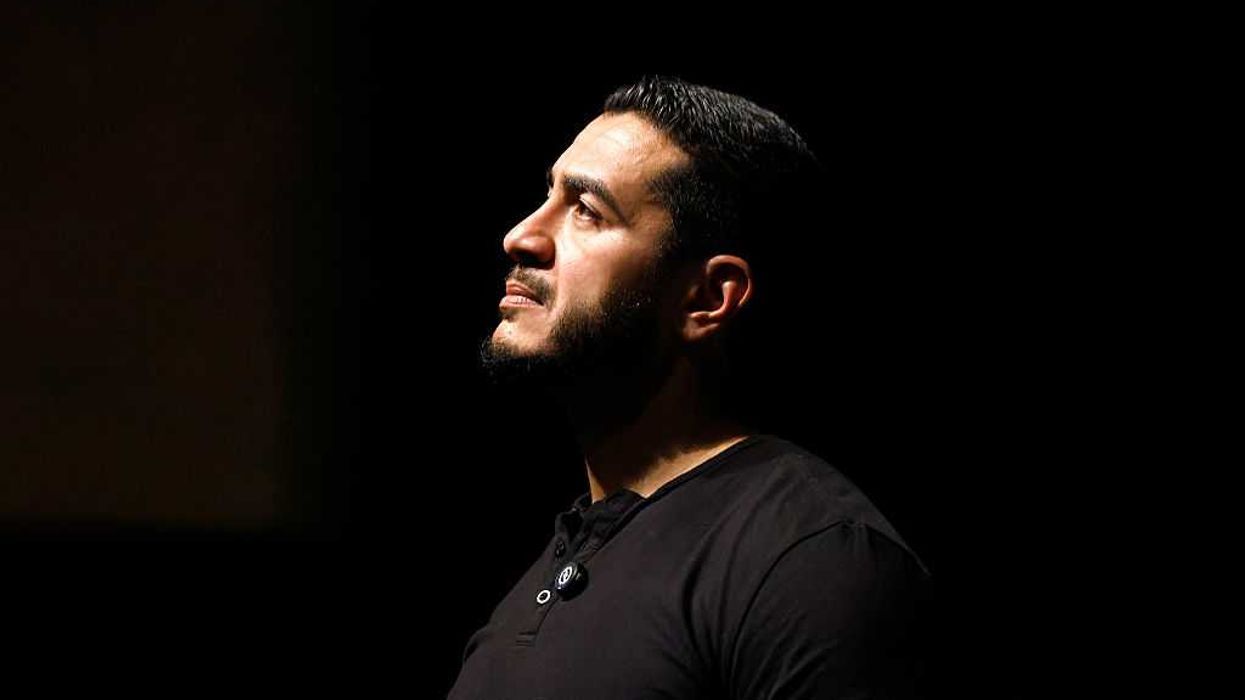
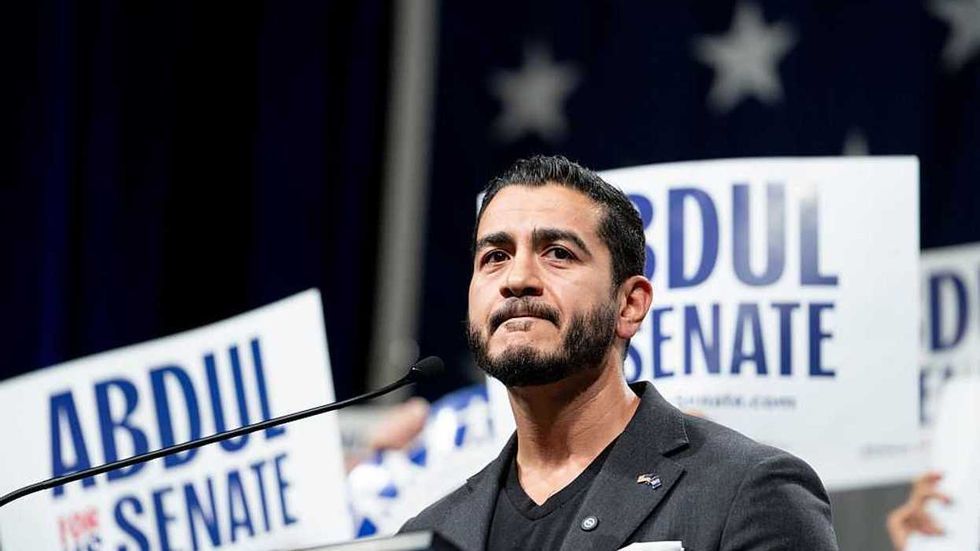
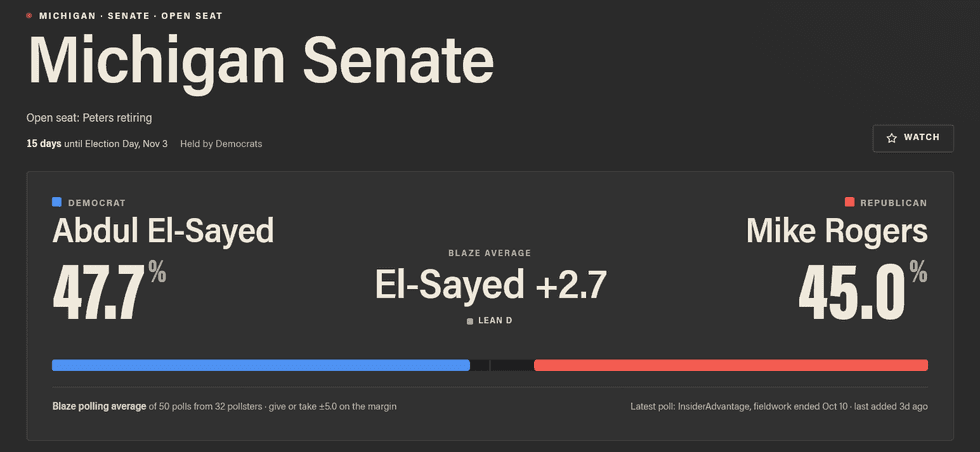
Abdul El-Sayed, the left-wing candidate running in the hotly contested Michigan Democratic Senate primary, suggested at a July 2025 campaign event that terrorists commit "heinous act[s]" because they feel "pain and frustration and a level of lack of agency" due to "hypocritical" U.S. actions that are "creating pain," video footage exclusively obtained by the Washington Free Beacon shows.
The post EXCLUSIVE: Michigan Senate Hopeful Abdul El-Sayed Blamed US for 'Creating' Terrorism: 'What Happens When People Are in Pain?' appeared first on .
The first-quarter campaign fundraising total for the 2026 midterms reveals that House and Senate Democratic candidates have picked up significant early momentum, potentially spelling trouble for Republicans as more primary elections approach.
At least one Democratic candidate raised more than a Republican in Georgia, North Carolina, Maine, Michigan, Ohio, Texas, New Hampshire, and Alaska, Punchbowl News reported.
'There's no way for Republicans to spin this: Their candidates are getting crushed.'
Texas state Rep. James Talarico (D) raised $27.1 million, breaking a record for the largest amount for a Senate candidate in any state. Talarico's fundraising significantly outpaced his potential opponents. Sen. John Cornyn (R) raised $9 million, and Attorney General Ken Paxton (R) raised $2.2 million.
Georgia Sen. Jon Ossoff (D) raised $14 million during the first quarter. The incumbent's fundraising far outpaced that of Republicans hoping to unseat him. Rep. Mike Collins (R) raised just over $1 million, and Rep. Buddy Carter (R) raised just $470,000.
In Ohio, former Sen. Sherrod Brown (D) is hoping to defeat Republican incumbent Sen. Jon Husted. Brown raised $10.1 million in the first quarter, while Husted brought in $2.9 million.
Former North Carolina Gov. Roy Cooper (D) is running against Michael Whatley (R) and three other candidates to secure retiring Republican Sen. Thom Tillis’ seat. Cooper raised $13.8 million in the first quarter, while Whatley raised $5 million.
RELATED: 'Record' cash advantage gives GOP upper hand in state AG races

House Democratic challengers also raised significant funds in the first few months of the year.
In Arizona, JoAnna Mendoza (D) raised over $2.3 million, among the highest reported by a Democratic House candidate. Mendoza's opponent, incumbent Rep. Juan Ciscomani (R), raised $1.1 million.
In Wisconsin, Democratic candidate Rebecca Cooke is looking to oust incumbent Rep. Derrick Van Orden (R). Cooke raised $2.4 million, while Van Orden raised $1.3 million.
"Of course, this is only part of the picture. Candidates are now using joint fundraising committees to air TV ads. Super PACs will play a big role," Punchbowl News reported. "GOP Rep. Ashley Hinson did raise the most in Iowa's open Senate race. And Democratic primaries will drain some resources."
"But there's no way for Republicans to spin this: Their candidates are getting crushed," the outlet stated.
RELATED: 'We have a glaring disadvantage': Democrats panic as GOP dominates in fundraising, NYT reports

While Punchbowl News insisted it was all doom and gloom for Republican candidates, the National Republican Congressional Committee saw the Q1 funding results as a win for the GOP.
"Republicans are LAPPING Democrats in fundraising & building a war chest they can't match," the NRCC wrote in a post on X, adding that the GOP "outraised, outworked, [and] outmatched" their Democratic counterparts.
Mike Marinella, the national press secretary for the NRCC, stated, "Once again, and for every single quarter this campaign cycle, @NRCC Patriots have outraised [the Democratic Congressional Campaign Committee] Frontliners."
"House Republicans have the momentum on our side, and the money proves it," he wrote.
Federal Election Commission reporting showed that Democratic Senate candidates have raised $368 million for their 2026 races, compared to $324 million raised by Republicans. Democratic House candidates collected $691 million, while Republicans raised $578 million.
Some of the most prominent names in Republican political consulting did not respond to a request for comment on this story.
Like Blaze News? Bypass the censors, sign up for our newsletters, and get stories like this direct to your inbox. Sign up here!
The left-wing candidate for Senate in Michigan, Abdul El-Sayed, campaigned this week with a man running for the University of Michigan's board of regents who shared since-deleted X posts that celebrated late Hezbollah leaders as "martyr[s]" and called on the Iranian regime to "show no laxity" against Israel.
The post El-Sayed Campaigns With UMich Board of Regents Candidate Who Shared Since-Deleted Posts Praising Hezbollah and Iranian Regime appeared first on .