Our Transhumanist, Sci-Fi Future Has Arrived. But You’re Not Going To Like It
 Technological progress isn’t ushering in an era of prosperity and bliss. It’s inaugurating an era of demonic, inhuman evils.
America is getting darker. Christians have felt it for some time, but now even some of the nonreligious crowd is noticing it. A shadow creeps across the nation, breeding chaos, confusion, and unmitigated wickedness.
Some want to fight the encroaching corruption with legislation, others with innovation, but Rick Burgess, BlazeTV host of the spiritual warfare podcast “Strange Encounters,” says those kinds of solutions treat only the symptoms, not the disease.
Underneath the rampant degeneracy permeating American institutions and culture is the root of all evil, and until we look it in the face, our country will continue to slide ever deeper into a pit of despair.
On this episode of “Strange Encounters,” Rick discusses America’s spiritual predicament, including the possibility of demonic portals in the U.S., with Tom DiMarco, author of the recently published book “The Only Way Out: A Brief Look at the Driving Forces Behind Today's Chaos and the Only Person Who Can Save Us.”
Rick regularly encourages his audience to engage in what he calls “spiritual housecleaning,” meaning to examine what you’ve brought in or allowed to come into your home. Some things — like Halloween decorations, occult or witchcraft-related objects, and even media or content that promotes darkness — can be invitations of welcome to demonic forces.
But it’s not just individual Christians who need to engage in spiritual housecleaning. The nation at large is in desperate need of it too.
One item in America’s “house” deserving of scrutiny, says DiMarco, is Freemasonry — the world's oldest fraternal organization.
Although it’s presented as a brotherhood promoting charity and personal improvement, DiMarco paints a more complicated picture.
“There's lower levels of the Masons, and it's basically a men's club ... they do a lot of good things, but there's levels, and as you climb up the levels, you get to a point where you're sworn to secrecy,” he says, citing claims of ancient deity worship among some Masonic circles.
The symbolism woven into some of America’s most prestigious monuments is another point of contention, says DiMarco. He points to the Washington Monument and the Capitol building as primary examples.
He explains that the Washington Monument is an “obelisk,” a tall, four-sided pillar tapering to a pyramid top that translates literally to “Baal’s shaft” — a phallic fertility symbol tied to pagan worship of Baal, who the Bible associates with child sacrifice.
The U.S. Capitol building's dome, he argues, represents ancient pagan symbolism tied to a “fertility goddess” (the rounded shape designed to mirror pregnancy).
He further claims that inside the dome's "belly" — in the Rotunda's central fresco, “The Apotheosis of Washington” — six ancient gods are depicted, including figures symbolizing the god of war under names like Astarte, Ishtar, and Isis, whom he says evolved into the modern "Columbia" (as in District of Columbia), with Masonic influence in the naming and design.
On top of that, DiMarco claims that the man George Washington appointed to oversee the initial setup of the federal territory, Daniel Carroll (a wealthy aristocrat with alleged Masonic ties), set up the layout of Washington, D.C.'s monuments and buildings so that, when viewed aerially from the White House, it forms a pentagram — a five-pointed star often associated with occult or Satanic symbolism.
He argues that “the monuments are the compass and the square — the symbol of Freemasonry.”
Even our Statue of Liberty, he says, is modeled after a pagan goddess, “now named Columbia.”
“The second commandment, you know, specifically tells us not to build these things,” says DiMarco. “I think they become portals. They're areas where it's a gateway for these [demonic] beings to gain strength.”
He and Rick say that in ancient Israel, idolatry (worshiping other gods through idols, high places, Asherah poles, Baal altars, etc.) and adopting pagan practices were seen as direct violations of the covenant with God. The Bible repeatedly shows that these practices led to divine judgment — exile, defeat, or curses — while removing them via repentance, destruction of the idols, and returning to exclusive worship of Yahweh were often prerequisites for God's restoration, blessing, protection, and deliverance.
They suggest that if America wants to see “a reign of peace,” like the one brought about by the “good kings” of Judah, we have to follow their steps and remove idols and pagan altars.
“As long as these things are here, we will have war,” says DiMarco.
To hear him unpack his portal theory, watch the full interview above.
To enjoy more bold talk and big laughs, subscribe to BlazeTV — the largest multi-platform network of voices who love America, defend the Constitution, and live the American dream.
Anyone can search the currently available Epstein files and see what turns up. As a professor at Arizona State University, I searched for my own school. I did not expect to find so much ASU-related material.
One reason: ASU employed Lawrence Krauss, paying him a substantial salary to write books arguing that the universe created itself from nothing.
Epstein’s philosophy collapses under its own weight because it begins with a lie about God.
That claim is its own story. You will object, rightly: “But we can’t get something from nothing.” Krauss replies, “By ‘nothing’ I mean quantum foam.” And you respond, “Then the title misleads. You don’t mean nothing. You mean quantum foam.”
Krauss also became close with Jeffrey Epstein. In one exchange, Krauss wrote: “I really do love you deeply as a friend Jeffrey. I don’t think I know anyone else who so honestly cares about me, and I don’t think I can ever truly express how wonderful that feels. Thank you. The cruise was a great reset.” In other messages, they discuss science and religion.
That is what caught my attention. As I read Epstein’s comments about religion — and listened to his interview with Steve Bannon on similar themes — a picture began to form of how Epstein made sense of the world and, more chillingly, of himself.
A question hangs over every moral horror: How does a moral monster live with himself? Even if we limit ourselves to the explicit immorality in the files — without speculating about coded language or hidden networks — how did he sleep at night? What silenced his conscience?
Several pieces fit together.
In the ASU-related material and in interviews, Epstein does what I have often seen among intellectuals: He retreats into abstraction. He speaks about the history of ideas, mathematics, and cutting-edge research in a way that floats above concrete people and particular moral obligations.
That retreat protects a self-image. He can pose as the enlightened patron of science, funding humanity’s progress. That image sits in grotesque contrast with the cruelty he inflicted on actual human beings.
This pattern tracks with Paul Johnson’s thesis in “Intellectuals”: Intellectuals who talk about serving “humanity” often treat individuals in their orbit badly. Grand claims become a shield. The rhetoric of progress becomes moral insulation.
Think of the professor who preaches liberation while using DEI programs to impose racial essentialism and ideological coercion. He can tell himself he is helping “the marginalized” even as he harms colleagues and students in the real world.
Or consider the pop star who repeats slogans like “no one is illegal on stolen land.” The moral performance happens at the level of abstraction. The carelessness happens at the level of reality.
RELATED: Why Christians should care about politics

Epstein goes further by trying to dissolve moral accountability at the metaphysical level.
He argues that physicists once believed reality could be fully captured by mathematics. Now, he claims, we understand reality is irrational. Mathematics can only approximate what he calls “the limit,” but the limit itself remains unknowable. Some call that limit “God.”
But if God is unknowable, then God becomes irrelevant to our calculations about life and moral choice.
At one point, Epstein frames this as a male-female divide. The male mind, he says, runs on logic and mathematics. Reality, however, does not fit that paradigm. Reality is fundamentally irrational and accessed through feminine intuition. Ultimate reality, in his telling, is best understood as the divine female.
Humans, in Epstein’s view, are beasts with frontal lobes sophisticated enough to rationalize their impulses.
He may have believed he was elevating the feminine. The framework reads more like a metaphysical excuse: reason fails, therefore the standard fails.
The tension between reason and intuition is ancient. Epstein narrows “reason” to a single project: reducing the world to material causes through mathematics. When that project does not deliver what he wants, he does not abandon reductionism. He abandons reason.
Francis Schaeffer described this move in godless intellectual life: When autonomous reason cannot sustain itself, the thinker does not repent. He escapes into irrationality. Intuition becomes the alibi. Mystery becomes permission.
In conversation with Krauss, Epstein defends a kind of religion, but not biblical religion.
Krauss, echoing the New Atheists, treats religion as an evolutionary leftover — maybe useful in an earlier age, unnecessary for modern man. After all, modern man allegedly knows universes can create themselves out of nonexistence.
Epstein pushes back, but only to reduce religion to psychological management. Religion concerns the “inner world,” he suggests, while science and mathematics concern the outer world. We cannot ignore the inner world. Its purpose is peace. Anxiety and depression signal inner disorder; religion restores equilibrium. That, for Epstein, becomes religion’s function.
Not worship. Not truth. Not repentance. Peace.
That is New Age self-help with a faux religious vocabulary.
Put the pieces together and a Nietzschean outline emerges.
Nietzsche described the dialectic between the Apollonian and the Dionysian. The Apollonian seeks order, reason, structure. Yet it can become sterile and suffocating. The Dionysian seeks raw experience — ecstasy, pleasure, intoxication, release. Dionysian revelry becomes not only indulgence but purgation: a controlled environment where darker impulses can be acted out so a man can return to ordinary life and call himself functional again.
God’s moral law is written on the heart. We are not left with "unknowable limits" as our excuse. We are without excuse.
Humans, on this view, are beasts with frontal lobes sophisticated enough to rationalize their impulses.
That is the worldview of the modern pagan: order and chaos, calculation and intoxication, “science” by day and ritualized transgression by night. Add Epstein’s skepticism about knowable truth and his reduction of religion to inner peace, and the method of self-justification comes into focus.
His reported fascination with longevity technologies and strange diets fits too. Death becomes the great enemy. It must be cheated — through science, mythic elixirs, or Silicon Valley innovation.
RELATED: America’s old cultic trick: Sex, salvation, and the return of polygamy

The unsettling part: These temptations are not unique to Epstein.
Many people oscillate between cold rationalism and irrational indulgence. Many treat morality as a social construct and religion as therapy. Many use abstractions to excuse what they would never defend in plain language.
That should drive self-examination, not mere disgust. Are we living inside the Apollonian-Dionysian loop, shifting between self-justifying “reason” and self-excusing “release”?
Epstein’s philosophy collapses under its own weight because it begins with a lie about God.
God has not hidden Himself. Scripture teaches that His eternal power and divine nature are clearly revealed through creation. His moral law is written on the heart. We are not left with “unknowable limits” as our excuse. We are without excuse.
The claim that reality is fundamentally irrational is not a profound insight. It is an evasion. It is a way to suppress what is plain.
That is why Lawrence Krauss’ self-creating universe and Epstein’s divine female belong in the same category: idols. They exchange the truth for something else — something that grants permission.
Romans 1 describes the pattern of Epstein’s life: the darkened mind, the suppression of truth, the exchange of glory for self-justification, and the descent into sexual corruption. The cure is not oscillation between sterile rationalism and ecstatic purgation. The cure is redemption. The cure is communion with God restored.
We need Christ, who alone frees us from the pagan dialectic — ancient and modern — and grants eternal life, “that they may know You, the only true God, and Jesus Christ whom You have sent” (John 17:3).
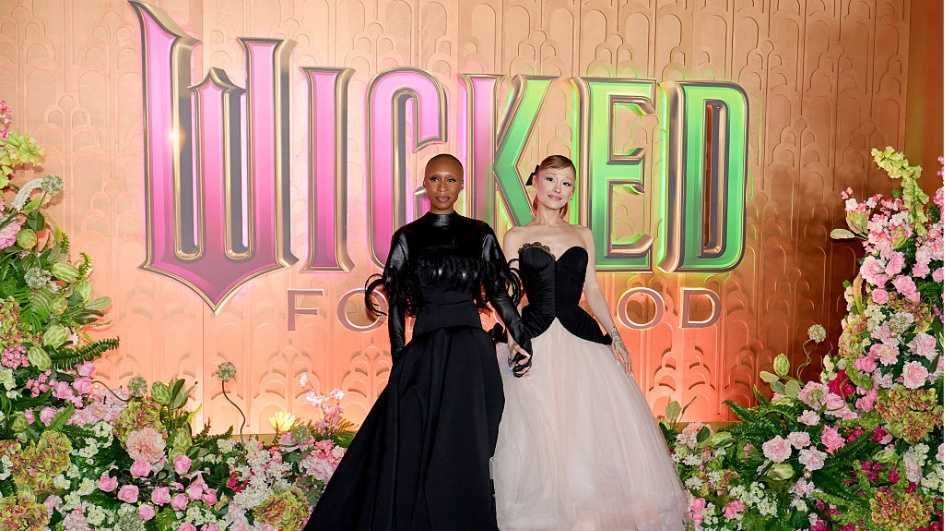
As I watched Jon M. Chu's "Wicked: For Good" last week, I kept thinking about another, very different filmmaker: David Lynch.
Specifically, the Lynch that emerges from Alexandre Philippe's excellent 2022 documentary "Lynch/Oz," wherein we discover just how deeply the infamously surreal filmmaker was influenced by one of cinema's sweetest fantasy films: the original "Wizard of Oz."
In the era of #WitchTok ... a story like 'Wicked' has built-in appeal.
Philippe's film includes footage from a 2001 Q and A in which Lynch confirms the extent of his devotion: "There is not a day that goes by that I don't think about 'The Wizard of Oz.'"
And that shouldn't be surprising given how much it shows up in his work. From Glinda the Good Witch making an appearance in "Wild at Heart," to the hazy, dreamlike depiction of suburbia in "Blue Velvet," his films exist in a dual state between the realm of fairyland and the underworld.
Indeed, Lynch doesn't reject either. In proper Buddhist fashion, these two forces exist in balance, equally potent and true. There is both good and evil in his world. Neither negates the other's existence. And when darkness spills over into the light, it may be tragic, but it is also just another part of the world. Like Dorothy, his protagonists find themselves walking deeper into unknown territory. The protagonists of his films truly "aren't in Kansas anymore."
"The Wizard of Oz" is potent because it captures the logic of fairyland better than almost any film ever made. Channeling the fairy stories of J.R.R. Tolkien, Lewis Carroll, and George MacDonald, it transports the mind to a realm that is more real than real, where even the most dire intrusion of evil can be set right according to simple moral rules.
As G.K. Chesterton famously puts it:
Fairy tales do not give the child his first idea of bogey. What fairy tales give the child is his first clear idea of the possible defeat of bogey. The baby has known the dragon intimately ever since he had an imagination. What the fairy tale provides for him is a St. George to kill the dragon.
"Wicked" and its new sequel reject this comforting clarity for something altogether more "adult" and ambiguous. Instead of presenting good and evil as objective realities that can be discerned and defeated, the films show how political authorities manipulate those labels to scapegoat some and exalt others.
They do so by swapping the original's heroes and villains. The Wonderful Wizard is a cruel tyrant. Glinda is foppish and self-obsessed. Dorothy is the unwitting tool of a corrupt regime. And Elphaba — the so-called Wicked Witch — is reimagined as a sympathetic underdog with a tragic backstory, a manufactured villain invented to keep Oz unified in ire and hatred.
Elphaba exudes a whiff of Milton's Lucifer — an eternal rebel in a tragic quest to upend the moral order. But unlike "Paradise Lost," "Wicked" presents rebellion against its all-powerful father figure not as a tragic self-deception, but as a justified response to systemic cruelty.
"Wicked: For Good" takes the ideas of its predecessor even further than mere rebellion. If "Wicked: Part One" is about awakening to the world's realities and becoming radicalized by them, "Wicked: For Good" is about the cost of selling out — the temptation to compromise with a corrupt system and the soul-crushing despair that follows.
This is where the irony of the film's title, "Wicked: For Good" comes in. Once a person sees the world for what it truly is, they can't go back without compromising themselves. They've "changed for good." They've awakened and can't return to sleep.
It's worth considering why the "Wicked" franchise is so wildly popular. Gregory Maguire's original 1995 novel has sold 5 million copies. The 2003 stage show it inspired won three Tony Awards and recently became the fourth longest-running Broadway musical ever. And the first film grossed $759 million last winter, with the sequel poised to make even more money.
Perhaps it is no coincidence that this outsize success comes at a time when Wicca and paganism have grown into mainstream cultural forces. In the era of #WitchTok, in which self-proclaimed witches hex politicians and garner billions of views on social media, a story like "Wicked" has built-in appeal. It offers glamorous spell-casting and a romantic tale of resistance to authority.
RELATED: 'Etsy witches' reportedly placed curses on Charlie Kirk days before assassination

The temptation of witchcraft is one that always hovers over our enlightened and rationalistic society. Particularly for young women, witchcraft offers a specific form of autonomy and power — over body, spirit, and fate — that patriarchal societies often deny. Many view witchcraft as progressive and empowering; "witchy vibes" have become a badge of identity.
Thus the unsettling imagery of Robert Eggers' 2015 film "The Witch" comes into focus: A satanic coven kidnaps and kills a Puritan baby, seduces a teenage girl, and gains the power to unsubtly "defy gravity" through a deal with the devil.
"Wicked" is all about this power to transcend. Even as its protagonist grows despairing in the second film and abandons her political quest for the freedom of the wastelands, the film presupposes that it is better to resist or escape a corrupt system than submit to it.
Ultimately, the two films leave their audience with a bittersweet moral: Society is dependent on scapegoats. The Platonic noble lie upon which all societies rest cannot be escaped — but it can be redirected. A new civic myth can be founded that avoids sacrificing the vulnerable and overthrows the demagogues atop Mount Olympus. And the witches play the central role in overturning the world of Oz. Their rebellion sets it free.
But because the films blur the clear, objective distinction between good and evil — even while acknowledging that real evil exists — the characters in "Wicked" often drift in moral grayness, defining themselves mainly in relation to power. The world becomes overbearing, radicalizing, and morally unstable.
This is far afield from the vision of Oz presented in the 1939 film, the one David Lynch venerated as vital to his understanding of the world. But it reflects how modern storytellers often grapple with Oz. Almost every sequel or spin-off struggles to recapture the sincerity of the original. The 1985 sequel "Return to Oz" reimagined the land with a dark-fantasy twist. 2013's "Oz the Great and Powerful" comes closest to the original tone but centers on fraudulence and trickery.
"Wicked," too, falls in line with the modern tendency to subvert and complicate traditional stories of good versus evil. "Frozen," "The Shape of Water," "Game of Thrones," and "Star Wars: The Last Jedi" all explore morally conflicted worlds where bravery is futile or where Miltonian rebellion is celebrated.
Of course, seeing the stories of our childhood with a jaundiced adult eye can be quite entertaining; it's perfectly understandable why even those not in covens love these films. They are well-made, well-performed, and especially irresistible to former theater kids (I am one).
Their popularity isn't inherently bad either. They are perfectly fine in isolation. It is only when we contrast them with the clarity and beauty of the original — and place them within the context of our society — that a sad truth emerges: Finding fairyland is hard. Most of us prefer to live in the Lynchian underworld.
Every summer, the shadowy Bohemian Club — a private gentlemen’s society based in San Francisco — hosts a clandestine retreat called “Bohemian Grove” in Monte Rio, California, where highly influential men in politics, business, media, culture, and entertainment gather for two weeks on a secluded 2,700-acre private property deep in the redwood forests.
The event is shrouded in mystery — no paparazzi, no women, no entry without an invitation, and lots of whispers of strange rituals and elite networking.
Twenty-five years ago, Infowars founder Alex Jones snuck in and secretly recorded one of Bohemian Grove’s most cherished rituals: the "Cremation of Care.”
On a podcast with Glenn Beck, Jones shared the wild tale of his Bohemian Grove infiltration.
The Cremation of Care is a theatrical ceremony, where attendees burn an effigy before a large owl statue to symbolically banish worldly concerns for the duration of the retreat. It’s similar to how Burning Man attendees set fire to the “Temple” on the final day of the festival to represent letting go of personal burdens.
“It’s occultic, and there’s vibes of that everywhere,” says Jones of the event. He explains that Mark Twain founded Bohemian Grove in the late 1800s, but it was later taken over by the Republican establishment and Skull and Bones (a secret society at Yale University), which is what gives the gathering its secretive, Germanic, druidic, and Masonic character.
After sneaking in with Jon Ronson, a British journalist and documentary filmmaker, who gained access via an insider, Jones, having narrowly escaped inquisitive Secretive Service guards, hid under the deck of one of the cabins.
“I got into the woods, got to the first camp and nobody was there, and I climbed up underneath the log cabin deck, and there were like literally centipedes and spiders. It was like 'Indiana Jones Temple of Doom,'” he laughs.
At nightfall, he emerged from his hiding place and stealthily joined a large crowd walking toward the lake.
And then he beheld it: the infamous stone owl.
Jones paints a chilling scene straight from a thriller’s darkest frame — “big crowds of men coming in hundreds and hundreds,” descending a shadowy hill, dwarfed by towering redwoods so colossal their trunks could swallow cars whole. “Bats and frogs” stir the murky air with restless flutters and croaks, their eerie chorus blending with a live symphony’s foreboding rendition of “In the Hall of the Mountain King.”
Jones, trying to fly under the radar, then climbed into a redwood tree and recorded the “dramatic footage” of the burning ritual.
“They mixed in Babylonian, druidic, Canaanite, faustian stuff in the hour. They bring out a hearse that's horse drawn with the effigy of a child. They then call on the goddess to come and they call these other gods to come,” Jones recounts. “So it's kind of an amalgamation like the Bible says of all these religions.”
In retrospect, especially after receiving Bohemian Grove annals years later, Jones says he realized that famous people, including American broadcaster Walter Cronkite, played the voice of the owl. These voice actors were stationed inside the statue where they controlled sounds, such as amplified voices or eerie effects, to enhance the theatrical atmosphere.
“I'm not saying they're all devil worshipers ... it's more of a crazy art festival, but there is an occultic thing to it,” he tells Glenn.
The duo speculate that the majority of attendees are there just to have a good time, but the inner ring of people who control the event are indeed hosting legitimate pagan rituals, even if their guests aren’t aware.
Jones says the masterminds orchestrating the retreat use these two weeks to assess who among their guests might be of use to them. Jones recalls how most of the Bohemian Grove crowd was just having fun, but there were some, especially the official Bohemian Club members, who clearly took the ritual seriously. One man — “some billionaire,” he says — practically growled “this is a very important ritual” when Jones suggested it was a “neat” spectacle.
The members “were trying to transmute their problems onto this ritual” in hopes that “Karma” or some other vengeful deity would “pass over them,” he explains, calling the burning “very hardcore.”
“It was very sophisticated, very dark, [and] beyond black magic,” he says, explaining that the burning, like many ancient pagan rituals, aimed at casting one’s sins into an “interdimensional cauldron” before “[sending] it to another plane.” In other words, it’s the satanic version of Christ’s ultimate sacrifice that atoned for the sins of man.
To hear Jones’ full recount, watch the interview above.
To enjoy more of Glenn’s masterful storytelling, thought-provoking analysis, and uncanny ability to make sense of the chaos, subscribe to BlazeTV — the largest multi-platform network of voices who love America, defend the Constitution, and live the American dream.
Burning Man is a week-long event that describes itself as being focused on “community, art, self-expression, and self-reliance” that’s held annually out West in the desert.
The event centers around the symbolic burning of a large wooden effigy that is referred to as the “Man," and Allie Beth Stuckey is calling it what it is: pagan worship.
“It’s about self-expression, self-reliance, self-discovery, self-fulfillment, self-liberation, and even self-worship,” Stuckey says. “Ultimately, that’s what all paganism is.”
“It’s no surprise that this event has grown in popularity over the years. It really is just a celebration of the carnal celebration of sex, drugs, perversion,” she continues, noting that attendees adopt “new names,” lay their burdens on the wooden effigy, and eliminate monetary transactions on the philosophy of shared resources when they enter the event.
“This is like an upside-down world of Christianity, that when we come into Christianity, we also become new creations, and we take on an easy yoke and a light burden when we follow the way of Christ, and we cast all of our cares upon the Lord because he cares for us,” Stuckey explains.
“This is a cheap and pagan imitation of that because it is pretending to offer its attendees freedom, while really attaching them and bounding them to the heavy burden and slavery of sin,” she adds.
Burning Man holds sessions that you can participate in like a rope-bondage suspension, orgies, marriages, crafting, and getting branded.
“You can get branded, you know, like a cow,” Stuckey says, shocked. “These people so badly want to be a part of something bigger than themselves, they want to be marked for something more, they want something indelible on them and even in their hearts and souls.”
“And they are looking for all of that in the wrong place, of course, which is exactly what Satan does,” she adds.
To enjoy more of Allie’s upbeat and in-depth coverage of culture, news, and theology from a Christian, conservative perspective, subscribe to BlazeTV — the largest multi-platform network of voices who love America, defend the Constitution, and live the American dream.
 Now, more than ever, we need to put the Saint back into St. Patrick’s Day!


 While President Trump honored Palm Sunday, King Charles III neglected it — instead honoring a pagan holiday.
 A massive new Pew survey with a misleading headline tells the tale of America’s ongoing de-Christianization.
 Federalist Senior Editor John Daniel Davidson's new book, Pagan America: The Decline of Christianity and the Dark Age to Come, offers a sobering assessment of the threats to the American way of life as religiosity declines.
 thefederalist.com
 www.theblaze.com
 www.theblaze.com
 www.theblaze.com