Portland-Area County Hit With Class Action Lawsuit for Race-Based Homeless Policies

Multnomah County, Ore., was hit with a class action lawsuit on Monday over its race-based homeless programs, which promise that "[p]eople of color will be served at higher rates" than white people and include "culturally specific" apartments for the "BIPOC Community."

The post Portland-Area County Hit With Class Action Lawsuit for Race-Based Homeless Policies appeared first on .

Want to sell your book? Vilify the Christians who raised you.


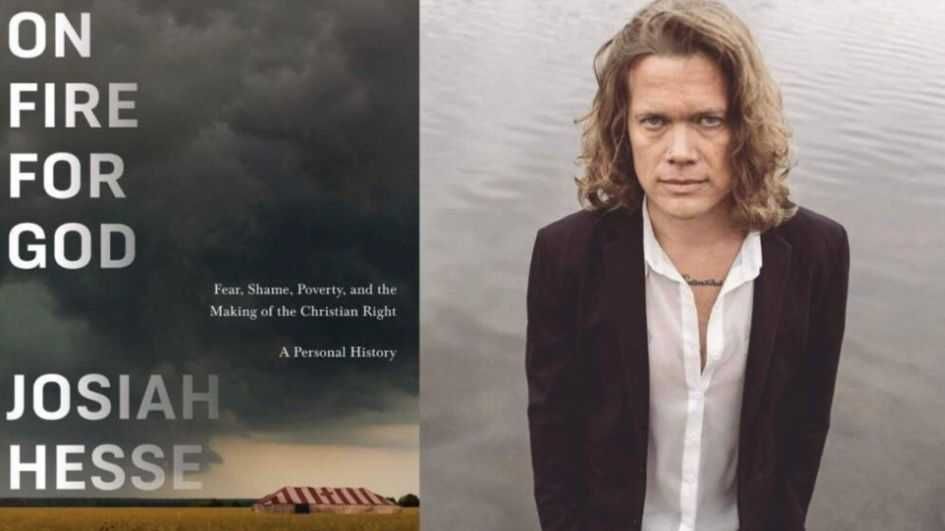
Last year, here in Portland, I went to an author event at my local bookstore. The book was called "On Fire for God: Fear, Shame, Poverty, and the Making of the Christian Right." It was a memoir by Josiah Hesse.

The event description said the memoir was about Hesse’s “bleak and difficult childhood in a small, rural Evangelical community in Iowa.”

My guess is that his literary agent or his editor understood how hungry mainstream publishers are for books that attack and slander the Christian faith.

Apparently, Hesse suffered mental anguish as a child when he was told by church elders that he was going to be tortured in hell for his sins.

Breaking with his church and family while still in his teens, he struck out on his own, eventually becoming a successful writer and journalist. Now he had written a book exposing the Christian right.

Dissing Christians

Hesse was doing a national book tour. He was traveling the country doing interviews and podcasts. He had just been featured on National Public Radio.

Needless to say, the mainstream media loved this book. A full frontal attack on the Midwestern evangelicals is always welcome in their circles. Especially if the author escaped the oppression of the church and found shelter in the safe spaces of progressive liberalism.

The book event began with Josiah Hesse making a grand entrance into the bookstore’s event area.

I didn’t know what to expect from such an author in terms of appearance, but I was definitely not expecting the rock-star shag haircut, the crisp white shirt, the shimmering black dinner jacket, or the elegant cravat around his neck.

Had this guy come here on his yacht? His face had definitely been moisturized. He looked like he could be in an ABBA tribute band.

Getting to know the author

Hesse took the stage and began his talk. He described growing up as an evangelical Christian.

As a young man, he was sensitive and imaginative and didn’t fit in. His parents, meanwhile, were loyal evangelicals. His dad believed in the “end times” and the eventual rise of the Antichrist.

In his teen years, Hesse’s feelings of alienation from his family and community got progressively worse. It didn’t help matters that he developed a taste for wearing high heels and trying on his mother’s clothes.

Small-town boy

So it turns out that Josiah was gay! Not that there’s anything wrong with that. Eventually, he did what so many young gay people do: When he was old enough, he moved to the nearest big city. In this case, Denver.

There, he scraped by, working odd jobs and picking up writing gigs. Over time, he was able to develop his talent and eventually got a literary agent and published a book called "Runner's High" at a major publishing house.

Watching him talk, he seemed like an upbeat guy. He told funny stories. He didn’t seem traumatized by his Christian upbringing. He was just gay. And now he was a successful writer who was gay.

RELATED: My search for America's last decent public libraries

Joe McNally/Getty Images

Family ties

I also noticed the “breaking with his family” part of the story wasn’t quite as severe as promised. In his talk, he described returning home, hanging out with his dad, meeting up with old friends, reconnecting as best he could.

It was an interesting and relatable story.

So what happened to the evil Christian right? That’s what the book was supposed to be about. Where’s the trauma? Where’s the abuse? Where are the scars?

The Portland audience seemed restless and disappointed. Where was the evil? That’s what they came for. WE WANT OUR CHRISTIAN EVIL!

Not following the script

I haven’t read the book, so I don’t know for sure what’s in it. Hesse did quote some statistics during his talk.

These statistics seemed designed to reassure the anti-Christian audience that he was on their side. Trump is bad. Conservatives are neanderthals. Christians are brainwashed and in some cases predatory.

But I was skeptical. I didn’t believe Hesse was really this simpleminded. He was clearly an intelligent guy. He wasn’t super political. He didn’t hate his family, or his town, or his old friends.

He had moved away from his rural community, as any talented gay person would do. He found his people in Denver. And now he was writing books and living his best life.

Go where the money is

My guess is that his literary agent, or his editor, or maybe Hesse himself understood how hungry mainstream publishers are for books that attack and slander the Christian faith.

They especially love books that confirm the stereotype: “small-town Christians = bigots + racists.”

These memoirs are so popular that there’s a formula:

  • The author is abused and humiliated by the sadistic locals.
  • The author breaks free of their bigotry and finds his way to the “good people,” i.e. college-educated liberals in coastal cities.
  • There, the formerly oppressed author can flourish and be his true self: gay, or nonbinary, or furry, or poly-whatever.
  • Everyone lives happily ever after.

That’s the genre that Josiah Hesse’s "On Fire for God" supposedly belongs to. (See also "Educated" by Tara Westover, another memoir with almost the exact same storyline.)

Did Josiah strictly adhere to that formula? More or less. My main impression of the author: He looked happy. His writing career was going great. He was on a national tour. He was staying in nice hotels. He was wearing a cravat.

And I’m sure his publishers got what they wanted too. Another book that confirms that educated people, good people, moral people are uniformly against the Christian right, which is apparently an ongoing threat to our nation.

The only problem is: Whenever someone writes a book about the “dangerous Christian right,” it turns out he is just describing another small town in Iowa — usually, a town where, if you actually went there, you would find kind, decent people who, when you brought up the “Christian right,” wouldn’t even know what you were talking about.

Jesus in the temple (of progressivism): What I learned watching Portlanders debate a street preacher


Recently, I stopped to grab a pizza slice in the Hawthorne district of Portland. This is a trendy neighborhood, full of vintage shops, vinyl record stores, hipster cafes. The vibe is very liberal progressive.

As I approached the pizza place, I heard someone talking over a loudspeaker. I assumed there was a protest going on. Or a Pride event.

A green-haired woman said: 'Are you sure God is a He?'

But then I saw what it was: A street preacher was proselytizing and holding a big sign that read, "SINNERS REPENT! OR BURN IN HELL!"

Potty mouths repent!

I’d never seen one of these guys in the wild. Not in Portland. I’ve seen them on YouTube, where they often get into fights with people. Or sometimes, they get attacked.

As I got closer, I could read the large sign and its long list of hell-bound sinners:

  • Perverts
  • Fornicators
  • Homosexuals
  • Adulterers
  • Potty mouths
  • Drunkards
  • Thieves
  • Liars
  • Used car salesmen (yes, this was on the list)

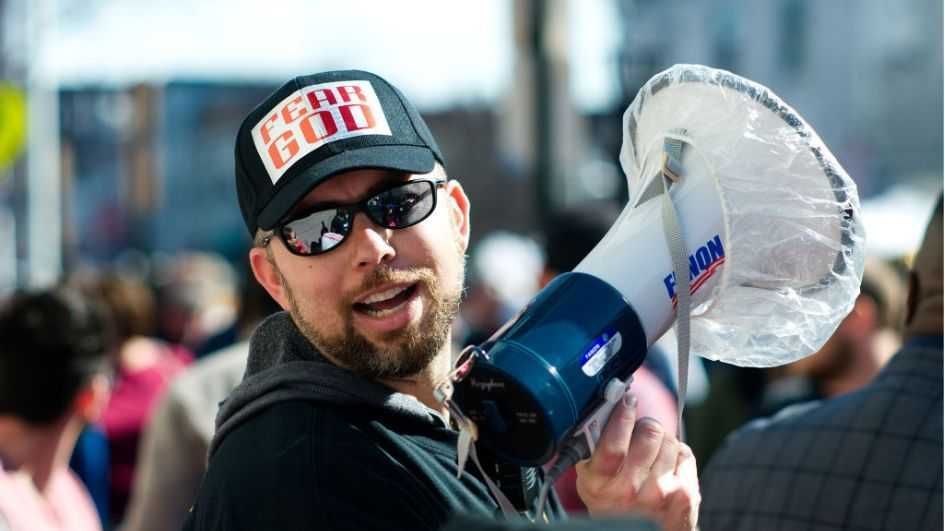
The street preacher was a skinny, youngish guy (30?) with a trendy mustache. He wore a cap that said in big letters, "OBEY GOD."

He was standing on the corner, just outside my pizzeria. At the moment I went inside, he was being yelled at by a short, angry, gray-haired man (50?). I didn’t hear what was being said. I went inside.

Once I had my slice, I sat by the window so I could further observe the adventures of the street preacher and his sign.

By then, the short, angry guy had left. What had he been yelling about? He was probably outraged that a street preacher would dare come plant himself in the middle of the liberal Hawthorne district. And it was June! It was still Pride Month!

We need to have a dialogue

Once the short, angry guy was gone, things calmed down. But other people continued to stop and gawk at the street preacher or engage him in conversation.

For a while, a young woman (25?) was questioning him. She wasn’t yelling, but she seemed pretty worked up.

The street preacher listened to her and seemed to consider what she was saying. I was surprised by how intelligent he looked. Also, he was a reasonably good-looking guy. He wasn’t the pot-bellied, crew-cut fanatic one might expect.

Does God exist?

By the time I finished my pizza slice, a new crowd of people had formed around the street preacher. I went outside and joined the group. I wanted to hear what people were saying.

A middle-aged man wearing cargo shorts and Teva sandals was asking the street preacher questions: If there’s a God, why are there wars? Why is there poverty and disease? And how could God send anyone to burn in hell for eternity? Doesn’t God forgive? Doesn’t He love everyone equally?

To me, these questions sounded like what a 14-year-old would ask. Which made me wonder to myself: “Is everyone in Portland 14?”

RELATED: What was the 'alt-right'? 'Whitepill' clears up the media hysteria

Passage Publishing; Washington Post/Getty Images
What would Jesus do?

Another bystander joined in. He said that Christ didn’t go around denouncing people for their sexual preference. How could the street preacher carry a sign criticizing any people? Jesus would never do that.

The street preacher’s reply was something like: “The true God is a rigorous God. A righteous God. A God who does not tolerate sin. A God who does not excuse liars and perverts. God wants us to be godly. He wants us to live godly lives.”

A green-haired woman said: “Are you sure God is a He?”

The street preacher said: “God is our heavenly Father. He knows what is best for us. It is not our place to negotiate with Him. It is our place to obey Him.”

Classic liberal beliefs

That quieted the nonbelievers for a moment. But then other people chimed in. They espoused the classic liberal belief that “tolerance” and “acceptance” were always best. Who are we to judge?

But the street preacher stuck with his “rigorous” God idea. God had given us simple instructions. It was up to us to follow them. If you think you have a better plan than God ... if you think you know better than God ... well, good luck with that!

So who won the debate?

I don’t think anyone changed their minds during these discussions. But it was interesting to watch. People were respectful of each other at least. That was nice to see.

The main thing I took away from the debate was how poised the street preacher was. He was deep in enemy territory. But he never lost his cool. And he had clear and succinct responses to every question.

It was the Hawthorne atheists who couldn’t really articulate a coherent position. The best they could come up with was: “If God exists, why are people sad?”

Nor could the onlookers match the street preacher’s moral conviction. They were relativists. They couldn’t say what was “bad” or “good.” Anything could be “good,” if that’s what you were “into.”

Which worked fine in nonbinary, morally ambiguous Portland. But it wasn’t going to win an argument with this street preacher. Not today. Not even with the entire Hawthorne district backing you. This guy was taking on all comers. And he was not backing down.

HUD Launches Investigation of Portland-Area County Over Race-Based Homelessness Programs

The Department of Housing and Urban Development on Friday launched an investigation into Multnomah County, Oregon, over the county's race-based homelessness programs, writing in a letter to county officials that the programs likely violate the Fair Housing Act.

The post HUD Launches Investigation of Portland-Area County Over Race-Based Homelessness Programs appeared first on .

'Culturally Specific Corrections Counselors,' a 'Construction Diversity and Equity Fund,' and Race-Based Shelter Referrals: Portland Proposes Budget Larded With Racially Discriminatory Programs

Multnomah County, Oregon, which includes the majority of Portland, plans to spend nearly $300 million on explicitly race-conscious programs over the next year, documents reviewed by the Washington Free Beacon show, including a program that aims to house minority veterans "at rates equal to or greater than their white peers."

The post 'Culturally Specific Corrections Counselors,' a 'Construction Diversity and Equity Fund,' and Race-Based Shelter Referrals: Portland Proposes Budget Larded With Racially Discriminatory Programs appeared first on .

Is it finally time to abandon my ultra-liberal hometown?


I’m looking at new apartments this week here in Portland, Oregon. It’s time for an upgrade.

This has triggered a debate I often have with myself: If I’m going to move, why not leave dysfunctional, far-left Portland altogether?

Had I become so comfortable with the bad vibes of Portland that I would stay here indefinitely, out of inertia or laziness or not wanting to start over?

This is my chance to move to a different city. Or another state. Somewhere with fewer drug addicts and criminals roaming the streets and fewer democratic socialists roaming city hall.

I grew up in Portland. I have lived here off and on throughout my life. During my most productive years as a writer, I lived in bigger, more media-oriented cities, mainly New York and Los Angeles.

But I’ve always loved coming back to Oregon and assumed I would settle here when I retire. Portland always felt like my place. I love the tall trees, the gentle rain, the misty Oregon coast.

Free radicals

Unfortunately, over the last 15 years, Portland has become a hotbed of radicalism and political intolerance. So much so that it has affected my daily life.

I’ve always socialized with creative types. But in Portland, the artistic community is often more hysterical than the violent protesters in the street.

Once it became known I was conservative, I lost about 80% of my writer friends. And maybe half of my other friends. This social exclusion was especially bad during the years around #MeToo, and then COVID, and of course the constant presence of Trump derangement syndrome.

Un-friendzoned

The result is that living here has been like living on a desert island. I feel unwelcome at art events. I avoid literary parties and gallery openings.

One egregious example: I didn’t attend the celebration of life for one of my most important literary mentors, a beloved Portland poet who encouraged me as a young writer and helped advance my career.

I owed so much to this man, and I couldn’t go to his funeral!

RELATED: WACK JOB: My adventures in the mental health industrial complex

Michael Ochs Archives/Getty Images

Tiny bubbles

Recently, I saw a TikTok video by a woman whose family had moved from Seattle to Wyoming.

Her message was simple: “No matter how much you think you are aware of the bubble you live in, when you get out of these far-left cities, a whole new world opens up to you.”

This hit me hard. Had I become so comfortable with the bad vibes of Portland that I would stay here indefinitely, out of inertia or laziness or not wanting to start over?

My own private Idaho

One reason I’m reluctant to move to a red state is I’m not sure I would fit in.

Take for example, Boise, Idaho, the closest red city to Portland. I’ve visited there many times. It’s clean. There are no homeless. The people are super nice. It’s very “churchy” and family-oriented. There’s a large Mormon population.

But could I adapt to such a place? I’ve lived in liberal cities MY ENTIRE LIFE. I have never lived in a place like Boise. Would I find people who understand my sense of humor? People who like the obscure music I listen to? Or read the books I read?

Yes, the people of Boise would share my core values. But would they share my urban tastes?

Go east, young man

I had a Republican friend here in Portland who moved to Florida during Trump’s first term. At the time, that seemed like a drastic change.

For a couple of years, I emailed him every few months to ask how he was doing. He had settled right in. Florida was great. He loved it there.

As he grew more comfortable in Florida, I grew less comfortable in Portland. Now, in 2026, moving to Florida 10 years ago seems like a genius move. I am humbled by his foresight.

The great escape?

So what should I do? Be the latecomer, arriving in Tampa or Austin or Nashville a decade after all the smart people already moved there?

I guess it’s never too late. I could still escape.

But what about the tall trees, the gentle rain, and the misty coastline I love so much? What about my roots in the place where I grew up?

Robert E. Lee didn’t abandon his home state of Virginia in the face of a civil war. But Virginia was famous for its proud history and strong cultural heritage.

I’m from Portland, famous for people with orange hair who don’t know what gender they are.

Fall into the gap

I’ve always assumed Portland’s current political extremism would fade over time. Sooner or later, people would calm down and return to some form of normalcy.

But whenever I try to connect with my former liberal friends, I quickly learn that the derangement is stronger than ever.

So, should I stay or should I go?

These are the decisions we have to make during these difficult times — as we struggle to maintain our sense of ourselves and of where we came from.

Disabled Woman Sues Multnomah County After Race-Based Program Denies Her Rent Relief

A disabled woman is suing the homeless services department in Multnomah County, Oregon, after she was denied rent relief due to her low score on the county's race-based prioritization rubric, which awards more points for requesting "culturally specific services"—including "BIPOC"-focused housing—than for having a disability.

The post Disabled Woman Sues Multnomah County After Race-Based Program Denies Her Rent Relief appeared first on .

EXCLUSIVE: In Cities Across America, Homeless Services Are Doled Out Based on Race and Sexual Identity

The homelessness crisis in Multnomah County, Oregon, is among the worst in the country. Home to deep-blue Portland, where the deaths of homeless people quadrupled between 2019 and 2023, according to data from the county health department, Multnomah has a per-capita homeless rate of 1.3 percent, and some shelters are closing due to budget problems.

The post EXCLUSIVE: In Cities Across America, Homeless Services Are Doled Out Based on Race and Sexual Identity appeared first on .

I love my MAGA hat — but sometimes you want coffee without a triggering a screaming meltdown


I went to meet an old friend for coffee on the East Side of Portland. I don’t make it over to the East Side very often. That’s the more progressive, “social justice” side of town.

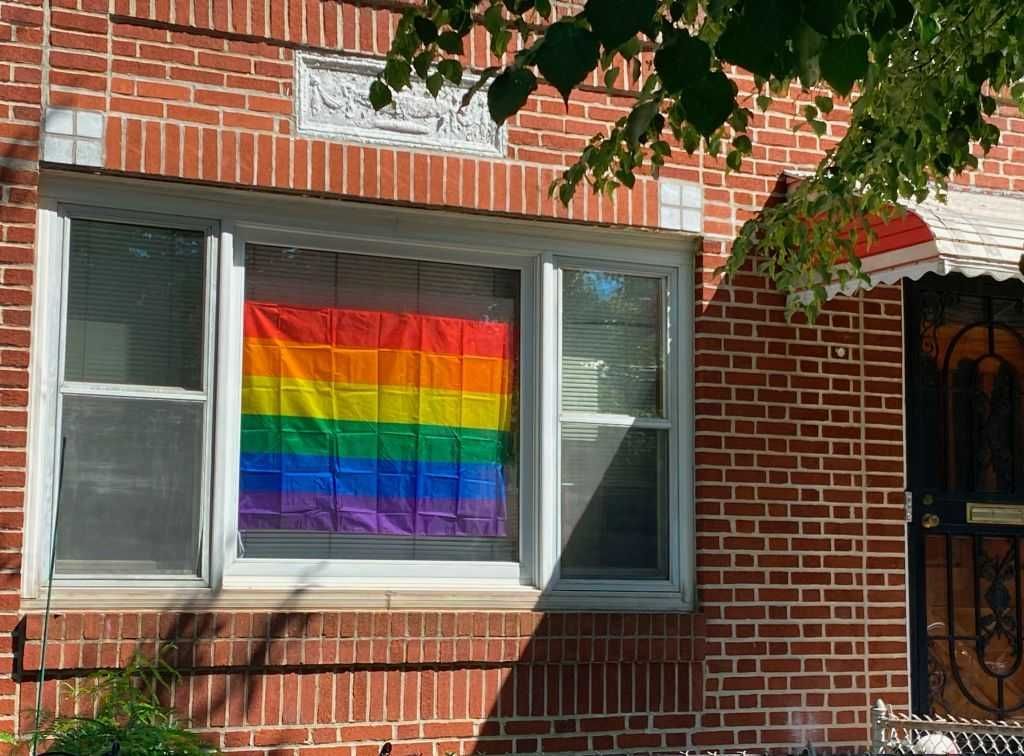
That’s where the most WE BELIEVE IN SCIENCE signs are. And Pride flags. And other statements of left-wing beliefs, prominently displayed.

Who in their right mind would wear an actual MAGA hat on the East Side of Portland? You might get attacked by a woman with face tattoos.

It’s also where people get stabbed, shot, and drive their cars into other people’s houses.

I live on the West Side, where people are more reserved and reasonable. Though there’s a lot of SCIENCE and PRIDE over there too.

Philadelphia Freedom

So I pulled up at the cafe to meet my friend. The sun was out, so people were sitting at outside tables: a lesbian couple, three skinny guys with tattoos, and an odd-looking woman in a dress and lipstick — but also with a tuft of gray hair growing out of the bottom of her chin. I was a bit startled by that.

And then another surprise: When I reached for the cafe’s front door, I saw myself in the glass reflection. I was wearing my bright red Phillies baseball cap.

In case you don’t know, the Phillies are a baseball team from Philadelphia. Their team colors are red and blue. Their hats are red.

I also own a Boston Red Sox hat that is navy blue, a San Diego Padres hat that is brown, and some other hats of other colors. I wear all these hats randomly. I own all these hats because I play softball in the summers and I like to rotate my hats.

The problem with the Phillies hat is that it’s almost the exact same shade of red as a MAGA hat. So if people catch sight of it out of the corner of an eye, they think they have spotted a MAGA person.

For this reason, my Phillies hat has been out of my usual hat rotation. When Biden was president, I wore it occasionally. But with Trump back in office and Portlanders suffering from their various Trump derangement diseases, I do not.

RELATED: The secret to senior softball? It's all about the magic bat

Irfan Khan/Getty Images

Behind enemy lines

Earlier that day, I had been wearing the red Phillies hat to run errands near my house. On the West Side, nobody cares what color hat you’re wearing.

But on the East Side, they do care. They care a lot. For instance, the woman with the gray beard had looked up at me as I walked by. She was probably checking my hat. And since it didn’t say MAKE AMERICA GREAT AGAIN, she went back to her coffee.

And really, who in their right mind would wear an actual MAGA hat on the East Side of Portland? Nobody. Especially going to a hipster coffeehouse. You’d be asking for trouble. You might get attacked by a woman with face tattoos.

Seeing the bright red hat in the door’s reflection, I had to make a decision. Go into the leftist cafe with my Phillies cap? Which might draw stares. Which might provoke comments. Or go back to my car and throw it in the trunk?

I mean, at some point, you gotta say enough is enough. A hat is just a hat. Even if it was a MAGA hat, shouldn’t I be allowed to wear it? Isn’t this America?

Our Lady of the Sacred Hat

I did have a MAGA hat back in the early days. This was when I was volunteering for a Republican candidate for governor in 2018. At some point, someone handed out MAGA hats.

Unfortunately, they were so badly made that they were unwearable. The top part of the crown wasn’t stitched properly, so it pointed upward in a clownish way.

Later, I found a real MAGA hat that was immaculate. It looked fantastic. But I never wear it. I keep it under lock and key. It’s my most prized possession.

To poke or not to poke

Meanwhile, back at the cafe, I had to make a decision. Seeing my hat in the door’s reflection, I could clearly see the big white “P” on the front. The “P” stood for “Philadelphia Phillies.” Any idiot could see that.

But leftists are crazy. And they can be dangerous. Especially in Portland. One is wise not to provoke them.

Also, my old friend was probably left-leaning himself. We hadn’t discussed it, but he lived on the East Side with his wife and kids. So even if he wasn’t a Democrat, he would have to pretend he was.

Did I want to put him through the awkward moment of seeing my bright red hat and asking himself, “Why is he wearing that?”

I did not. Nor did I want to get stared at. Nor did I want to have to explain myself. Nor did I want the barista to spit in my coffee. Or worse.

Live to fight again

So I went back to my car and threw my Phillies hat in the trunk. Fortunately, my old Los Angeles Dodgers hat was crumpled in the back. I uncrumpled it, put it on, and went back to the cafe.

Now there would be no problems. Though I did get a very suspicious look from the gray-bearded lady.

Anti-ICE inflatable frogs join Democrats at State of the Union counter event


While President Donald Trump gave the first State of the Union address of his second term on Tuesday night, many Democrats boycotted the speech and opted to engage in some unconventional counterprogramming.

For example, some Democrats attended an event organized by Defiance.org at the National Press Club in Washington, D.C, and at least one of them was joined on stage by some ... special guests.

'Tonight I defy Trump and his authoritarian project by standing in joyful, radical, peaceful resistance with the Portland Frog Brigade!'

Video emerged on Tuesday night showing Oregon Rep. Maxine Dexter (D) speaking at the event, while six inflatable frogs stood beside her and many more stood off to the side.

"Tonight I defy Trump and his authoritarian project by standing in joyful, radical, peaceful resistance with the Portland Frog Brigade!" Dexter said as the frogs jumped around and waved small American flags.

RELATED: VIDEO: Federal agents clash with mob of Antifa-fueled, anti-ICE protesters in Portland

Photographer: Al Drago/Bloomberg via Getty Images

Defiance.org describes itself as a "club for courageous Americans — people willing to take peaceful, lawful, defiant action to defend democracy from a wannabe dictator." The organization partnered with the Portland Frog Brigade for this event, though the group has been making its anti-Immigration and Customs Enforcement stance known since last year.

According to its "about" page, the Portland Frog Brigade was created after an anti-ICE activist — apparently known by several names such as Toad, Toad Todd, and antifascistfrog — was sprayed by federal law enforcement outside Portland's ICE facility. The organization emphasizes that the "absurdity" is core to the idea behind the group:

The image of a cartoon frog facing off against a wall of heavily armored men was so strikingly absurd that it cut straight through the noise and brought home the reality that our government is treating peaceful citizens as enemies.

From that moment, the frog became a symbol of resistance that refuses to lose its joy. The Brigade took inspiration from Toad and grew as so many others donned inflatable animal suits and joined actions across the country and around the world.

However, not all is well in inflatable paradise.

The partnership between Defiance.org and Portland Frog Brigade has apparently caused infighting with an adjacent group called Operation Inflation.

Operation Inflation posted a video on Instagram criticizing the partnership and distancing itself from the other organization: "The frog brigade, however, saw the frog and emptied it of context, taking the image without the work, the aesthetic without the politics, and shared it with an establishment that can only function through neutralizing resistance."

"When the loudest voices take the safest route, do not trust them," the spokesperson in a red frog suit said.

Toad, the figurehead, reposted the video on his own Instagram account, seemingly attempting to likewise distance the symbol from the Portland Frog Brigade. He has also previously called the brigade a "business of grifters seeking to piggy off the backs of actual activists."

Like Blaze News? Bypass the censors, sign up for our newsletters, and get stories like this direct to your inbox. Sign up here!