A Supreme Court That Doesn’t Stop Birthplace Citizenship Isn’t Originalist
 Originalism counts for little if justices can brush aside the historical evidence because it is inconvenient.
Qualified immunity, a doctrine the Supreme Court created in 1967, bewilders ordinary citizens who run headlong into it after government officials trample their constitutional rights. In plain English, the doctrine often blocks lawsuits against officials unless a prior court decision “clearly established” that the specific conduct at issue violated the Constitution. That standard leaves many victims without a remedy and lets many constitutional wrongs go unanswered.
That is not right. The Constitution exists to protect individual rights, not to insulate officials who violate them from accountability.
Qualified immunity can turn constitutional protections into paper rights — recognized in theory, unavailable in practice.
Recent years have also supplied fresh reasons to question the doctrine’s scope. Abuses tied to the weaponization of law enforcement and the criminal justice system have come to light with unsettling regularity. Think of Crossfire Hurricane, where senior officials used a discredited dossier — commissioned by Hillary Clinton’s campaign and funded through political channels — to pursue surveillance warrants and to monitor an opposing campaign before and after the 2016 election.
Or consider Arctic Frost, the childishly named operation (Arctic Frost is a type of orange, as in “Orange Man Bad”) that targeted hundreds of Americans, including one of the co-authors (Eastman) and relied on sweeping demands for private communications and records in search of a predicate offense in hopes of derailing President Trump’s 2024 campaign.
Episodes like these, and others, zero in on a basic question: When government power crosses constitutional lines, who answers for it?
Qualified immunity often supplies the answer: nobody.
Now the Supreme Court appears to be taking an unusual look at the doctrine — at least if its recent handling of three qualified immunity petitions offers any clue.
In prior years, the court has frequently disposed of qualified immunity petitions quickly, sometimes through summary action with no explanation. This term looks different. Three cases involving qualified immunity have sat on the court’s docket far longer than the usual pattern would suggest. The justices have repeatedly requested responses and, in several instances, called for lower-court records. The court has also rescheduled cases for conference after conference without issuing a decision.
That process does not prove the court plans to revisit the doctrine. But it does suggest heightened attention.
The petition for writ of certiorari in Smith v. Scott was filed nearly a year ago. The case arises from a tragic encounter that began as a call for help. A 65-year-old man contacted police because he believed intruders lurked outside his apartment. Officers arrived, found no intruders, and then attempted to handcuff him. The encounter escalated. Officers restrained him on the ground, and an officer allegedly applied pressure that impeded his breathing until he died.
Both the district court and the Ninth Circuit denied qualified immunity. The officers then asked the Supreme Court to intervene. The respondent (Scott’s estate) initially waived a response, which commonly happens in cert-stage litigation. The court did not let the waiver stand. It called for a response after the case’s first conference last May. After a later conference, the court requested the record. Since then, it has repeatedly relisted the petition — an astounding 13 times — without resolving it.
Zorn v. Linton involves a protest at the Vermont State House. Demonstrators occupied the chamber floor to protest government policy. Most left when the building closed. Shela Linton stayed and refused to leave. Officers removed her using a rear wristlock. She sued, alleging unreasonable force that caused pain, injury, and trauma.
The district court granted qualified immunity. The Second Circuit reversed and denied qualified immunity. The petition reached the Supreme Court in September. Once again, the respondent waived a response, and once again the court requested one. The case then cycled through conference after conference before the court requested the lower-court record on February 27.
This case matters for another reason. Many qualified immunity disputes involve fast-moving encounters where officers make split-second judgments. This one involves an interaction with warnings, time, and repeated opportunities to comply. It tees up an issue courts often sidestep: the obligations citizens assume when they knowingly violate a lawful order and force officers to escalate to removal. Does a protester’s refusal to leave reduce the scope of what counts as “unreasonable” force, so long as officers use measured escalation? Put differently: Were Linton’s rights even violated?
Villarreal v. Alaniz sits at the intersection of qualified immunity and the First Amendment. Police arrested journalist Priscilla Villarreal under a state statute that barred solicitation of nonpublic information. The reporter argued that the arrest violated her First Amendment rights.
The procedural history highlights the doctrine’s power. The district court granted qualified immunity. A Fifth Circuit panel denied it. The full Fifth Circuit later granted it en banc. The Supreme Court vacated and remanded the decision for further consideration. The Fifth Circuit again granted immunity.
Judge Andrew Oldham, in a concurring opinion, made an observation that cuts to the heart of qualified immunity’s justification. Courts often defend the doctrine by pointing to the realities of policing: officers must act quickly, sometimes under threat, with incomplete information. Oldham questioned whether that rationale “makes sense” in a case involving time to find a statute, plan an arrest, consult counsel, and investigate facts. Under those circumstances, why should immunity hinge on whether a prior case matches the fact pattern with near-photographic precision?
The cert petition was filed last July. The Supreme Court requested a response in August. It later requested the record after multiple conferences.
No outsider can know what the justices plan. But these three cases, taken together, give the Supreme Court a menu of options.
The court could reinforce qualified immunity, especially in excessive-force cases, and use the term’s docket to signal more protection for officers facing a rising tide of litigation.
The court could narrow qualified immunity — particularly in cases where officials have time to deliberate, plan, and consult — because the “split-second decision” rationale does not apply.
RELATED: The common-sense case for nationalizing US elections

The court could also recalibrate the doctrine without overruling it: clarify what counts as “clearly established” law, tighten the inquiry, or distinguish between scenarios that demand rapid judgment and those that involve considered decisions.
In the abstract, “immunity from liability for violating rights” begins to resemble artificial judicial indemnification. Modern society does not grant that kind of blanket protection to most other professions. A surgeon, an engineer, or a corporate executive cannot avoid accountability because no prior case warned that the precise mistake at issue would cause harm. The law often holds them to general standards of care, not hyper-specific precedent.
Qualified immunity operates differently. It can turn constitutional protections into paper rights — recognized in theory, unavailable in practice.
Whatever the court’s destination, the road looks different this term. The extended consideration, repeated relists, and requests for records in multiple cases point to sustained attention. That alone marks a change.
If the court means to revisit qualified immunity, even in part, the consequences will ripple far beyond these three cases. Federal courts hear thousands of civil rights claims each year. The doctrine shapes whether citizens can vindicate constitutional rights at all.
At minimum, one conclusion now seems hard to avoid: The Supreme Court is looking closely. And when the court looks closely, doctrine can move significantly.
The Supreme Court’s recent ruling greenlighting mass layoffs at the Department of Education sends a clear message: The courts no longer belong to the Democrats.
For decades, Democrats relied on judges to impose policies they couldn’t pass through Congress. But that strategy has collapsed. With a conservative majority now on the bench, the judicial workaround has given way to constitutional limits — and the left is losing.
Every time Democrats sue to block Trump’s orders, they hand him another opportunity — and this court is more than ready to lock in conservative victories for a generation.
In the final week of its 2024-2025 term, the high court:
In high-stakes emergency cases, Trump keeps winning — notching victories in nearly all 18 Supreme Court petitions. That includes greenlights to deport migrants to third countries and enforce the transgender military ban.
Democrats thought they could run out the clock with courtroom delay tactics. Instead, they handed Trump a fast pass to the one branch he dominates.
Only one branch of government speaks with a single, constitutionally defined voice — the executive. And right now, that voice belongs to the president, no matter how loudly the deep state screams.
Unlike the executive, Congress isn’t built for speed. It’s a fractured, slow-moving body by design — hundreds of voices split by region, party, and ego. The judiciary can splinter, too, with power scattered across lower courts nationwide.
But the Supreme Court? That’s a different story.
With a 6-3 conservative majority, Trump holds a 2-to-1 advantage. Imagine if Republicans had that kind of dominance in Congress.
Trump wouldn’t be scraping by with a razor-thin 220-212 majority in the House. His agenda would cruise through. In the Senate, forget the 60-vote filibuster firewall — Trump’s bills would pass outright.
Reconciliation wouldn’t be a high-wire act. It would be routine. No more watching the Senate parliamentarian gut key provisions from his One Big Beautiful Bill Act.
Granted, the Supreme Court can’t launch policy offensives like Congress or the White House. It waits for cases to land.
But thanks to Democrats, those cases keep coming. Every time they sue to block Trump’s executive orders, they hand him another opportunity — and this court is more than ready to lock in conservative victories for a generation.
For decades, Democrats treated the courts as a shortcut to power. When they couldn’t pass laws, they let judges do the work. Roe v. Wade was the crown jewel — a sweeping federal abortion mandate they never could have gotten through Congress. Even Ruth Bader Ginsburg admitted the legal reasoning was flimsy.
They used the same playbook to expand the welfare state and rewrite social policy from the bench. Judicial activism became the norm, and both sides played the game. But Democrats played it harder — and now the rules are turning against them.
What once looked like a string of permanent victories has turned into a pipeline of defeats. Every lawsuit they file hands Trump’s Supreme Court another shot at affirming his agenda. Even when he technically loses, the rulings often leave behind a roadmap showing exactly how to win the next round.
RELATED: Supreme Court grants massive victory to Trump administration on cutting down Department of Education
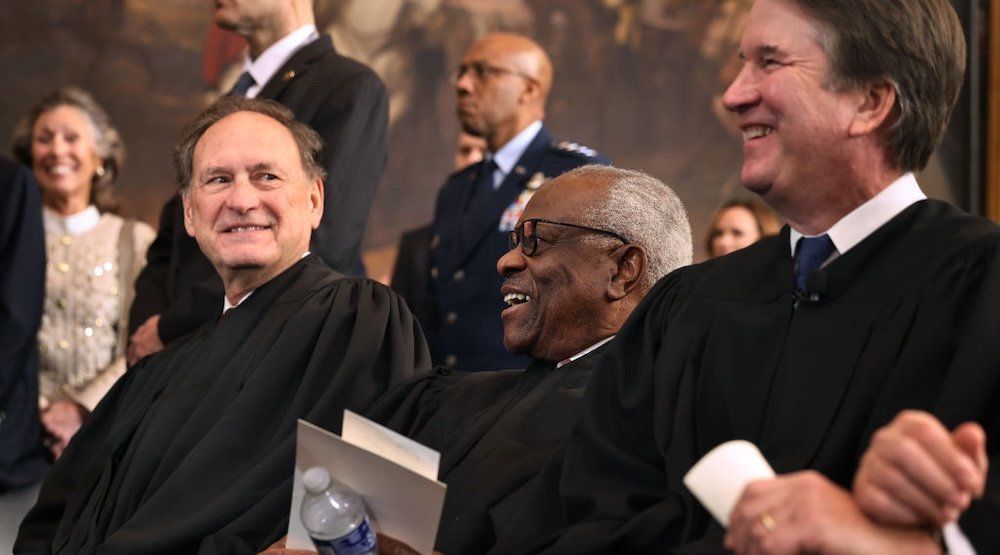
Democrats’ Supreme Court problem could get a lot worse. Justice Sonia Sotomayor, the court’s oldest liberal at 71, has Type 1 diabetes and a history of health problems. If she steps down during Trump’s term, he could lock in a 7-2 conservative majority.
And if either Clarence Thomas, 77, or Samuel Alito, 75, decides to retire, Trump could replace them with younger conservatives — extending the court’s rightward tilt for decades.
Trump has every incentive to issue bold executive orders. Each lawsuit the left files creates another opening for the Court to back him — and turn temporary wins into permanent precedent.
By chasing headlines and placating the base with short-term court fights, Democrats are handing Trump the long game. Their decades of judicial overreach have backfired. The courts they once controlled now serve as Trump’s most powerful weapon.
 A new Pew Research study dismantles a phony line of attack used by media activists to smear the Supreme Court's conservative majority.
 Associate Justice Clarence Thomas has often served as critical voice of reason on the U.S. Supreme Court. So, it wasn’t a surprise when he delivered a much-needed dose of reality about the high court’s constitutional role during a rare public appearance late last week. Speaking at the Catholic University Law School, the current court’s longest-serving […]
 The Supreme Court has become a paper tiger, failing to hold defiant lower courts accountable when they make rogue decisions.
 The actions hemming in the administrative state put power back where it belongs — with elected representatives and ultimately with the people.
 As the Fischer case may soon prove, the convictions the special counsel seeks could be for crimes that don’t exist.
 Capitol Hill should resist this lie with every constitutional power it can muster.
 thefederalist.com
 www.theblaze.com
 www.theblaze.com
Levin: Precedents and presidents, the left's relentless campaign against Trump
Not a single person has been charged with insurrection regarding January 6, yet the Democrat Party continues to dredge up baseless allegations against former President Donald Trump.
Meanwhile, there’s plenty of actions other former presidents have taken that could also be looked at through a criminal lens.
“What if a president ordered the killing of an American citizen overseas or ordered the killing of what he believed to be terrorists but also winds up killing, let’s say, an American citizen who’s 16 years old, a teenager— perhaps the son of one of these terrorists who hasn’t actually committed a terrorist act,” Mark Levin says.
“Is that criminal, guys?” Levin asks, adding, “well, that’s what Obama did.”
“So my question to you is: should Obama have been prosecuted for knowing that he could possibly kill an innocent American citizen while trying to take out his father?” He adds.
This isn’t hypothetical. That case was actually brought to federal court by the American Civil Liberties Union against the Obama administration.
However, the court did nothing.
“It sidestepped,” Levin explains, “that’s what they do for Obama and Biden and their ilk.”
Joe Biden isn’t innocent either.
“Can Joe Biden be sued for violating our immigration laws by people who’ve literally lost family members as a result of that decision? People being killed on the border, people being raped on the border, illegal aliens in the country killing American citizens — can he be used for that?” Levin adds.
Want more from Mark Levin?
To enjoy more of "the Great One" — Mark Levin as you've never seen him before — subscribe to BlazeTV — the largest multi-platform network of voices who love America, defend the Constitution, and live the American dream.