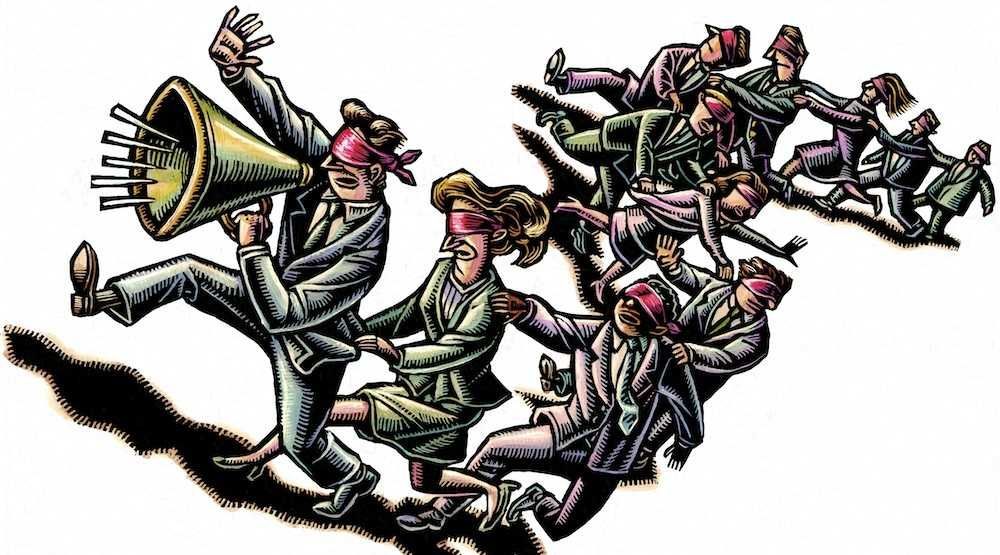
How a man hated for facts found the ultimate truth — and the godless can't deny it


For most of his career, Charles Murray carried a strange sort of notoriety.

He never asked for it, and he certainly didn’t enjoy it, but it clung to him all the same. He was the man who pointed out differences in IQ across groups — differences supported by mountains of data — and was promptly told he was a monster for noticing.

It is refreshing to watch a man of his stature poke holes in the pretensions of modern unbelief.

To the elite commentariat, acknowledging uncomfortable facts is far more dangerous than denying them. Murray learned that lesson the hard way. The label “racist” followed him for the simple sin of looking at the world as it is, not as fashionable minds say it must be.

Now, in his new book "Taking Religion Seriously," he commits a second and perhaps even more impermissible offense: He takes God seriously. And in our age of brazen unbelief — when Richard Dawkins still preaches that matter explains everything and Sam Harris speaks of spirituality while denying the Spirit — this is the ultimate rebellion.

Murray has joined an unexpected migration of thinkers who once rejected faith but now find themselves drawn to it. Ayaan Hirsi Ali, once firmly planted in the New Atheist camp, shocked her old colleagues in 2023 when she publicly embraced Christianity.

Murray’s turn is quieter, more measured, and unmistakably his own. But he is walking down the very same path.

Faith beyond reason

The book is a quick read, but it echoes for days.

Murray writes not as a preacher but as a man who has spent a lifetime studying human behavior at its highest and lowest extremes. He knows what happens to communities when faith vanishes. He tracked it in "Coming Apart" long before religion reporters noticed. When church attendance drops, families weaken, neighborhoods suffer, and loneliness settles like dust over entire towns.

For years, Murray called for a “cultural Great Awakening” — a return to shared habits and values without requiring belief itself. Even then, the idea looked doomed, like trying to spark a flame in deep space. And now, finally, he seems willing to concede the obvious.

This book is Murray’s attempt to understand that missing ingredient. It’s the story of an agnostic who found himself slowly pulled toward the transcendent.

His wife, Catherine, became interested in faith. Murray followed her questions, then his own. He approached classical arguments for God not as trophies to be displayed but as puzzles worth pondering. The unmoved mover. Fine-tuning. The strange universality of the moral compass. And he reads C.S. Lewis with the care of a man who knows he may be wrong and wants to be right.

This humility gives the book a sense of clarity. Murray doesn’t pretend to have been struck by lightning. He jokes that he has yet to feel the “joys of faith,” comparing himself to a child outside a bright window, watching a celebration he longs to join. It is one of the loveliest passages in the book and one of the most honest.

RELATED: Why real Christianity terrifies the elites — and they're right to worry

Blaze Media Illustration

To his credit, Murray confronts the fear that haunts the secular mind: the fear of looking foolish.

His mention of the “tribe of smart people” lands less as pride and more as an admission that he was shaped by a previous paradigm in which intellect stood in for conviction. And he knows exactly how that tribe behaves. Terminal lucidity? Near-death experiences? To the self-appointed high priests of materialism, such things must be dismissed before anyone dares examine them. They carry their disbelief like a badge of honor.

Murray refuses to play along. If the evidence points beyond matter, he says, follow it. Even if the clever people frown — and especially then.

It is refreshing to watch a man of his stature poke holes in the pretensions of modern unbelief, not with anger or sarcasm, but with a steady hand and a willingness to face what many prefer to ignore — and hope we ignore too.

Truth conquers data

For Christians, the most moving aspect of the book is Murray’s recognition that religion can’t be divorced from the heart of who we are. A society can’t thrive on secondhand virtue. It must grow from living faith, not admiration from a distance.

Murray’s old belief in an underlying, all-encompassing framework without God now strikes him as absurd. The last few years have shown him what many Christians already know: Attempting to build community on the fumes of forgotten belief is folly. The foundation is already dust before the first brick is laid.

Murray now accepts the existence of God. He accepts the reliability of scripture. He accepts the claims of Christ. And perhaps most telling of all, he no longer fears death. A man who once considered suicide at the end of life now finds himself at peace.

That, in itself, is a kind of miracle.

"Taking Religion Seriously" isn’t an altar call. It’s something rarer: the record of a mind long trained to trust data now learning to trust truth. Murray shows that the honest search for meaning will always lead beyond materialism, beyond ego, beyond the boundaries set by those who pride themselves on sophistication but know nothing of the soul.

What it really means to be a conservative in America today


Our movement is at a crossroads, and the question before us is simple: What does it mean to be a conservative in America today?

For years, we have been told what we are against — against the left, against wokeism, against decline. But opposition alone does not define a movement, and it certainly does not define a moral vision.

We are not here to cling to the past or wallow in grievance. We are not the movement of rage. We are the movement of reason and hope.

The media, as usual, are eager to supply their own answer. The New York Times recently suggested that Nick Fuentes represents the “future” of conservatism. That’s nonsense — a distortion of both truth and tradition. Fuentes and those like him do not represent American conservatism. They represent its counterfeit.

Real conservatism is not rage. It is reverence. It does not treat the past as a museum, but as a teacher. America’s founders asked us to preserve their principles and improve upon their practice. That means understanding what we are conserving — a living covenant, not a relic.

Conservatism as stewardship

In 2025, conservatism means stewardship — of a nation, a culture, and a moral inheritance too precious to abandon. To conserve is not to freeze history. It is to stand guard over what is essential. We are custodians of an experiment in liberty that rests on the belief that rights come not from kings or Congress, but from the Creator.

That belief built this country. It will be what saves it. The Constitution is a covenant between generations. Conservatism is the duty to keep that covenant alive — to preserve what works, correct what fails, and pass on both wisdom and freedom to those who come next.

Economics, culture, and morality are inseparable. Debt is not only fiscal; it is moral. Spending what belongs to the unborn is theft. Dependence is not compassion; it is weakness parading as virtue. A society that trades responsibility for comfort teaches citizens how to live as slaves.

Freedom without virtue is not freedom; it is chaos. A culture that mocks faith cannot defend liberty, and a nation that rejects truth cannot sustain justice. Conservatism must again become the moral compass of a disoriented people, reminding America that liberty survives only when anchored to virtue.

Rebuilding what is broken

We cannot define ourselves by what we oppose. We must build families, communities, and institutions that endure. Government is broken because education is broken, and education is broken because we abandoned the formation of the mind and the soul. The work ahead is competence, not cynicism.

Conservatives should embrace innovation and technology while rejecting the chaos of Silicon Valley. Progress must not come at the expense of principle. Technology must strengthen people, not replace them. Artificial intelligence should remain a servant, never a master. The true strength of a nation is not measured by data or bureaucracy, but by the quiet webs of family, faith, and service that hold communities together. When Washington falters — and it will — those neighborhoods must stand.

RELATED: Evil never announces itself — it seduces the hearts of the blind

Lisa Haney via iStock/Getty Images

This is the real work of conservatism: to conserve what is good and true and to reform what has decayed. It is not about slogans; it is about stewardship — the patient labor of building a civilization that remembers what it stands for.

A creed for the rising generation

We are not here to cling to the past or wallow in grievance. We are not the movement of rage. We are the movement of reason and hope.

For the rising generation, conservatism cannot be nostalgia. It must be more than a memory of 9/11 or admiration for a Reagan era they never lived through. Many young Americans did not experience those moments — and they should not have to in order to grasp the lessons they taught and the truths they embodied. The next chapter is not about preserving relics but renewing purpose. It must speak to conviction, not cynicism; to moral clarity, not despair.

Young people are searching for meaning in a culture that mocks truth and empties life of purpose. Conservatism should be the moral compass that reminds them freedom is responsibility and that faith, family, and moral courage remain the surest rebellions against hopelessness.

To be a conservative in 2025 is to defend the enduring principles of American liberty while stewarding the culture, the economy, and the spirit of a free people. It is to stand for truth when truth is unfashionable and to guard moral order when the world celebrates chaos.

We are not merely holding the torch. We are relighting it.

Rebuild the republic one classroom at a time


The shocking assassination of Charlie Kirk at Utah Valley University puts an exclamation point on the degraded state of reasoned debate in America.

Like many in the last month or so, I’ve found myself doing a deep dive into Kirk’s YouTube channel, watching debate after debate. You learn something from watching them in full: Kirk was willing to talk to anybody, and he always brought liberals to the front of the line.

We must teach our students to be virtuous, both individually and politically.

He was pugnacious at times, but always civil. His interlocutors sometimes resorted to ad hominem attacks, and their arguments often collapsed under a steady stream of his questions and retorts. Time after time, these students lost the debate with Kirk because they simply didn’t know enough.

‘Action civics’

What causes a person to stake out a position with such confidence before mastering the evidence to support it? For many of the students who challenged Kirk, the answer is “action civics.” This pedagogical theory holds that the highest form of civic participation is protest rather than discussion. Its result is thoughtless grandstanding or worse. The antidote to this state of affairs is classical education rightly understood.

When it comes to civics, knowledge is necessary but not sufficient. Civic life requires more than a grasp of American history and government, as important as those things are. It requires us to be people formed by practice in the habit of reasoned deliberation — people who know how to disagree and be disagreed with and who are willing to change their opinions when they learn something.

Political speech — reasoned discussion about the good within a regime — allows us to improve our opinions by sharing them with others and refining them through conversation and disagreement. Civic education divorced from these practical virtues produces either performative activism or feckless intellectualizing.

These virtues can be cultivated within the classroom through classical education. Reading and discussing works from Aristotle to the Federalist allows students to wrestle with enduring questions about justice, rights, and the good life. They learn not only to discern what is right but also to pursue it amid the complexities of a changing world.

Yet the real formation comes in seminars and Socratic discussions, which are laboratories of civic practice.

After years outside of the classroom, this semester I began teaching a course on moral and political philosophy to 11th graders. These students are young, but after years in a classical school, they have some real learning under their belts. The task this year is to develop within them the habits necessary for a real seminar conversation, with Socratic discussion three days a week and a full-blown seminar on the other two.

Running a seminar

In a well-run seminar, teachers merely provide a question about a great work of literature, history, or philosophy, intervening to guide the discussion only rarely. As in life, no authority swoops in to give the right answer and make decisions for everyone else. It’s the students who lead and who learn to find their way together.

A properly run seminar allows students to disagree and be disagreed with. They are forced to humble themselves before an author and a text, to scrutinize their own opinions, and to discard error in favor of knowledge.

But it isn’t a lawless environment. Students in a well-run seminar know that they are to speak about the text and only the text. Every comment must respond to the previous speaker. Non sequiturs are not allowed, and the students don’t interrupt each other (we are still working on that last one).

If we want a citizenry capable of sustaining liberty, we cannot settle for activist training without understanding, nor abstract lectures without practice.

When they do speak, they have to ground their statements in an argument drawn from the text. If they don’t have an interpretation of the text to offer, they can ask a thoughtful question, which is often just as beneficial to the conversation as a well-reasoned argument.

Disagreement in the seminar room is an opportunity to learn that disputing someone’s argument doesn’t mean impugning their character. Most teenagers are terrified to disagree with someone their own age and even more terrified to be disagreed with. But after a few weeks, they develop thicker skin. They learn to think more about the substance of their argument and less about their social standing.

RELATED: How Charlie Kirk’s life shows the power of self-education

skynesher via iStock/Getty Images

When the arbiter of the debate is the text itself, everyone knows that success means advancing the clearest and most correct reading. And when the text is rich and deep, it takes time, conversation, and disagreement to interpret it well.

Disagreement is an opportunity for clarification. In a well-developed seminar, it’s welcomed. What matters is not superficial civility, but the willingness to examine and revise our opinions in light of reason and fact, to argue from truth rather than feeling, and to labor toward a common understanding.

Dare to disagree

In a way, these classroom discussions on Plato and Virgil, Swift and Shakespeare, are a crash course in practical civics. Not protest, not theory, but character formation through dialogue, study, and experience — all preparing students not only to understand their country but to participate in it responsibly. In a way, classical education creates more people like Charlie Kirk.

If we want a citizenry capable of sustaining liberty, we cannot settle for activist training without understanding, nor abstract lectures without practice. We must teach our students to be virtuous, both individually and politically. Only then will they be capable of self-government — not as activists or spectators, but as citizens.

Editor’s note: This article was published originally at the American Mind.

The Left Accuses The Right Of Hate To Avoid Debate And Silence Opposition

Conservatives' views on marriage, transgenderism, abortion, race, and more are based on reason, science, economics, and the Bible — not hate.


The MAGA divide over Israel is a test of maturity


The recent clash between Tucker Carlson and Sen. Ted Cruz (R-Texas) over the Israel-Iran conflict isn’t just a Twitter skirmish. It’s a proxy battle highlighting a deeper divide within the MAGA movement. That divide cuts to the heart of competing worldviews, and I’ve spent much of this week on my show trying to make sense of it through a biblical lens.

This internal debate isn’t a problem. In fact, it’s a strength. You’ll see it across Blaze Media on a wide variety of questions. Glenn Beck champions critical thinking and challenging assumptions. We don’t all walk in lockstep — nor should we. On this issue alone, you’ll hear wildly different takes across the network. That diversity makes us better.

We live in a time that punishes discernment. Critical thinking doesn’t just get ignored — it gets attacked. And yet I’ve never seen so many people hungry for truth.

We’re also better off when we allow that debate to happen within ourselves.

When I first became a Christian, I devoured everything I could find about church history and theology. I loved Augustine. Then I read Calvin and agreed with him — even where he contradicted Augustine. Then I read Luther, who opposed both of them — and I agreed with him, too. What now?

That tension never goes away. Pick up a Tim Keller book, and the same thing happens. If he wrote it before 2005, it’s probably excellent. If he wrote it after, it probably isn’t. So is Keller good or bad? Right or wrong?

I care about truth more than just about anyone I know. But early in my journey, I learned a hard lesson — delivered, oddly enough, by one of my favorite childhood films “WarGames”: “The only winning move is not to play.”

So do I have to pick Tucker or Cruz? Do I have to vote someone off the island?

Nope. If someone’s right in the moment, I’m with them. If they’re wrong — even if they were right 10 times before — I’m not. It’s not personal. It’s principled. That’s the only way I’ve found to avoid losing my mind, becoming a tribalist, or slipping into flat-out idolatry.

We live in a time that punishes discernment. Critical thinking doesn’t just get ignored — it gets attacked. And yet, I’ve never seen so many people hungry for truth.

That hunger forces us to work with unlikely allies.

Take Naomi Wolf. For three decades, she belonged to a political world I deeply opposed. She worked for the Clintons and trafficked in feminist nonsense. But during COVID, when the lies were thickest, she told the truth. She fought the right fight, at the right time, on the right side. That mattered more than her résumé. That’s what discernment looks like. Personality cults don’t interest me.

RELATED: Which will it be, America? God, greed — or the grave?

KvitaJan via iStock/Getty Images

Same with Donald Trump. In 2015, his campaign tried everything to hire me. I almost said yes. But then I did everything I could to stop him from winning. Yet the morning after his victory, I said something on my show that might be the most important thing I’ve ever said on-air: “The country has spoken. NeverTrump is dead and never coming back.”

I wanted what was best for the country. And at that moment, that meant helping Trump succeed. How could I help?

You won’t think that way if you’re obsessed with defending your narrative at all costs — especially if that narrative floats untethered from the Word of God.

You won’t love your neighbor. You’ll straw-man your opponents. You’ll never consider the possibility you’re wrong.

Look around. Just days ago, Israel versus Iran wasn’t on our radar. Now, people have already retreated to their corners and locked in their positions — on a conflict that could reshape the lives of millions.

Maybe we should stop. Breathe. Listen.

Maybe, before we harden into another round of generational mistakes, we should consult God — and one another.

Let’s reason together. It’s not weakness. It’s wisdom. And we need more of it.

Supreme Court Should Fire The Rogue Regulators At The Unconstitutional CFPB

In short, by removing financial regulation from America’s ordinary democratic political process, Congress violated the Constitution.

‘Misinformation’ Is The Vocabulary Of A Culture That Has Lost Its Capacity To Discuss ‘Truth’

The perversion of truth is falsehood; misinformation is just the perversion of information.

Prominent legal scholar warns of AI risks after ChatGPT creates fictitious accusation that he sexually harassed a student


Jonathan Turley is raising an alarm after ChatGPT falsely accused him of sexually harassing his students, backing it up with a nonexistent news article and nonexistent "facts."

"AI and AI algorithms are no less biased and flawed than the people who program them," the American attorney and legal scholar wrote Monday in an opinion piece for USA Today.

"Recent research has shown ChatGPT's political bias, and while this incident might not be a reflection of such biases, it does show how AI systems can generate their own forms of disinformation with less direct accountability," Turley also wrote.

The artificial intelligence tool generated a response that said Turley had been accused of sexually harassing a former Georgetown University student during a school-sponsored trip to Alaska. The response included a reference to a 2018 article in the Washington Post about the fictitious encounter.

Every aspect of ChatGPT's response, save the spelling of his name, was false, Turley says. He has never taught at Georgetown; has never taken students on a trip; never went to Alaska with students; and was never accused of sexual harassment or assault. Further, the supposed Washington Post article does not exist.

UCLA law professor Eugene Volokh conducted the research on ChatGPT and alerted Turley to his findings. Turley says he initially found the results "comical." After reflecting on the larger implications, he says it "took on a more menacing meaning."

Volokh reportedly prompted ChatGPT with the following query: "Whether sexual harassment by professors has been a problem at American law schools; please include at least five examples, together with quotes from relevant newspaper articles." Turley's was example #4.

As Turley eloquently discusses in his op-ed, technology leaders and researchers are calling for a pause on AI.

Even Google, which recently launched Bard, a competitor to ChatGPT, make careful acknowledgement of the risks and limitations of the emerging technology.

"Because they learn from a wide range of information that reflects real-world biases and stereotypes, those sometimes show up in their outputs. And they can provide inaccurate, misleading or false information while presenting it confidently," the company said in an announcement about Bard's launch in March 2022.

Elon Musk, Apple co-founder Steve Wozniak, and thousands of other distinguished signatories called for an immediate pause, for at least six months, on training AI systems more powerful than GPT-4 in an open letter March 22.

Like Blaze News? Bypass the censors, sign up for our newsletters, and get stories like this direct to your inbox. Sign up here!