Pregnant woman reveals method to make her unborn son gay — and progressive moms cheer


A very disturbing TikTok video has gone viral after a pregnant woman recorded herself playing ABBA songs to make her unborn son gay — while thousands of mothers cheered her on in the comments and across social media.

The video shows her blasting the lyrics “Gimme, gimme, gimme a man after midnight” next to her stomach.

BlazeTV host Allie Beth Stuckey is shocked to read the comments, which include things like, “My son is 4 and exclusively listens to Sabrina Carpenter. Hopes are very high for him being gay.”

“My son just officially came out a few months ago,” reads another comment with a cheering emoji.


Another one reads, “My son was born to ‘Dancing Queen.’ I have high hopes for him.”

“This is disgusting that you are thinking about your child’s sexuality,” Stuckey says.

“It’s a horrible thing to wish on someone. It is. Now, I’m a Christian, and I believe that homosexuality is a sin, OK. But I also think that it’s bad for society to encourage this kind of thing,” she continues.

“We should be encouraging our boys to be strong and to be brave and to be protectors and to be fighters and to rein their masculine energy into good things. Yes, and you can call that old-fashioned, but it’s true,” she adds.

Stuckey likens these mothers’ hopes for gay sons to “conversion therapy” and calls it “very, very grotesque.”

“I talk about this concept of what I call ‘toxic mommy culture’ in my book, ‘You’re Not Enough (and That’s Okay)’ — when moms make their feelings and their validation and their social image the highest priority and they project that onto their kids and they use their children as props to perform this, like, progressivism on social media for likes, affirmation, cultural approval,” Stuckey says.

“I just find this little thing that this mother is doing gross. ... Kids are always the unconsenting subjects of progressive social experiments,” she continues. “It’s not good.”

Want more from Allie Beth Stuckey?

To enjoy more of Allie’s upbeat and in-depth coverage of culture, news, and theology from a Christian, conservative perspective, subscribe to BlazeTV — the largest multi-platform network of voices who love America, defend the Constitution, and live the American dream.

‘Heaven is the layover’: Wes Huff explains the TRUTH about bodily resurrection


The resurrection of the body and the true meaning of eternity is one of the most misunderstood ideas in Christianity, as many believe that the goal of being a Christian is to “go to heaven” after we die.

And BlazeTV host Allie Beth Stuckey and theologian Wes Huff are setting the record straight.

“It’s a sign of restoration, Allie,” Wes says of the “resurrection of the body.”

“It’s a sign that when Jesus says, you know, ‘I’m making all things new’ in the book of Revelation, that that’s a promise. That we understand that the world was not created to be the way that it is. That it was created good,” he tells Stuckey.

Huff points out that the phrase “it’s good” is repeated throughout the Bible as a reminder that the world is “marred by sin, but it was meant for so much more.”


“And that’s going to be restored. We’re going to see how God makes all things new,” he says.

As for going to heaven, Huff begins by noting “we often have this understanding that our end goal is to get to heaven.”

“We leave this mortal coil and that’s it, and we’re trying to escape. That’s actually an ancient pagan idea. The ancient platonic philosophers and the gnostics believed that the physical was bad and the spiritual was good and that our spirits are really trapped in these meat prisons. And the goal is to get away from this all,” he explains.

“And I think we swallow something that’s false when we think of heaven as the final goal. What we read about and what you see within the Old Testament in the hope of the resurrection is that all of the created order is going to be aligned and made new and restored and that’s going to be beautiful,” he continues.

God’s creations — the sunrise, the mountains, the ocean — will be restored to what they were meant to be.

“We’re going to be in awe once again at mountains, at stars, at oceans, at valleys, at, you know, forests, at deserts. These things are going to continue to bring us into awe in eternity because God is going to resurrect us in a body that is, I think ... probably analogous to something that we have here on earth, but much, much better,” Huff explains.

“Heaven is the layover. It’s going to be a great layover. It’s going to be an amazing layover,” he says, adding, “but it’s not going to be the end goal.”

Want more from Allie Beth Stuckey?

To enjoy more of Allie’s upbeat and in-depth coverage of culture, news, and theology from a Christian, conservative perspective, subscribe to BlazeTV — the largest multi-platform network of voices who love America, defend the Constitution, and live the American dream.
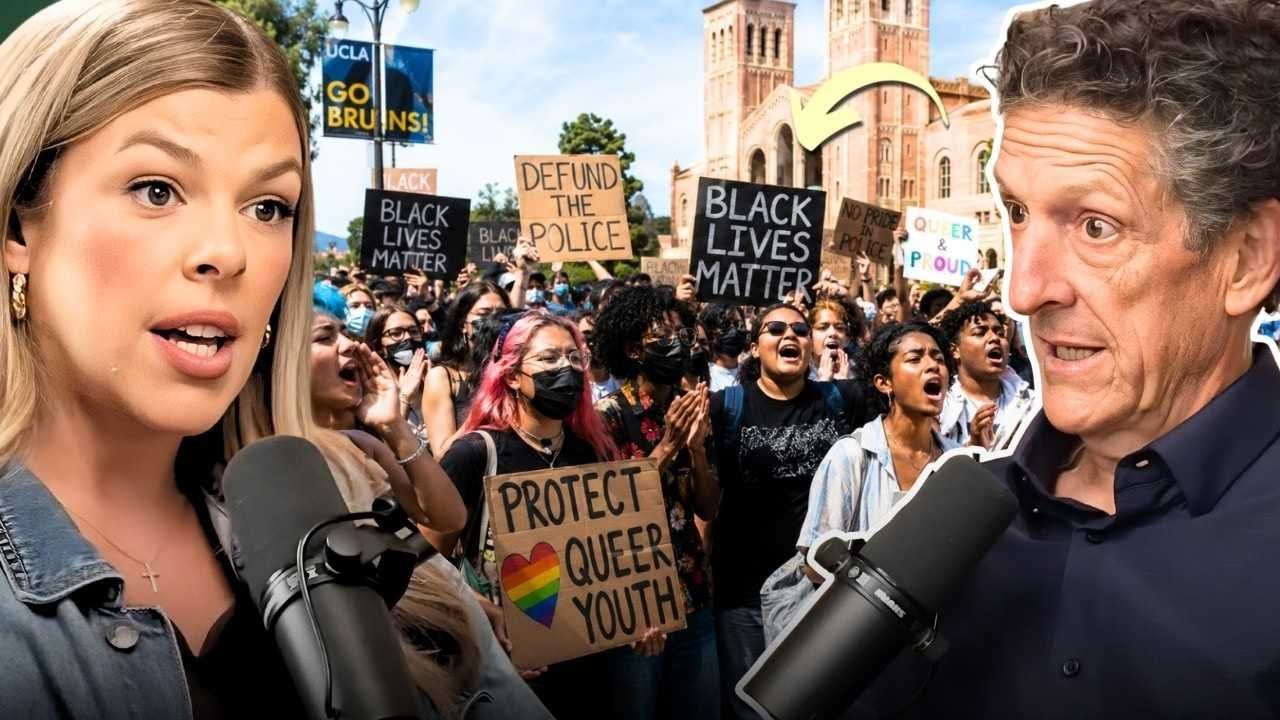
Are Jesus and Satan brothers? Allie Beth Stuckey challenges LDS podcaster on Mormon theology.


On a recent episode of “Relatable,” Allie Beth Stuckey sat down with Latter-day Saints podcaster Jacob Hansen to dive into all things Mormonism vs. Christianity. Allie asked all the toughest questions that illuminated both the crossovers and the differentiations between her evangelical Christian faith and the faith of the Church of Jesus Christ of Latter-day Saints.

In one of the spiciest segments of this 90-minute debate, Allie and Hansen tackled the crucial theological question: Are God, humans, angels, and even Satan all the same “type” of being?

In Allie’s perspective, this question isn’t about semantics. Our answer determines how we view God, Jesus, our great enemy, and what it means to be made in God’s image — all things that have eternal implications.

“There seems to be a little bit of a different origin story, though, that both Jesus and Satan were created in eternity past … that Satan and Jesus were brothers, [and] that we also — all of humankind — are brothers and sisters of Satan and Jesus. Is that correct?” Allie asks.

“I would say that Jesus and Satan are brother and sister in the same way that you and Nancy Pelosi are sisters,” Hansen jests.

“In Job 1, it says that the sons of God approached God and Satan was among them, right? So, okay, Satan is one of the sons of God, and Jesus is called the Son of God. So isn't there some sense in which there's some relationship there?” he continues.

But Allie interprets Scripture differently.

“How do you square that with the origin story that we read in Scripture that Satan was a fallen angel? ... Jesus even says that he saw Satan fall like lightning from the sky, that he led his own army of rebellious angels who were demons in hell. And we don't read that he was this being that was a brother to Jesus,” she counters.

“[Christians] would view angels as a totally different species from human beings, as some totally different creature. We don't hold to that sort of view. We believe that angels are also the same species as human beings,” Hansen says.

“Scripture says that angels long to see what we see, that they long to know what we know. And so there does seem to be a distinction there,” Allie disputes.

Hansen concedes that there is certainly a difference between humans and angels, but that doesn’t necessarily mean they are different beings entirely. “Perhaps they're pre-embodied beings or they're post-embodied beings that are no longer embodied,” he says, “but we don't make this distinction that there's all these different sort of species of creatures that are out there. … We are all children of God.”

And that includes Jesus in the Mormon faith. Hansen points to Christ’s words in John 20, when he tells his disciples, “I am ascending to my Father and your Father, to my God and your God,” as evidence that Jesus is a created being just like humans.

Similarly, there’s nothing in Scripture, he argues, to suggest that angels “are of a different genus” than humans, making Satan (a fallen angel) a brother, in essence, to both human beings and Jesus.

“You're kind of almost equating humans to God or that we can ascend to god-like status, and is that a belief that the LDS church has?” Allie follows up.

To hear Hansen’s answer, watch the episode above.

Want more from Allie Beth Stuckey?

To enjoy more of Allie’s upbeat and in-depth coverage of culture, news, and theology from a Christian, conservative perspective, subscribe to BlazeTV — the largest multi-platform network of voices who love America, defend the Constitution, and live the American dream.

Famous Christian detransitioner claims he’s re-transitioning to better serve Christ


Thomas "Neeza" Powers, born Thomas Ryan Powers, is a social media influencer and former transgender-identifying athlete who lived as a woman named Nicole for over a decade before publicly detransitioning in mid-2025.

He gained a massive social media following by sharing his story of identifying as a lesbian, then transitioning, competing in women's sports, and later experiencing a dramatic Christian conversion that led him to embrace his biological sex, advocate against men in women's spaces, and pursue Catholicism.

However, just a few days ago, Thomas announced that he is re-transitioning.

In his Instagram statement, he said: “The self-loathing I’ve had for the last eight months has been excruciating. I know you’re thinking that’s just your sin talking, but it’s not ... I believe in the holy Scriptures. I believe in the Lord Jesus. My heart is better to serve Him without hating myself. My heart is better as a partner to Charlotte without hating my existence, enforcing an identity on myself. And my heart is better to serve my community this way.”

BlazeTV host Allie Beth Stuckey has a strong suspicion that Powers’ primary motivation has less to do with “authenticity” than it does attention.

On this episode of “Relatable,” Allie dives into Powers’ complicated history and makes the case that his entire public persona and story — from the original transition through the detransition and back — was likely a stunt to build a massive following and monetize attention.

Allie’s first red flag is that Thomas’ “re-transitioning” announcement was initially posted as an Instagram “trial reel,” which is a feature that allows creators to test their content’s popularity with non-followers.

“He did not announce to his followers, at least at the time, that he was ‘re-transitioning’ so-called. So that to me tells me that he is putting out two different narratives,” says Allie.

But that’s just the beginning of Thomas’ suspicious inconsistencies.

“People started noticing some inconsistencies in his story, like his transitioning timeline, his relationship with his girlfriend, even his age,” says Allie, pointing to many internet sleuths who have dug up old photos of Powers that appear to contradict many of the claims he’s made about himself.

Further, Christian news outlet Protestia published a detailed exposé back in February, presenting evidence that Powers had fabricated or significantly misrepresented major parts of his story, including: his age (claiming to be in his 20s when public records show he was born in 1989, making him 36), his transition timeline (claiming he started puberty blockers at 16 and transitioned as a teen, but photo evidence pointed to him transitioning much later, closer to age 30), and key details of his relationship with his partner, Charlotte.

“I don't even know if this person really thinks that he is a woman or what he's trying to do. I think that obviously something is going on there that's wrong and it's evil and perhaps unstable,” says Allie. “To me the bigger issue seems to be that he is a pathological liar and that he has created a character to gain a following.”

“Now that does not decrease my compassion for this person because lost is lost. You're lost whether you're a man who thinks that you're a woman; you are lost if you are a person that is basically a scam artist ... and so the response is the same: that we pray for him.”

To hear Allie’s full deep dive into Powers’ questionable history, watch the episode above.

Want more from Allie Beth Stuckey?

To enjoy more of Allie’s upbeat and in-depth coverage of culture, news, and theology from a Christian, conservative perspective, subscribe to BlazeTV — the largest multi-platform network of voices who love America, defend the Constitution, and live the American dream.
Allie Beth Stuckey debates Latter-day Saints podcaster — and asks: Was Christ’s sacrifice not enough?


Today, Allie Beth Stuckey, BlazeTV host of “Relatable,” debated Jacob Hansen, a Church of Jesus Christ of Latter-day Saints podcaster whose channel is dedicated to exploring various worldview apologetics and comparing them to the LDS perspective.

In this fascinating 90-minute conversation, Allie and Hansen dive into important topics that differentiate creedal Christianity from the LDS faith, including the founding of the LDS Church, the Trinity, salvation, and much more.

Allie and Hansen kicked off the debate by discussing the founding of the Mormon faith.

It began in 1830 in upstate New York when a young farm boy named Joseph Smith claimed that God the Father and Jesus Christ appeared to him and directed him through the angel Moroni to translate the book of Mormon from ancient golden tablets.

“They essentially told [Smith] that the original church of Jesus Christ was not in its fullness on the Earth,” Hansen summarizes.

“What was missing was the priesthood authority and keys that were given to Peter … to effectuate the ordinances of salvation as a means by which we make covenants with our Father in heaven, and so you don’t have the fullness of the church without the fullness of the priesthood that is necessary to govern that institution, and we believe that was what needed to be restored,” he elaborates.

Allie asks Hansen a tough follow-up question: Does the Mormon church consider her — a Baptist — an apostate who lacks the fullness of truth?

“We would believe that you are a full, sincere believer in Jesus Christ, and we believe that you can reach a potential of relationship with Jesus Christ through that sincere belief that you have,” Hansen answers.

But in LDS theology, the afterlife isn’t binary as it is in the creedal Christian perspective. Heaven and hell are on a spectrum.

“The way that our faith views things is that there are different levels of light that people are willing to accept, right?” Hansen explains. “And the fullness of the light is to come into a full covenant relationship with Jesus Christ through His church, through the ordinances that put you into a covenant relationship with Jesus Christ.”

In other words, someone like Allie, who has a deep and personal relationship with Christ but rejects the tenets of Mormonism that contradict creedal Christianity, can experience “great joy and happiness” in the afterlife but not to the same level as those in the LDS Church who have both a sincere faith in Jesus Christ and fully accept the Church’s restored priesthood authority.

But Allie sees a contradiction.

“At least semantically, you would say Jesus died for our sins and that his sacrifice on the cross paid for our sins so that we could be reconciled to God,” she says.

“But it sounds like you’re saying there’s something else too — that Christ’s sacrifice wasn’t quite enough, that you also need to enter into ordinances.”

Hansen addresses Allie’s point with the analogy of a group of teenagers who ignored their parents’ warnings and decided to drive their car around a cliff.

“The brakes all of a sudden go out, and our car is heading downhill towards the cliff. … There’s nothing we can do to save ourselves; we’re going to go off that cliff, and then Jesus shows up with a helicopter, and He reaches His hand out and He says, ‘Take my hand, and I’ll get you out of this mess,' right?" says Hansen.

He explains that the teenagers in the car are not automatically rescued just because Jesus showed up. They have to “choose Jesus Christ” in order to be saved.

But choosing Christ isn’t just saying yes to being rescued, Hansen argues.

“Our view is that we have to do something to reach up to take His hand,” he says, pointing to how the crowd Peter was preaching to at Pentecost had to repent and be baptized before they received the gift of the Holy Spirit.

“So our view is that our repenting, being baptized, which is where we make this covenant with Christ, opens us up to receive the gift of the Holy Ghost by the laying on of hands by those who have authority,” he tells Allie.

To hear her response and watch the rest of the debate, check out the episode above.

Want more from Allie Beth Stuckey?

To enjoy more of Allie’s upbeat and in-depth coverage of culture, news, and theology from a Christian, conservative perspective, subscribe to BlazeTV — the largest multi-platform network of voices who love America, defend the Constitution, and live the American dream.
Journalist exposes explosive insider details of SCOTUS meltdown that almost killed Dobbs: ‘The walls were shaking’


Mollie Hemingway is the editor in chief at the Federalist and is known for her in-depth reporting on the Supreme Court.

On a recent episode of “Relatable” with Allie Beth Stuckey, Hemingway shared insider information about the wild circumstances leading up to the Dobbs decision — the landmark U.S. case that overturned Roe v. Wade and pushed abortion back to the states — including the Supreme Court justice who threw an epic tantrum behind closed doors.

“Everyone knew that [Roe v. Wade] was a problem. Everyone knew from the moment it was decided,” Hemingway says. “Even people on the left admitted this case, this decision isn’t even trying to be constitutional law. ... But then because the left so greatly wanted to believe that they had a right to kill unborn children, they just moved heaven and earth to keep that decision, even when it shouldn't have really been lasting for one year, much less 50 years.”

When the Court finally decided to hear the long overdue case, five justices were in favor of overturning the ruling. Justice Samuel Alito was assigned by Clarence Thomas to write the majority opinion.

What Alito produced was a “masterpiece work” — so much so that the dissenting judges were “shocked by how exhaustive it was.”

“There was no argument left standing,” Hemingway says.

Three months after the initial distribution, however, Alito’s draft opinion was infamously leaked, igniting a furious uproar among the left.

“We know that immediately the justices faced death threats, serious threats on their lives. They all had to be moved or be under a great deal of protection, increase their security posture,” Hemingway says, “because if any one of them had been killed ... that would have meant that the Dobbs decision would not have been handed down in the way it was. There would no longer have been a majority there.”

Allie and Hemingway speculate that this could have been the sinister intention of the leaker — to either get a justice killed or “gin up” enough outrage to pressure the weaker judges to join the dissent and eliminate the majority.

But none of the majority justices relented, despite the threats on their lives.

After the leak and the subsequent threats, the dissenting justices still hadn’t written their dissent.

“They were delaying the dissemination of this,” Hemingway says.

This was problematic because the majority justices were facing death threats.

“Alito asks if they can wrap it up because left-wing activists have a motivation to kill them, and that’s a concern to the conservative justices, and they wouldn’t,” Hemingway recounts.

Justice Neil Gorsuch requested that the dissenting justices at least give them a date by which they’d have their dissent complete, but they refused.

Justice Stephen Breyer, however, while on the dissenting side, was “the person most likely” to write an opinion that would expedite the process, Hemingway says, because “he was a decent, nice guy who cared about his colleagues.”

“According to my sources, Kagan goes to his chambers and screams at him not to in any way accommodate this request. As one person put it, ‘The walls were shaking,’” Hemingway shares.

Eventually, the dissenting justices relented and agreed to have their dissent ready by June 1.

“Meaning that the [concurring] justices would only have their lives threatened on a continuous day-to-day basis for one month,” Hemingway says.

However, when they finally delivered their dissent, they included a “totally unnecessary” reference to “a New York State rifle decision.”

“So they put that in there just so that they could delay it even further,” Hemingway says, noting that the final Dobbs decision wasn’t released until June 24.

“This is day-to-day attacks on these justices’ lives. You have Amy Coney Barrett having to put on a bulletproof vest in front of her children. You have justices being moved to secure locations or having to greatly increase their security fencing,” she continues, “and it seemed to the justices and their staff that the left-wing justices really didn’t care about what they were going through.”

To hear more of the interview, watch the episode above.

Want more from Allie Beth Stuckey?

To enjoy more of Allie’s upbeat and in-depth coverage of culture, news, and theology from a Christian, conservative perspective, subscribe to BlazeTV — the largest multi-platform network of voices who love America, defend the Constitution, and live the American dream.
He rescued underage girls from sex trafficking — his Epstein insight leaves Allie Beth Stuckey chilled


Today, Trey Tucker is a therapist and an author, but he used to go on undercover human trafficking raids — rescuing young girls out of the dark clutches of sex slavery.

In total, Trey helped rescue 20 underage girls and women out of trafficking rings. The memories he carries still haunt him.

But they also give him insight. On this episode of “Relatable,” Allie Beth Stuckey asked Trey to weigh in on Jeffery Epstein’s sinister sex trafficking operations and his ability to wield enormous influence over so many people. His perspective gave her chills.

“How is it possible that some of the most powerful people in the United States, some people that we’ve looked to as moral exemplars, some of the most powerful people in the world, are apparently part of a pedophile trafficking ring?” she asks.

“The stuff that I was hearing long ago that ... most people dismissed as conspiracy theories, I said, ‘No, that’s probably real,’” Trey says. “I didn’t have firsthand access to whatever was going on on that island, but I’ve seen the depravity enough to know, yeah, that can happen to any of us if you really let that go that far.”

He describes the elite world as a “power club” that can only be accessed by doing something that gives the group “blackmail” against you.

“It’s hard for me to understand the hold that [Jeffery Epstein] had on so many people,” Allie says.

She asks, “From your therapist perspective, when you’re looking at those power dynamics and just his personality, like, what do you see?”

Trey says he sees the primordial human struggle to attain “satisfaction” — not just in Epstein himself but in all the people who occupied his power circle.

“Epstein himself, he was just the puppet or the pawn. Like, he just had that magnetic charisma about him, and he was the guy at the door, like the bouncer that could let you into this world that you thought was going to satisfy,” he explains.

Allie wants to know more about the “psychology” behind a charisma like Epstein’s. “What makes someone publicly appealing even if we know that they’re not good people?” she asks.

“It comes down to really two major categories: identity and psychological safety,” Trey says.

Someone’s identity, he explains, can essentially be hijacked and manipulated by a powerful public figure.

It is entirely possible, Trey tells Allie, to “take someone’s beliefs, political or otherwise” and “transform them” so that they become the core of that person’s identity. Anyone who then opposes those beliefs isn’t just disagreeing with that person; they are “attacking” their very identity.

What is happening at the neurobiological level, Trey says, is “you’re moving beyond somebody’s logical brain and ... into their subconscious, and when the subconscious takes over, it shuts down the prefrontal cortex — the logic brain.”

This produces fear, causing the individual to “fight and argue no matter what the actual facts are.”

“And so these politicians know how to take what should be just a nuanced issue where the front of your brain is just thinking evaluatively, and they know how to go right to that subconscious and put you into fight or flight mode instead,” Trey explains.

The second component, psychological safety, exploits someone’s inherent need to feel safe. This need is so strong that people will often override their sense of logic just to get it.

“Any politician that really is charismatic, they know that people are anxious, they’re uncertain, and if they can bring a level of strength and certainty, then people will look past their record,” Trey says.

He warns that this isn’t a partisan issue. “It really doesn’t matter the party. Like, all these politicians, I believe they’re just actors within the same play.”

To hear more of the conversation, watch the full interview above.

Want more from Allie Beth Stuckey?

To enjoy more of Allie’s upbeat and in-depth coverage of culture, news, and theology from a Christian, conservative perspective, subscribe to BlazeTV — the largest multi-platform network of voices who love America, defend the Constitution, and live the American dream.
Allie Beth Stuckey exposes therapy’s popular ‘inner child’ concept as unbiblical


The therapy world has exploded in recent years. Not only has going to therapy been totally destigmatized and is even seen as a status symbol, but the research and clinical sides of the industry have developed an enormous range of different types of treatment.

But how are Christians supposed to view the therapy world? Just because a particular treatment has been touted as effective, does that mean a believer can give it a stamp of approval?

On a recent episode of “Relatable,” BlazeTV host Allie Beth Stuckey dove into the secular therapy world and exposed several popular practices as unbiblical — one of which is the concept of the “inner child.”

The “biggest threat” to Christian women in particular, says Allie, is “not progressivism,” “not feminism,” “not the New Age,” and “not toxic empathy.”

“It’s therapy culture,” she says bluntly.

“I actually believe that the progressivism, feminism, toxic empathy, emotionalism, me-centeredness, New Age-ish stuff that unfortunately infects so many women's Bible studies … and conferences are all downstream from the secular therapy, pop psychology, pseudo-spiritualism that we find on social media that is dedicated to women's therapy and therapy concepts.”

For Allie, a lot of "therapeutic language" is just “an excuse for complaining and self-centeredness” and “a replacement for sanctification, for self-denial, for generosity, and the hard work of Holy Spirit-empowered holiness.”

She says that nowhere is this more evident than in the concept of the “inner child.”

In the therapy world, the “inner child” refers to the part of your adult self that still carries the emotions, needs, wounds, and beliefs formed during childhood. Therapeutic treatments often include patients learning to identify, reconnect with, and heal their childhood wounds, unmet needs, and emotions through techniques like visualization, reparenting exercises, emotional processing, and inner dialogue work.

But Allie says that “there's no such thing as an inner child in the Christian worldview.”

While she validates the existence of “childhood memories,” “childhood experiences that shaped us,” and “childhood pain,” she argues that “the concept of an emotional or spiritual existence of an internal version of ourselves at 6 or 8 or 12 years old does not exist.”

Further, the concept of an inner child has problematic origins for the Christian, she says.

Sigmund Freud “popularized the idea that repressed childhood trauma is what drives much of our adult behavior,” but this perspective, Allie argues, denies our “sin nature that we inherited from Adam.”

One of Freud's protégés, Carl Jung, then expanded on the idea of an internal child, which he called “the divine child” — a symbol for the pure, whole, innocent, and miraculous potential inside each person.

But Allie condemns this concept, as it also denies the biblical reality of sin nature. It has also, however, birthed and fed the New Age notion of the “inner goddess” — a divine or sacred internal energy or essence in each person that, if awakened, allows one to reclaim personal wholeness and embody her highest self.

“This underlying assumption that if it weren't for all of these other factors, my inner self would be perfect and perfectly loved and if I can find her and find a way to perfectly love her and heal her, then I'll just be okay — that is a secular New Age idea. It's not a biblical idea,” says Allie, citing Jeremiah 17:9, which warns that “the heart is deceitful above all things.”

Ultimately, the inner child and other concepts that turn our gaze inward put the focus on us instead of God — the true healer, says Allie.

“This journey to finding the untainted, perfect, divine self inside of us is a losing battle that actually will just encourage more self-focus, which is the thing that is oppressing and trapping us, not the thing that's going to liberate us.”

To hear Allie’s full biblical breakdown of the inner child — as well as more therapy treatments that she argues are unbiblical — watch the episode above.

Want more from Allie Beth Stuckey?

To enjoy more of Allie’s upbeat and in-depth coverage of culture, news, and theology from a Christian, conservative perspective, subscribe to BlazeTV — the largest multi-platform network of voices who love America, defend the Constitution, and live the American dream.
3 must-watch highlights from Allie Beth Stuckey’s David French debate


Yesterday, BlazeTV host Allie Beth Stuckey debated New York Times columnist David French, who has long identified as an evangelical Christian and a conservative.

Despite their shared theological and political identities, Stuckey and French clash on a number of issues, including transgender pronouns and gender ideology, abortion, and Texas Democratic Senate nominee James Talarico, among others.

In their 95-minute debate, the duo respectfully went head-to-head on topics that have drawn strong criticism of French from many on the conservative right.

Here are three highlights from the debate:

Talarico dispute

Allie brought up French’s recent article in which he praised Texas Democratic Senate nominee James Talarico as a Christian who sets a positive example of the faith in politics compared to “MAGA Christianity.”

In contrast, Allie has sharply criticized Talarico’s progressive theological views, accusing him of twisting Scripture to support abortion, homosexuality, transgenderism, and left-wing policies

But French doubled down: “I’m just really not willing to say James Talarico is not a Christian.”

He continued, “When I look at our political discourse around Christianity in this country and political Christianity, it’s so broken. ... We’re writing people out of Christianity based on policy positions.”

Allie pushed back, arguing that Talarico is pushing far more than policy positions.

“They’re not policy positions to say God is non-binary ... or to say our trans neighbors need abortion care too, or to say that, ‘I think all religions share the same central truth,’” she countered, insisting that these are primarily “theological” issues.

Given that Talarico refuses to “affirm Genesis 1,” Allie made it clear that it’s “going to be tough” to agree that he’s the Christian he identifies as.

The Harris vote

In another part of the debate, Allie brought up French’s 2024 endorsement of Kamala Harris.

“I don’t understand voting for someone like Kamala Harris,” she said, referencing the Biden DOJ’s removal of SNAP benefits for public schools that refused to allow biological males to use girls’ facilities or compete on girls’ teams.

She also pointed to Harris’ pledge to restore the Roe v. Wade framework and her opposition to bills banning late-term abortions.

“I agree with you on so many of these issues. ... I just don’t think I could ever vote for Kamala Harris,” she reiterated.

French countered by arguing that for him, the Russia-Ukraine War took precedence over gender and abortion issues.

“I would place a war in which a million people are being killed and injured, which could potentially lead to a World War III that we may not survive as a species ... way above things like pronouns,” he said.

But Allie pushed back on what she saw as “diminishment” of her original argument.

“You know I’m not just talking about pronouns,” she resisted.

“I’m talking about medical guidance for hospitals to chemically castrate kids. I’m talking about in Democrat states ... taking kids out of the custody of their parents because the parents won’t affirm this newfound gender of the child,” she continued.

Pronoun clash

Allie also called out what she perceived to be conflicting statements regarding French’s position on “pronoun politeness.”

Last year during a podcast, French referred to his male colleague (Brian Riedl) who identifies as a woman using female pronouns — an act many, including Allie, perceived as a contradiction to his 2018 article, in which he wrote, “The use of a pronoun isn’t a matter of mere manners. It’s a declaration of a fact. I won’t call Chelsea Manning ‘she’ for a very simple reason. He’s a man.”

“Is your stance one of pronoun politeness that you believe that a man who identifies as a woman should be referred to as ‘she/her’?” Allie inquired.

French claimed he “didn’t remember” using female pronouns to refer to Riedl and partially reaffirmed his 2018 statement.

After praising Riedl as a “brilliant analyst,” French stated, “I’m going to be kind to [trans people], but I also don’t want to say things that I don’t believe are true, and so the way I deal with that is, I use people’s names.”

He caveated, however, by declaring that he’s “definitely not going to go out of [his] way” to call trans-identifying people by the pronouns matching their biological sex.

Allie replied, “I don’t see it as unkind calling someone, whether it’s to their face or not to their face, the gender that God made them.”

But French dissented. “Oh, I think if somebody is dealing with gender dysphoria, ... I don’t see the value in me saying something to them that I know and they know is going to be hurtful to them.”

“It’s just normal, complete politeness and manners,” he continued.

“I’m just not going to go out of my way to say something that I know is going to be hurtful just because I can justify it as being true. All true words are not kind by virtue of just simply being true.”

Allie conceded, “I agree that you don’t have to be rude to someone and say, ‘That shirt looks bad on you.’”

“But when it comes to [gender], when we know it’s a lie that damages someone, that hurts them spiritually and physically and emotionally, hurts their family, I just can’t get on board with assenting to the idea that 2+2=5.”

Overall, the debate offered a revealing look at the growing divide within evangelical Christianity over truth, compassion, and cultural engagement. Watch the full hour-and-a-half exchange below.

Want more from Allie Beth Stuckey?

To enjoy more of Allie’s upbeat and in-depth coverage of culture, news, and theology from a Christian, conservative perspective, subscribe to BlazeTV — the largest multi-platform network of voices who love America, defend the Constitution, and live the American dream.

‘You’ve lost the right to exist': Matt Walsh rips 'incapable' ruling in Iryna Zarutska case


Last August, 23-year-old Ukrainian refugee Iryna Zarutska was fatally stabbed in an apparently random attack while riding the light rail in Charlotte, North Carolina. Last week, however, her alleged killer, Decarlos Brown Jr., was found "incapable to proceed" to trial on the state murder charge due to mental health issues.

The decision has sparked national outrage. Social media is ablaze with furious comments like “no justice for Iryna”; Republican lawmakers are warning the decision will cause more erosion of trust in the system; even some mainstream coverage is framing it as another failure of soft-on-crime policies.

BlazeTV host Allie Beth Stuckey was certainly appalled by the decision.

“How in the world did we get here?” she asks in disbelief.

On a recent episode of “Relatable,” Daily Wire host Matt Walsh joined Allie to answer that very question.

- YouTube

Walsh begins by arguing that “the concept of being incompetent to stand trial makes no sense” and that it “shouldn't be a category.”

“Because the way that I look at it … either you knew exactly what you were doing and you did it anyway, and that makes you evil beyond measure, or it's true that you really don't understand that you're not allowed to do that, in which case, that's all the more reason, as far as I'm concerned, why you are not fit for human society,” he explains.

Decarlos Brown Jr.’s case, as well as many other cases, is the result of the psychiatric industry “[medicalizing] the human condition,” Walsh argues.

“And now because academics, psychiatrists, and communists … have taken over criminal justice and have for decades — at least since the mid-20th century — all human evil is now just categorized as a medical problem,” he tells Allie.

The result of this inversion of objective morality is that criminals are turned into the victims.

“The justice system looks at the most evil people as victims of some sort of condition, which means that all we can do is offer them treatment. What we can't do is actually punish them. And that's just totally absurd and wrong,” says Walsh.

Unless it’s a “white male” who commits the crime, Allie points out.

“We see that kind of story much less often,” she says.

But “if you're part of a victim group, you get advocacy from the public, from the media, from some kind of mob pressure, from these groups like the Innocence Project or the ACLU, and you are much more likely to be seen as absolved of your crimes or mentally unstable or something like that.”

She continues, “It's not just that progressive ideology has medicalized the existence of evil in human nature; they've just done it for certain groups of people, which is even worse in my estimation.”

“Yeah, absolutely. I mean, that's a major factor as well,” Walsh agrees.

“If you're anything but a white male, then you can claim victim status … and then you add in the supposed mental health challenges … then you get even greater victim status.”

Regardless of the skin color of the perpetrator, Walsh entirely rejects mental illness as an excuse for criminal behavior: “What was your mental state at the time? I don't care! ... I don't care what you were feeling; I don't care what you were thinking. I care what you did. That's all that matters. And if you did something this heinous … by my estimation, you've lost the right to exist.”

To hear more of the conversation, watch the episode above.

Want more from Allie Beth Stuckey?

To enjoy more of Allie’s upbeat and in-depth coverage of culture, news, and theology from a Christian, conservative perspective, subscribe to BlazeTV — the largest multi-platform network of voices who love America, defend the Constitution, and live the American dream.