Want fewer RINOs? Give GOP conventions more power

Deep-red states keep electing Republicans who govern against their voters. Democrats campaign on anti-corruption and inflation in swing states while delivering nothing but leftism in their bluest states. Republican voters should expect their reddest states to govern just as aggressively on the right. Instead, Republicans-in-name-only dominate.
Whenever I demand action against red-state RINOs, the GOP’s obedient chorus lectures conservatives about “unity.” Unless we overhaul these state parties — changing how they select nominees or running on third-party ballot lines — we will keep suffering Democratic governance under the Republican banner. Democrats will also keep gaining ground in states they once couldn’t penetrate.
Conservatives cannot keep treating nominations as a procedural detail and then wonder why Republican victories fail to produce conservative government.
South Dakota shows both the problem and a remedy. The state chooses some statewide nominees at party conventions rather than direct primaries. This summer, state Rep. Heather Baxter defeated Secretary of State Monae Johnson by 18 points at the GOP convention. Activists concluded that Johnson had obstructed the election integrity agenda on which she originally campaigned.
Statewide incumbents almost never lose direct primaries. The convention gave activists a chance to hold Johnson accountable for her record.
Critics might dismiss those delegates as too extreme or uncompromising. Johnson answered that objection herself: After losing their support, she endorsed the Democrat in the general election — in South Dakota.
“South Dakota deserves a Secretary of State who will strengthen confidence through performance rather than provocation; who will support election officials rather than burden them for political effect; who will protect voter access and election security without pretending those goals are enemies; and who will treat the office’s employees, voters, candidates, and business owners with dignity,” Johnson wrote in her statement endorsing Democrat Terrence Davis last Saturday.
Her language about “voter access,” followed by her endorsement, confirmed that delegates were right to give her the boot.
Johnson had already turned against pro-lifers fighting a ballot initiative to enshrine abortion on demand in South Dakota’s Constitution. House Speaker Jon Hansen (R) founded the Life Defense Fund, which contacted petition signers to verify that they had consented to having their names on the petitions. Johnson accused the group of running a “scam.”
Petition organizers’ claims of public support deserve verification. A signature should reflect a voter’s consent, and election officials should welcome efforts to establish whether that consent was real. Suspected petition fraud warranted scrutiny. In Florida, Republican Gov. Ron DeSantis’ administration investigated alleged fraud in a similar abortion petition drive in 2024. “The circulators appeared to have forged the voters’ signatures and inserted the voters’ personal identifiable information into the petitions without consent,” Secretary of State Cord Byrd wrote in a letter that year.
RELATED: The GOP has mastered the art of wasting a majority

Johnson accused Hansen’s group of “impersonating” her staff and “trying to pressure voters into asking that their name be removed” from the petitions. She sought a criminal investigation, but Attorney General Marty Jackley found no evidence of lawbreaking.
“By labeling our lawful activity as a scam, Secretary of State Johnson has done significant and irreversible damage to the pro-life movement in South Dakota,” Hansen said in May 2024.
Voters rejected the abortion amendment, but it garnered 41% of the vote — an alarming share in such a red state. Conservatives had better be prepared to scrutinize petition drives for future abortion, marijuana, and ranked-choice voting initiatives.
Johnson won convention support in 2022 by campaigning on election integrity. Once in office, she obstructed conservatives seeking to investigate or confront election fraud. With her support of the Democrat, we now know she was never really on our side.
This contest offers two lessons.
First, conservatives must stop letting threats of party disunity protect liberal Republicans. If a defeated RINO will support a Democrat, that strengthens the case for removing that Republican even sooner. Given the Democrats’ radical agenda, anyone willing to endorse them would remain a subversive force under the GOP banner.
Red states teem with these politicians. In Alaska, liberal Republicans shared power with Democrats, gradually creating a uniparty. Ranked-choice voting further blurred the distinctions. Despite reliably backing Republican presidential nominees, Alaska is essentially a province of the Democratic Party. Democrats are favored to win the legislature and flip a U.S. Senate seat, while their candidate for governor leads by double digits in a recent poll.
When Republicans in the reddest states share power with Democrats, conservatives cannot settle for “at least we have a Republican.” Keep rewarding that conduct, and even the Republican label will eventually disappear.
Kansas offers another warning. Republicans’ refusal to unite behind a conservative agenda has helped Democrats hold the governorship for eight years. Unpopular incumbent Republicans have now made Kansas competitive at the federal level. Former Republican Gov. Bill Graves even endorsed Democrat Adam Hamilton against Republican Sen. Roger Marshall.
We have allowed liberals to weaken the party from within for years. The demand for unity always seems to bind conservatives, while liberal Republicans remain free to support the other party. That arrangement rewards the politicians responsible for the division and silences the voters trying to fix it.
RELATED: The party of democracy keeps editing the results
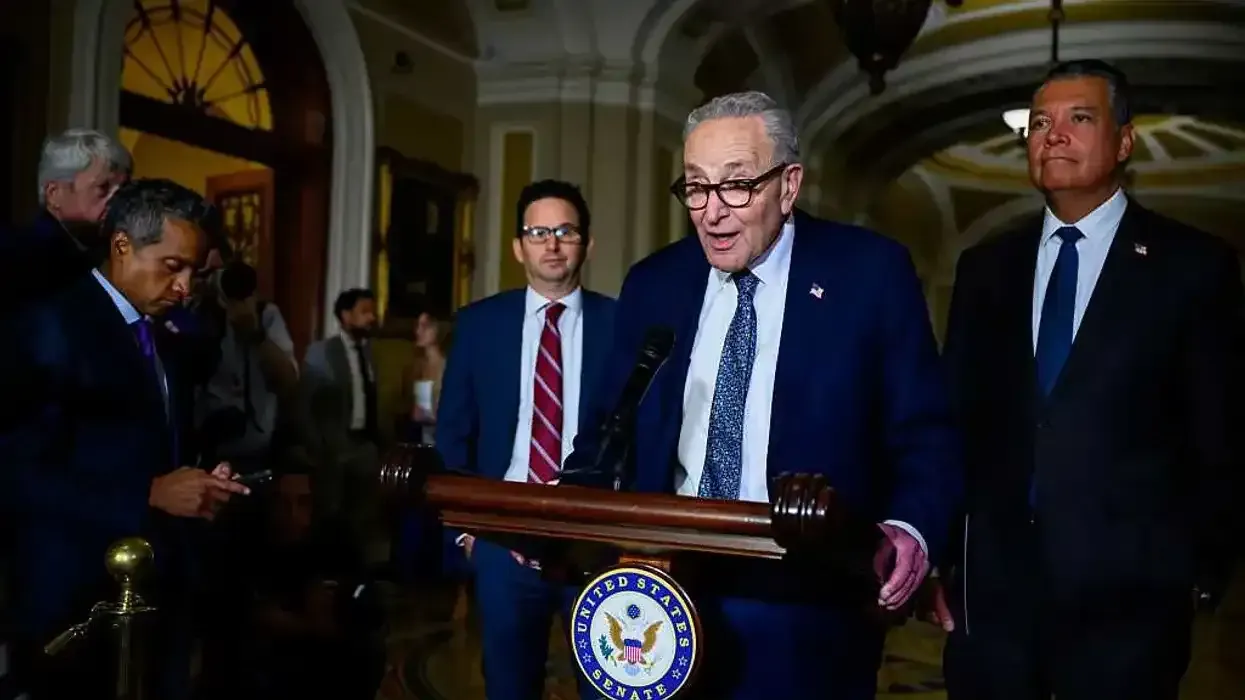
The second lesson: State conventions give conservatives a better chance to reclaim their party than direct primaries do because they draw informed activists. Johnson’s endorsement is unlikely to elect a Democrat in South Dakota. The point is the convention allowed conservatives to expose and remove her. Try doing that in a direct primary while special interests spend heavily to mislead low-information voters who barely follow these races.
As conservatives rejected Johnson at the convention, liberal Republicans won key direct primaries. Hansen would have easily won the gubernatorial nomination had convention delegates decided that race. Instead, Gov. Larry Rhoden won the primary. He has opposed initiative petition reform, which conservatives need to confront the process helping turn red states blue.
Meanwhile, about 16 liberal former legislators and challengers defeated conservative freshmen in legislative primaries, aided by an infusion of Big Tech cash. Baxter herself lost her legislative primary before defeating Johnson at the convention in the same election cycle.
Conservatives cannot keep treating nominations as a procedural detail and then wonder why Republican victories fail to produce conservative government. The selection process determines who we send into office and whose demands they heed.
Conservatives who want different results must change how their parties choose candidates. Keep the same primary system, and the uniparty will keep collecting the nominations.
 Not a single Democrat in the Senate is willing to support the Safeguard American Voter Eligibility (SAVE) America Act, and a new op-ed from The Washington Post might just explain why. The SAVE America Act would amend the 1993 National Voter Registration Act (NVRA) to require documentary proof of citizenship to register to vote and […]

 Photographer: Al Drago/Bloomberg via Getty Images
 'RCV is only the latest potentially misguided proposal threatening to transform our election system for the worse.'
 Photo by LOGAN CYRUS/AFP via Getty Images
 Photo by Kevin Dietsch/Getty Images
 A new study of voting records found that congressional lawmakers are less conservative than the voters they work for in 41 out of 50 states, according to The Institute for Legislative Analysis. “While one may expect the most conservative lawmakers in Congress to represent the deepest red states, the data proves this is simply not […]
 The University of Nevada at Reno is doubling down on diversity, equity, and inclusion policies, hoping the administration won’t notice its illegal racial discrimination.
 Voters gave Republicans a mandate on a range of issues. Fixing the problems that led to the 2020 election chaos is one of them.
 www.theblaze.com
 www.theblaze.com
 www.theblaze.com
 thefederalist.com