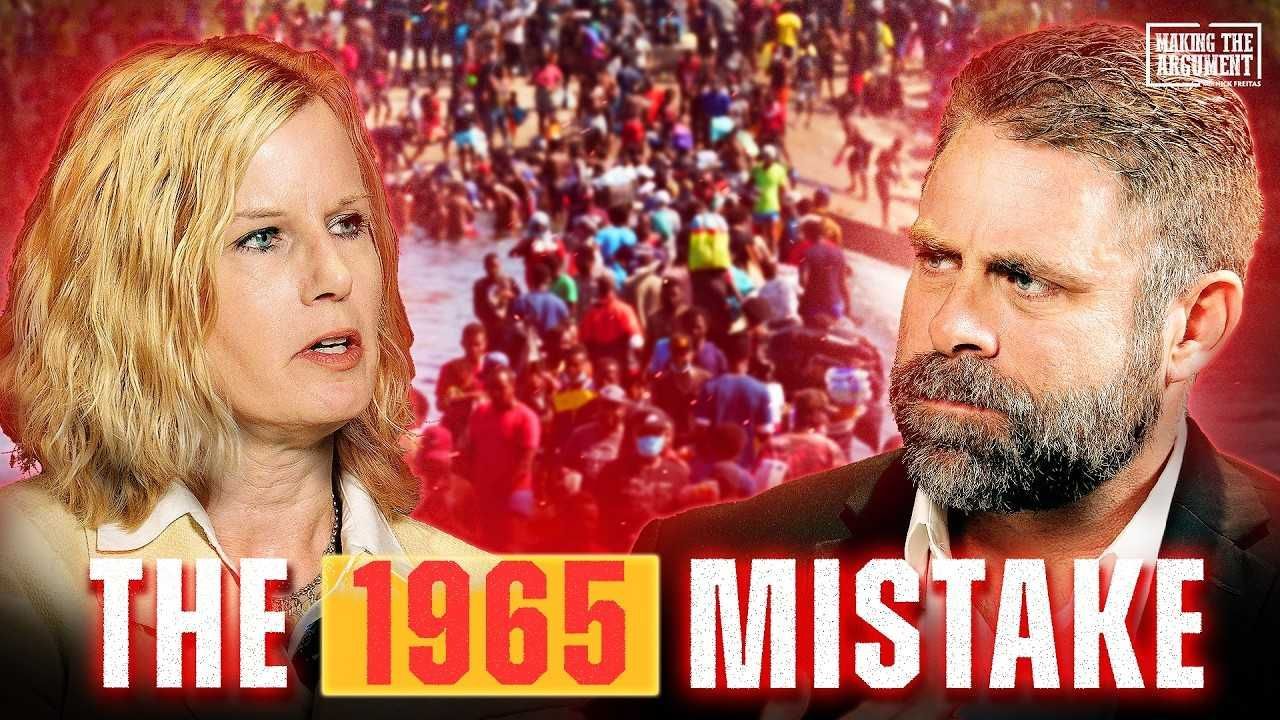
The Great Replacement isn’t a theory. It’s the plan.


The Great Replacement theory is a conjecture popularized by French writer Renaud Camus in his 2011 book, “Le Grand Remplacement,” claiming that globalist elites are deliberately orchestrating mass immigration of non-white people into Western countries to demographically replace and ultimately disempower or even eradicate white European populations.

It’s often branded as a far-right conspiracy theory, but just look at the evidence:

  • Mass illegal immigration is orchestrated or deliberately enabled under progressive administrations, despite polls indicating that most citizens want less immigration.
  • Skyrocketing housing costs, student debt, stagnant wages, and taxes make it nearly impossible for young white/middle-class natives to afford children, while many immigrant households (legal and illegal) get access to welfare, EITC, child tax credits, Medicaid, and housing aid that effectively subsidize higher fertility or larger families.
  • Politicians, corporate media, and advertising openly celebrate that the country is becoming “majority-minority,” cheering it as a moral and cultural improvement.
  • Anyone who complains about the speed or scale of immigration (even mildly) gets instantly branded “racist,” “white supremacist,” or “xenophobic,” faces censorship, bans, and job cancellation, and is shut out of respectable discourse.

So it’s not just a theory. It’s a scheme that’s very much in action right now.

“Demographic replacement of the American stock is the plan in order to manipulate elections in the democracy,” says Auron MacIntyre, BlazeTV host of “The Auron MacIntyre Show.”

He plays a clip from White House Deputy Chief of Staff Stephen Miller telling Sean Hannity the same thing.

“The Biden administration, Secretary of Homeland Security Alejandro Mayorkas, devised a scheme to fly illegal aliens into the country and then to escort them en masse across the border by the millions and to give them something known as parole, which gives them a work permit, which gives them a Social Security number, which gives them access to the voting booth,” Miller declared. “This was the plan all along.”

To its core, the plan is deeply undemocratic, MacIntyre explains. “The whole idea of the democracy is that it represents the beliefs and will of the people and that the popular sovereignty is supposed to guide the politicians,” he says.

“So if instead of the popular sovereignty guiding the politicians, the politicians [via immigration] can create and manufacture popular sovereignty in their favor, then they can control the entire system.”

And that’s exactly what the Democrat Party wants, he says — to secure all future elections by turning the nation into a blue blob of welfare-dependents who will reliably vote Democrat to keep their benefits.

“[The Great Replacement theory] is not a conspiracy theory. This is not some weird internet idea. This is the plan of the Democratic Party. This is what they want. This is their political strategy,” MacIntyre reiterates.

The masses of immigrants from Afghanistan, Somalia, and Venezuela — they’re “here for a reason,” he insists. “They’re here to replace you.”

“You address this, or the country drowns.”

To hear Auron’s in-depth breakdown of the Great Replacement theory, watch the video above.

Want more from Auron MacIntyre?

To enjoy more of this YouTuber and recovering journalist's commentary on culture and politics, subscribe to BlazeTV — the largest multi-platform network of voices who love America, defend the Constitution, and live the American dream.

The FORGOTTEN voice behind 'How the Grinch Stole Christmas'


The iconic voice that sings the song “You’re a Mean One, Mr. Grinch” from the animated special “How the Grinch Stole Christmas” ensured the tune has stayed a classic for ages — but the man behind the voice was never given credit.

“They needed somebody that could bring the Grinch, somebody who had a scowl that could match the Grinch. And that’s when the guy who was never named comes into the picture and walks into the studio,” Blaze Media co-founder Glenn Beck explains.

“And somewhere in a Los Angeles recording booth late at night, I think 1966, he steps up into a booth, up to a microphone, and his voice is so deep, it’s almost as if it rolled out of the earth itself,” he continues.


“He steps up to the microphone, and he records the now really super famous anthem in ‘The Grinch,’” he adds.

The song may only be six verses, but while he recorded the song, the crew and those who worked on it said that “they knew that that performance would outlive all of them.”

“They put it in the show. The show airs. Credits roll. His name’s not on it. Not a mention, not a whisper,” Glenn says.

While he was never officially given credit, the man who delivered what Glenn calls “one of the most unforgettable performances in Christmas history” was named Thurl Ravenscroft.

“His name is nowhere to be found, but it should be. And it should be remembered, because he’s great,” Glenn adds.

Want more from Glenn Beck?

To enjoy more of Glenn’s masterful storytelling, thought-provoking analysis, and uncanny ability to make sense of the chaos, subscribe to BlazeTV — the largest multi-platform network of voices who love America, defend the Constitution, and live the American dream.

Glenn Beck: I wish I had realized THIS about Christmas much EARLIER


If you’re a parent, you may have wandered into the stage of life where all of your children are no longer gathered around your Christmas tree on Christmas morning — and Blaze Media co-founder Glenn Beck is no stranger to this stage.

“You pine for the days when we were all together,” Glenn says, before recalling his best and worst Christmases.

“I remember I was broke, dead broke. Stu, he was, like, 18 years old, and he’s living in an apartment. He’s got a nicer apartment than I did. We lived in the same complex. I was, like, 35 or 40. And I just was completely broke,” Glenn recalls.


“I was with my daughter, and we were in a CVS, and she was there by the cash register, and there was this little ornament. ... It was a little teeny tree ornament. And she’s like, ‘Oh, that is so nice.’ And she was little little. And I thought, ‘Oh.’ ... It just broke my heart because all I could think of is, ‘I can’t even afford that. I’m such a loser as a dad,’” he continues.

However, this was not Glenn’s worst Christmas.

“My worst Christmas was the first time I had real success, and I decided, I’m going to buy everything I ever have ever wanted for my kids. And literally the boxes were almost up to my waist. I mean, I had all the kids and all the presents and everything you could possibly want,” Glenn explains.

“And it was so empty. That was my worst Christmas. And my kids never talk about that Christmas. Never,” he says.

“Somewhere along the line, we let that lie creep in, and we bought into it — the lie that says what I give is what you’re worth. That lie is absolute poison, and it’s absolutely not true,” he continues.

“You think that your kids are counting boxes, and quite honestly, teenage years, they might be. They might be. But they grow out of those. You just put up with the teenage years. They’re coming. They suck. They go away. They’re not counting boxes; they’re not looking at labels. ... They’re counting on you,” he adds.

Want more from Glenn Beck?

To enjoy more of Glenn’s masterful storytelling, thought-provoking analysis, and uncanny ability to make sense of the chaos, subscribe to BlazeTV — the largest multi-platform network of voices who love America, defend the Constitution, and live the American dream.

Never trust the MSM: Vanity Fair Trump admin hit piece only confirms its malice


Vanity Fair’s bombshell profile of White House chief of staff Susie Wiles and other key figures within the Trump administration turned out to be a disingenuously framed hit piece.

"Significant context was disregarded and much of what I, and others, said about the team and the President was left out of the story," Wiles wrote on X. "I assume, after reading it, that this was done to paint an overwhelmingly chaotic and negative narrative about the President and our team."

“If I were President Trump, I would fire whoever let Vanity Fair do this because you could call this an unforced error,” BlazeTV host Liz Wheeler comments on “The Liz Wheeler Show,” pointing out that the photography used was also edited to be incredibly unflattering.

“Look at that picture of Susie Wiles. No one claims she’s a runway model. Like obviously she’s not 20 years old. No one cares about that. But that is obviously a photograph that is deliberately intended to make her look psycho,” Wheeler says.


Vanity Fair also included an extremely close-up photo of Marco Rubio, where according to Wheeler, they “make him look like he’s dying of the plague.”

“That was intentional. It wasn’t an accident. ... They did this on purpose. It was malicious because they’re trying to undermine these people, especially the people who they think might have political careers after President Trump,” she explains.

But it wasn’t just Wiles and Rubio targeted by the magazine. They also included a close-up, heavily edited photo of Karoline Leavitt, who Wheeler says “obviously is a nice-looking person.”

“They are deliberately trying to make her look ugly ... they’re trying to drive a wedge between President Trump and his staff,” she says.

“And I know the president is not naive. He’s not going to let that happen. And honestly, like I said, I know this is going viral on X, but really people should not be that upset about it,” Wheeler says, pointing out that the tactic is “tired.”

“Again, my bigger question is, ‘Who OK'd this interview?’ Like really? Are you an idiot? To give the mainstream media this opportunity to try to attack you, whoever approved it should be fired,” she adds.

Want more from Liz Wheeler?

To enjoy more of Liz’s based commentary, subscribe to BlazeTV — the largest multi-platform network of voices who love America, defend the Constitution, and live the American dream.

Glenn Beck: Brown University killer fits a chilling pattern of evil and self-destruction


On Dec. 13, Claudio Manuel Neves-Valente opened fire inside the Barus and Holley building at Brown University, where he killed students Ella Cook and Mukhammad Aziz Umurzokov and wounded nine others.

Valente then fled to Brookline, Massachusetts, where he is believed to have shot and killed Nuno Loureiro, an MIT nuclear science and engineering professor from Portugal. The suspect was finally found dead in New Hampshire after a manhunt that lasted for days.

While the motive is still being investigated, Blaze Media co-founder Glenn Beck believes whatever it was, it may have had extremely sinister and demonic roots.

“Some students remember, they said he screamed out, 'Allahu Akbar.’ Apparently now, people are saying, ‘I think he was barking,’” Glenn explains.


“If you’re barking, that might be a sign of, the guy was completely out of his mind,” he continues, pointing out that the shooter also killed himself after taking several lives.

“What’s interesting to me is how many of these people are — they go and do something, and then they kill themselves,” Glenn says, relating it to Steve Deace’s movie “Nefarious.”

“In ‘Nefarious,’ Satan has possessed this guy. And once in a while, Satan lets him come out, and the guy’s like, ‘Help me, help me, please help me’ ... and then Satan takes control of him again. And what happens?” Glenn asks.

“He kills himself,” he answers.

“I think, unlike any time before in my lifetime, you can see this is evil. There is a force that seems to be sweeping the entire world. All of these people do these horrendous things, and then they shoot themselves. ... It’s almost as if evil is playing with these people, getting them to do all of this horrible, horrible stuff,” he continues.

After they’re finished, “Boom. They kill themselves. Because they’re just a meat puppet of evil, and they’re of no use to evil.”

“They’ve done their job,” Glenn adds.

Want more from Glenn Beck?

To enjoy more of Glenn’s masterful storytelling, thought-provoking analysis, and uncanny ability to make sense of the chaos, subscribe to BlazeTV — the largest multi-platform network of voices who love America, defend the Constitution, and live the American dream.

‘It’s a Wonderful Life’: The amazing UNTOLD story of the classic Christmas movie


“It’s a Wonderful Life” wasn’t always a beloved classic — in fact, it was a complete failure that nearly destroyed the careers of Frank Capra and Jimmy Stewart.

“It was actually born out of failure, it was born out of exhaustion, and it was born out of people who felt just like its lead character, George Bailey,” Blaze Media co-founder Glenn Beck says.

“The movie was made by Frank Capra, and it was right after World War II. Frank Capra had just come back. He didn’t come home triumphant. He came home a changed man. He had spent the war making film for the United States government, the war department, about why the West is worth saving,” he explains.

Capra came back and started his own studio, betting “absolutely everything on it.”


“‘It’s a Wonderful Life’ was supposed to be the movie that proved Frank Capra is still Frank Capra. And it nearly ruined him,” Glenn explains.

“The movie lost money. Critics really didn’t like it. They mocked how schmaltzy it was. Audiences stayed home. Jimmy Stewart, this was his first movie that he made when he came back home from the war. And this was his start,” he continues, pointing out that not even Stewart could save it.

“The most beloved man in America gave a really raw, shaken, almost too real performance for people at the time. He wasn’t the cheerful hero that is coming out of war as a victory. This was a man that was cracking under the weight of responsibility, a man who did everything right, but he still felt like he was a failure,” Glenn says.

The movie was what Glenn calls “a noble misfire,” before everyone forgot about it.

“And so, the rights lapsed. There was no grand relaunch. There was no marketing genius. Just a legal oversight that let the rights lapse,” Glenn says.

That’s where Ted Turner and Superstation TBS come in.

“They needed some holiday programming, and they needed it cheap. And when I say cheap, what Ted really meant was free. ‘We need a bunch of free programming that we can run all Christmas. ... No rights, no royalties,’” Glenn explains.

“The vaults open up, and lo and behold, they find ‘It’s a Wonderful Life,’” he says.

Want more from Glenn Beck?

To enjoy more of Glenn’s masterful storytelling, thought-provoking analysis, and uncanny ability to make sense of the chaos, subscribe to BlazeTV — the largest multi-platform network of voices who love America, defend the Constitution, and live the American dream.

Gratitude AND​ fiscal concerns: Glenn Beck breaks down Trump’s warrior dividend for service members


In his address to the nation on Wednesday night, President Trump announced that he’s issuing a “warrior dividend” to approximately 1.45 million eligible U.S. military service members as a thank-you for their sacrifice and service. The one-time payment of $1,776 — a symbol of America’s founding — is set to arrive before Christmas.

Reactions to the announcement have been varied. Many service members and military families have welcomed the timely $1,776 bonus, with some veterans expressing cautious optimism. Critics, both on Capitol Hill and in media outlets, have raised concerns about the repurposing of congressional appropriations originally meant for military housing allowances.

Glenn Beck has mixed feelings too.

“I don’t like when the government hands out money, but ... if anybody can use it, it’s the military,” he says.

“$1,700 is a huge amount for most people in the military. ... We don’t do enough for our military, and so it’s the best kind of, I don’t know, stimulus package I’ve ever seen,” he adds.

Glenn’s co-host Stu Burguiere shares the sentiment that our military members are beyond deserving; however, he can’t ignore the fact that this is “money that we don’t actually have.”

“The argument is with tariffs that we have enough, but of course that pays only for a slight amount of our deficit,” he says.

The second issue Stu has is that according to the U.S. Constitution’s Appropriations Clause (Article I, Section 9), Congress has exclusive power over spending. Even one-time bonuses like the warrior dividend typically require explicit congressional authorization.

“Congress doesn’t even pay attention to [that clause] anymore. They don’t seem to care,” Glenn says.

However, there is another upside to these warrior dividends, he says. Besides the fact that they help America’s most deserving population, the money will also stimulate the economy.

“I can guarantee you, they’re going to get it, and they’re going to use it on their family for Christmas, which will stimulate the economy so much,” Glenn says.

To hear more of the conversation, watch the video above.

Want more from Glenn Beck?

To enjoy more of Glenn’s masterful storytelling, thought-provoking analysis, and uncanny ability to make sense of the chaos, subscribe to BlazeTV — the largest multi-platform network of voices who love America, defend the Constitution, and live the American dream.

You’ve got the Christmas story wrong: Lee Strobel tells Glenn Beck the ONE Greek word that shatters our classic narrative


Back in 2005, “The Case for Christ” author and Christian apologist Lee Strobel published a book called “The Case for Christmas: A Journalist Investigates the Identity of the Child in the Manger.”

In September this year, 20 years after its original publication, Strobel released an updated version of his Christmas book to include the latest scholarship, research, archaeological findings, and scientific insights that have emerged since.

On this episode of “The Glenn Beck Program,” Glenn interviews Strobel about these fascinating new findings that change the way we read the Christmas story.

According to the most widely accepted narrative, Mary and Joseph came to Bethlehem for the census, arrived at an inn, but were turned away by the innkeeper for lack of space, forcing Mary to give birth to Jesus in a separate stable or barn among animals, where she laid him in a manger.

But Strobel says there’s one Greek word that changes this narrative entirely, and that word is “kataluma.”

In the ancient manuscripts of the gospel of Luke, “kataluma” is the word used to describe the place where Mary and Joseph were turned away, but it doesn’t mean inn, according to most scholars.

It actually translates to “guest room.”

A typical house in first-century Bethlehem, Strobel explains, had “one large room broken down into two parts.”

“The larger part was a living area — that’s where people would live, eat, sleep — and then there was a couple of steps down to a smaller area where the animals were brought at night,” he explains.

However, because animals were often seen as beloved pets, sometimes they were allowed to come up into the main living area. A manger (a feeding trough) was therefore a common item in both the upper and lower spaces of the house.

Wealthier families also had a “kataluma” — a guest room — in their homes, used for hosting traveling family and friends.

The original scriptures say that Mary and Joseph were turned away from the “kataluma” because it was occupied. This means that the couple likely didn’t seek shelter at an inn at all but rather at a relative’s home.

It makes sense that the “kataluma” would have been full at this time because of all the people traveling into Bethlehem for the census. Mary and Joseph, Strobel explains, were likely told by their relatives that they could just stay and birth the baby in the main living area.

“And yes, there is a manger there. And yes, some of the animals may have come up the stairs because of the commotion,” he says, reiterating that animals and mangers were common in a home’s main living space.

“There probably was no inn,” he concludes.

But an imprecise translation for “kataluma” isn’t the only evidence for this new narrative.

Strobel explains that Luke uses the word “kataluma” only one other time in the book, and it clearly refers to a separate room in a family home. But he uses a different word — “pandocheion” — to refer to a traditional inn in the parable of the Good Samaritan.

“If he wanted to use the word ‘inn,’ he would have used ‘pandocheion,’ but he didn’t. He used ‘kataluma,’” he says.

Further, “in first-century Jewish culture, the value of hospitality was so high that it would have been impossible for an innkeeper to turn away a pregnant Jewish woman,” Strobel tells Glenn.

“It would have destroyed his business. ... And we don’t even know there were any inns in Bethlehem. It was a small town — 500 people. It wasn’t on a main crossroads. There may or may not have even been an inn there in the first place,” he adds.

The revelation that Jesus was most likely born in a home rather than in a dirty barn “changes everything,” Glenn says.

But there are even more details that the traditional Christmas story gets wrong about Jesus’ birth, according to Strobel.

According to the standard narrative, Mary is on the verge of giving birth when she and Joseph arrive in Bethlehem, but this urgency, Strobel says, comes from “a book of fiction that was written in 200 A.D.”

The scriptures only tell us “that while they were in Bethlehem, she gave birth. Doesn’t say they’re in Bethlehem five minutes or five days or five months,” he explains.

To hear more incredible revelations from Strobel’s investigations into the authentic Christmas story, watch the video above.

Want more from Glenn Beck?

To enjoy more of Glenn’s masterful storytelling, thought-provoking analysis, and uncanny ability to make sense of the chaos, subscribe to BlazeTV — the largest multi-platform network of voices who love America, defend the Constitution, and live the American dream.

Glenn Beck praises Trump as ‘disciplined’ for baiting media into reporting on his wins


President Trump addressed the nation this week about his administration’s many accomplishments over its first year — and shockingly, in a move very unlike the president, the speech was only 20 minutes.

“Eleven months ago, I inherited a mess, and I’m fixing it. When I took office, inflation was the worst in 48 years, and some would say in the history of our country, which caused prices to be higher than ever before, making life unaffordable for millions and millions of Americans,” Trump began.

“Over the past 11 months, we have brought more positive change to Washington than any administration in American history. There has never been anything like it. And I think most would agree,” he continued.

Some successes Trump pointed out were that “drugs brought in by ocean and by sea” are down 94% and the “grip of sinister woke radicals in our schools” has been broken.


He also touted that he has “settled eight wars in 10 months, destroyed the Iran nuclear threat, and ended the war in Gaza, bringing for the first time in 3,000 years peace to the Middle East, and secured the release of the hostages, both living and dead.”

Trump recalled the rising inflation under Biden, which he happily reported has declined since he took office.

But one thing the president didn’t say is that we’re going to war with Venezuela — and BlazeTV host Glenn Beck believes he might have tricked the media into covering all his successes.

“Everybody was speculating, ‘He’s going to say we’re going to war.’ ... I don’t think we’re going to war with Venezuela. I think he’s making it look like we’re going to war to freak Venezuela out and to get Maduro out, but I don’t think we’re going into war,” Glenn says.

“I saw this as the kickoff of the campaign. I saw this as, okay, this is the message for 2026 for the Republicans. And it was so disciplined and so tight,” he continues, pointing out that sometimes the media won’t cover a speech like that.

“I wonder if the war thing wasn’t a way to get them to cover this,” he adds.

Want more from Glenn Beck?

To enjoy more of Glenn’s masterful storytelling, thought-provoking analysis, and uncanny ability to make sense of the chaos, subscribe to BlazeTV — the largest multi-platform network of voices who love America, defend the Constitution, and live the American dream.