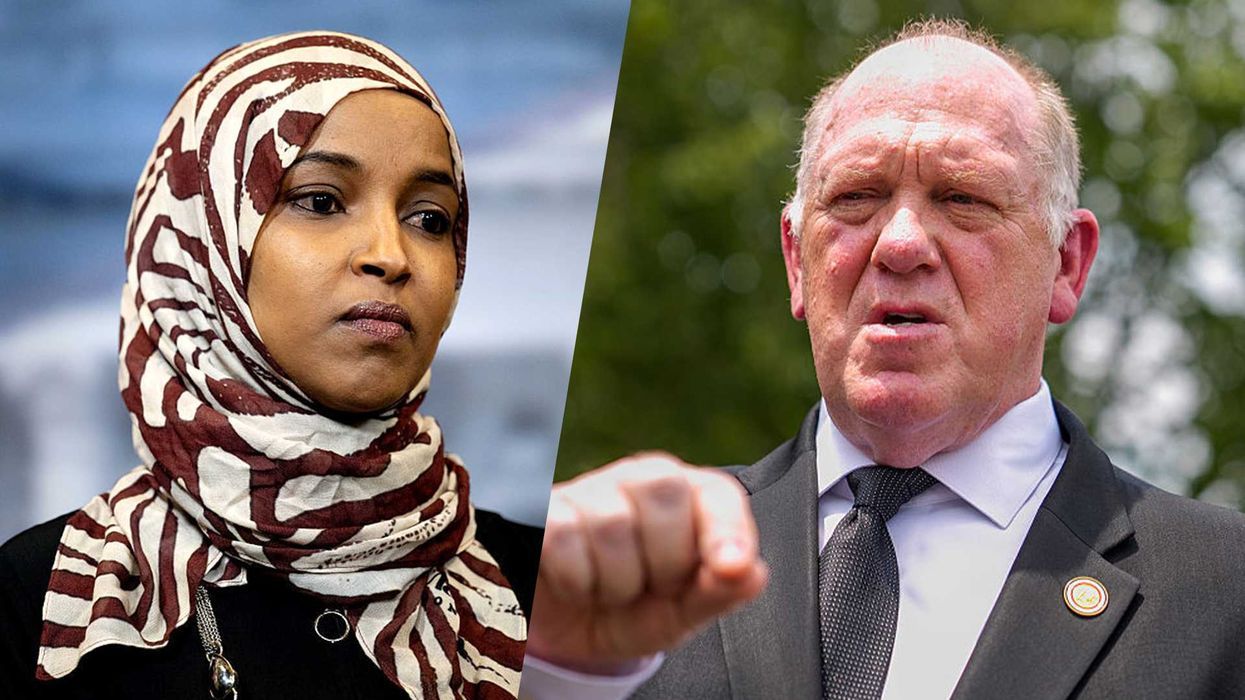
Tom Homan Admits Deportations Are ‘Slightly Down’
'Am I happy ... right now? No'
Florida Rep. Maria Salazar (R) and her some 20 Republican co-sponsors of a massive amnesty bill have put President Trump in a terribly awkward position. In truth, it is more than just awkwardness; it is political malpractice.
The fanfare around the amnesty bill, the Dignity Act, has begun a process of division and distraction going into a crucial midterm cycle.
Merely floating the idea of amnesty results in more illegal immigration to the US border.
The Dignity Act is dominating conversations surrounding the trajectory of immigration enforcement under the Trump administration and forcing the question of whether the administration supports it.
Last week, CBS News peppered border czar Tom Homan with loaded questions about the supposed need for providing legal status for illegal aliens in the United States. After trying to put the question away, Homan responded, “There’s discussions going on. I’m involved with some and not others, but I’m not going to get ahead of the president on this.”
Discussions of amnesty in the Trump administration? The internet exploded, and it’s largely still exploding. Given the low level of deportations conducted to date, some 340,000 in FY2025 according to recent estimates, many political observers are starting to question whether the mass deportation program will be fulfilled at the scale advertised.
This low number, in addition to the lack of explicit opposition to the Dignity Act from the Trump administration, has led many people to reasonably believe that amnesty discussions are on the table. Republicans pushing amnesty is nothing new, after all. Additionally, the co-sponsors of the Dignity Act largely are all endorsed for re-election by President Trump.
What we are witnessing appears to be strategic ambiguity. Salazar and her allies are hitting the media circuits claiming that somehow the Dignity Act is not amnesty. That claim has rightfully been ridiculed, but they remain insistent that a square peg is a circle.
RELATED: The Dignidad Act is a complete betrayal of Republican voters

Meanwhile, the White House has carefully avoided criticizing the bill by name, instead choosing to rule out amnesty of any type. Take another Homan quote, for example: "I said from day one, I’ll say it again ... President Trump said amnesty is off the table. I support that. I don’t think amnesty should be on the table.”
Having known Homan for years, I know that he genuinely opposes amnesty. But in this environment, supporters of the president’s promised immigration agenda need to hear that the White House considers the Dignity Act to be amnesty. Without that explicit rejection, the ambiguity will be perceived as tolerance.
Of course, it is not the White House’s job to denounce every last bill that pops up in Congress. But the unfortunate truth is that the Dignity Act is out there and has captured enough attention that it is a subject of an intense debate that, if left untended to, will only dampen midterm turnout.
That’s one reason why what Salazar and her ilk have done is so damaging. Shilling for amnesty will be taken seriously unless explicitly denounced, putting the White House in a position it should not be in.
Salazar’s damage gets worse. Take for example what Homan said during his CBS interview that did not receive any meaningful attention: “I would love Congress to do some things. My concern right now is that a lot of the successes we’ve had, unprecedented success, is based on executive orders, which can certainly be turned around by the next president.”
What Homan was referring to are border security laws to prevent a future Democrat administration from doing the exact same thing that Biden did and demanding amnesty in exchange for turning off another invasion.
How do I know? Well, I worked with Homan to help put together H.R. 2, otherwise known as the Secure the Border Act of 2023, during the Biden years. That bill was purely defensive in nature. It closed loopholes that the Biden administration weaponized to let 10 million plus cross the border.
RELATED: Funding is useless if Democrat judges can still hold ICE hostage

While it is true that President Trump didn’t need new laws to secure the border, it is also true that President Newsom, Ocasio-Cortez, or Comey won’t need new laws to open it again. We could find ourselves in the exact same negotiating posture as before: trade border security for amnesty, the very same trick that President Reagan fell for in historic fashion.
Any serious person who has worked in the immigration space knows that merely floating the idea of amnesty results in more illegal immigration to the U.S. border. During the Obama years, illegal aliens were flowing across with smiles on their faces and bragging about the “permisos” they had to cross due to Obama. As Biden readied to enter the White House, illegal aliens flooded the border for the same reason.
With news emerging that the U.S. border may not be as completely zipped tight as we hoped, Salazar’s advertising for amnesty can predictably result in more illegal aliens deciding to roll the dice and head north.
For all these reasons and more, the wise thing for both political and national sovereignty reasons is for the Trump administration to respond to Salazar’s push with an explicit and unmistakable denunciation.
A skeptical base needs to see strength on the immigration issue. Clearing up any confusion on this matter would go a long way toward restoring trust and keeping the president’s strongest base of supporters together going into the midterm elections.
Markwayne Mullin, who took over as secretary of the Department of Homeland Security following Kristi Noem's ouster in March, announced Thursday that there is going to be another senior personnel change at his agency.
Todd Lyons will leave the role of acting director of U.S. Immigration and Customs Enforcement, effective May 31.
'A phenomenal patriot and dedicated leader.'
"Director Lyons has been a great leader of ICE and key player in helping the Trump administration remove murderers, rapists, pedophiles, terrorists, and gang members from American communities," said Mullin. "He jumpstarted an agency that had not been allowed to do its job for four years."
"We wish him luck on his next opportunity in the private sector," added Mullin.
Lyons is a veteran ICE official who has served with the agency since 2007.
Around the time he entered the role of acting director in March 2025 — following the demotion of his predecessor, Caleb Vitello — Noem characterized Lyons as a work horse who, with border czar Tom Homan, had done "incredible work cleaning up our communities and making them safer."

In the months since, Lyons has been on the receiving end of relentless abuse by anti-ICE activists such as New Jersey Rep. LaMonica McIver (D), who subjected him to a 3.5-minute rant during a congressional hearing in February. After questioning Lyons' religiosity, McIver asked him, "How do you think Judgment Day will work for you with so much blood on your hands?"
The radical Democrat who allegedly assaulted ICE officers last year, asked further, "Do you think you're going to hell, Mr. Lyons?"
When disgraced ex-California Rep. Eric Swalwell (D) demanded Lyons' resignation in February, he refused, later stating, "I will not resign, because I believe in the rule of law and will continue to uphold my oath."
A pair of unnamed U.S. officials told CBS News that Lyons was planning to leave the federal government to spend more time with family, including his sons, in Massachusetts.
Prioritizing family was also DHS Assistant Secretary Tricia McLaughlin's apparent reason for resigning earlier this year.
White House deputy chief of staff Stephen Miller said in a statement that Lyons is "a phenomenal patriot and dedicated leader who has been at the center of President Trump's historic efforts to secure our homeland and reverse the Democrats' sinister border invasion."
Homan said in a statement obtained by CNN, "I commend him for a distinguished law enforcement career and the countless contributions he has made to protect our country and advance its interests."
Like Blaze News? Bypass the censors, sign up for our newsletters, and get stories like this direct to your inbox. Sign up here!
President Donald Trump's administration has offered several concessions to persuade lawmakers to restart funding for the Department of Homeland Security, but Democrats continue to refuse to compensate Transportation Security Administration personnel.
The White House and Democratic lawmakers have remained in a negotiation stalemate since the DHS shut down on February 14.
'If this continues, it's not hyperbole to suggest that we may have to quite literally shut down airports – particularly smaller ones if callout rates go up.'
Border czar Tom Homan and the White House director of legislative affairs, James Braid, wrote a letter dated March 17 to Republican Sens. Susan Collins of Maine and Katie Britt of Alabama, detailing the administration's offered concessions.
The letter, which was shared by the Daily Wire, explained that the "majority" of Democrats' demands "would make it impossible to fully protect American citizens from dangerous criminal aliens and expose law enforcement and their families to increasing threats of violence."
"In other words, they would prioritize illegal aliens above American families," it reads.
The letter detailed how Homan ended the surge operation in Minnesota, canceled Immigration and Customs Enforcement's roving patrols, updated protocols for dealing with unlawful agitators, deployed body-worn cameras, and enhanced cooperation with local law enforcement.
RELATED: Spring break blues: DHS highlights outrageous airport conditions amid Democrat shutdown

Homan and Braid stated that the White House has offered to codify several improved guidelines, including expanding the use of body-worn cameras, limiting immigration enforcement activities in certain sensitive locations, increasing the oversight of detention centers, and requiring officers to visibly display their identification.
Despite the administration's efforts to negotiate, Democratic lawmakers repeatedly failed to make a good-faith effort to compromise, according to Homan and Braid.
"The Administration has worked in good faith to again reach bipartisan agreement on full funding for the entire Department of Homeland Security and institute common-sense operational improvements to federal immigration enforcement operations that enhance the safety of American communities," the letter reads.
Senate Minority Leader Chuck Schumer (D-N.Y.) accused the White House of not taking the negotiations seriously.
"The issue is, they're not getting serious," Schumer stated. "The key issues of warrants when you bust into someone's house, the key issue of identity of police and no masks, they haven't budged on those."
RELATED: 'Is it even REMOTELY reasonable?' Scott Jennings demolishes liberal CNN panel on DHS funding feud

Meanwhile, TSA agents missed their first full paycheck last week. An estimated 366 TSA agents quit last month, NBC News found.
A TSA spokesperson told Fox News that the national callout rate jumped to 10.19% on March 15, compared to 2% before the shutdown.
"If this continues, it's not hyperbole to suggest that we may have to quite literally shut down airports — particularly smaller ones if callout rates go up," acting Deputy TSA Administrator Adam Stahl told the news outlet.
Like Blaze News? Bypass the censors, sign up for our newsletters, and get stories like this direct to your inbox. Sign up here!

Everyone in America has an opinion on what has gone right or wrong at the Department of Homeland Security and its component agencies, particularly Immigration and Customs Enforcement and Customs and Border Protection. To answer the Talking Heads lyric “Well, how did I get here?” would yield a thousand different answers. I have a pretty good sense of what happened. Even before President Trump returned to the White House, I argued that meeting his bold deportation goals would require very different enforcement tactics than the ones the administration chose.
That debate makes for great fodder for finger-pointing. But a better question is: Where do we go next?
The administration needs to move its attention from sanctuary cities to sanctuary farms, factories, and industrial hubs.
To answer it, some of the nation’s leading immigration policy and legal experts, former senior and rank-and-file law enforcement officials, and advocates are coming together to devise a way forward. Details will be announced in the days to come, but the goal is straightforward: President Trump can and will meet his core campaign promise to “carry out the largest deportation operation in American history.”
Last year, Immigration and Customs Enforcement deported about 230,000 illegal aliens from the interior of the United States. That is a far cry from the 1 million figure some administration officials floated as a projection — and far below other totals the administration has suggested at various points. Making analysis harder, the Department of Homeland Security stopped releasing enforcement data for the first time in decades.
President Trump promised to exceed the deportation efforts of President Dwight D. Eisenhower, who, by the most conservative estimates, removed about one-third of the illegal population in 1954. Any way you cut the data, even using the lowest-end estimates of the total illegal population in 2025, the administration is not on pace.
One reason: In its first year, the Trump administration prioritized a particular subset of illegal aliens — criminals. People can debate whether that was the right call, but that’s what happened. Prioritizing criminals means concentrating resources on fewer targets, and it has produced high-profile standoffs in cities like Minneapolis and Los Angeles. I will refer to that 2025 effort as “worst first,” as Border Czar Tom Homan has sometimes called it — phase one.
RELATED: Federalism cannot be a shield for sanctuary defiance

We can credit the Trump administration for highlighting the issue of criminal illegal aliens, removing many, and forcing the hand of radical Democrats, some of whom have taken the absurd position of rioting in defense of rapists and murderers. They are who we thought they were.
Now phase two can begin: widening the aperture of immigration enforcement and placing quantity above the perceived “quality” of deportations. The goal was mass deportations, not the “best” deportations. In short, the public wants commas in the numbers.
The Trump administration can, at minimum, quadruple last year’s totals. It can do it quickly if it shifts priorities — especially by refocusing on worksite enforcement. The administration needs to move its attention from sanctuary cities to sanctuary farms, factories, and industrial hubs.
Deportation is a contact sport — not only between ICE and illegal aliens, but between the Trump administration and special interests that value cheap labor, politicians who need cheap talking points, and activist judges and violent mobs. Those forces can be overcome, and in the coming weeks and months, we will show how.
The goal is to help President Trump deliver on what he promised — and to surpass President Eisenhower’s historic efforts. To do that, President Trump needs support from the base and the right, not a constant drumbeat of consultants, pollsters, and “moderate” Republicans trying to undermine him. Those forces are coming together, and I believe the result will be less drama and more commas.
Americans deserve a road map to move from phase one into a more successful phase two.