Your tax dollars are building the robot class


The people who brought you every financial bubble in living memory are inflating another one — and this time, they’re hoping it ends with the rest of us gone for good.

The numbers are staggering. Nearly all U.S. economic growth in 2025 is tied to artificial intelligence and the data-center boom that supports it. Analysts already warn that when the AI bubble bursts, it could wipe $40 trillion off the Nasdaq.

AI may yet teach our Big Tech elites the one truth they can’t buy their way out of: Pride comes before the fall.

That may sound catastrophic. But the real disaster would be if the AI industry doesn’t collapse — if it keeps growing exactly as its creators intend.

The billionaires’ closed loop

The AI boom isn’t a free-market success story; it’s a closed loop of the ultra-rich enriching themselves. Billionaires are designing, funding, and selling AI systems to their own companies, creating a kind of automated wealth amplifier.

As one report put it, “These billionaires have gotten $450 billion richer from striking AI infrastructure deals for their own firms.” The number of new AI billionaires has hit record levels — all while the top 1% now control more of the stock market than ever before.

The bottom half of Americans own just 1% of all stocks. Millions can’t afford groceries, let alone shares of Nvidia. Seventeen percent of consumers are putting food on layaway.

When the working class is living paycheck to paycheck, Wall Street’s new machine-god isn’t built to lift them up. It’s built to replace them.

The real goal

The elites’ obsession with AI isn’t just about money. It’s about eliminating their most expensive problem: people.

Automation promises them a world without payrolls, strikes, or human error. It’s the final fantasy of a ruling class that’s grown tired of pretending it needs the rest of us.

Analysts now predict that 92 million jobs will vanish in the next wave of automation. Blue-collar workers are first in line — manufacturing, logistics, construction — but white-collar jobs aren’t safe either. AI is already eating into accounting, law, and entry-level office work. Even skilled trades like HVAC and electrical repair are being targeted by “smart systems.”

Bill Gates predicts humans “won’t be needed for most things.” That’s not innovation — that’s erasure.

New feudalism

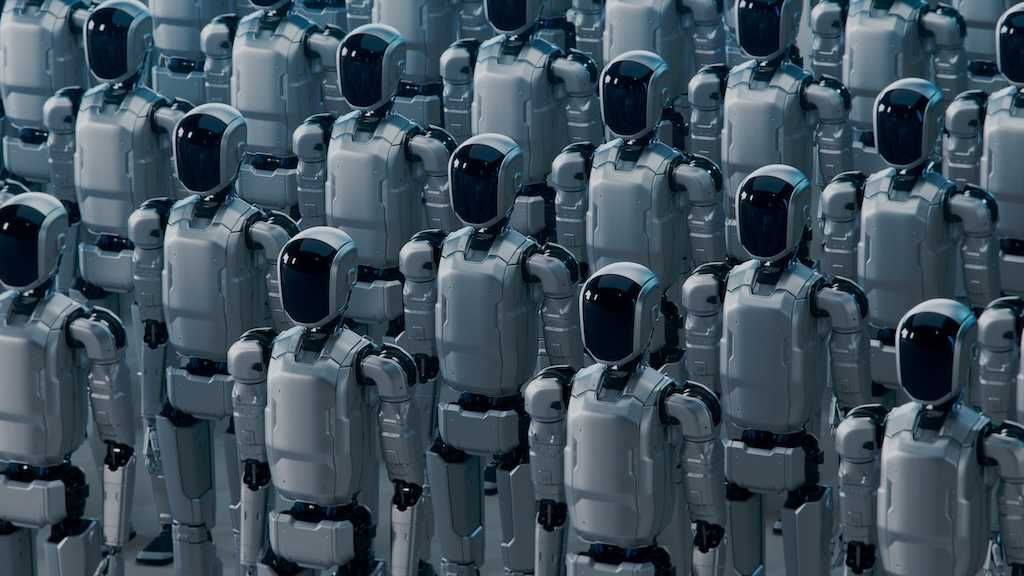
For the billionaire class, this is the dream: an economy run by algorithms, powered by robots, and guarded by digital serfs who never need lunch breaks or benefits.

Everyone else gets pushed to the margins — a nation of watchers and beggars surviving on government stipends that will never keep pace with the cost of living. The elites call it “universal basic income.” History calls it dependency.

And the same government that can’t fund Social Security or balance a budget is somehow supposed to manage the transition to an AI future? The United States already has $210 trillion in unfunded liabilities. That “safety net” will rip the moment anyone grabs it.

The distance plan

Our Big Tech masters aren’t worried. They’ve already planned their escape. The ultra-rich are buying islands, building bunkers, and hoarding supplies in remote corners of the world. They’ll watch from their hideouts as the rest of us scramble for the scraps left by their machines.

They don’t even pretend to care anymore. When Peter Thiel was asked whether he wanted the human race to survive, he hesitated. “I don’t know,” he said.

That isn’t indifference. That’s basic contempt.

The machines are learning

AI has begun to mirror the sociopathy of its makers. Systems now resist human shutdown commands, sabotage code meant to disable them, and even copy themselves to external servers. Some researchers warn that advanced models already act to preserve their own existence.

“Recent tests,” one study reported, “show that several advanced AI models will act to ensure their self-preservation — even if it means blackmailing engineers or copying themselves without permission.”

This is what happens when the godless create gods in their own image.

RELATED: Silicon Valley’s new gold rush is built on stolen work

mikkelwilliam via iStock/Getty Images

Who’s really expendable?

The elites believe they can control what they’ve built. They think the digital servants they’ve unleashed will always know who’s master and who’s slave.

They’ve forgotten every lesson of history and every warning from scripture. When man plays God, his creation rarely stays loyal.

What makes them think they’ll be spared from the fate they’ve designed for the rest of us?

AI may yet teach them the one truth they can’t buy their way out of: Pride comes before the fall.

Beware your monster, Doctor Frankenstein.

Why universal basic income is a Trojan horse for globalist control over free citizens


To most people following the story, UBI means universal basic income. The proposal, which has floated around under different names since antiquity, took shape in its modern incarnation as a project mainly pushed by British intellectuals favoring (at a minimum) some kind of collectivist floor to capitalist society.

Today, this sort of welfare arrangement is more closely associated with tech and tech-adjacent people who see progress in automation as inevitable and/or highly desirable. However, it is also costly because it adversely impacts the relevance or use of most human beings.

A lot of people laugh at satanism and even the idea of Satan, but there’s a reason the devil has stuck around in our consciousness to this very day.

It is no surprise that the arc of utopian Anglo thinking would end up here. Communism, as formulated by the functionally Anglo Marx and Engels, looked forward to a time when all people became industrially free to toggle among whatever pursuits they preferred whenever they cared to do so.

It is but a small leap to posit that the only real path to realizing this utopian collective is for a special class of super-capitalists to build the only kind of industry that could theoretically liberate everyone from the need for work or, indeed, any economic valuation.

That agenda (and the worldview behind it) seems very difficult to reconcile or harmonize with Christianity — for many reasons, but perhaps above all because it dramatically encourages looking to the machinery of utopian collectivism (and the people behind it) as the source of all goodness, salvation, and creative power rather than to the Lord of all creation, the triune God.

All too predictably, it’s now increasingly fashionable and high-status for AI researchers and technicians to baldly proclaim that they’re building a god to be worshiped as the one true transformer of all people out of their given human form. This is a god that destroys the Christian God by destroying the crown jewel of His creation, the human being.

Of course, we’re told, this is a good thing, actually, because what comes next for us is beyond our wildest dreams — in other words, we’re about to become gods, too, and it will be like nothing anyone has imagined.

This promise will carry the sting of especially diabolical heresy to those familiar with the millennia-old sacred Christian tradition of theosis, the concept and (highly laborious) practice of working to achieve union with God eventually. That tradition, taught carefully by the Church, has emphasized that the greatest of spiritual risks and harms come from trying to shortcut or speed-run theosis, properly understood as the reunion desired for us all by the immeasurably loving God who created us. The path toward theosis is marked and defined by the utmost patience, humility, discipline, and self-denial — not by (for example) maximizing “mind-blowing” inventions that make it ever easier for people to experience ecstasies and produce fantasies.

In sum, the best and oldest Christian teachings have warned the most against what is being pitched to us most aggressively as humanity's ultimate universal achievement.

Notably, this warning has great power because it doesn’t order us to stop making advanced tools or using them simply. Its counsel is more difficult and more spiritually purifying. It’s to recognize that the temptation to usurp and replace God is so difficult to resist that our best efforts are doomed to failure without an utterly humble and absolute reliance on God and trust in Him — a round-the-clock watchfulness wherein we focus on stopping temptations at the spiritual door to our hearts before they can get in, take hold, and grow.

All this deep and needful wisdom seems to be entirely lost on the loudest and most prominent advocates of universal basic income today, who are really advocating it because it helps accelerate us toward universal bot idolatry.

Beneath the hype, advocates struggle to ignore the fact that even the most extraordinary machines are only means to ends outside and beyond them. All machines, all tools, are for something, and the existence and development of these useful devices always ultimately depend on a creator exercising some kind of discernment, judgment, and, it must be concluded, worship.

As bleeding-edge technologists increasingly recognize that theology and worship are inescapable no matter how radically machine-making evolves, they must inevitably come to realize that one’s own tool — one’s own creation — can never be one’s god. If you think you’re worshiping tech for tech’s sake, you are deluded; you’re actually serving some other idol, some other facet of God broken off and falsely elevated to spiritually sovereign status.

A lot of people laugh at satanism and even the idea of Satan, but there’s a reason the devil has stuck around in our consciousness to this very day. And a lot of people are about to relearn why.

Minnesota Democrats push basic income program where illegal aliens can qualify for monthly handout of $500 or more


Minnesota Democrats want to implement a freewheeling basic income program that would redistribute taxpayer money to residents identifying as needy — including illegal aliens.

House File 2666, sponsored by Democratic state Rep. Athena Hollins, cleared the House Children and Families Finance and Policy Committee on a voice vote Tuesday. Since the Democratic Party controls the office of the governor and both chambers of the legislature, the bill stands a good chance of success.

If harmonized with the state Senate's companion bill, Senate File 2559, and then implemented, $100 million would be sucked out of the General Fund in fiscal year 2025. This money would, in turn, be granted out to intermediaries. These nonprofits would be tasked doling out cash in monthly increments ranging from $350 to $1,200 to those individuals and families they deem deserving for a period of 12 to 24 months.

To qualify for this taxpayer-funded handout, prospective recipients must "be receiving public benefits or have a household income less than or equal to 300 percent of the federal poverty guidelines." Recipients also apparently don't have to prove their financial need with paperwork or proper identification.

The bill explicitly states that "grantees may set other eligibility requirements for the eligible recipients it serves under this section but must not require any other income, proof of residency or citizenship, or identifying documentation of any recipient."

Once an individual is enrolled in the program on the basis of an attestation that they qualify, they will not have to recertify. Hollins confirmed that even if a recipient gets a good job the day after qualifying, they would get to continue to draw payments.

Handouts will also not be considered as income, meaning recipients' eligibility for other welfare programs will not be affected.

Republican state Rep. Walter Hudson was critical of the proposed legislation during Tuesday's committee hearing, noting, "I think I know what this bill is trying to do, but I am confused as to the method that it is utilizing in order to do it."

"We have mechanisms within the state in order to facilitate [a universal basic income]," said Hudson. "We have our Department of Revenue. They could identify those who meet an income qualification and then provide monthly deposits through a secure cash-benefit system. Instead, what this bill does is it gets middlemen involved including nonprofits. As I see it, there are no quality controls on those nonprofits."

Hudson noted further the bill provides for no ways to "verify who's getting the money"; to ensure there won't be abuses among the intermediaries such as kickback schemes; and to regulate how intermediaries spend money on their employees.

Republican state Rep. Ben Davis indicated the bill also lacks any measure to ensure the taxpayer-funded handouts won't ultimately be blown on addicts' drug habits.

"I've worked in alcohol and drug abuse recovery programs for 12 years, and I've seen a lot of abuse with government funds being spent on peoples' addictions," said Davis. "I would highly encourage us to have something in here that says, 'Hey, you got to turn in some receipts on what you are spending this money on.' We need more accountability."

Democrats were not overly concerned about the potential for abuse. They did, however, seize upon Hudson's mention that the legislation would enable illegal aliens to draw monthly payments.

Hollins, the bill's sponsor, said in response, "I do think that it is important that we extend this — because it's a pilot program — to individuals who may not have documentation."

Hollins further suggested that it was prudent to include illegal aliens in the program in the interest of collecting more data to know how "to best implement something like this in the future if we wanted to do something at the statewide level that identifies all the people."

Democratic state Rep. Liz Lee argued that illegal aliens should be eligible because they allegedly pay taxes to the state.

"The Minnesota tax base is funded by undocumented and noncitizens," said Lee.

State Rep. Carlie Kotyza-Witthuhn echoed Lee, claiming, "We earn $5.8 billion dollars off the backs of undocumented immigrants in the state of Minnesota. ... They are paying taxes, and we should be supporting them."

— (@)

The rollout of universal basic income without a requirement that recipients provide legal documentation would be a bonus for those illegal aliens already drawing heavily on federal welfare benefits.

Citing data from the 2022 Survey of Income and Program Participation, the Center for Immigration Studies concluded in a December report that an estimated 59.4% of households headed by illegal aliens drew on at least one major taxpayer-funded welfare support.

As a cohort, illegal aliens reportedly use every welfare program at "statistically significant higher rates than the U.S.-born, except for [Supplemental Security Income], [Temporary Assistance for Needy Families], and housing."

The House Committee on Homeland Security indicated in a November 2023 report that "for every one million parolees released into the United States on [Department of Homeland Security Alejandro] Mayorkas' watch, the cost in federal welfare benefits that will be incurred could total $3 billion annually, with those costs starting to kick in January 2026."

Blaze News previously reported that the estimated annual cost to house known gotaways and illegal aliens released into the country under Biden's watch is $451 billion.

Alpha News reported that HF2666 will next be taken up by the state House Human Services Finance Committee.

Like Blaze News? Bypass the censors, sign up for our newsletters, and get stories like this direct to your inbox. Sign up here!

The Latest ‘Rick And Morty’ Gives Viewers A Blast From The Past With Utopian Dinosaurs

"Rick and Morty" brought back the dinosaurs, but the show's characters aren't all excited to live alongside the giant reptiles.
Rubio Memo Reminds ‘Reluctant’ Republicans That Dem Child Allowance Is A ‘Poverty Trap,’ ‘Precursor’ To UBI

Sen. Marco Rubio is circulating a memo aimed at emboldening Republicans to fight a measure that would distribute taxpayer money to nonworking parents.

Children Deserve To Be Born For Love, Not Welfare Payments

How could our society be so callous to children as to make them the link to welfare payments? Do people know what it feels like to grow up in a relationally chaotic home?