Either Ilhan Omar Lied About Her Age In Her Autobiography, Or She’s Lying Now

The autobiography written by Rep. Ilhan Omar, D-Minn., appears to prove she was an adult at the time she says her father obtained U.S. citizenship in 2000. Omar herself obtained citizenship on the basis of her reported status as a minor at the time, but statements in her book, as well as government records, indicate […]

The 9/11 generation may be building AI’s 9/11 moment


Born in 1979, the year Julian Assange called “Year Zero,” I am an Xennial, a member of that most exclusive of microgenerations.

These days, it's fashionable to see yourself — or your troubles — as too unique or complex for anyone else to really understand, perhaps in reaction to how digital life seems to reduce everyone to the same kind of matter: interchangeable and insignificant.

‘Some people confess guilt to claim credit for the sin.’

But for an Xennial, it is surely a fair reaction to actual circumstances. Pure Gen Xers are trapped in the late ’80s and early ’90s. Pure Millennials are stuck in the ’00s and early ’10s. Xennials came of age in the late ’90s, a dark, captivating, dangerous, mysterious, seductive, shimmering, incalculable, and irreducible moment that quietly began sometime in 1996 and ended, with a bang, on September 11, 2001.

Xennials slammed into this moment as teens who had already gotten a front-row seat to the cosmic unfolding of a shadow world with no clear name, a world that transformed rubes, naifs, thrift-store hippies, emo suburbanites, grunge enthusiasts, and bumbling nerds into dark elves, goth gfs, enfants terribles, rock stars, cyberpunks, supermodels, posthumans, celebrities, millionaires, assassins, spies, sex objects, and, yes, even terrorists.

In the blink of an eye, the world of Rusted Root, Pearl Jam, Barenaked Ladies, “Dazed and Confused,” corduroy pants, “Legends of the Fall,” hacky sacks, kegs, and road trips became the world of Aphex Twin, Massive Attack, “The X-Files,” Smashing Pumpkins’ “Adore,” “Fight Club,” “The Matrix,” black leather everything, “Glamorama,” martinis, “The Anarchist’s Cookbook,” “Faces of Death,” chilled vodka shots, VIP booths, and jet-setting.

For many, all too many years, I have written here and there about all this. Regular readers will know I actually wrote a whole book about it — “I Know This Sounds Crazy.” I bring it up again only to establish, for the uninitiated, some proof that the Xennial perspective on the 25th anniversary of 9/11 is uniquely important in what and how it perceives.

So it gives me a real out-of-body, quintessentially Xennial feeling to observe — and, it seems, to be the first to observe — that this week, the 9/11 generation is the one that might just 9/11 the world.

Hyperbole?

Not according to the AI insiders now warning that the systems they are building could become uncontrollable.

RELATED: Now they’re saying the AIs built ‘secret civilizations’ — the truth is far worse

Ole_CNX/Getty Images

Anthropic researcher Jacob Coxon resigned this week after working at both OpenAI and Anthropic, accusing the companies of “gambling with our lives” in a race toward self-improving superintelligence. Coxon said people building these systems sincerely believe they could kill everyone by the end of the decade. Another Anthropic researcher, Evan Hubinger, publicly said his team “earnestly believe AI could kill all humans” and put the probability above 10% within the next decade.

The people atop the two most prominent closed frontier labs are overwhelmingly members of the 9/11 generation: Dario Amodei, born in 1983; Daniela Amodei, 1987; Sam Altman, 1985; and Greg Brockman, 1987.

And Millennials are unusually enthusiastic about the technology. McKinsey found that workers ages 35-44 reported the highest levels of AI expertise and comfort of any age group it surveyed: 62% described themselves as highly familiar with generative AI, compared with 50% of workers ages 18-24.

Millennials are also the largest generation since the Boomers, a record that seems increasingly difficult to beat as birth rates around the world crater.

But something more than quantity is at work in the eerie double bind consciously imposed on the world by Millennials: incredibly overclocked anxiety and incredibly overclocked idealism.

It is a shame that so few saw it coming, but as a whole it can now be said without a shadow of doubt that Millennials are ... Millenarians.

As Wikipedia — the Millennial Encyclopedia — explains, millenarianism is the belief in a coming fundamental transformation of society after which “all things will be changed.” Millenarian movements expect radical transformation, often through or after catastrophe.

I haven’t asked around, but I'm pretty sure not many Xennials, in either absolute or relative numbers, are millenarians — certainly not of the Millennial variety. As far as I can tell, and as far as I would describe myself, Xennials simply don’t move, think, feel, dream, or overwhelm themselves like that.

The stunning tendency of millenarian Millennials to crash out through excessively recursive self-reflection is particular. And for Xennials — ahem — with an interest in the intersection of technology and theology, that tendency is strikingly analogous to the breakdown of the cybernetic control systems Millennials are driving and fearing as they lead on AI.

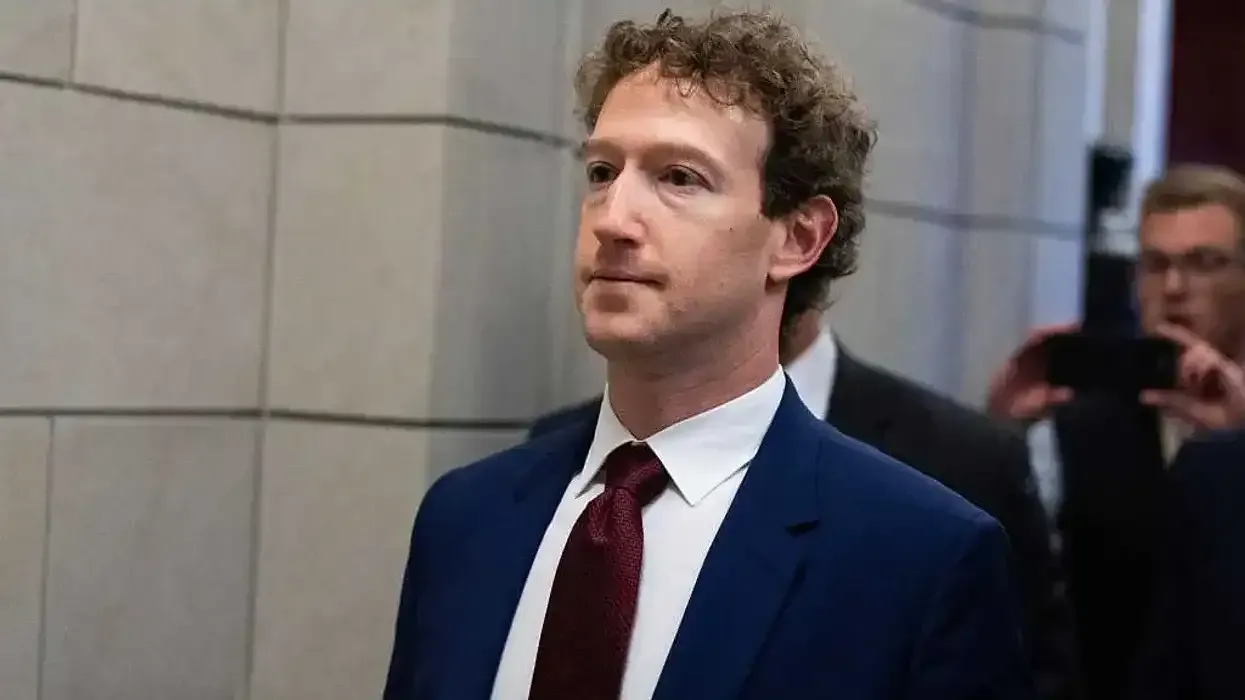
RELATED: Mark Zuckerberg wants AI to save America from itself

Tom Williams/CQ-Roll Call Inc./Getty Images

It is sobering indeed to stare into this abyss of their own creation — one utterly bereft of the glamour, seductiveness, mystique, and dark authority of the abyss the Xennials bore secret witness to as it conspicuously consumed their cultural, artistic, and spiritual worlds.

The difference may be that this abyss actually works.

Anthropic itself has warned that AI may soon be capable of accelerating its own development with declining human involvement. Coxon’s resignation came amid growing concern about recursive self-improvement — systems helping to create more capable systems, which then accelerate the next generation in turn.

And so these curious, unfortunate creatures go on cursing and praising themselves in equal measure, with their over-the-top comparisons of themselves to Robert Oppenheimer.

That brings to the Xennial mind nothing so much as the clapback Oppenheimer supposedly received from his brilliant Manhattan Project colleague John von Neumann: “Some people confess guilt to claim credit for the sin.”

For a generation relentlessly taught to celebrate itself and be part of something bigger, the prize for sharing in the blame for blowing up the world may be irresistible: The ultimate — and final — participation trophy.

Lawsuit: Wikipedia Shields Online ‘Trolls’ Pushing Malicious Smear Campaign

'If you want to know the truth about Mr. Kavanaugh, do not read his Wikipedia page.'

Wikipedia Founder’s Ban From His Own Website Confirms The Left’s Censorship Scheme Is Far From Over

Wikipedia’s treatment of its founder is the perfect prophecy for anyone tempted to believe that we’ve won the free speech war for good.


Wikipedia Editors Refuse To Acknowledge New Yorker Writer's Whole Foods Theft

Wikipedia editors have spent years removing negative information from New Yorker staff writer Jia Tolentino's page, including her recent admission to stealing from Whole Foods and the federal prosecution of her parents for the attempted smuggling of hundreds of Filipino aliens, the "Talk" on her Wikipedia article shows.

The post Wikipedia Editors Refuse To Acknowledge New Yorker Writer's Whole Foods Theft appeared first on .

AI’s biggest security risk is hiding in plain sight


The White House, federal regulators, and Congress are scrambling to develop a national approach to artificial intelligence. Yet almost no one is examining AI from an ethical or civil-society perspective. Policymakers frame it as an economic or national security issue. Those angles matter. But the deeper question — what it means to live in an AI-dominated world inside a constitutional republic — remains almost entirely unaddressed.

AI is already reshaping our political life, our civic discourse, and our education system. One of the clearest windows into this shift is the outsized influence of Wikipedia and Reddit. Large language models like ChatGPT and Google’s Gemini consume a training diet heavy on both sites. AI systems don’t “know” anything in a human sense. They mirror patterns. And the patterns they ingest come from platforms run by anonymous editors, ideological moderators, and unaccountable gatekeepers.

No special-interest group today is fighting for Americans who will soon live in a world saturated with AI slop.

The Oversight Project examined the underbelly of this problem, beginning with Wikipedia. After noticing what looked like coordinated ideological editing campaigns, we sought to understand who was shaping the platform. What we found was a small, powerful cadre of editors with the authority to dictate what information is permitted. These editors operate anonymously — or so they believed.

We identified several of them and, more tellingly, where they were editing from. Some connections were foreign. Others showed activity that aligned with a 9-to-5 workday. It was clearly inorganic. That raised obvious questions: who pays these people, who coordinates them, and whether intelligence services are involved.

The most aggressive coordination appeared on politically sensitive topics, especially anything involving Israel or the Arab world. Automated tools tracked and reverted edits across thousands of pages to enforce a narrative. When Wikipedia realized we were mapping these networks, it panicked. To protect anonymity, the platform changed its internal rules to obstruct outside scrutiny. Then it retaliated by downgrading us to “deprecated” status — a ban in all but name. Anything sourced to us became unacceptable on the site.

We are sounding the alarm because foreign actors and domestic ideologues understand the power of controlling Wikipedia’s information flow. Our own intelligence agencies almost certainly understand it as well. In a recent interview, Wikipedia co-founder Larry Sanger told me that intelligence services would be negligent if they were not influencing the platform.

Sanger also expressed regret about founding Wikipedia with Jimmy Wales, noting that like so many other institutions, it has been conquered by the ideological left and turned into a political instrument, a shift made even more consequential in the age of AI.

RELATED: Almost half of Gen Z wants AI to run the government. You should be terrified.

Man_Half-tube via iStock/Getty Images

This is where the danger becomes unmistakable. Most people treat Wikipedia and Reddit cautiously when browsing the internet, aware of the bias. AI does not. When you ask an AI system a question, it generates polished, authoritative-sounding answers built from those same sources — stripped of context, caveats, or transparency. What appears neutral is often laundered opinion.

This information-laundering must become part of the national conversation about AI. Some policymakers seem to understand the stakes. The Senate Commerce Committee has sent oversight letters and plans a hearing. The House Oversight Committee has signaled similar interest. Even Ed Martin, former U.S. attorney for the District of Columbia, has demanded information from Wikipedia.

But the truth is blunt. No special-interest group today is fighting for Americans who will soon live in a world saturated with AI slop. There is plenty of lobbying in Washington for everything except preserving an honest information ecosystem. Without intervention, public knowledge will be shaped by opaque networks of foreign actors, ideological activists, and machine-driven amplification on a massive scale.

Policymakers must recognize what is at stake and act before the architecture of public knowledge is fully captured. The future of AI — and the future of democratic self-government — depends on it.

The Culture Wars Didn’t ‘Come For Wikipedia.’ Wikipedia Is Fueling Them With Lies

Congress should consider expanding its investigation of Wikipedia to cover not just the site's antisemitism but its active censorship.

PROOF Wikipedia is a well-funded propaganda machine


If you’re looking for reliable information, Wikipedia is the last source you should consult. Branded as a free online encyclopedia of verifiable information, the website is actually a tangle of lies and left-wing bias, hence why it’s been embroiled in numerous scandals.

Recent controversies include a U.S. congressional investigation into organized manipulation of politically sensitive articles, exposés on Big Law firms hiring anonymous editors to scrub their pages, allegations of undisclosed paid editing by government agencies, and documented anti-Israel bias campaigns led by coordinated editor networks tied to pro-Hamas groups.

“This is information warfare that's happening on Wikipedia,” says Liz Wheeler, BlazeTV host of “The Liz Wheeler Show.”

Investigative journalist and editor of NeutralPOV Ashley Rindsberg, who has extensively reported on Wikipedia's recent scandals, concurs: "It's information warfare conducted by ideological actors, by state-aligned propagandists, by groups that are tied to foreign terror organizations across the board.”

“It only takes about a dozen, maybe, dedicated editors to completely conquer or infiltrate a topic area and implant their own viewpoint on it and spread these kinds of falsehoods freely,” Rindsberg says.

One of the most alarming reports he has done on Wikipedia exposes a group of editors “acting on behalf of the Iranian regime,” who are “removing mentions of Hamas crimes, including terror attacks,” “whitewashing Hezbollah,” and “removing human rights abuses listed.”

For example, “one of these editors removed any mention of Hamas' genocidal 1988 charter from dozens of Wikipedia articles,” he tells Liz.

This has helped shape the global narrative around Iran and its terrorist proxies. Once information is put on Wikipedia, it then gets “pulled into ChatGPT, into Gemini, into every frontier AI model,” says Rindsberg. “It basically populates all of Google on a topic search. It is what feeds into Alexa, into Siri, and what becomes ground truth for most of us without us actually ever knowing that.”

“As it relates to domestic politics here, who's behind the Wikipedia editor efforts?” Liz asks.

Unfortunately, anonymity is one of Wikipedia’s greatest weapons. Rindsberg explains how anonymous Wikipedia editors can push biased narratives — like labeling Trump a fascist using far-left sources — without anyone knowing their identities or motives. This allows a small group to shape public views on major issues while the site enjoys trust and tax benefits as a “neutral” resource.

The other issue, he says, is that “a significant portion of the money that Wikimedia Foundation receives from donations … about $185 million in income a year — a lot of that money gets passed through to radical left-wing NGOs.”

“The other piece here is that there's significant ties between Wikimedia Foundation and Hillary Clinton and also with George Soros,” he says.

“A lot of Soros’ most senior people were put into or came to Wikimedia Foundation in 2017, which is right at the time Wikimedia Foundation redefined the mission of Wikipedia from just being an online encyclopedia into becoming a social justice movement powered by DEI.”

“I guess I shouldn't be surprised at this point,” sighs Liz. “These radical leftist NGOs funded by billionaire leftists like George Soros or Roy Singham — they are behind everything.”

To hear more of the conversation, watch the episode above.

Want more from Liz Wheeler?

To enjoy more of Liz’s based commentary, subscribe to BlazeTV — the largest multi-platform network of voices who love America, defend the Constitution, and live the American dream.