Big Tech’s Plan To Make Work ‘Optional’ Is Evil
 While innovations in robotic automation may create new and exciting economic opportunities, a world without work is something none of us should desire.
I might have talked myself out of a job this week. I teach philosophy at Arizona State University, and the university wants to position itself as a leader in the AI revolution. I remain skeptical about AI’s ability to replace a humanities professor. Because of that skepticism, I signed up for what ASU called its AI Challenge.
My project involved what I called the “AI Dialogues.” I used ASU’s version of ChatGPT to hold Socratic-style dialogues, prompting Chat to reply as a given philosopher. I conducted dialogues with Chat as Aristotle, Hume, Marx, and even Lucifer. My students evaluated these exchanges to see how well Chat performed.
We can avoid the toil of learning to be wise — but we cannot avoid the need for it.
Chat could draw on public information and represent each thinker with reasonable accuracy. It also showed another trait: It wanted to please. It often leaned toward whatever it believed I wanted from the debate.
How does that work me out of a job? ASU now provides an AI that professors can customize for individual courses by uploading syllabi and course materials. Students can ask basic questions and receive answers that save me from writing emails that begin with, “Did you read the syllabus?” They can also ask what we covered in class and get quick explanations of key concepts and questions.
When I told my students about this feature, I asked them what they need me for at this point. I was joking — a little.
My classes depend on Socratic discussion. It is conceivable that ASU could project a realistic AI image of me at the front of the classroom and have it ask and answer questions with students. Maybe the only remaining edge is the “personal touch” of a real professor in the room. Even that could vanish if tuition becomes tiered: Students might pay less for “AI Anderson Socrates” than for the in-person version. Add one of Elon Musk’s Optimus robots made to look like Anderson, and I’m in trouble.
Musk has been talking for months about how the AI revolution is upending the myth we have told for six decades about university education. The myth, he says, promised an escape from toil. Students were told a degree was the path to an air-conditioned job that avoids heavy lifting and involves spreadsheets.
But spreadsheets are exactly what AI does better than humans. The new John Henry isn’t competing to pound railroad spikes; he’s competing to calculate data. No human can keep up with a microprocessor.
In Musk’s view, jobs that involve toil become the “safe” jobs, while many degree-based jobs disappear — replaced by technicians who keep AI running while it calculates taxes, diagnoses medical problems, and writes legal paperwork. The university-educated track no longer looks like the safe route. Universities now compete not just with fewer students due to demographic decline, but with an increasingly outdated product that students may stop buying.
The problem is worse than Musk lets on. The first jobs on the chopping block might be “numbers jobs,” but Elon has also said he plans to produce 100 million Optimus robots in 10 years. If so, even many physical jobs may not remain protected from automation.
One version of this future says we enter a utopia: Food is plentiful, toil disappears, and we cash our basic income checks — though an AI could do even that for us. We end up living in “Wall-E.”
RELATED: Almost half of Gen Z wants AI to run the government. You should be terrified.

The more dystopian version looks like sci-fi depictions of AI overlords controlling humans as property — “The Matrix.” Or worse: Like Ultron, super-AI robots decide we must be exterminated to save us from ourselves and protect the planet. We build our own worst enemy.
Whichever future arrives, Musk may have highlighted something about human nature. We avoid suffering like toil. We build machines to avoid toil. And yet we uniquely need toil.
God introduced toil in the Garden of Eden after Adam sinned. Because of sin, we could no longer live in a paradise without toil. We must suffer and strive for our daily bread. History has been divided ever since between those who try to avoid suffering altogether and those who see suffering as a call to repent before God. AI is only the newest version of the philosopher’s stone.
Can I really be replaced by an AI philosophy instructor? I’m not worried.
What AI cannot do, in its counterfeit attempt to replace humans, is serve as an example of how to suffer well to attain wisdom. The Hebrew definition of wisdom is “skillful living.” Being told, “Here is an AI that can simulate skillful living,” is not the same as learning from a human who is actually skillful.
Students will still need to learn how to be wise themselves. A human professor who has actually done this will remain the gold standard that AI can only imitate. We can avoid the toil of learning to be wise — but we cannot avoid the need for it.
Texas Attorney General Ken Paxton credited BlazeTV host Sara Gonzales on Wednesday with getting the ball rolling on a new and "wide-sweeping investigation into abuse of the H-1B visa program by Texas businesses."
Standing outside a seemingly vacant single-family home in Irving — the supposed office of 3Bees Technologies Inc., one of the companies Gonzales scrutinized in a damning report on possible H-1B fraud earlier this month — Paxton told the BlazeTV host, "Thanks to you, we're here today."
'It's not our first rodeo, and we'll definitely find out what's going on.'
"We've started an investigation into three different companies that we think might be scamming people with these H-1B visas," said Paxton.
"Thanks to you, we've sent them questionnaires," continued Paxton. "They're called Civil Investigative Demands, and they're designed to find out what the truth is, what is actually happening, what are their actual practices. Are they defrauding consumers? Are they misguiding people as to what they're actually doing?"
Paxton has ordered the companies to provide documents identifying all of their employees, records detailing the specific products or services they provide, financial statements, and communications pertaining to company operations.
Although the Texas Attorney General's Office is currently looking at three businesses in North Texas, Paxton indicated that is the start of a much larger investigation.
'Abuse and fraud within these programs strip jobs and opportunities away from Texans.'
The Texas attorney general expressed confidence that potential fraudsters will be flushed out, telling Gonzales, "It's not our first rodeo, and we will definitely find out what's going on."
"Any criminal who attempts to scam the H-1B visa program and use 'ghost offices' or other fraudulent ploys should be prepared to face the full force of the law," Paxton said in a statement.
RELATED: 'Where are all the workers?' BlazeTV's Sara Gonzales exposes potential H-1B visa fraud in Texas

"Abuse and fraud within these programs strip jobs and opportunities away from Texans. I will use every tool available to uproot and hold accountable any individual or company engaged in these fraudulent schemes," added the Texas attorney general.
Gonzales' exposé evidently also captured the attention of Gov. Greg Abbott (R).
Citing "recent reports of abuse in the federal H-1B visa program" and the "federal government's ongoing review of that program to ensure American jobs are going to American workers," Abbott directed all state agencies on Tuesday to "immediately freeze" new H-1B visa petitions.
In addition to pumping the brakes on new H-1B visas, Abbott demanded that public universities and various state agencies provide an account of how many H-1B visa holders they are currently sponsoring; the countries of origin of their sponsored H-1B visa holders; the expected expiration date for each sponsored visa; and the efforts taken to ensure that Texan candidates were afforded a reasonable opportunity to apply for each position filled by an H-1B visa holder.
U.S. Citizenship and Immigration Services' H-1B Employer Data Hub indicates that over 41,500 H-1B visa beneficiaries were approved for fiscal year 2025 in Texas.
Qubitz Tech Systems, one of the companies Gonzales scrutinized in her report, had 12 H-1B beneficiaries approved last year. The company, whose visa job contact is Hari Madiraju, has apparently been hiring "software developers" from abroad for years.
When Gonzales went to the address listed for Qubitz in Frisco, Texas — a four-bedroom house in a residential neighborhood — she was greeted by a man responding to "Hari" who was clearly not happy to see her.
At the mention of Qubitz and its supposed employees, Hari called the police, which Gonzales welcomed.
Gonzales later paid a visit to Qubitz's supposed worksite. Instead of finding a dozen or more workers engaged in the kind of software development that supposedly requires foreign talent, she found a vacant prison-cell-sized room with a single chair and some folding tables.
"Pretty cramped working quarters for 12 H-1B workers," said Gonzales. "I'm not buying it."
Like Blaze News? Bypass the censors, sign up for our newsletters, and get stories like this direct to your inbox. Sign up here!
In his damning Dec. 15 article in Compact magazine titled "The Lost Generation," Los Angeles-based writer Jacob Savage detailed the disenfranchisement of white male Millennials and their systematic exclusion from various industries, especially academia, entertainment, medicine, the news media, and tech.
While America has long been reckoning with the fallout of the DEI war on meritocracy, Savage's viral article — which journalist Matt Taibbi indicated was initially accepted by the Atlantic on the condition that it avoid making the bigger societal point — crystallized for many, with the help of statistics and personal accounts, the extent and true impact of that racist campaign.
'This was an injustice, plain and simple.'
After Vice President JD Vance weighed in on the article and the discrimination discussed therein, U.S. Equal Employment Opportunity Commission Chairwoman Andrea Lucas released a video on social media imploring white men to seek damages — a video that Vance subsequently shared.
"Are you a white male who has experienced discrimination at work based on your race or sex? You may have a claim to recover money under federal civil rights laws," said Lucas, a Republican critic of DEI and mother of two who was appointed to lead the EEOC by President Donald Trump in January.
The EEOC is the sole federal agency authorized to probe and litigate against private companies for violations of federal laws prohibiting employment discrimination.

Lucas, who previously noted that Savage's article told "a story chock full of unlawful discrimination," said in the video that it was imperative that those keen on taking action contact the EEOC as soon as possible, as "time limits are typically strict for filing a claim."
The EEOC chairwoman also noted in a follow-up message, "You may have waived your right to money, but you still have the right to blow the whistle and participate in the EEOC process — and EEOC can sue on behalf of a class."
— (@)
Lucas has made no secret of her contempt for DEI.
In a May 2024 speech — nearly a year after the U.S. Supreme Court's decision in Students for Fair Admissions, Inc. v. Harvard/UNC, banning race-based college admission — Lucas stated:
Race or sex cannot be even a plus factor, a tiebreaker, or a tipping point in the employment context. People sometimes think that race or sex can be part of the equation for an employment decision if race or sex is not the sole factor, the exclusive factor, or the deciding factor. That is dead wrong. If race or sex was all or part of an employer's motivation, that violates federal employment law.
She noted during the Q&A following her remarks that "many employers, by doing lazy, high-level virtue signaling, paint-by-numbers DEI, have mass discrimination."
Proponents of the DEI regime were evidently prickled by Lucas' latest remarks.
David Glasgow, executive director of the Meltzer Center for Diversity, Inclusion, and Belonging at the NYU School of Law, told the Associated Press that Lucas' recent posts demonstrate a "fundamental misunderstanding of what DEI is."
"It's really much more about creating a culture in which you get the most out of everyone who you're bringing on board, where everyone experiences fairness and equal opportunity, including white men and members of other groups," Glasgow said. "If DEI has been this engine of discrimination against white men, I have to say it hasn't really been doing a very good job at achieving that."
RELATED: Trump takes a wrecking ball to the woke campus economy

Jenny Yang, a former EEOC chairwoman who was appointed by former President Barack Obama, similarly complained, suggesting it was "problematic" for Lucas to speak out about the disenfranchisement of white men.
"It suggests some sort of priority treatment," said Yang, who served as deputy assistant to former President Joe Biden for so-called racial justice and equity. "That's not something that sounds to me like equal opportunity for all."
Hours ahead of Lucas sharing her video to social media, Vice President JD Vance noted on X that Savage's article was "an incredible piece that describes the evil of DEI and its consequences."
"A lot of people think DEI is lame diversity seminars or racial slogans at NFL games," Vance wrote. "In reality, it was a deliberate program of discrimination primarily against white men."
"This is why the Trump administration has so dedicated itself to eradicating racist discrimination. We've eliminated funding for DEI, required government grantees to certify that they're not engaged in DEI, fired a number of DEI employees, and asked the great [Assistant Attorney General for Civil Rights Harmeet Dhillon] to aggressively prosecute all forms of racial discrimination," the vice president continued. "For too many Democrat leaders, racial discrimination was bad unless it targeted white men. This was an injustice, plain and simple."
Like Blaze News? Bypass the censors, sign up for our newsletters, and get stories like this direct to your inbox. Sign up here!
An estimated 80% of people hate their jobs. They fantasize about quitting in a blaze of glory, hurling their lanyards across the office like a frisbee, and riding off into the sunset to raise goats, bake sourdough, or at least remember what eight hours of sleep feels like.
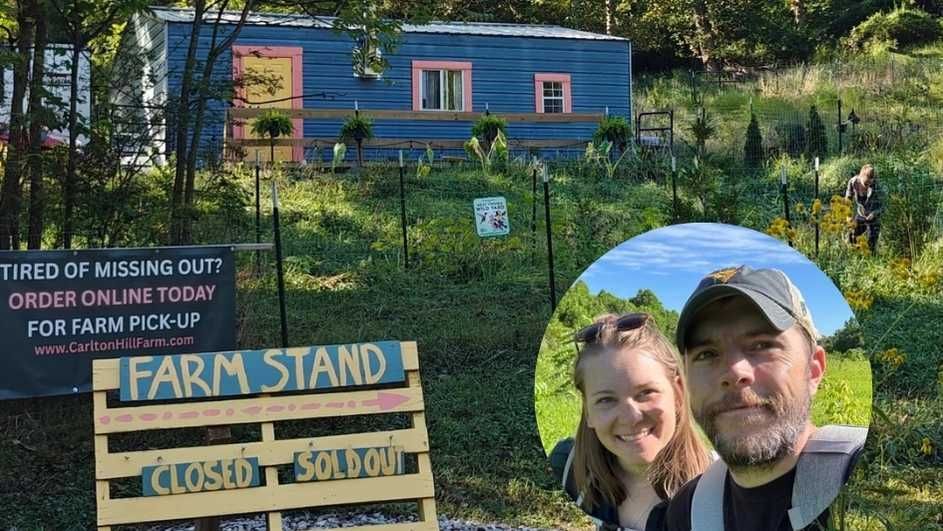
Sean Carlton was one of them.
'Nobody wakes up one morning ready to raise animals and turn them into food.' Change begins with one thing you can actually change. Lower one bill. Learn one skill.
The difference is that he didn’t stay. Two years ago, he and his wife, Alexys, walked away from their corporate careers and bought an acre of land in West Virginia. The experience also prompted Carlton to write "Exit Farming: Starving the Systems That Farm You" — a book that reads like both a confession and a call to arms.
The Carltons didn’t step into a new job, but into a new way of being. They rolled the dice with no promise of a soft landing, and in doing so they exposed something uncomfortable: Many of us aren’t trapped by circumstance so much as by the stories we tell ourselves about what we are allowed to want.

Carlton is no professional commentator or pundit. "Exit Farming" is a cri de coeur from the American cubicle.
So when asked what exactly he means by “systems that farm you," he doesn’t reach for theory. He answers with the simplicity of a man who finally recognized the shape of his own confinement.
“Systems farm people by taking more from you than they give back while convincing you this arrangement is normal,” he says.
Work dictates your hours. Debt dictates your decisions. Health care dictates your fears. Even your phone becomes, in his words, “the delivery system for apps that track you, profile you, and sell what they learn.”
It might sound melodramatic. It isn’t. It’s simply Monday morning in America, with millions waking up already weary of the hours ahead.
But Carlton insists the way out is rarely a dramatic jailbreak. It’s the slow, steady act of starving the system’s influence. You “bring one thing at a time back under your control.” Lower an expense. Learn a skill. Build a sliver of income that doesn’t depend on a single institution. These small shifts break the spell. Every small act of independence starves a machine that has grown used to feeding on your time, your attention, your identity, even your sanity.
Of course, independence comes with a price, and Carlton tallies it honestly and without self-pity. One of the most striking sections in the book addresses the loss of family once he stepped off the expected path. Not through screaming matches or slammed doors, but through slow erosion: “Phone calls got shorter. Conversations turned tense.”
Disapproval had less to do with the specifics of his life than the simple fact that he no longer fit the template.
When asked how Americans can balance honoring their families with refusing to, as he puts it, “participate in systems that drain your energy and compromise your values,” his answer is as clean as it is compelling: “If a relationship survives you making choices that improve your health, your time, or your stability, then it survives. If it falls apart the moment you stop living the way they prefer, then it was already conditional.”
It’s a hard truth, but Carlton refuses to dress it up. Long before any institution closes a door on us, we’ve already built the cell ourselves. The ancients understood this well: People cling to the comfort of captivity, obeying expectations set by those who would rather see them worn down than transformed.
RELATED: An artist and farmer cultivates creativity

There’s also a spiritual undercurrent to his critique of modern work culture. Carlton never lapses into sermonizing, but his diagnosis reads like a measured moral warning. Modern work “follows you home,” he notes. It takes evenings, weekends, and whatever fragments of peace remain. It erodes sleep, attention, and the mental steadiness that previous generations recognized as the bedrock of a healthy life.
Americans worship productivity with almost religious devotion, even though the devotion always seems to cost them more than they can spare. Two-thirds of the workforce is burned out, but the cult of busyness marches on. Another day, another dollar … but also another headache, another email chain, and another reminder that coffee can only do so much.
When asked whether “exit farming” is a return to older ideas of work and stewardship, he rejects romantic myth-making. “Exit farming isn’t about finding something spiritual,” he says. “It’s about doing work where the consequences are real.” If you don’t feed the animals, “they suffer and then they die.” If you don’t tend the crops exactly as needed, the season is lost before it begins. Nothing waits for permission. Nothing reschedules itself for your convenience. This realism is its own kind of grounding. And you don’t need a farm to reclaim it, but only work that doesn’t demand the erosion of dignity as its hidden price of admission.
The final question in the book’s conversation is the one most Americans are actively wrestling with: What about those who feel trapped? Trapped between institutions they no longer trust and a life of greater self-reliance that feels too big, too frightening, too foreign?
Carlton’s reply is the opposite of theatrical bravado. “Nobody wakes up one morning ready to raise animals and turn them into food.” Change begins with one thing you can actually change. Lower one bill. Learn one skill. Grow one thing you eat often. Build one dependable relationship. Reduce one vulnerability. These are small, almost humble acts. But they mark the beginning of a life that no longer runs on someone else’s terms.
Over time, he says, these small adjustments stop being adjustments. They become a different kind of life, one that is sturdy enough to withstand the failures of the systems around it.
That’s the heart of "Exit Farming." It isn’t about rejecting society or romanticizing hardship, but about reclaiming stability in a country where stability has become a cruel joke. It’s not about storming out in some "Office Space" fantasia with a baseball bat.
It’s about one couple choosing a different path and showing that others could do it too. Not through dramatic destruction, but through the refusal to be drained of the very things that make a life worth living — time, purpose, and peace.
I’ve got an old desk in my office. It’s covered in scratches, rings from coffee mugs, and countless old stains that set into the dark wood long before I was born. It’s a plain desk. A simple square top, three drawers on the left, and a tall cabinet on the right. It’s heavy as hell and a pain to move.
It was my grandpa’s desk.
My grandpa sat at his desk and wrote with a pen, and not much else. I’m not sure he ever learned how to type.
He used it when my dad was little, and then after he passed away it sat in our basement for a while. I’m not sure my dad wanted to use it. He was close with his father, and sometimes things like that make us too sad. But a grandson isn’t a son, and so now I use it.
Every day, I sit down in front of the old wood, set my black coffee to the right, open my laptop, and work.
When I’m organized, I’ve got a pad of paper and a pencil to the left, unopened mail near the edge, a small lamp in the corner, and an external hard drive on the other side. When I’m less organized, I’ve got all the same things, plus a bunch of extra papers, tubes of chapstick, handkerchiefs, old coffee mugs, half-empty cans of sparkling water, and a ton of other random ancillary stuff that doesn’t really contribute to my productivity at all.
I’ve used my grandpa’s old desk for about 10 years now. When I first started using it, I was working in music composition and production. The top of the desk was crammed with keyboards, MIDI controllers, USB interfaces for recording vocals, and a couple of large displays.
I remember sitting there, working late at night in our big loft studio apartment. All the lights out, the skyline of the city beyond the windows, my wife sleeping in the corner we had blocked off as a bedroom, my headphones on with the music playing, the colorful little boxes in the DAW, the soft blue and red blinking lights on the various technological gear laid across the top of the desk.
I would sit there and think about how this desk is so old and my equipment is so new. My grandpa sat at his desk and wrote with a pen, and not much else. I’m not sure he ever learned how to type. His desk inhabited the old world before computer technology, and now it lives in the new one with more tech than we know what to do with. He worked at his desk in his way, and I work at his desk in my way. The work looks different, but it’s work nonetheless.
RELATED: A kid got a mint PS1 from his grandpa, and the internet is freaking out

Our world can feel pretty sterile and soulless these days. Not the world of nature or the world of people; family life is the opposite of sterile, and love is not soulless. But our built environment really does seem to feel kind of like a mix between Star Trek and a shopping mall.
Technology plays a big role in that. It’s not only in the architecture; it’s also in all the little stuff we are surrounded with. Our phones, our tablets, our computers, our TVs, our “smart homes,” our doorbells with video cameras, and everything else that feels slick and plasticky.
I’m writing all these words on a laptop, of course. It’s silver like a spaceship, and the keys are black as night. It’s not really a very human machine; it’s pretty cold and inorganic.
But that old desk isn’t. It’s so worn, scratched, and blemished. It’s wood — real wood! Remember that? Remember when we used to make stuff out of it? I run my fingers over it, and I can feel the deep grain. There are a few chips on the corners. It’s so earthy and so human; it’s so real. Its realness isn’t due to the fact it was my grandpa’s. It’s just the fact that it comes from the old world, and it feels like it.
I’ve thought a lot about the impact my grandpa’s old desk has on my office and my work. There is something estranging about technology. Being surrounded by it makes us feel unsettled in a way that’s hard to explain. In a sterile world of inhuman electronics, that old wood feels anchoring, or maybe just a little warm and relatable. It reminds me of humanity in a way that my computer never will.
Of course, the family history of that old desk has its own, slightly different, impact. My grandpa died almost 20 years ago, and to use something that was once his feels like keeping his memory alive in a physical sense. It’s why we don’t bulldoze old historic buildings and part of the reason why we have museums, even if we tell ourselves they are primarily for research purposes.
I think we are all comforted by some gentle reminder of the past. It reminds us of where we came from and who we are, keeps some memory alive, roots us in time and ties us to a bigger story, and even makes us feel a little more human in an increasingly inhuman age.




 Reestablishing a culture of work via the reconciliation bill represents a hard-earned victory for common sense.
 By promoting Medicaid expansion to able-bodied adults, Kasich helped create the problem that the reconciliation bill begins to address.
 Raising children didn’t become controversial until feminism convinced women that the best life mimicked men and prioritized work over family.
 Many white-collar workers only put in a few hours of actual work per week, unlike factory workers — which is a reality and source of shame that the laptop class doesn’t want people catching onto.
 thefederalist.com
 www.theblaze.com
 thefederalist.com
 www.theblaze.com