Democrat Staffers Blow Gasket Over Finally Being Asked To Work In-Person
'Is this a political committee or a daycare?'
Last week, a social media post went viral showing that a remarkable number of H-1B visa holders — brought to the U.S. ostensibly because American citizens already living here do not have the necessary skill sets in certain American industries — listed residential addresses as their “place of work,” according to government data. Upon further investigation, Blaze News discovered that not only were these claims true, but the legality of this loophole is strained, to say the least.
In a recent Blaze News column, Matt O'Brien, the deputy executive director at the Federation for American Immigration Reform, argued that the H-1B program, and with it the de facto “work from home” proviso, has always benefited corporations and foreigners at the expense of American workers.
'Executive branch officials intrude into Congress's lawmaking authority by interpreting statutes in an unreasonably broad fashion.'
But are H-1B visa holders legally allowed to work from home? What is the legal basis?
RELATED: Project Firewall: DOL targets visa sponsors in unprecedented H-1B enforcement crackdown
Experts have raised concerns that government agencies likely do not have the authority to permit foreign nationals on nonimmigrant visas to work remotely. “There are numerous provisions throughout the H-1B statutes requiring employers to specifically identify all worksites where alien employees will be performing labor. These provisions were intended to ensure effective worksite enforcement, to protect American workers from unlawful competition, as well as to protect foreign workers from exploitation,” O’Brien explained.
Nevertheless, upon review of the laws surrounding H-1B regulations, Blaze News discovered that there are no mentions of “remote work” that would explicitly permit or forbid H-1B holders to work from home.
Rather, the H-1B “work from home” phenomenon can apparently be traced to a last-minute change made in the final days of the Biden administration after Trump won the 2024 election.
On December 18, 2024, the DHS filed the “H-1B Modernization Final Rule,” which took effect three days before Trump was sworn in to office. This lengthy document reveals a months-long deliberative process in which Biden officials relaxed H-1B enforcement standards to explicitly permit remote work — all under the pretext of “modernization.”
In the final rule, the DHS officially declares that remote work in “higher education, nonprofit research, or government research” would be permitted: “Work performed ‘at’ the qualifying institution may include work performed in the United States through telework, remote work, or other off-site work.”
These rule changes do not mention the names of other industries, such as the technology sector, indicating that the changes apply only to a discrete subset of H-1B-qualified positions.
The final rule also shifts from “where” duties should be “physically performed” to focusing on “the job duties” more generally. For example, when considering whether to approve an exemption for the number of H-1B visas, capped at 65,000 per year, the rule says that United States Customs and Immigrations Services “will focus on the job duties to be performed, rather than where the duties are physically performed.”
The final rule further revealed that an unnamed H-1B “advocacy group” lobbied USCIS to make the rules more permissive for remote work: “An advocacy group and a joint submission supported the proposal and stated that H-1B regulations should focus on duties performed rather than location of work performed.”
When a commenter raised an issue about an ambiguous loophole in the final rule that might lead to “fraud and abuse,” the DHS issued a flat denial that relied heavily on prepositions: “Congress chose to exempt … noncitizens who are employed ‘at’ a qualifying institution, which is broader than being employed ‘by’ a qualifying institution.”
Not only is this consequential loophole predicated on a subtle difference in prepositions; the response does not address the commenter’s concern about preventing fraud and abuse.
RELATED: White House's H-1B proclamation sparks confusion and backlash
Another potential problem with this final rule is whether federal agencies in the executive branch have any legitimate authority to issue it at all since it seems to bypass congressional authority.
As O’Brien told Blaze News, “Remote work for H-1B workers [is] pure executive overreach. Remote work is permitted by Department of Labor regulations. However, those regulations do not trace back to any statutory source of authority as they should. Neither the initial H-1B legislation nor any of the subsequent amendments (the American Competitiveness and Workforce Improvement Act of 1998, the American Competitiveness in the Twenty-First Century Act, and the H-1B Visa Reform Act of 2004) mention remote work.”
The final rule is apparently an improvement upon a longer-standing regulatory interpretation of the law by the Department of Labor, which works in concert with USCIS and the DHS on the enforcement of H-1B regulations. In a 2008 fact sheet, the DOL apparently regards “place of employment” as “a location where the worker spends most of his/her work time.”
This interpretation does not appear to be explicitly exclusive to “work from home” employment situations, although, again, a review of the statute yielded no direct reference to remote work for H-1B nonimmigrant workers.
This indicates that USCIS and the DHS, under Joe Biden and Alejandro Mayorkas, appear to have effectively rewritten legislation.
“Executive branch officials intrude into Congress' lawmaking authority by interpreting statutes in an unreasonably broad fashion,” O’Brien added.
“While Congress is certainly not immune from turning bad policy into law, at least it generally does so publicly, after considerable debate. But remote work, like employment for H-1B spouses, has never been debated by the representatives of the American people; it was simply imposed by executive fiat," O’Brien continued.
This apparent “executive fiat” from the Biden administration raises several issues that warrant more attention, not least among them the seeming senselessness of immigrants to the United States performing remote work. This “modernization” rule thus encourages an increase in H-1B visa immigration at a time when immigration seems to make less sense from a business perspective.
Blaze News contacted the DHS for comment and was referred to the White House. The White House did not respond to Blaze News’ request for comment.
Like Blaze News? Bypass the censors, sign up for our newsletters, and get stories like this direct to your inbox. Sign up here!
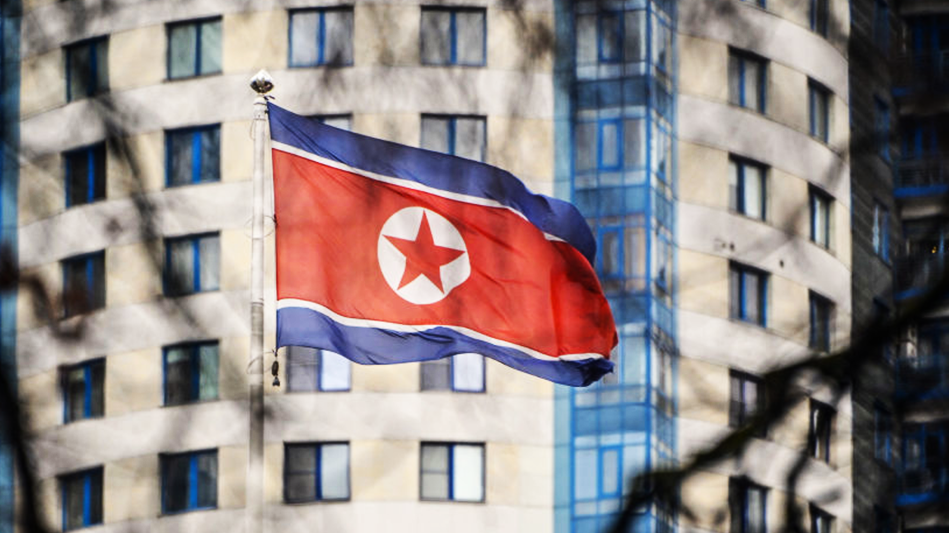
A woman in Arizona was sentenced to 102 month in prison for conspiring with North Korean entities to infiltrate American companies.
Her methods are being considered a "code red" by U.S. Attorney Jeanine Ferris Pirro, as American companies are unknowingly aiding North Korea in a tech war against the United States.
Christina Chapman, 50, was found to be working on behalf of the North Korean munitions development department, using a complex network of stolen identities in a scheme that is sure to send chills down the spine of any American.
'This is a code red. Your tech sectors are being infiltrated by North Korea.'
Chapman set up a network of almost 100 laptops at her home in Arizona, designed to allow North Korean agents to log in to the computers and pose as Americans working U.S. companies.
Using the fraudulent identities of 68 Americans, the North Koreans acquired remote employment with 309 companies, some of which were Fortune 500 companies.
Simply put, the North Korean entities would remotely access the computers in Chapman's home, then fraudulently infiltrate the companies they were purporting to work at, making it seem as if the activity was coming from an Arizona address.
Many of the foreign agents listed their home addresses as Chapman's residence and received paychecks at her address. This resulted in huge sums of money going directly to the North Korean government.
RELATED: North Korea claims new destroyer can now float weeks after humiliating 'launch'
In total, Chapman helped procure $17 million for the North Korean munitions department and will be forced to pay a fine of $176,850 and forfeit over $284,000 that was to be paid to the North Koreans, according to the Department of Justice.
"North Korea's munition department has trained and deployed more than 3,000 workers in information technology, or IT skills, so that they can then commit fraud on companies in the United States to generate revenue for the North Korean regime," Pirro stated during a press conference on Friday.
In a "message to corporate America," Pirro continued, "This is a code red. Your tech sectors are being infiltrated by North Korea. And when big companies are lax and they're not doing their due diligence, they are putting America's security at risk."
RELATED: 'I love Trump! I love Elon Musk!' Korean pop star bursts into pro-America praise at LA concert
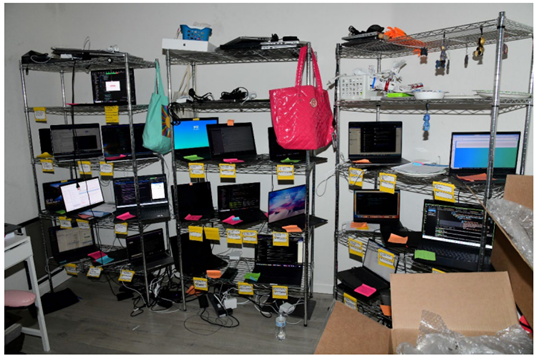
Photos from the DOJ showed not only an example of one of the fraudulent identities but also Chapman's remote worker farm. Dozens of laptops are seen, with notes denoting which U.S. companies they are assigned to and the fake identities they are associated with.
Pirro called on American corporations to step up their employee verification systems, which "went through a change as a result of COVID."
"There is this lax kind of overseeing of who employees are. It's time for businesses to verify their workers, monitor their conduct, create a zero-trust structure, and they've got to do this before the security of our country is compromised," Pirro added.
More than 90 laptops were seized from Chapman's home in October 2023. She was also found to have shipped 49 laptops and other devices supplied by U.S. companies to different locations overseas, including to Chinese cities on the North Korean border.
The DOJ noted that North Korea's IT network has generated between $250 and $600 million annually as of 2024.
Like Blaze News? Bypass the censors, sign up for our newsletters, and get stories like this direct to your inbox. Sign up here!
I have never worked in an office. I have always worked for myself. I have always set my own schedule and determined the rhythm of my day.
Back in early 2020, when COVID hit, everyone’s work changed. All of a sudden, people were working from home. Almost everyone I knew was asking me for advice. How to adjust. How to deal with it. How not to lose your mind. How to stay productive. There was one thing I told everyone: Dress decently for work from home.
When no one is there to make you dress decently, will you still dress decently? When no one is there to stop you from being a slob, will you turn into a slob?
Working from home can be great. You don’t have to battle endless traffic every morning. You can work from the comfort of the nook in your kitchen. You don’t have to be on guard constantly, always trying to stealthily dodge cultural land mine after cultural land mine.
You are free to get your work done when you want to get it done. You are also free to look like a slob. You don’t need to wear a jacket or a tie. You don’t need to wear a shirt with a collar.
Honestly, you don’t even need to wear a shirt at all. You can, theoretically, just lie in your bed naked and get all your work done. You can skip the grocery store and start ordering all your food in. You can end up living your life in pajamas. Hour after hour, day after day. It’s all the same.
Slowly, ever so slowly, you become a shut-in. You leave your house less and less because everything is so easy at your house. Your work is there. Your food can be delivered there. Your bed is there. And life is so much more comfortable in pajamas. Oh, isn’t it so easy when you don’t have to put anything on?
“I’m just not in the mood to get dressed today.”
And while these details of this trajectory are extreme, this is generally how it happens. One thing leads to another, and then another, and then another. It can happen to anyone, but it happens most often to those who are thrown headfirst into WFH. For the person who is used to a certain life working at an office with expectations thrust upon him from the outside, the freedom of work from home can have disastrous consequences.
Dressing decently for WFH is a simple act that helps stop many potential problems dead in their tracks. A great deal of the degeneration that occurs when working from home hinges on being homebound. If you look like trash, you don’t want to leave your house, so you won’t leave your house. It’s a vicious cycle. While if you look nice, you want to leave your house, so you will leave your house. It’s a positive cycle.
Dressing decently for WFH helps tremendously with productivity. In theory, you might be able to get all your work done from your bed. Practically, it’s not going to happen. You are not going to be that productive in pajamas. You are not going to be that sharp in your bed, in a hoodie, unshowered and unkempt. It’s just not going to happen. All of that makes your mind dull — and if not your observable mind, then certainly your spirit. You might be doing fine on paper, but really you are operating, at best, at 75%. That just happens to be enough to make it.
You are simply less capable when you are working from your bed while looking like a street urchin. Your mind is sharper when you are dressed with intention. You might not be dressing up for anyone else; you are working from home, after all, but you are dressing up for work. You are also dressing up for yourself, and that’s important. It’s good for you.
When you work from home for an extended period of time, you run the risk of having your life blend together into one indistinguishable mass. Your personal life blends with your professional life. Your work day turns into your personal day. You lose all distinction and end up feeling like you are always working and never resting.
Or it could be that it feels like you are never working. Or maybe you are just perpetually stuck in this strange no-man’s-land. Whatever it is, you don’t feel right. You lose distinction and slink down into a worse version of what you want to be.
Dressing decently for WFH helps correct this problem. Since you are not able to segregate your personal life from your professional life in space, you need to segregate them aesthetically. With your clothing, you can make a distinction between work hours and personal hours. Dressing up for work, even when you don’t have to leave, makes work into something distinct that also, in turn, makes your life outside work into something distinct.
Wear loafers when you are working and camp mocs when you aren’t. Wear a sport coat when you are working and a sweater when you aren’t. Wear an OCBD when you are working and a polo shirt when you aren’t. Wear a tie when you are working and take it off when you aren’t. Make some distinction.
It doesn’t mean that you have to wear a suit or anything overboard. Just some addition of something that makes work feel like work. It doesn’t have to be grand, but it has to be something. That little something, when repeated over and over again, helps separate your day. It helps to prevent everything from blending together into an amorphous mass. It helps you stay sane and the best version of yourself.
WFH is about freedom. And freedom is a revealing thing. It’s a doubled-edged sword. When we are free, we are allowed to rise and we are allowed to fall. It’s up to us. No one is making us do anything. We are in control. No one is going to make you dress decently for WFH. No one is going to make you care. In a deeper way, WFH reveals who aspires to something higher and who sinks to something lower.
When no one is there to make you dress decently, will you still dress decently? When no one is there to stop you from being a slob, will you turn into a slob?
At first it might be uncomfortable to wrestle with these questions, but ultimately, it is emboldening and energizing. WFH gives us an opportunity to dress decently not because someone made us, but because we want to. In an era of ultimate freedom, choosing to dress intentionally is about choosing sanity, doing something better for ourselves because we care about ourselves. That is what dressing decently for WFH does. It keeps us sane and keeps us better.

 Sen. Joni Ernst rolled open a scroll revealing a 'naughty list' of federal agencies with the lowest employee occupancy rates.
 ‘The plaza is a dangerous, open-air drug market, with addicts shooting up, snorting, and smoking drugs in plain view,’ Ernst wrote.
 www.theblaze.com