The ancient ‘throne of Satan’ that inspired Hitler returns in 2027
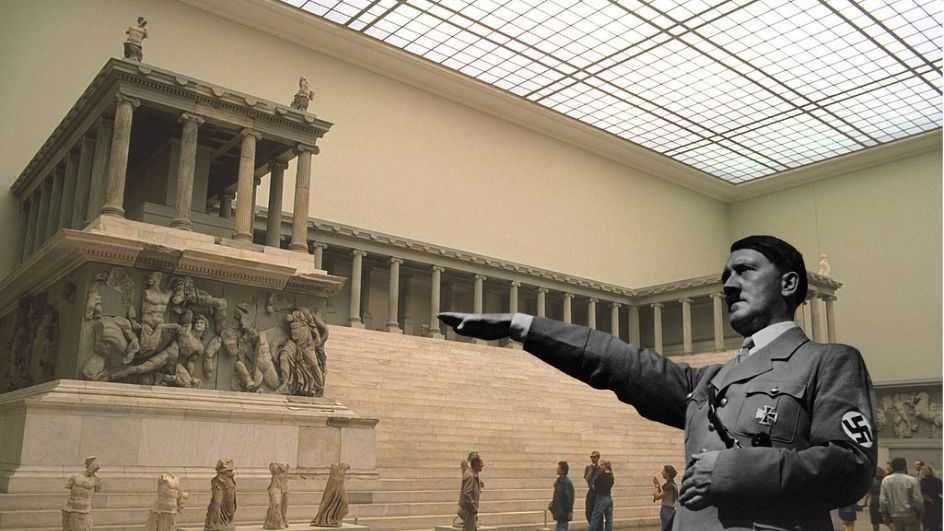


Is it possible there exists an ancient mystery that lies behind the events of the modern world, an object connected to everything from the rise of Adolf Hitler to the spread of Marxism, socialism and communism, the two world wars, nuclear destruction, the Cold War, and even the future of the world?

Could a mystery that began in the last book of the Bible be a key to some of the greatest evils and calamities ever to fall upon our world? It sounds like something out of a movie, a science-fiction novel, or a Hollywood fantasy — but it’s real.

Thus Hitler addressed the enormous Nazi rallies at Nuremberg from a structure deliberately modeled on the ancient monument some have identified with the 'throne of Satan.'

For more than a decade, the Pergamon Altar — a massive monument built more than 2,000 years ago in what is now Turkey — has been inaccessible to visitors as Berlin's Pergamon Museum undergoes a vast renovation. When the museum partially reopens next year, the altar will once again be revealed.

'Satan's throne'

To most visitors, it will be an archaeological treasure, admired for what it reveals about a long-gone civilization. But the altar has another history — one that begins in the last book of the Bible and, I believe, runs through some of the darkest events of the modern world.

The ancient city of Pergamon was one of the great centers of the Hellenistic world. In the second century B.C., its rulers constructed a monumental altar on its acropolis, on a foundation roughly 35 meters square. A huge staircase led upward through a colonnaded structure, while a marble frieze depicted a violent cosmic struggle: the Olympian gods crushing the rebellious giants.

Centuries later, Pergamon would appear in the book of Revelation.

In a message to the Christians living there, Christ declares: “I know where you dwell, where Satan's throne is.”

What exactly was “Satan's throne”?

Scholars have proposed several possibilities. Pergamon was a center of pagan worship and of the Roman imperial cult. But one interpretation has long identified the phrase with the city's enormous altar, whose architecture itself resembled a giant throne.

I believe that identification is significant.

Sinister discovery

With the advent of Christianity and the passing of the ancient world, the altar fell into ruin. Eventually parts of it were incorporated into later structures, and for centuries it disappeared from history.

Enter a German engineer named Karl Humann. Humann first encountered the ruins in the 1860s while working in the Ottoman Empire. He saw ancient marble sculptures being broken up and burned for lime and alerted the museums in Berlin. With permission from Ottoman authorities, German archaeologists began excavating Pergamon in 1878.

They soon uncovered the remains of the great altar.

Thousands of fragments emerged from the earth, including much of its enormous sculpted frieze. Under arrangements with the Ottoman government, the finds were transported on the backs of animals, then by ship and train, until pieces of the ancient altar began arriving in Berlin in 1879.

What would we expect to happen with the return of “Satan’s throne” to the world?

Germany had now become its new home. And as the ancient altar was being pieced together there, an old evil was taking a new and ominous form as well: anti-Semitism. In 1879, as pieces of the altar began arriving in Berlin, political agitator Wilhelm Marr popularized the term Antisemitismus and founded the League of Antisemites, helping transform a centuries-old hatred into a modern racial and political movement.

Altar of anti-Semitism

A decade later, in 1889, Adolf Hitler was born. The coincidence alone proves nothing. But the two threads — the ancient altar taking shape again in Germany and the country's increasingly racialized anti-Semitism — would converge with remarkable literalness after Hitler came to power.

After coming to power in 1933, Hitler commissioned his chief architect, Albert Speer, to transform the Nazi Party rally grounds at Nuremberg. Between 1935 and 1937, Speer constructed the massive grandstand at Zeppelin Field. His architectural model was the Pergamon Altar.

Thus Hitler addressed the enormous Nazi rallies at Nuremberg from a structure deliberately modeled on the ancient monument some have identified with the “throne of Satan.”

From that stage, Hitler raged before the world as his regime plunged Europe into war and carried out the Holocaust and the murder of millions.

And this was not the end of the altar’s strange journey.

RELATED: Has Andrew Jones found Noah's ark? A patient researcher builds his case.

Andrew Jones/Anadolu/Getty Images

Stalin's prize

As the Third Reich collapsed in 1945, the Red Army entered Berlin and took possession of the altar’s friezes. Along with enormous quantities of German cultural property, they were carried east into the Soviet Union, where they remained for more than a decade. The ancient sculptures that had traveled from Pergamon to imperial Germany and witnessed the rise and fall of Nazi Germany had now passed into Stalin’s Soviet Union.

In 1958 and 1959, the Soviet Union returned approximately 1.5 million cultural objects to communist East Germany, among them the frieze panels of the Pergamon Altar. By 1959, they were once again on display in Berlin — this time behind the Iron Curtain.

Pergamon. Imperial Germany. Nazi Germany. The Soviet Union. Communist East Germany.

And this is only part of the mystery. In my book "The Altar of Pergamon: The Mystery of the Dark Angel and the Future of the World," I explore what I believe are further connections between the altar and the forces and events that shaped the modern age — Marxism and communism, the Holocaust, the Cold War, the Atomic Age, the Cuban Missile Crisis, and even events that may yet shape the future of our world.

Pergamon's return

When I wrote it, I had no idea that the altar itself would soon be revealed to the world again. But I believe that timing is itself part of the mystery.

It can be hard for our modern sensibilities to grasp the possibility of such a thing as a “throne of Satan” altering the course of history. But the connections are grounded in concrete facts and remarkable historical convergences — more than 200 of them.

Though we like to imagine that we are in control of the world’s destiny and that we can solve our problems through our own resources, powers, and technologies, the Bible tells us something else: There is more to the world and to our lives than what we can see with our eyes. There is another realm, a spiritual realm, that can shape the course of our lives and our world.

What will happen when the altar is once more revealed to the world? We cannot say. But the ancient object connected to some of the greatest evils and cataclysms of the modern age may not be finished with history yet.

How Herodotus’ Ancient Wisdom Helps Make Sense Of Modern Times

Anhalt perceptively unpacks what Herodotus wants his readers to learn from history.
A Tale of Two City-States

I remember years ago reading (or was I just thinking?) that the age of Thucydides was over. His Peloponnesian War, the history of the devastating strife between Athens and Sparta in the fifth century B.C., was a text for the times during the confrontation between the United States and the USSR. No less a figure than Secretary of State George C. Marshall, at no other time than in 1947, at the start of the Cold War, said that to understand the international issues of the day it was necessary to study the Peloponnesian War. After the end of the Cold War in 1991, and with the replacement of the U.S.-Soviet rivalry with a world of ethnic, national, and religious blocs, it seemed that we had entered the era of another Greek writer, Herodotus, whose Histories describes a mosaic of international relations; maybe even more so in the era of the Global War on Terror. But now, great power rivalry is back, as the United States and its allies face formidable opposition led by China. We turn once again for wisdom and perspective, therefore, to the history of the competition between Athens and Sparta. To quote Godfather III, "Just when I thought I was out, they pull me back in!" Enter Adrian Goldsworthy, author of a new book on the rivalry between Athens and Sparta. The reader is in the best of hands. Goldsworthy combines the expertise of the scholar that he is with the common touch of the author that he has become. He is one of the very best historians of the ancient world writing for a popular audience.

The post A Tale of Two City-States appeared first on .

Without The Ancient Greeks, We’d Have No America 250 To Celebrate

We would be foolish (and ungrateful) to overlook the Greeks' wisdom in shaping our own national American heritage.

Humanity Can Still Learn From ‘The Father Of History’

Emily Katz Anhalt's latest book, Ancient Wisdom for Polarized Times, makes a powerful case for relearning the lessons of Herodotus.

Not Lost in Translation

A new translation of Thucydides is an occasion to be celebrated. An Athenian, Thucydides is the historian of the war that dealt a devastating blow to the city-states of ancient Greece in the fifth century B.C. The Peloponnesian War was a 27-year-long conflict between the two major power blocs of the historian's world, one led by his own country, Athens, and the other led by its rival, Sparta. Only one side could win but, in the end, both sides paid a price in blood, treasure, and spirit. A disaster but one that in Thucydides' hands offers one of civilization's most powerful learning experiences.

The post Not Lost in Translation appeared first on .

Did Jan. 6 threaten ‘our democracy’? Or prove the republic still works?


Like Dec. 7, 1941, Jan. 6, 2021, has taken on a mythic stature that surpasses the actual events of that day. Trump’s opponents view it as an “insurrection” — a deliberate attack on the Constitution, carried out by his supporters at his command to illegally overturn the 2020 election by threatening members of Congress. Many of his supporters, though, see it as a protest that spiraled into chaos, ensnaring citizens who never intended harm but wanted to express their belief that the election had been unfairly conducted.

I do not consider the events of that day an insurrection, nor do I believe that all those arrested received fair treatment. Still, Jan. 6 was a dark day for the republic — an act of lawlessness that stains Donald Trump’s legacy.

As Lincoln stated, no matter how desirable our goals may be, 'there is no grievance that is a fit object of redress by mob law …'

I do not believe he intended to overthrow the constitutional order. Instead, the events reflected the folly of taking politics to the streets, a tactic once favored by the left. More than anything, Jan. 6 exposed the dangers of unrestrained democracy — a threat America’s founders understood all too well.

The Great Seal of the United States proclaims that the American founding represents a novus ordo seclorum — a new order of the ages. The Constitution of 1787 was a remarkable achievement, establishing a commonwealth designed to protect the natural rights of all citizens. At the same time, understanding the founding requires looking to the past, particularly to the taxonomy of regime types identified by Greek philosophers such as Plato and Aristotle, the founders of political science.

What the Greeks knew

Greek political science differs from modern political science by focusing on fundamental questions. What is the best form of government? What system best ensures citizens’ excellence (areté) and happiness (eudaimonia)? What causes political communities to decline?

In contrast, today’s political science fixates on minutiae. Modern scholars, adopting a value-free perspective, struggle to explain why one form of government is superior to another beyond personal preference. As a result, they increasingly write more and more about less and less.

For the Greeks, political constitutions directly corresponded to the human soul (psyche). They divided the soul into three parts: nous, the intellective, reasoning part; thumos, the spirited part, concerned with honor and justice; and epithumeia, the appetitive part, which governs basic desires and is especially vulnerable to passions.

Each type of government, according to this framework, reflected a part of the soul. In this political taxonomy, the noetic part of the soul corresponded to rule by one; the thumetic part to rule by the few; and the appetitive part to rule by the many.

Each system had both good and bad versions. In a just system, rulers governed for the benefit of the entire polity. In a corrupt system, they ruled for their own benefit. The Greeks classified kingship as the good form of rule by one, while tyranny was its corrupted counterpart.

Aristocracy was the noble form of rule by the few, while oligarchy or plutocracy represented its decay. The good form of rule by the many was politeia, or a balanced constitution — a concept the Romans translated as res publica, best rendered in English as “commonwealth.” The corrupted version of rule by the many was democracy in its worst form: ochlocracy, or mob rule.

The founders feared unbridled passion and mob rule, which led them to reject democracy. They saw it as easily corrupted and unstable, prone to constant turmoil and disorder, and just as much a threat to citizens’ rights as tyranny or oligarchy. Democracies, they believed, were especially vulnerable to demagogues who could manipulate the masses.

To prevent this, the U.S. Constitution deliberately established a self-governing republic — the virtuous form of rule by the many.

Republic vs. democracy

No founder articulated the dangers of democracy — the perils of unchecked passions — better than Alexander Hamilton. Like most of his contemporaries, he viewed the American Revolution as an act of deliberate action, designed to secure the natural rights outlined in the Declaration of Independence: “life, liberty, and the pursuit of happiness.”

However, Hamilton also recognized that revolution is inherently lawless. Before establishing a government that safeguards rights and liberty, men must first “dissolve the [existing] political bands.” But revolutionary fervor, he warned, is ill suited for maintaining a stable political society — even one dedicated to protecting individual rights.

Hamilton understood that a passion for liberty was necessary if the cause of American independence was to succeed, but that ultimately it had to be tempered by the rule of law. As he said during the New York Ratifying Convention in 1788,

In the commencement of a revolution … nothing was more natural than that the public mind should be influenced by an extreme spirit of jealousy … and to nourish this spirit, was the great object of all our public and private institutions. Zeal for liberty became predominant and excessive. In forming our confederation, this passion alone seemed to actuate us, and we appear to have had no other view than to secure ourselves from despotism. The object certainly was a valuable one. But Sir, there is another object, equally important, and which our enthusiasm rendered us little capable of regarding. I mean the principle of strength and stability in the organizing of our government, and of vigor in its operation.

Passions unleashed in the fight for rights can ultimately destroy those very rights. Individual freedoms survive only when society maintains a strong sense of law and order.

Hamilton was alarmed by calls for “permanent revolution,” a theme that dominated Thomas Jefferson’s rhetoric. He saw Jefferson’s dismissive and intellectualized response to Shays’ Rebellion and the French Revolution — expressed in statements like “a little rebellion now and then is a good thing” and “the Tree of Liberty must be watered from time to time with the blood of tyrants” — as a dangerous philosophy. To Hamilton, this mindset invited chaos and guaranteed frequent upheaval rather than stable governance.

He believed that the solution was to instill respect for the Constitution, binding Americans to the rule of law. Though a creation of the people, the Constitution imposes necessary constraints that must be respected while it remains in force.

Hamilton argued that attaching people to the Constitution’s rule of law would preserve the new government as if it were an ancient institution. This stability would allow for the just administration of laws, without which the Revolution’s central aim — the protection of rights — could not be secured.

Through both words and actions, Hamilton worked to temper popular passions and connect citizens first to their state constitutions and then to the federal Constitution. He defended New York Loyalists after the Revolution, a position he reinforced through his "Phocion" letters. During the ratification debates in 1787 and 1788, he vigorously argued for the new Constitution, emphasizing its role in securing national stability.

As treasury secretary, he promoted fiscal responsibility, stressing the necessity of paying debts and honoring contracts. Within Washington’s administration, he sought to subordinate American gratitude to France and enthusiasm for the French Revolution to the dictates of international law.

Nothing better illustrates Hamilton’s commitment to moderating revolutionary fervor than a letter he wrote to John Jay around the same time he was crafting his own revolutionary pamphlets.

The same state of passions which fits the multitude … for opposition to tyranny and oppression, very naturally leads them to contempt and disregard of all authority. … When the minds of those are loosed from their attachments to ancient establishments and course, they seem to grow giddy and are apt more-or-less to turn into anarchy.

Lincoln: Passions vs. reason in politics

In his 1838 speech to the Young Men’s Lyceum of Springfield, “On the Perpetuation of Our Political Institutions,” Abraham Lincoln warned against the dangers of mob violence in pursuit of political goals. He saw it as a sign that unchecked passions were overtaking reason.

Lincoln identified the greatest threat to American freedom and prosperity not as a foreign enemy but as an internal danger. “If destruction be our lot, we must ourselves be its author and finisher,” he declared. “As a nation of freemen, we must live through all time, or die by suicide.”

I hope I am over wary; but if I am not, there is, even now, something of ill-omen, amongst us. I mean the increasing disregard for law which pervades the country; the growing disposition to substitute the wild and furious passions, in lieu of the sober judgment of Courts; and the worse than savage mobs, for the executive ministers of justice. This disposition is awfully fearful in any community; and that it now exists in ours, though grating to our feelings to admit, it would be a violation of truth, and an insult to our intelligence, to deny. Accounts of outrages committed by mobs, form the every-day news of the times. They have pervaded the country …

Thus, then, by the operation of this mobocratic spirit, which all must admit, is now abroad in the land, the strongest bulwark of any Government, and particularly of those constituted like ours, may effectually be broken down and destroyed — I mean the attachment of the People …

… Passion has helped us; but can do so no more. It will in future be our enemy. Reason, cold, calculating, unimpassioned reason, must furnish all the materials for our future support and defence. —Let those materials be moulded into general intelligence, sound morality, and in particular, a reverence for the constitution and laws

Lincoln allowed that there were bad laws, among which he included the laws supporting slavery.

When I so pressingly urge a strict observance of all the laws, let me not be understood as saying there are no bad laws, nor that grievances may not arise, for the redress of which, no legal provisions have been made. —I mean to say no such thing. But I do mean to say, that, although bad laws, if they exist, should be repealed as soon as possible, still while they continue in force, for the sake of example, they should be religiously observed. So also in unprovided cases. If such arise, let proper legal provisions be made for them with the least possible delay; but, till then, let them, if not too intolerable, be borne with.

But he maintained that “there is no grievance that is a fit object of redress by mob law …”

The mobocratic spirit and Jan. 6

Political conservatives consistently denounced political violence, including the unrest that followed Trump’s 2016 election victory, the riots and destruction that erupted after George Floyd’s death in May 2020, and numerous other instances of domestic looting and property destruction carried out by left-wing groups in recent years.

Yet as former U.S. prosecutor Andrew McCarthy noted, the central charge against Trump regarding Jan. 6 — that he undermined the Constitution’s electoral process — is difficult to dispute. He gave the mob assembled that day the false impression that Vice President Mike Pence had the authority to overturn Joe Biden’s victory. More importantly, he failed to quickly and decisively use his influence to call off his supporters, denounce violence, and urge them to leave the Capitol grounds.

McCarthy contended that if Democrats had pursued an impartial investigation rather than overreacting for partisan purposes, they could have built a compelling case that Trump violated his constitutional duty to preserve, protect, and defend the Constitution while faithfully executing the laws. A thorough congressional inquiry would have produced stronger articles of impeachment. Instead, Democrats omitted key allegations, allowing them to frame the riot as an “insurrection” for political advantage.

As McCarthy argued, the congressional January 6panel “was a blatantly partisan, monochromatically anti-Trump political exhibition that presented the country with a skewed picture, eschewing cross-examination and perspectives that deviated from its relentless theme: Trump’s incitement to insurrection had our democracy hanging by a thread.”

In the end, the riot of January 6 did not “prevent the peaceful transition of power.” Was the peace disturbed? Yes ...

... that’s why so many people have been prosecuted, some for serious offenses, and many others for trivial crimes that the Justice Department would normally decline to charge. But there was so little damage done to the Capitol that Congress was able to reconvene a few hours after order was restored. It promptly affirmed Biden’s victory, as it was always certain to do. No one tried to blow up the Capitol. No one tried to mass-kill the security forces. Our Constitution held firm, and there was never any reason to suspect it wouldn’t. Our democracy was not realistically imperiled, much less at the precipice of annihilation.

Ultimately, January 6 did not represent a threat to “our democracy” but instead illustrated why the Founders prudently established a republic rather than a democracy. They understood that democracies justify behavior such as occurred that day. Deliberation and the passage of laws by representative bodies are designed to permit prudence to curb the passions. As Lincoln stated, no matter how desirable our goals may be, “there is no grievance that is a fit object of redress by mob law …”

The History of History

Historiography, the history of history, is a richly complex subject, which asks why history has been written the way it has. Ever mindful of the truth factor in the portrayal of the past, it seeks out the ways it has been told and the most accurate ways it can be told. "History is written by victors" is perhaps the most common adage of historiography, and indubitably a false one. Victors may set out their own record of the past, but the past, on closer examination, is more complicated than their imagining. For the historiographer more, much more, is involved in history than a record of its winners and losers.

Oswyn Murray’s The Muse of History: The Ancient Greeks from the Enlightenment to the Present provides an account of both how history has been written and the theories, conscious and unconscious, that have supported its various leading versions over the past three centuries. A retired Oxford don whose speciality is the world of classical antiquity, Murray is the great-grandson of James Murray, the founding editor of The Oxford English Dictionary.

The post The History of History appeared first on .

IVF Modernizes Ancient Eugenic Practices Of ‘Selective Breeding’

If states enforced restrictions on IVF, embryos would no longer be commodities that society can do with as it pleases.

Is This Sparta? Revisionists Get The Legendary Warriors All Wrong

The warriors from other Greek city-states were usually farmers first and soldiers second — but Spartans dedicated their lives to battle.